The Architecture of the Cloud: Decoding the Maya of the Modern Mind
Human consciousness is a theater of constant projection. We believe we are navigating the world as it is, but in reality, we are navigating…
The Architecture of the Cloud: Decoding the Maya of the Modern Mind
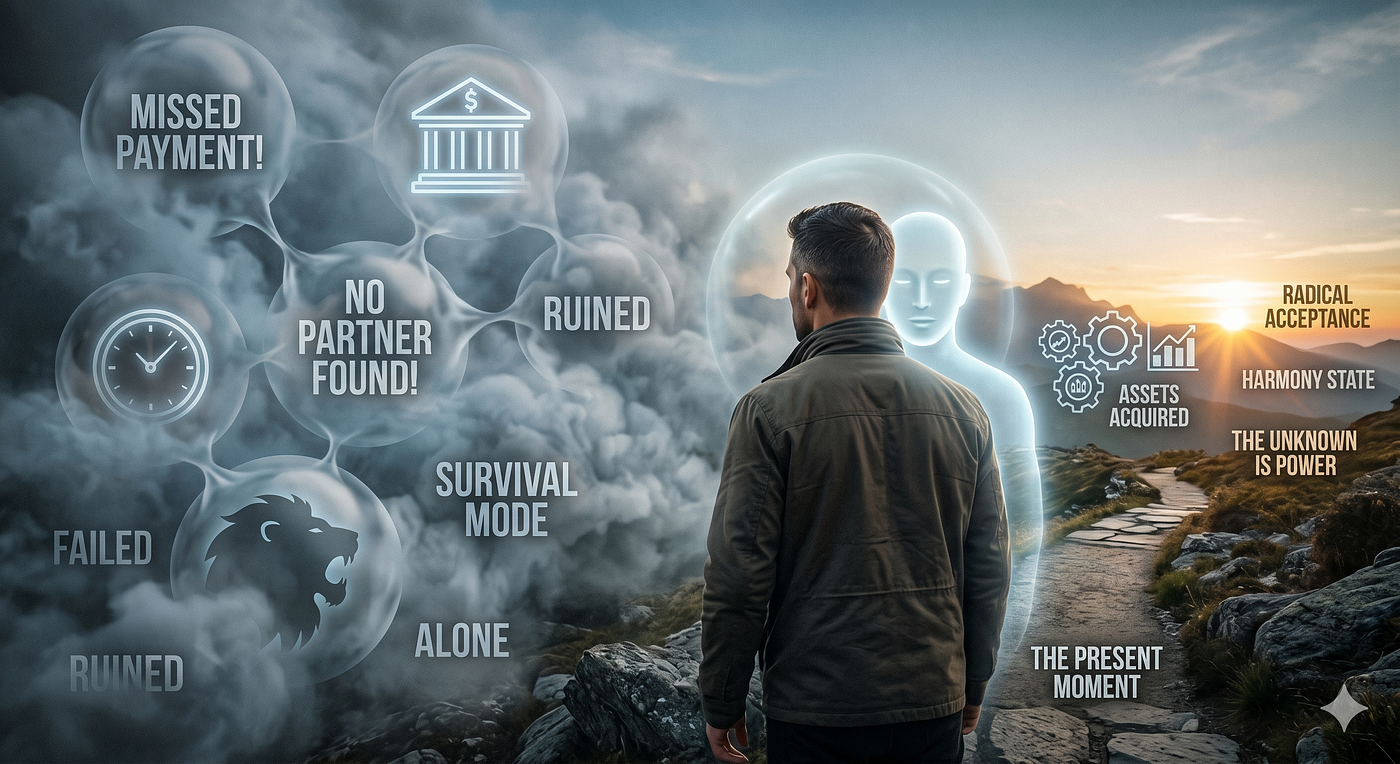
Human consciousness is a theater of constant projection. We believe we are navigating the world as it is, but in reality, we are navigating a “mental cloud” — a construct of past memories, future projections, and biological imperatives — that the ancient Indian philosophers termed Maya. While we often mistake Maya for the world itself, it is more accurately the filter through which we perceive the world. To understand this cloud is to understand why, despite our best efforts and intellectual growth, we repeatedly find ourselves trapped in what can be described as “fog bubbles” of reality.
The Survival System in a Symbolic World
The foundation of this mental cloud is a highly sophisticated, yet tragically outdated, survival system. Evolutionarily, our brains were designed for a world of physical threats — the proverbial lion in the tall grass. In that environment, the amygdala’s “fight-or-flight” response was a miracle of efficiency. It prioritized immediate survival over long-term logic.
However, in the modern world, this system lacks a “sensor calibration.” It treats an abstract threat — a missed payment notification, a lonely evening, or a status-based anxiety — with the same life-or-death intensity it once reserved for a predator. When the mind encounters such a trigger, it immediately pulls us into a “survival reality.” In this state, the prefrontal cortex — the seat of reason and perspective — is effectively bypassed. We lose access to our calm, rational selves, and the world “shrinks” to the size of the immediate threat. We are no longer people living our lives; we are cornered animals fighting for survival.
The Illusion of the “Fog Bubble”
These “fog bubbles” are the result of the mind’s desperate need to categorize the world. They function as absolute truths because the mind is a relentless pattern-matching machine.
Consider the “bank notification bubble”: A single text message about an account deficit is merely a data point. But the mind stitches it into a catastrophic narrative — I am failing, I will be ruined, I am in danger right now. The emotion of fear validates the story, and the story validates the fear. The “bubble” solidifies.
Conversely, consider the “best friend bubble”: If we are in the depths of a bad morning and a friend offers a favorite meal, our neurochemistry shifts. Dopamine floods the system, and suddenly, the past history of that person’s mistakes is erased. They are no longer the person who caused us grief; they are the savior of the present moment. Our reality is redefined by the most recent input. We are essentially weather vanes, turning toward whatever breeze — positive or negative — is blowing the hardest.
The Observer and the Paradox of Silence
The only escape from this cycle is the cultivation of the “Observer” — the part of the consciousness that witnesses the arrival of these bubbles without becoming identified with them. Yet, the mind fights this silence with everything it has.
When we reach moments of profound presence — where the chatter stops and the “world” seems to settle into a simple, immediate clarity — the ego feels a loss of control. It is terrified of the silence because the ego only exists through thought. As soon as we enter that state, the mind attempts to “capture” it by labeling it, dissecting it, or congratulating ourselves for achieving it. That very act of labeling creates the thought-hook that drags us back into the bubble. This is the “snap-back” phenomenon: we realize we are free, and that realization becomes the thought that binds us once again.
Finding Harmony in the Unknown
The deepest trap in our personal lives often centers on the future. We look at the empty space in our lives — the lack of a partner, the lack of a finished project, or the lack of financial stability — and our mind interprets this “not yet” as “never.” It conflates a current absence with a permanent impossibility.
True power, however, resides in the radical acceptance of the unknown. When we realize there is no “lion” — and when we reach a state where we are truly at peace with the possibility of failure or even the end of our current path — we deactivate the survival system’s engine. Fear is the fuel of the cloud; without it, the cloud begins to dissipate.
By providing our minds with “evidence of safety” — through structured routines, financial discipline, and a physical body that feels capable — we lower the volume of the internal alarm. This is the true path to harmony. It is not the absence of external challenges, but the presence of an internal state that is no longer reactive.
Ultimately, escaping Maya does not require us to abandon the world or destroy our goals. It requires us to become masters of the discernment between what is and what we fear. When we realize that our thoughts are merely shadows on the wall, we are finally free to stop running from them and begin to walk our own path with intention, clarity, and unwavering presence.
메타데이터
- post_id
- 4dac3b242c0e
- slug
- the-architecture-of-the-cloud-decoding-the-maya-of-the-modern-mind-4dac3b242c0e
- url
- https://medium.com/@thirusana80/the-architecture-of-the-cloud-decoding-the-maya-of-the-modern-mind-4dac3b242c0e
- canonical_url
- https://medium.com/@thirusana80/the-architecture-of-the-cloud-decoding-the-maya-of-the-modern-mind-4dac3b242c0e
- author_url
- https://medium.com/@thirusana80
- status
- ok
- fetched_at
- 2026-06-20 20:29:01




