Teaching in the Age of AI: Are We Assessing the Right Skills?
Do you allow students to use AI?
Teaching in the Age of AI: Are We Assessing the Right Skills?
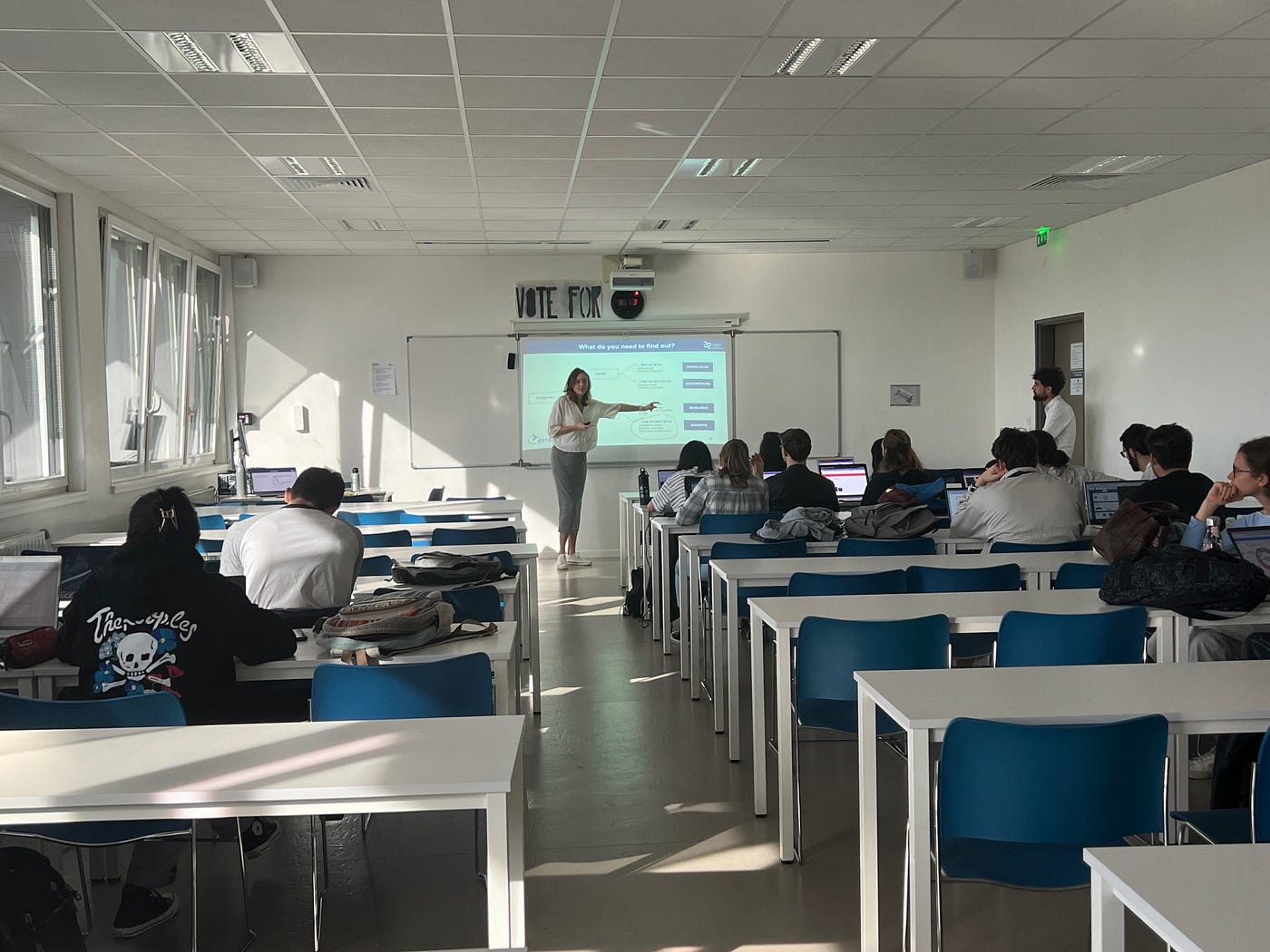
During the User-Centred Requirements Course at ESTACA.
Do you allow students to use AI?
The rise of generative AI has sparked countless debates across schools and universities. Some lecturers prohibit its use entirely. Others embrace it as an inevitable part of modern education. Most seem to be navigating a grey area somewhere in between.
As someone teaching Master’s students in aerospace engineering at ESTACA and CentraleSupélec in France, I’ve spent the last few years observing how AI is changing the classroom, particularly in courses focused on futures thinking and user-centred design.
And the more I observe, the more I wonder whether we’re focusing on the wrong question.
Perhaps the question isn’t whether students should use AI. Perhaps the question is what we should actually be assessing.
The problem with assessing outputs
Traditionally, higher education has placed significant emphasis on deliverables:
- Reports
- Presentations
- Essays
- Research papers
- Design concepts
The assumption has always been that the quality of the final output reflects the quality of the learning process behind it. AI challenges that assumption.
Today, a student can generate a reasonably structured report or design visualsation in minutes. They can create summaries, analyses, personas, stakeholder maps, and even whole prototypes with remarkable speed.
And this doesn’t necessarily mean the student understands any of it. Nor does it mean they don’t.
The final deliverable alone is no longer a reliable indicator of learning.
If two students submit equally polished reports, but one has deeply understood the topic while the other has simply refined AI-generated content, the output may look surprisingly similar. This creates a challenge for educators.
But it also creates an opportunity.
Why process matters more than ever
My courses are heavily workshop-based and project-oriented, using collaborative digital tools such as Miro in the classroom. Students work in teams to tackle complex challenges related to the future of the space sector and the development of user-centred products and services enabled by space technologies. Throughout the course, they follow a structured design and research process guided through a Miro board, documenting their thinking, decisions, and outputs along the way. At the end, each team delivers a short presentation of their final concept and key insights.
Their final presentation is important. But it‘s not the only thing I assess.
Throughout the process, I observe how teams collaborate, how they approach ambiguity and uncertainity, intrinsic to any design process. How they challenge assumptions. How they justify decisions. How they synthesise research.
And perhaps most importantly, what questions they ask. These moments are much harder for AI to replace.
A student can use AI to generate a stakeholder map. But can they explain why certain stakeholders are more influential than others? Can they identify contradictions? Can they recognise missing perspectives? Can they defend their choices when challenged?
These are the moments where genuine learning becomes visible.

Future Foresight for the Space Industry warm up exercise.
The most valuable assessment happens through conversation
One thing I’ve come to appreciate even more in the age of AI is the value of interaction.
During workshops, I frequently move between teams asking questions:
- Why did you make that assumption?
- What evidence supports this conclusion?
- What alternative scenarios did you consider?
- What would happen if this trend evolved differently?
Sometimes students have excellent answers. Sometimes they realise they haven’t thought deeply enough.
Either outcome creates learning.
What’s equally important is when students ask questions back. The students who are genuinely engaged tend to be curious.
They seek clarification. They challenge frameworks and the exercises. They test ideas.
No AI-generated report can fully replicate that dynamic exchange. And this type of learning often happens in the conversation itself.

User interview mock exercise during the User-Centred Requirements for Space course at ESTACA. Students use collaborative Miro boards to guide and document each step of the design process, creating a visible record of their research, decisions, and outputs.
Should prompting become an assessable skill?
If AI is becoming a tool that students will use throughout their careers, should we start assessing how effectively they use it?
Not whether they used AI but how they used it.
After all, interacting with AI is not a passive activity. The quality of outputs depends heavily on the quality of inputs.
Students who ask vague questions often receive generic answers. Students who provide context, challenge assumptions, iterate, and critically evaluate responses tend to obtain much more useful results.
In many ways, prompting resembles skills we have always valued:
- Critical thinking
- Problem framing
- Research design
- Communication
- Iteration
- Reflection
Perhaps prompting is not a new skill at all. Perhaps it is simply a new expression of existing cognitive abilities. It became part of the process.
What AI cannot replace

Future Foresight for the Space Industry warm up exercise.
There is understandable concern that AI may reduce learning. In some cases, it certainly can.
Students may become overly reliant on generated content. They may skip parts of the learning process. They may accept outputs uncritically.
But there are also things AI still struggles to replace.
- Curiosity.
- Empathy.
- Judgement.
- Collaboration.
- Negotiation.
The ability to navigate uncertainty. The courage to challenge assumptions. The ability to connect seemingly unrelated ideas.
Ironically, many of these are precisely the skills that futures thinking and design methodologies aim to develop.
As AI becomes more capable, these human capabilities may become even more valuable.
When students choose not to use AI

Final solution visualisations from different student teams. Some consciously avoided AI, some used it as a support tool, and others leveraged it extensively for visualisation.
One observation I did not expect is that in almost every course, there is at least one team that consciously decides not to use AI.
Not because it is forbidden. Not because they don’t know how to use it. It’s because they want to challenge themselves and be different from the rest of the class.
These teams often make their decision explicit during the final presentation or delivery. They usually include a statement that all research synthesis, ideation, and analysis were completed without generative AI tools. And they are often surprisingly proud of it.
I find this fascinating. A few years ago, students would rarely discuss the tools they did not use.
Today, AI has become such a visible presence that choosing not to use it feels like a methodological decision worth mentioning.
At the same time, I also encounter teams that use AI extensively but fail to document how. They present polished outputs but provide little visibility into the prompts, iterations, or critical evaluation that shaped the results.
In these cases, assessment becomes difficult. If the process is invisible, it is harder to evaluate the quality of the thinking behind it, usually resulting in a lower overall grade.
This has led me to view prompts not merely as technical inputs, but as part of the project’s methodology.
Just as researchers document their methods and designers document their process, students using AI may increasingly need to document how they interacted with these tools.
The interesting question is not whether AI was used. The interesting question is whether students can explain why they used it, how they used it, and how it influenced their decisions.
Designing education for an AI-enabled world
Perhaps the future of education is not about building stronger barriers against AI.
Perhaps it is about designing learning experiences where process matters more than output.
Where students must explain their reasoning. Where discussion is part of assessment. Where collaboration is visible. Where reflection is required. Where questions matter as much as answers.
AI is unlikely to disappear from the classroom. The challenge for educators is not deciding whether it belongs there.
The challenge is ensuring that the uniquely human aspects of learning remain at the centre of education.
From what I see in my classrooms, those human aspects are not disappearing.
If anything, they are becoming easier to recognise.
메타데이터
- post_id
- 4dae73fcbde8
- slug
- teaching-in-the-age-of-ai-are-we-assessing-the-right-skills-4dae73fcbde8
- url
- https://medium.com/@olakozawska/teaching-in-the-age-of-ai-are-we-assessing-the-right-skills-4dae73fcbde8
- canonical_url
- https://medium.com/@olakozawska/teaching-in-the-age-of-ai-are-we-assessing-the-right-skills-4dae73fcbde8
- author_url
- https://medium.com/@olakozawska
- status
- ok
- fetched_at
- 2026-07-18 00:06:11




