Stop Saying “GPay.” Start Saying UPI.
What I learned after spending a week reverse-engineering India’s payment stack — and presenting it as a masterclass at my workplace
Stop Saying “GPay.” Start Saying UPI.
What I learned after spending a week reverse-engineering India’s payment stack — and presenting it as a masterclass at my workplace
I noticed something at the billing counter last week.
The cashier asked, “Cash or GPay?”
Not card or UPI. Not cash or digital. GPay.
It bothered me — not because anyone’s wrong in everyday conversation, but because I’m a developer, and the words we use shape how we think about systems. The thing actually moving money between bank accounts isn’t Google Pay. Google Pay is a wrapper. The rails underneath are UPI.
That tiny linguistic slip is the whole point of this article. Because once you see what’s actually happening under the hood, you understand why India’s payment system is being studied, copied, and exported to other countries.
I spent the last couple of weeks digging into it and then taught a masterclass on the topic at my organisation. This is the writeup.
Photo by Mika Baumeister on Unsplash
The India of 2012 was a cash country
Before we get to the architecture, you have to feel the problem.
In 2012, the average Indian made roughly six non-cash transactions a year. Six. Per year. Most of the country settled rent, groceries, salaries, weddings — everything — in physical cash. Around 145 million households were unbanked. Seamless digital payments, in any meaningful sense, did not exist.
The RBI knew this was a structural drag on the economy. Cash is slow, traceable only when you want it to be, and it locks the poor out of the financial system. You can’t get a loan against cash flow that nobody can see.
So the question on the table was: how do you get a country of 1.4 billion people, in thousands of dialects, on hundreds of bank systems, to move money digitally — for free, instantly, and from a feature phone if needed?
The answer took about a decade to build.
The unsung infrastructure: NEFT, RTGS, IMPS
Here’s a fact that surprised even me — and where I have to correct something I initially had wrong in the deck.
The “instant” digital payment story in India doesn’t start with UPI. It starts with the RBI quietly building three systems most people have never thought about:
- RTGS (Real-Time Gross Settlement) — launched by the RBI in 2004 for high-value, real-time interbank settlements. (Reserve Bank of India)
- NEFT (National Electronic Funds Transfer) — launched by the RBI in November 2005 for batch-based retail transfers. (RBI Press Release, 2005)
- IMPS (Immediate Payment Service) — launched by NPCI in 2010, not RBI directly. This is the one I want to flag. IMPS was the first instant, 24×7, round-the-clock retail transfer system in India, and it was built by NPCI on top of the foundation RBI had laid. (NPCI)
So the cleaner story is: RBI built NEFT and RTGS. NPCI (set up by RBI + the Indian Banks’ Association in 2008) built IMPS on top of that. UPI was then built on top of IMPS.
It’s layers. Every layer hid more complexity from the user. By the time you got to UPI, the layers underneath did the hard work invisibly.
And here’s the part nobody talks about: all of these systems are free to the end user. No transaction fees, no per-swipe cuts. The state effectively decided that payment infrastructure is a public good, like roads.
NPCI: one body, one mandate
In 2008, RBI and the Indian Banks’ Association created the National Payments Corporation of India.
The mandate was three words long: unified, secure, accessible.
One organisation to consolidate India’s fragmented retail payments — instead of every bank inventing its own digital plumbing — and to do so under bank-grade encryption while being usable by anyone with a phone number.
NPCI is a not-for-profit. That detail matters. It’s why UPI transactions don’t carry merchant fees the way Visa and Mastercard do.
IMPS → UPI: from “the pioneer” to “the revolution”
IMPS (2010) UPI (2016) Built by NPCI NPCI Speed Instant Instant Availability 24×7 / 24×7 Registration Separate, with MMID + mobile None — uses your existing bank app Identifier MMID / account+IFSC Virtual Payment Address (e.g., you@okaxis) User experience Clunky Effortless
IMPS proved that real-time interbank transfer at retail scale was possible. UPI took those learnings and made the user experience disappear. You don’t register for UPI separately. You don’t memorise MMIDs. You just enter a UPI ID, type a PIN, done.
UPI went live for the public on 25 August 2016. (NPCI UPI Overview)
What UPI actually is (and why “GPay” is wrong)
This is the part I want every non-technical reader to internalise.
Think about how the internet works:
Internet world Payments world The Internet (TCP/IP) UPI Chrome / Safari Google Pay / PhonePe / Paytm YouTube / Instagram A specific UPI app HTTPS UPI’s encrypted protocol
The Internet is the protocol. Chrome is one browser that speaks it. YouTube is one website on top of it.
UPI is the protocol. Google Pay is one app that speaks it. PhonePe is another. Paytm is another. BHIM is the one NPCI itself runs. There are 400+ UPI-enabled apps in India.
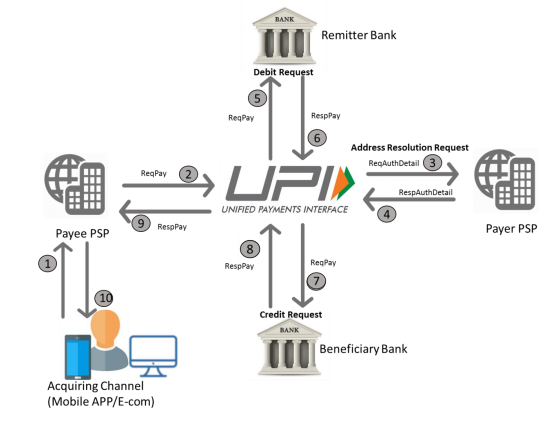
When you “GPay” someone, you’re not using Google’s money pipes. You’re using UPI’s pipes, with Google’s app as the steering wheel. Google Pay doesn’t even hold your money — your bank does. Google Pay just authenticates you, builds the request, signs it, and hands it to a Payment Service Provider (PSP) bank, which hands it to the NPCI switch.
So as a developer, the next time someone asks “Cash or GPay?”, the technically honest answer is “UPI.”
The 4-layer architecture (what actually happens when you tap “Pay”)
Here’s the stack, top to bottom:
Layer 1 — User Interface: Google Pay, PhonePe, Paytm, BHIM, your bank’s own app. They all sit on top of the same rails. None of them hold your money.
Layer 2 — PSP & VPA Resolution: Every UPI app is partnered with a Payment Service Provider bank (Google Pay sits on Axis, PhonePe on Yes Bank, BHIM on NPCI itself). The PSP authenticates you via your MPIN, resolves your VPA (you@okaxis) into a real bank account + IFSC code, and digitally signs the request. Payload is encrypted (AES-256).
Layer 3 — The NPCI Switch: This is the central routing engine. Every UPI transaction in the country flows through here. It validates the signature, scores the transaction against a fraud-detection model in real time, picks the route, logs everything for audit, and forwards to the remitter bank. NPCI’s UPI infrastructure runs across multiple data centres in active-active mode and is engineered for 99.99% uptime.
Layer 4 — Bank Core: The remitter bank debits the sender’s account after checking balance and limits. It sends a debit acknowledgement back through the switch. The switch routes the credit instruction to the beneficiary bank, which credits the receiver and fires off an SMS. Settlement between the banks happens later, in net batches.
End to end: under two seconds.
The 2-second journey, millisecond by millisecond
When you tap Pay:
- 0–200 ms — Your app builds an encrypted packet locally with your MPIN.
- 200–400 ms — PSP authenticates the device fingerprint, hashes the MPIN (SHA-256), applies a digital signature.
- 400–600 ms — The receiver’s VPA is resolved to an account + IFSC via NPCI’s directory.
- 600–900 ms — NPCI switch validates, scores for fraud, picks the route.
- 900–1200 ms — Sender’s bank checks balance, debits, acknowledges.
- 1200–1500 ms — Receiver’s bank credits, fires SMS.
- 1500–1700 ms — Audit log entry written; net settlement queued.
- 1700–2000 ms — Both banks confirm; your app shows the tick.
If any step fails: 3 automatic retries → rollback → refund → user notified within 30 seconds → money back in 24–48 hours.
UPI’s reported failure rate is well under 0.1%.
The scale that broke records
These are the numbers that, honestly, are difficult to fit in your head:
- December 2025: UPI processed 21.63 billion transactions in a single month, worth ₹27.97 lakh crore. That was a record. (Business Today)
- Full year 2025: 228+ billion transactions, ~₹300 lakh crore in value. Volume up 32.5% YoY. (Meetanshi UPI statistics)
- Daily average in 2025: ~698 million transactions per day.
- June 2025: UPI crossed 650 million transactions in a single day, officially surpassing Visa’s global daily average of ~640 million transactions. (PaymentsJournal, The Bridge Chronicle)
- India’s share of global real-time payments: ~48.5% by volume. (RBI Annual Report 2024–25)
To make that concrete: a system that didn’t exist ten years ago now processes more daily transactions than Visa does globally. And it does it for free.
UPI is now live in at least eight countries outside India — UAE, Singapore, Bhutan, Nepal, Sri Lanka, France, Mauritius, and Qatar — with active rollouts under discussion in Cyprus, Japan, Oman, the UK, and Australia. (IBEF, Paytm)
“But isn’t PayPal the same thing?”
This is the question that came up in the masterclass, and it’s worth answering carefully.
No. PayPal is not part of UPI, and it doesn’t work the same way.
PayPal is a US-based, privately operated payment processor that runs on its own closed-loop architecture. When you pay someone on PayPal, the money typically sits in a PayPal balance (a stored-value wallet) until you withdraw it to a bank. PayPal makes money on transaction fees, currency conversion margins, and merchant processing. It’s a great product. It’s just a fundamentally different design.
UPI is an open, regulated, interoperable protocol governed by NPCI under RBI oversight. There’s no PayPal-style middleman wallet. Money moves bank-to-bank, settled by the central bank’s infrastructure. The protocol is open enough that any compliant app — yours, mine, a tiny regional bank’s — can plug into it.
That’s why UPI is being studied as a model for public digital infrastructure, and PayPal is being studied as a model for fintech profitability. Different goals, different architectures.
Photo by Marques Thomas on Unsplash
What’s next
NPCI’s roadmap from here:
- UPI One World — foreign tourists can pay at Indian merchants without an Indian bank account.
- UPI 123Pay — UPI on basic feature phones, no smartphone or data needed. Works on a regular call flow.
- Credit on UPI — credit lines (not just bank balances) linked directly to your UPI ID. The early form of this is RuPay credit cards on UPI; the bigger goal is BNPL and pre-approved credit at QR scale.
- Global Protocol — NIPL (NPCI’s international arm) is partnering country by country. The ambition isn’t subtle: make UPI the world’s default real-time payment standard, the way HTTPS is the default for web traffic.
What I took away from the masterclass
Three things, and they’re not technical.
One: language matters. Calling UPI “GPay” is harmless at the counter but unhelpful in a boardroom. The protocol is the thing. The app is the wrapper. Get the words right and the strategy gets clearer.
Two: India built the unsexy part right. No one celebrates payment switches and ISO message standards. But that’s the work that compounds. RTGS in 2004, NEFT in 2005, NPCI in 2008, IMPS in 2010, UPI in 2016 — each step was a foundation for the next. The country that ignored every step would not have a UPI today.
Three: free is a feature. UPI’s most underrated decision was making P2P transactions free for users and keeping merchant fees at zero for transactions under ₹2,000. That single choice is why adoption was vertical instead of linear.
If you’ve read this far, do me one favour. Next time you’re at a counter — say “UPI.”
References
- NPCI — UPI Product Overview. npci.org.in/what-we-do/upi
- NPCI — IMPS Product Overview. npci.org.in/what-we-do/imps
- RBI — Payment and Settlement Systems Annual Report 2024–25.
- Business Today — UPI ends 2025 on a high with record monthly and annual transactions (Jan 2026). Link
- PaymentsJournal — How India’s UPI Rose to Dominate Real-Time Payments (June 2025). Link
- The Bridge Chronicle — UPI Surpasses Visa in Daily Transactions (July 2025). Link
- IBEF — UPI goes global: Cross-border transactions grow 20-fold in a year (Aug 2025). Link
- Paytm Blog — NPCI to Expand UPI Reach to 4–6 More Countries by 2025. Link
- TechCrunch — India’s digital payments strategy is cutting out Visa and Mastercard (Jan 2025). Link
- Wikipedia — Immediate Payment Service. Link
- Montran India — India’s RTGS and NEFT Systems — A Perspective. Link
메타데이터
- post_id
- 4db1212913b2
- slug
- stop-saying-gpay-start-saying-upi-4db1212913b2
- url
- https://medium.com/@sridhar_suresh/stop-saying-gpay-start-saying-upi-4db1212913b2
- canonical_url
- https://medium.com/@sridhar_suresh/stop-saying-gpay-start-saying-upi-4db1212913b2
- author_url
- https://medium.com/@sridhar_suresh
- status
- ok
- fetched_at
- 2026-06-17 08:20:12