The Rise and Fall of Nimrod
Few figures loom as large and as dark as King Nimrod, a ruler whose ambition was so vast it sought to eclipse the heavens themselves. His…
The Rise and Fall of Nimrod
Few figures loom as large and as dark as King Nimrod, a ruler whose ambition was so vast it sought to eclipse the heavens themselves. His tale is not merely a record of conquest but a profound lesson on the perils of arrogance and the fragility of absolute power.
Thousands of years ago, Nimrod rose to prominence as the king of the Chaldean tribe in Babylon. Initially known as a just man, his reign saw the construction of a mighty empire that stretched across the known world. He built great cities like Babylon, Nineveh, and Calah, and his influence was felt from the southern lands to the northern reaches of Mesopotamia. People looked upon him with awe, for he was the first and greatest king the world had seen.
But with unparalleled power came an insidious pride. Nimrod’s heart, once open to justice, became clouded by his own greatness. He looked upon his vast kingdom, his powerful armies, and the advanced civilization he commanded, and he began to see himself as more than a man. He declared himself a god, ordering his people to bow not to the stars and idols they once worshipped, but to statues of him. His name, though not explicitly mentioned in the Quran, is widely believed by Islamic scholars to be the king who, swollen with pride from the power Allah had given him, argued with the Prophet Ibrahim (Abraham).
In this society, faith had been misplaced. People worshipped idols of wood and stone, believing these lifeless objects could grant them food, healing, and forgiveness. They revered the sun, moon, and stars, attributing to them the power over life and death. Into this world of profound misguidance, Allah sent the Prophet Ibrahim as a beacon of truth.
The first clash between faith and tyranny occurred within Ibrahim’s own home. His father, Azar, was a crafter of the very idols Ibrahim knew to be false. With wisdom and respect, Ibrahim questioned his father, “Do you take idols as gods? Truly, I see you and your people in clear error.” He debated with his people, using logic to show them that the celestial bodies they worshipped were transient, rising only to set again. A true god, he argued, never disappears.
His words of truth, however, were met with anger and rejection. Ibrahim’s steadfastness in monotheism led him to a daring act. During a city-wide festival, while the temples were empty, he entered with an axe and shattered all the idols, leaving only the largest one intact. He hung the axe around its neck, setting the stage for a powerful lesson.
When the people returned and saw the destruction, they immediately suspected Ibrahim. Dragged before them, he was asked, “Did you do this to our gods?”
Ibrahim calmly replied, “Perhaps the biggest one did it. Ask him.”
The people scoffed, “You know they cannot speak.”
“Then how can you worship that which cannot even protect itself, let alone you?” Ibrahim countered. His logic was irrefutable, but their pride was too great to admit the truth. Instead of reflection, they chose rage.
The matter was brought before King Nimrod. The confrontation between the humble prophet and the arrogant king is a pivotal moment in the narrative. Ibrahim declared, “My Lord is the one who gives life and causes death.”
Nimrod, in his hubris, retorted, “I give life and cause death,” likely by pardoning a prisoner and condemning another.
Ibrahim then presented a challenge that silenced the tyrant: “Allah brings the sun from the east, so bring it from the west.” The disbeliever was stunned, left with no response. His authority was challenged, his divinity questioned, and his ego wounded.
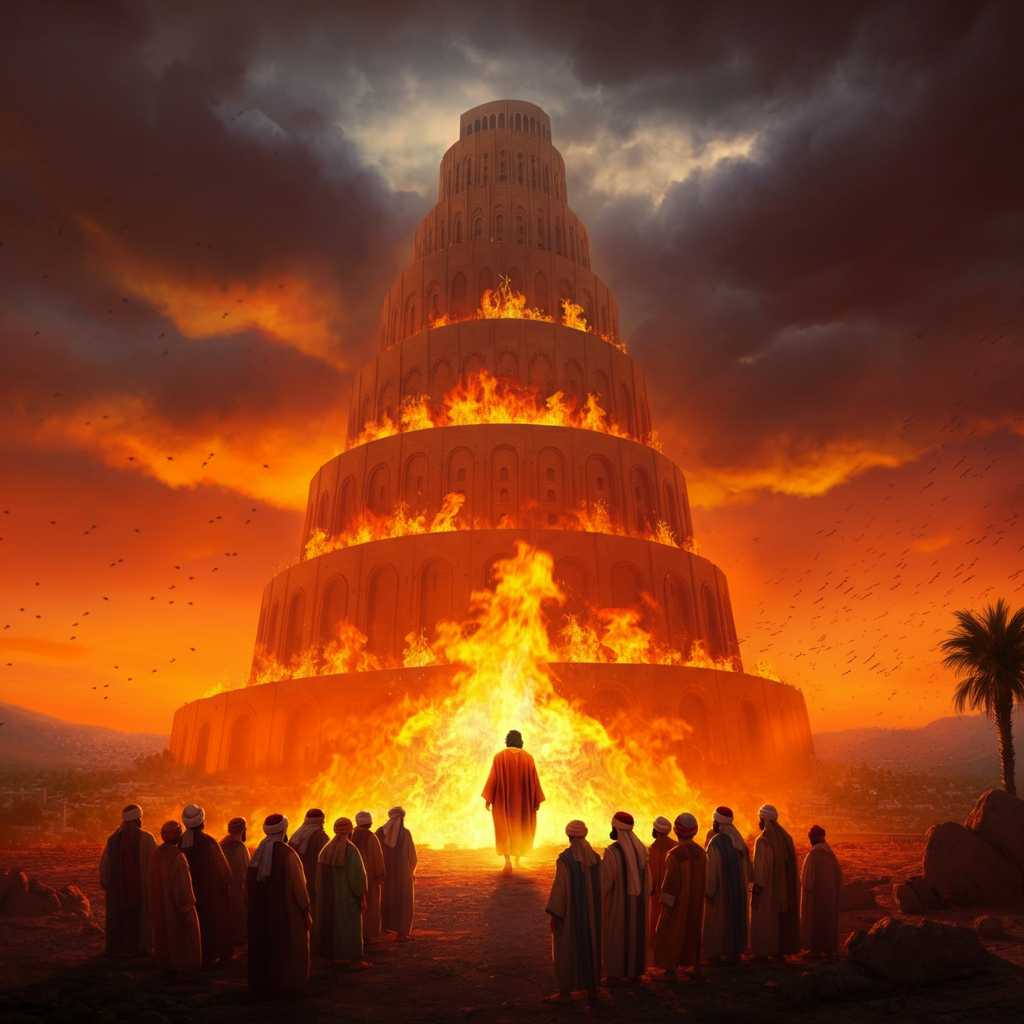
Humiliated and furious, Nimrod ordered a punishment of unprecedented cruelty. A massive fire was to be built, its flames reaching for the clouds. For a month, wood was gathered, and the people eagerly contributed, believing they were defending their gods. Ibrahim was bound and brought to a giant catapult, the first of its kind, designed to hurl him into the inferno.
As he stood on the precipice of a fiery death, Ibrahim’s faith did not waver. He placed his complete trust in his Creator, uttering the timeless words, “Allah is enough for us, and He is the best disposer of affairs.”
Just as he was launched into the searing heat, a divine command was issued: “O fire, be cool and peaceful for Ibrahim.” The flames, which had been hot enough to keep onlookers at a great distance, miraculously became a gentle haven. The fire consumed only the ropes that bound him. To the utter astonishment of Nimrod and the crowd, Ibrahim walked out of the blaze unharmed, his face radiant with divine mercy.
This miracle should have been a clear sign, but Nimrod’s heart was sealed by arrogance. His defiance grew, leading him to an even greater act of folly. “If there is a god in the sky,” he declared, “I will reach him and defeat him.” He commanded the construction of a colossal tower, and upon reaching its peak, he shot an arrow toward the heavens. By a divine plan, the arrow returned to him stained with blood, leading his foolish followers to believe he had wounded the God of the sky.
His pride now boundless, Nimrod challenged Ibrahim to bring forth his God’s army for a final battle. Ibrahim stood alone before Nimrod’s massive forces. Soon after, a cloud appeared on the horizon — not of soldiers, but of countless mosquitoes. The swarm descended upon Nimrod’s army, a tiny, relentless force that consumed flesh and left only bones.
Nimrod fled in terror to his palace, believing he was safe. But a single, weak mosquito found its way inside and entered the king’s nose, burrowing into his brain. The once-mighty ruler was subjected to an unbearable, buzzing torment inside his own head. He slammed his head against walls and ordered his guards to strike him with hammers, desperate for a moment of relief. For 400 years he had worn a crown, but his end came from the relentless torture of the smallest of creatures. His suffering grew until a final, forceful blow cracked his skull, ending the life of the tyrant who dared to challenge God.
The story of Nimrod serves as a powerful reminder that true power belongs only to the Creator. His rise was a test, and his fall was a lesson — a testament to the fact that pride, no matter how grandly built, will ultimately be brought low by the unassailable power of divine justice.
메타데이터
- post_id
- 4dbd2e701a05
- slug
- the-rise-and-fall-of-nimrod-4dbd2e701a05
- url
- https://medium.com/@upol.zarief/the-rise-and-fall-of-nimrod-4dbd2e701a05
- canonical_url
- https://medium.com/@upol.zarief/the-rise-and-fall-of-nimrod-4dbd2e701a05
- author_url
- https://medium.com/@upol.zarief
- status
- ok
- fetched_at
- 2026-07-17 14:20:58




