How Do You Know If Security Guards Actually Completed Their Patrol?
For many organizations, security patrols are a critical part of daily operations.
How Do You Know If Security Guards Actually Completed Their Patrol?
For many organizations, security patrols are a critical part of daily operations.
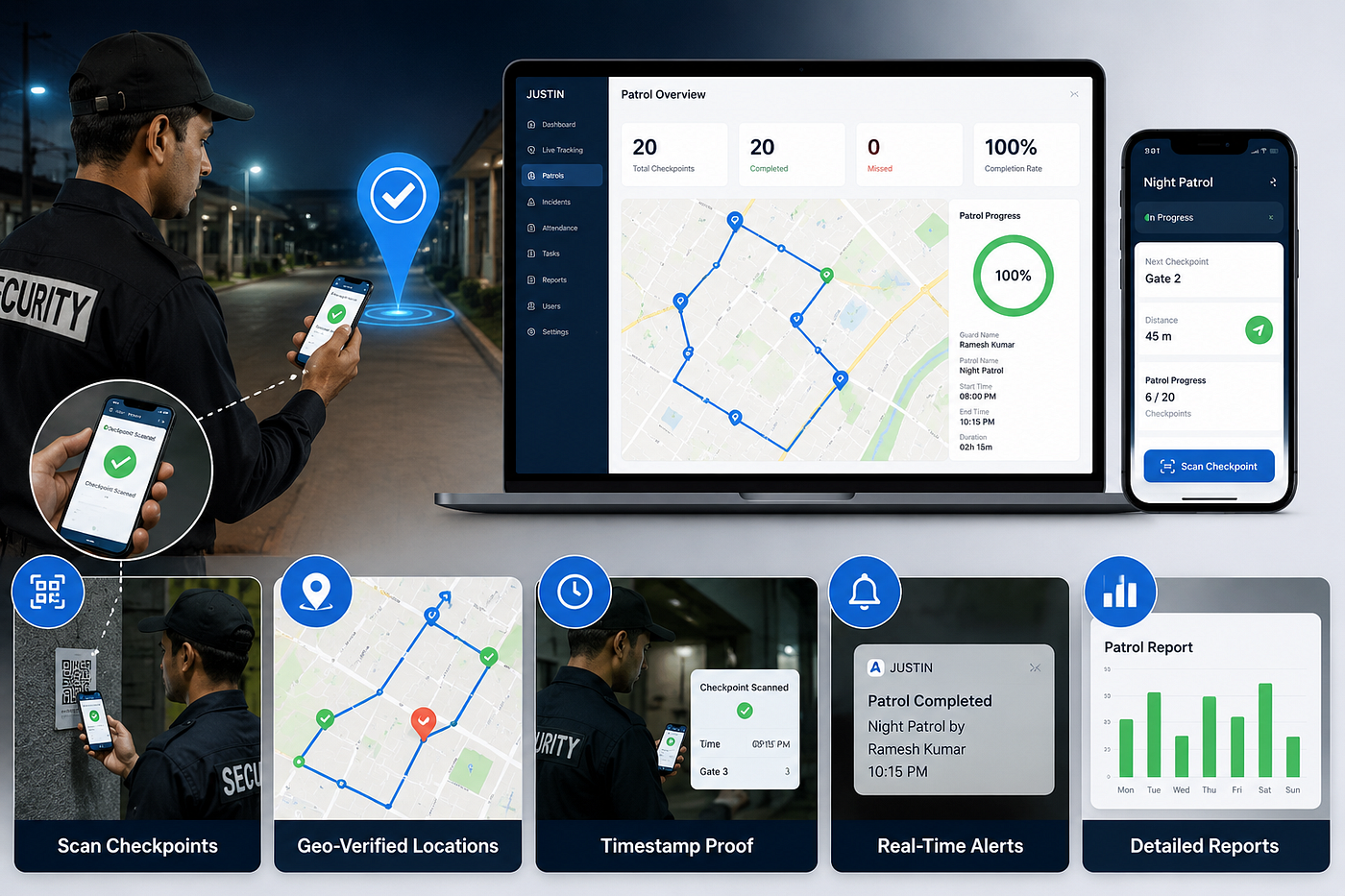
JustIN — Geo-Fencing Patrolling and Attendance App
Whether it’s a solar power plant, manufacturing facility, warehouse, mining site, logistics hub, or industrial park, patrols help ensure that assets, personnel, and infrastructure remain protected around the clock.
But here’s a question that many security managers struggle to answer with complete confidence:
How do you know if guards actually completed their patrol?
At first glance, the answer may seem straightforward. Guards submit patrol logs, supervisors receive reports, and shifts are marked as completed.
However, the reality is often more complicated.
The Visibility Problem in Security Operations
Traditional patrol management relies heavily on manual processes.
A guard may sign a register before starting a shift. A patrol report may indicate that rounds were completed. Checklists might be submitted at the end of the day.
They don’t necessarily confirm:
- Whether every checkpoint was visited.
- If patrol routes were followed correctly.
- Whether high-risk areas were monitored on time.
- How long guards spent at specific locations.
- If incidents were reported immediately when they occurred.
Without real-time visibility, organizations are often forced to rely on trust rather than verification.
And in security operations, blind spots can be costly.
Why Attendance Doesn’t Equal Accountability
Many organizations have invested in digital attendance systems to improve workforce tracking.
While attendance verification is important, it only confirms that someone started their shift.
It doesn’t answer what happened afterward.
- A guard may check in on time, but did they complete all assigned patrols?
- Were restricted areas inspected?
- Did they respond to unusual activity?
- Were security protocols followed consistently?
The difference between attendance and accountability is significant.
Attendance tells you who was present.
Accountability tells you what was accomplished.
The Cost of Unverified Patrols

When patrol activities cannot be verified, organizations face several risks:
1- Security Gaps
Missed checkpoints and incomplete patrol routes can leave vulnerable areas exposed.
2- Delayed Incident Response
Without real-time reporting, incidents may go unnoticed until they become larger problems.
3- Compliance Challenges
Industries with strict safety and security requirements often need documented proof of patrol activities.
4- Limited Operational Visibility
Managers lack the information needed to identify performance issues, improve processes, and allocate resources effectively.
How Technology Is Changing Patrol Management
Modern security operations are moving beyond paper logs and manual reporting.
*Location-based technologies, mobile applications, geo-fencing, and real-time tracking* are helping organizations verify patrol activities more accurately than ever before.
Instead of relying solely on reports, managers can now access:
- Real-time patrol status
- Location-verified checkpoint visits
- Patrol route tracking
- Incident reporting with location data
- Historical patrol records
- Performance analytics
This creates a more transparent and accountable security operation.
Building a Culture of Accountability
The goal of patrol verification is not to monitor employees unnecessarily.
When guards know that patrol activities are documented and verifiable, consistency improves. Supervisors gain better visibility, management receives accurate operational data, and organizations can make informed decisions based on facts rather than assumptions.
Most importantly, security teams gain the tools they need to perform their responsibilities more effectively.
Looking Ahead
As facilities become larger and security requirements become more complex, the need for verified patrol management will continue to grow.
Organizations can no longer rely solely on attendance records or manual logs to measure performance.
The real question is no longer:
“Did the guard check in?”
It’s:
“Did the patrol actually happen?”
The organizations that can answer that question with confidence will be better positioned to improve security, strengthen compliance, and maintain operational excellence.
Because in modern security operations, visibility isn’t just valuable — it’s essential.
메타데이터
- post_id
- 4dbf9b08861f
- slug
- how-do-you-know-if-security-guards-actually-completed-their-patrol-4dbf9b08861f
- url
- https://medium.com/@justin_app/how-do-you-know-if-security-guards-actually-completed-their-patrol-4dbf9b08861f
- canonical_url
- https://medium.com/@justin_app/how-do-you-know-if-security-guards-actually-completed-their-patrol-4dbf9b08861f
- author_url
- https://medium.com/@justin_app
- status
- ok
- fetched_at
- 2026-07-10 15:36:45