An old publication reveals a permaculture past
Co-developer of the permaculture design system with Bill Mollison, David Holmgren, has spoken about how permaculture lacks a sense of its…
Our permaculture, our story…
An old publication reveals a permaculture past
Co-developer of the permaculture design system with Bill Mollison, David Holmgren, has spoken about how permaculture lacks a sense of its own story. For too many, permaculture has been a design system without that story. All that many students gain is a scanty version of the design system’s story from the point of view of their teachers. And what those teachers learn is linked to their own educational lineage. Bill Mollison’s autobiography, Travels in Dreams, relieved this lack of a story for permaculture to some extent. It was later supplemented by the publication of Permaculture Pioneers.
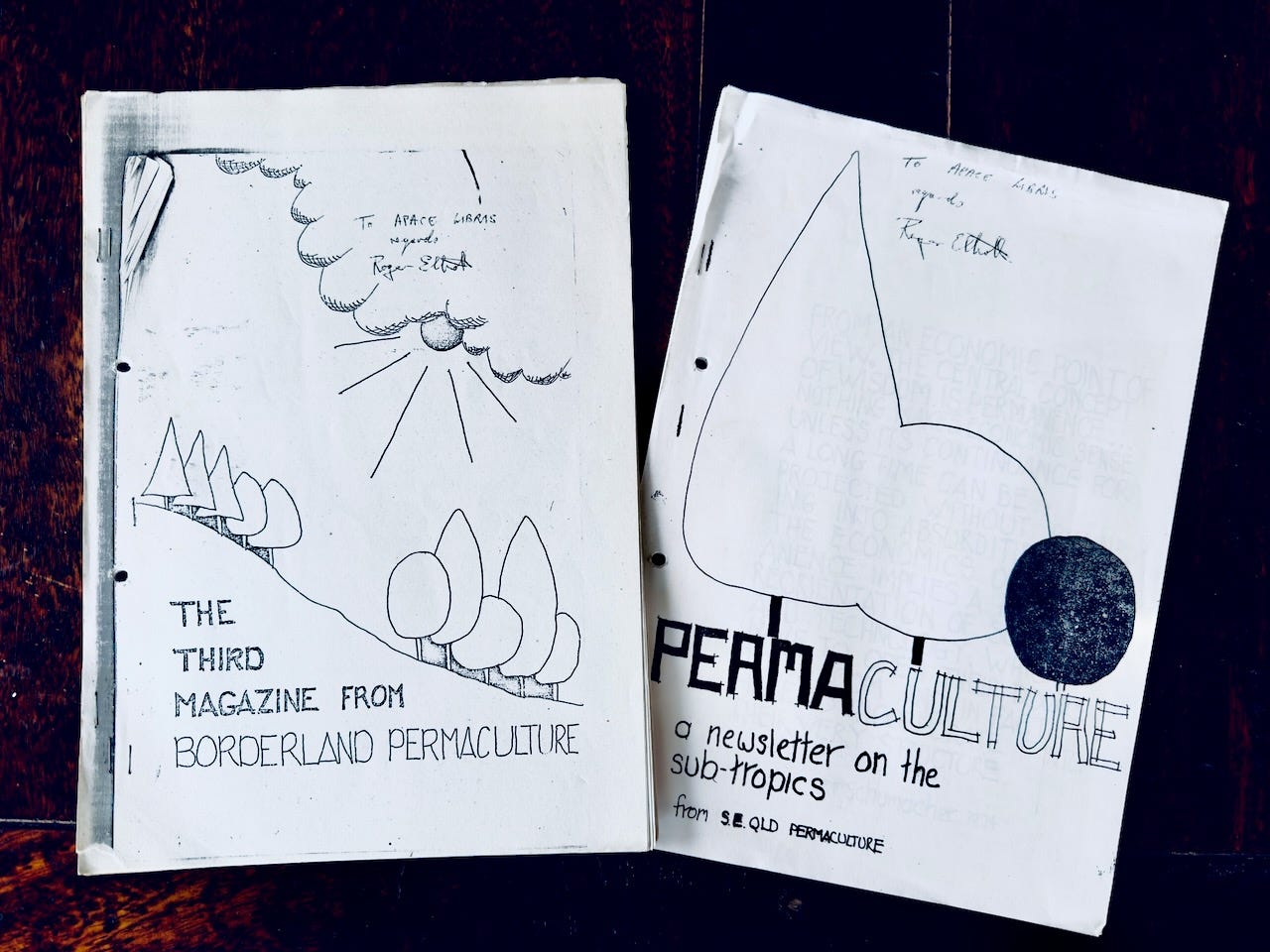
Permaculture’s past in print.
The system was born, but its past is often a blank page. Bill Mollison and his co-developer David Holmgren gave permaculture life, but where is its story?
David has spoken about how permaculture lacks a sense of its past. For too many, permaculture has been a design system without a history. All that many students gain is a sparse version of the design system’s story from the point of view of their teachers, a story passed down through the teacher-student lineage. I think we can agree that permaculture histories are partial histories made up from stories based on permaculture at a particular time at a particular place. There are other permacultures experienced by different people in other places. This is why the history of the design system is a fractured history.
A different pathway to learning
What you are about to read is a part of that fractured history in the form of a fictionally-formatted history. The content is as factual as I can make it. The conversation between the people is not. The format was chosen to avoid a straightforward journalistic account and to explore how stories can be pathways to learning.
The protagonists meet by chance when both arrive at the same time to leave surplus home garden produce in the neighbourhood house’s community refrigerator. It’s a resource for families finding difficulty in meeting their food needs during our cost of living crisis. Why so? After accounting for a family’s recurring costs, food purchase is the only major expenditure where costs can be curtailed. At the community refrigerator, Bret leaves a box of home grown Dutch cream potatoes. Mimi, a bundle of silverbeet leaves. It is their way of enacting the permaculture ethic about distribution of surplus, of sharing what is spare.
The two know each other as members of the local branch of Permaculture Tasmania. Mimi, now in her early forties, softly spoken, her dark hair carrying the first strands of grey, is a nurse-practitioner at the local urgent care centre. Bret is a few years younger, slightly over average height and maintains the skeptical attitude that allows him to cut through fluff and nonsense to get at the core of issues. He worked for an international development NGO in the South Pacific and now freelances his services more as a project manager and an adviser than an in-country practitioner. After running into each other at the community centre, Mimi accepts Bret’s offer of coffee at his place.
“Students learn snippets of its history pieced together from their teachers. They in turn get their strories from their teachers. If you regard the teacher to student chain as a teacher’s lineage, what you often get are fragmented echoes of a story never fully told. You get the story of permaculture told from a single person’s experience of it. Problem is, there are many such individual stories, but there is no comprehensive volume or online source bringing together the scattered history of permaculture.”
“Bill gave us Travels in Dreams,” Bret replies. “That book revealed his permaculture story. But… unless you stumble upon an old copy in a secondhand bookshop, that story is lost. No digital copy of the book was published. Paper copies go out of print and disappear. The knowledge they contain is lost. Digital copies are forever… or for as long as there is an internet.”
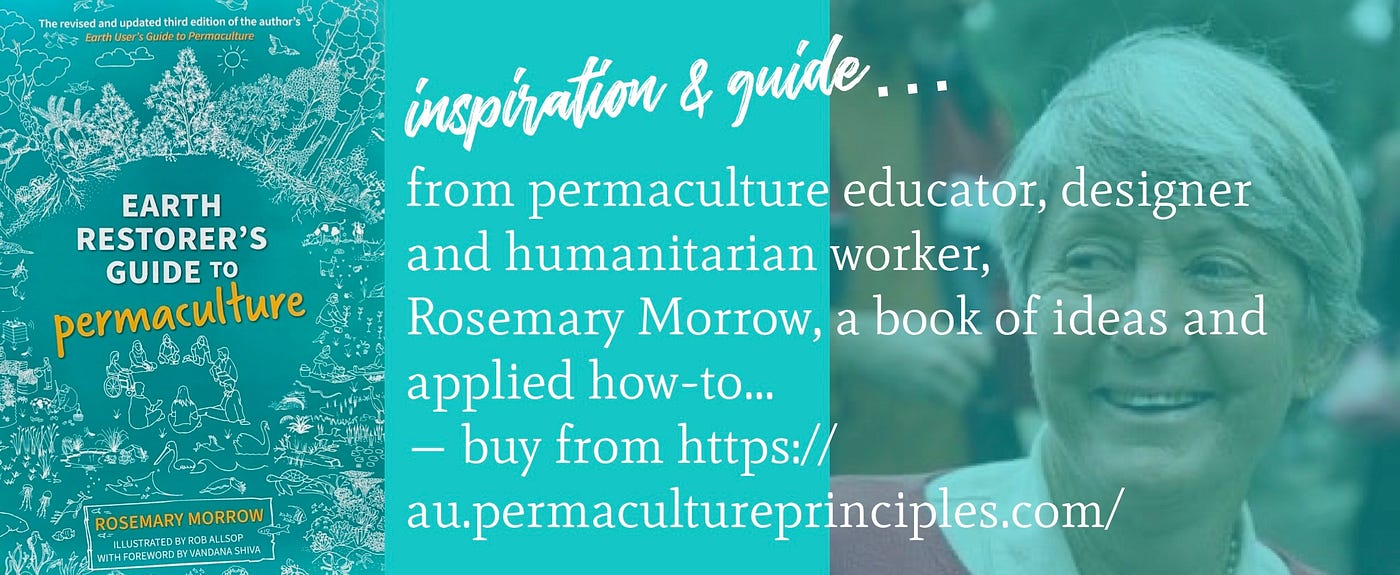
Mimi looks from Bret to his bookshelf. Stacked in an ordered row is the literary history of permaculture, right back to Permaculture One and Permaculture Two. Instructional books. Rosemary Morrow’s books. A couple books by David Holmgren. Forgotten titles like Production Without Destruction. Urban Permaculture — the UK book by David Watkins and the Australian magazine-format book of the same title published by the long-gone Earth Garden magazine. Linda Woodrow’s The Permaculture Home Garden. J Russell Smith’s Tree Crops: A permanent agriculture. Lessons From Nature. The One-Straw Revolution. Robert Hart’s Forest Gardening. And more of Bill’s books. Newer titles, too. If the teacher-student link is a lineage, here we have the literary lineage of permaculture, Mimi thinks.
“David gave us his own story. Bill his. Then came the Permaculture Pioneers book with the stories of those who went out to create permaculture in Australia. They took Bill and David’s and Rosemary Morrow’s ideas as inspiration and turned them into reality.”
A moment’s silence. Bret lifts his cup and takes a sip of the hot, caffienated beverage. Like his friend, he counts his years in permaculture in decades. Years teaching the design system, years practicing it in home and community gardens, years trying to imbue permaculture thinking into international development NGOs. He knows his friend’s story in the design system is one of working with communities to improve their resilience to the shocks now coming at an accelerating pace.
“You know”, he starts, leaning towards her. “I think permaculture is now saturated with ‘how-to’ books. We saw them start to appear a few years after Bill and David’s first book back in 1978. Now there’s more… many more. And not just books in print. The digital copies never see a printer. Go look at Amazon’s Kindle online store and you find them. I don’t know how many books about forest gardening I’ve seen. It’s like… market saturation. We’ve got to the point that they repeat each other rather than explore new avenues for permaculture.”
Mimi thinks for a moment. “There’s an argument for books on the same topic but written for different climates, different regions. Gardening books, for instance. Growing food is done differently in the UK… oh, they are still amid their Brexit divorce so I’ll exclude them from Europe and the books appearing there… … and different than in Australia. And growing food is different in Tasmania than on mainland Australia.
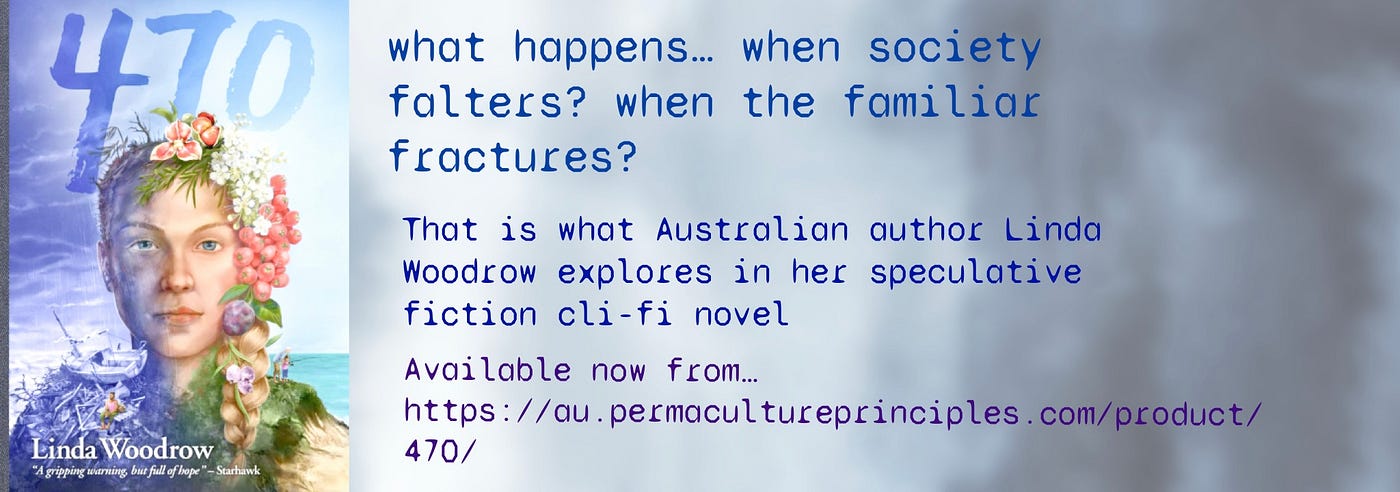
“But your point about books repeating much the same content… I think you are right. What we need are books that carry instructional and other content in a more-reader-engaging format. Like you find in fiction writing or in the work of the literary journalists of the 1980s. Linda… what’s her name… the writer in northern New South Wales… Woodright?… no… Woodward. Her book 470. It carried messages and ideas wrapped in fictional form. And Kim Stanley Robinson, he does that too. They use fiction to introduce fact, speculation to introduce ideas. They use fiction writing strucrures with rising tension leading to a climax, a revelation. They invent characters who carry the ideas they want to get across. Ideas introduced through fiction. It’s more readable than most non-fiction formats. That’s what we need. More of that!”
“The story’s still unraveling”, Bret says. “The story of permaculture. But one thing’s clear. Permaculture’s history isn’t just a footnote to the design system. It’s the guts, the formative essence of it. That’s what I thought when a few days ago I came across a couple old newsletters. I sat there reading them. They took me back to the days of permaculture’s origin, to the time it was making its tentative start. There was much uncertainty around it then. Would permacultue amount to something worthwhile or would it disappear as a good idea stillborn? It found its footing in the alternative subculture of the time, but would permaculture outlive it? Or would it go on to exist as its own subculture, perhaps? I sat there and imagined how it must have happened. Those old newsletters… they carry a story.”

Looking back
It is the early 1980s. We are in the humid subtropics. It is summer. In Tomewin, near Murwillumbah, the town slumbers in the sticky warmth, shimmering heat waves rising from overheated galvanised iron roofs. Local people are used to it. They move with a rural slowness.
But others are moving with the haste that comes with a new and inspiring idea. We don’t know who established the Garden of Eden. Someone, somewhere knows, but it is not explicitly documented in the available records. Those are scanty. The names John Palmer and Bob Roe come up as linked to the place. Where are they now? What happened to them?
With others they are south-bound. Not to Sydney and not to Melbourne. To Tasmania. There, something new and intriguing is unfolding and they want to be part of it.
Reaching the Bass Strait coast in the island state’s northwest, their destination is a town called Stanley. Specifically, an intentional community that goes by the name of Tagari. Their reason for going there? To join a course. And the teacher of that course? A Tasmanian who only a few years before had written a book on something that none had ever heard of. The story doing the rounds was that Bill Mollison had been a bushman, fisherman, a field researcher for a state government department, and that he had quit academia to focus on this new idea of his, the same idea the people from Tomewin were coming to learn about.
Bill and his co-worker, a student at the Hobart College of Advanced Education, a landscape design student named David Holmgren, had coined a novel name for their new idea. They called it permaculture. As in ‘permanent culture’. The reason that people from the far away Tomewin are there is to participate in what will be a 17-person strong course. It is one of the first permaculture design courses ever. It is the May of 1980.
Course finished, they return to the subtropics. They have work to do. Was it with others they set up Borderland Permaculture? It goes by another name too: South East Queensland Permaculture, a community-based association. Surely this is one of the first of the many permaculture associations that will follow.
Now, so many decades after those foundation years, Bret holds Borderland’s legacy in his hands. Permaculture — A newsletter of the subtropics.
He hands the A4 size, typewritten and dog-eared publication to Mimi. “I don’t know how many copies were printed. I’ve seen only two.”
“How did you find them?”, Mimi asks as she flicks through the pages, an expression of curiousity on her face.
“It’s more like a magazine in content and design”, she says. “…and this is interesting. It emphasises permaculture’s integration with the alternative lifestyles movement of the time, focusing on sharing labor, expertise, and multi-use designs tailored to subtropical climates. It highlights early designers like John Palmer and Bob Roe from Tomewin and Uki, alongside Max Lindegger who was then living further north near Nambour. Later, in the 1980s, Max was instrumental in setting up Crystal Waters Permaculture Village in the Sunshine Coast hinterland.”
There is silence for a minute or two as Mimi reads paragraphs here and there.
“Wow. This isn’t how things turned out. The newsletter promoted the franchising of trained ‘permaculture agents’ who had completed a permaculture design course. They would submit ten designs for approval to be accepted. But approval by whom?”. Bill Mollison, persumably. And then what?
Bret takes a sip of his coffee and looks at Mimi. “I think it was model for the growth of permaculture and for quality assurance. You know how it is… if you leave a new idea open it risks being wrongly interpreted or even co-opted by people who have never done the training. And if that happens the idea is misinterpreted, misrepresented and weakened. But Bill’s idea… franchising… it didn’t materialise. Instead, the approach that evolved was that design course graduates were free to offer design services without peer oversight.
“If you read further, Borderland reports on the permaculture design course they attended… the one led by Bill Mollison in Stanley.”
Let me read, Mimi says. There is silence for a minute or two. Then she reads aloud:
“Seventeen people from most corners of Australia gathered for a two week course in permaculture design at the Tagari Community in Stanley on the north-west coast of Tasmania. Bill Mollison lectured about the two permaculture books and shared his experiences.
“Those books… they would have been Permaculture One and Permaculture Two. Curiously, Bill and David co-wrote Permaculture One but David didn’t cooperate with Bill to write Permacuture Two. So why was that? Perhaps he had left Tasmania by then. There was roughly a year between the books… 1978 and 1979.”
Mimi reads on. “The course is coordinated by Earl Saxon who gave a generalised talk on ecological principles. Bill encouraged the participants to become expert in design but to link up with other people, for example, unemployed groups and trained implementers. The emphasis is on sharing with the existing alternative movement for labour and expertise. Paying jobs would come from governments, councils and other institutions and some private urban and farm properties.
“Design aims to maximise energy gains on site. Emphasis is on efficient use of all features… multiuse wherever possible. Design is suited to different needs. Costs vary depending on client abilities to pay… ‘cheap’ or ‘in kind’ for the alternative movement… normal landscape fees for institutions, etc. For example, $300 for average urban situations. The amount saved is far in excess of this even in the first few months of living on site.”
“Wow! How things have changed”, Mimi says, looking over at Bret. “A design for only $300! It would cost that figure multiplied now.”
She reads on. “The agents trained in the course will be fully franchised when they submit ten designs for Tagari’s approval. Designers in Queensland from Brisbane River north are Max Lindegger and Bill Peak at Nambour and Cooroy. From Brisbane River south into NSW to the Bellingen River are John Palmer and Bob Roe from Tomewin and Uki.
“An addendum adds that one of the 1980 permaculture design workshops, lectured by Bill Mollison, was held in the Coolangatta region from 27th April to 3rd May, at Tomewin.”
Mimi places the publication on the table, leans back and looks at Bret. “Okay,” she says. “That answers my earlier question about who would do the approving. Tagari. It seems Bill envisioned Tagari as the core institution of what would be an evolving network of teacher practitioners.”
“But it didn’t end up being like that, did it?”, Bret adds. “Sure, there was the Permaculture Institute that Bill set up and we can maybe regard that as what Tagari evolved into. For years the Institute was the central body in permaculture. Teachers would registed their students with it. They would get their student’s design course certificates from it. But then the Institute found the work all too much and they ceased to offer those services. I recall that was in the nineties and teachers were starting to issue their own certificates, anyway. That grew into what we have today. A decentralised and distributed network of permaculture practitioners and teachers scattered across the country.”
“And that accounts for the diversity of permaculture design course content,” Mimi responds. “It also explains how spiritual and esoteric stuff entered into some design courses. Bill called it ‘woo’. He said it had no place in permaculture. Always the rational man, he was really opposed to it.
“And just on that, I remember some years back the argument… it was more a discussion than an argument… around biodynamic agriculture, especially its esoteric teachings. Did it have a place in permacuture? Opinion varied. And, yet, biodynamic gardens were as productive as any other organic garden. Critics said that was because biodynamics used organic techniques irrespective of the esoteric content. The conversation seems to have faded away.”
Mimi’s cuiousity is aroused. Over the following couple days she digs up what references to the Garden of Eden and Borderlands Permaculture she can find. The historic record is sparce. What she finds if this…
The Garden of Eden was a subtropical permaculture demonstration site in Tomewin, near Murwillumbah. There, Borderlands was reported as establishing a regional seed bank and exchange. Just as Borderland was an artefact of permaculture’s early history, so talking about it took Mimi and Bret into the early history of seed saving in Australia.
References come from various websites, suggesting that Borderland’s had one of Australia’s first permaculture-specific seed exchanges. It followed Self Reliance Seeds, an early Australian seed-saving initiative of the late 1970s and early 1980s that was closely aligned with permaculture. Self Reliance Seeds produced a seed catalogue. It promoted collecting, storing and exchanging seeds to build resilience against commercial dependency. It is reported to have had links to Borderlands Permaculture’s Tweed region seed bank some time around 1980.
Phoenix Seeds emerged from Self Reliance Seeds in the early 1980s as a Tasmania-based and permaculture-aligned seed supplier. Michael Self is said to have collaborated with Bill Mollison to launch the business. Records of the reasons behind Self Reliance Seeds’ transitions into Phoenix Seeds are scarce, however the name suggests a rebirth, as per the mythological phoenix rising from the flames.
The reason for the transition was documented by Canberra Seed Savers, possibly in 2022 or 2023:
‘We were particularly delighted to receive a visit from Joe Swartz, a much-respected elder of the seed saving movement in Australia. Joe literally wrote the book on seed saving with his 1980 publication, Help Save Our Seeds Through Homegrown Action (still available via the National Library!). And to really add icing to the cake, Joe very generously donated two archive boxes of heritage seed catalogues and historical publications that take us back to the very beginnings of the Australian seed saving journey.
“The then-Self Reliance Seed Co’s Seed Magazine and Catalogue (December 1980) contains fascinating articles about the genesis of seed saving with the impending introduction of Plant Varietal Rights legislation.
‘Interestingly, this magazine contained, loosely slipped between pages, a notification from the Self Reliance Seed Co that they were having to cease trading as a result of a threat from a US company alleging copyright infringement. As the notice points out, a small community-based entity can simply not afford to take on such international litigation. Globalisation had, indeed, arrived.’
That was the story from the time. Phoenix Seeds’ non-hybrid varieties, also known as heritage seeds because they were passed on through the generations, were available then. There were rumours of the legal trouble circulating in permaculture circles. Any remaining documentation about the incident would likely be found in the archives of the Permaculture Institute now based near Sisters Beach in northern Tasmania.
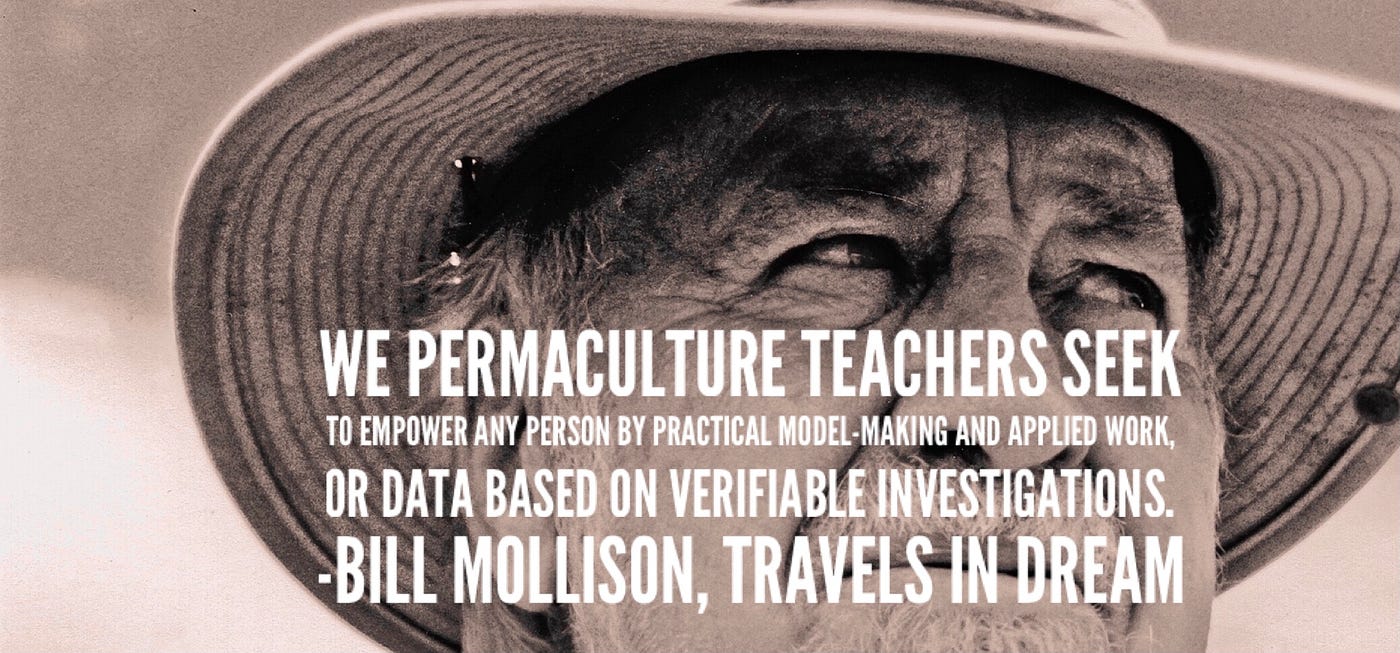
In 1986, Jude and Michel Fanton were inspired by Bill Mollison’s permaculture teachings to set up the Seed Savers’ Network, initially based near Nimbin in northern NSW and later in Byron Bay. The Network was to prove the most enduring of the seed exchanges that were set up in those early days of permaculture.
In 2018, Eden Seeds, an Australian supplier of non-hybrid seeds, published this:
‘Phoenix Seeds 04 Sep 2018 We are saddened to hear of the passing of Michael Self in early August after a long illness.
Michael worked with Bill Mollison to start Self Reliance Seed Co which later became Phoenix Seeds.
When I moved from Brisbane in 1982 to Sandy Creek, Gympie, to build an adobe mud-brick house, the garden often took precedence over building and seeds came from Phoenix Seeds. We extend our condolences to family and friends. …Alf Finch.’
The value of the historical record
The value of South East Queensland Permaculture’s journal lies in its shedding light on the design system’s very early days. Permaculture was still taking shape in those times. The vision its few participants held for it was to some extent different to how it turned out. But that is how things evolve. An idea reformats as it adapts to the prevailing conditions, and they might be different to the conditions of its time of origin. Adaptation is important. In the long story of evolution it has been not the strong that survive. It has been the adaptable.
Sometimes, and as members move on and age, and if no one documents the story and publishes it, it is only by its publications that an organisation is known. That is true for Borderland Permaculture whose Permaculture — a newsletter of the subtropics still calls to us today from a past many permaculture practitioner know nothing of.
In Tomewin, Garden of Eden functioned as a short-lived permaculture demonstration site. There are no records of the site’s evolution beyond the 1980s.
References
Canberra Seed Savers https://canberraseedsavers.org.au/meeting-a-seed-saving-legend/
Seed Savers’Network https://en.wikipedia.org/wiki/The_Seed_Savers'_Network
Looking back
[embed]The artefact Archeologists discover permacuture’s past…medium.com
The movement

메타데이터
- post_id
- 4dc6b30f990f
- slug
- an-old-publication-reveals-a-permaculture-past-4dc6b30f990f
- url
- https://medium.com/permaculture-3-0/an-old-publication-reveals-a-permaculture-past-4dc6b30f990f
- canonical_url
- https://medium.com/permaculture-3-0/an-old-publication-reveals-a-permaculture-past-4dc6b30f990f
- author_url
- https://medium.com/@russgrayson-au
- status
- ok
- fetched_at
- 2026-06-09 15:37:30