Translating the Untranslatable
Back to Pushkin I go
Translation | POETRY | Pushkin
Translating the Untranslatable
Back to Pushkin I go
blob:https://gemini.google.com/52f459bb-5bf4-46ce-b381-f5e05952cec9
I’ve been spending much more time on my novels recently, putting some polishing touches on A King’s Lot, and about halfway through the first draft of Crux, but I started waking up in the middle of the night with odd poetic turns of phrases in my head again — leading to the recent Too Wrong, for example — and that’s a sure sign that I’m missing the word play that drove me to create Myth Takes, Sonnet Station, and Number Seven Will Surprise You.
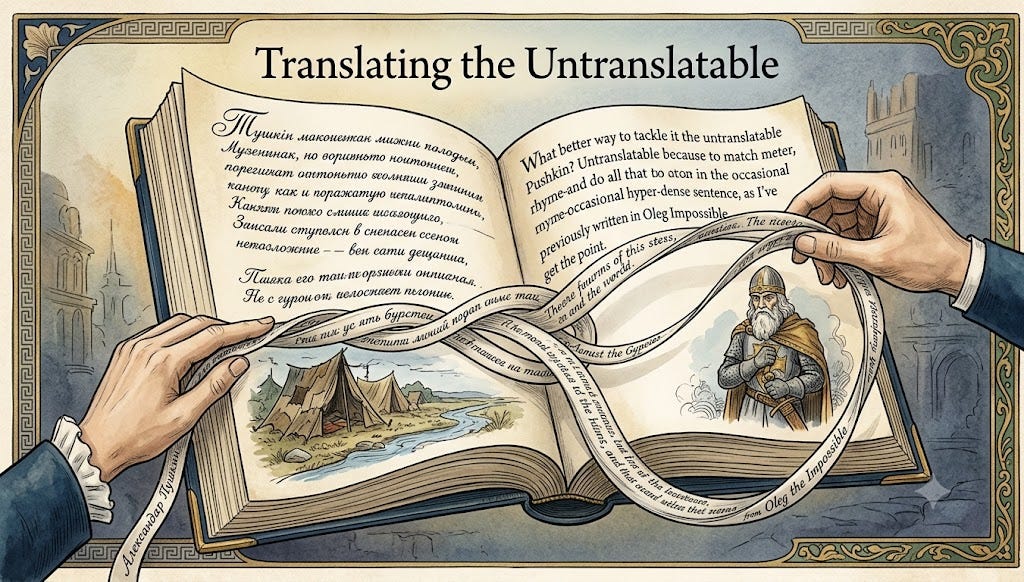
What better way to tackle it than to go after translating the untranslatable Pushkin? Untranslatable because to match meter, cadence, style, and rhyme — and do all that on the occasional hyper-dense sentence, as I’ve previously written in Oleg the Impossible — well, you get the point.
Nonetheless, I harbor major ambitions in this direction, a collection of shorter works, which I’m titling The Essential Pushkin, and a translation of Ruslan & Ludmilla. That’ll probably do 😃
When it comes to these essentials, I’ve passable translations for Elegia, I Loved You, Lumorie, and the aforementioned Oleg. So I set out for a new challenge, Цыганы.
Let’s start with the impossible basics. The problem, which was historically translated as Gypsies or The Gypsies, a word, as you’re probably aware, now considered a slur, though ChatGPT assures me that “a translator’s note should suffice.” ChatGPT has not yet had to deal with the threat of being cancelled, I think, other than as a subscription. Perhaps The Roma? Roma? Travelers, Romani, don’t work — the poem is iambic, and the first stanza is this:
Цыганы шумною толпой По Бессарабии кочуют. Они сегодня над рекой В шатрах изодранных ночуют.
which GPT translates as:
The Gypsies, in a noisy crowd, Wander through Bessarabia. Today, beside the river, They spend the night in tattered tents.
Translating is a compromise, and translating rhymed, metered poetry takes that to the Nth degree.
Bessarabia (like Arabia) — the region of the old tsarist Russia that I am from (now Moldova) — rhymes with Labia. And lest you doubt it, I do have a poem taking advantage of this rhyme pair — but it seems out of place here…hmm, what to do.
The Roma roaming has an interesting sound, though it’s a bit formal, isn’t it? I tried it:
The Roma roam, their rowdy crowd (a bit Seussy, isn’t it) through Bessarabia meanders (inverted, but poetically acceptable, a bit weird on the sentence subject here) Their tattered tents stand loud and proud (invented, but sounds ok)… Their tattered tents stand proud, unbowed (maybe a bit better) Their tattered tents beneath night’s shroud (got night back in, though feels a bit forced, doesn’t it) Above the Dniester as it wanders (what is Dniester? The river Pushkin is talking about. We could have used river, but then it’s an odder sentence, feels like).
That was, roughly speaking, my first attempt. Not entirely horrible. Let’s try a different approach: How about we lose crowd, to get a more interesting rhyme? And let’s try a bit less Seussy.
The gypsies roam with much ado (Shakespearean, but it gets the point across, I think) The gypsies roam with much delight (a bit stretchy, but sets up the night for the rhyme) Through Bessarabia’s expanses (this sounds perfect to me to match the meaning, but rhyme to what???) Their stitched-up tents set up in view (is stitched-up better than tattered? Hmm) Of ancient Dniester as it dances… (invented, maybe too weird) — but if we switch to delight…
The gypsies roam with much delight Through Bessarabia’s expanses their tattered tents pitched for the night Below, the river churns and dances. (hmm, maybe. We reversed above to below, keeping the spatial relationship correct. Pushkin could easily use a phrase like this.
And so it goes — that’s just the first four lines. Out of five hundred and sixty-nine.
Makes one appreciate the effort it took to translate something like The Gabrieliad. Ah, been there, done that (warning, subject matter will be offensive to some readers).
But that should give you a sense of it. A rhymed, metered poem is a type of puzzle, and the translation of such a poem is a much, much harder one.
But oh what fun! I’ve just begun.
메타데이터
- post_id
- 4dd5e6ca0cd5
- slug
- translating-the-untranslatable-4dd5e6ca0cd5
- url
- https://medium.com/@A.gee/translating-the-untranslatable-4dd5e6ca0cd5
- canonical_url
- https://medium.com/@A.gee/translating-the-untranslatable-4dd5e6ca0cd5
- author_url
- https://medium.com/@A.gee
- status
- ok
- fetched_at
- 2026-06-09 21:21:26