Mission, Without Illusions
Rabbi Eli Schlanger HY”D at the Chanukah Menorah Lighting on Bondi Beach in 2022.
Mission, Without Illusions
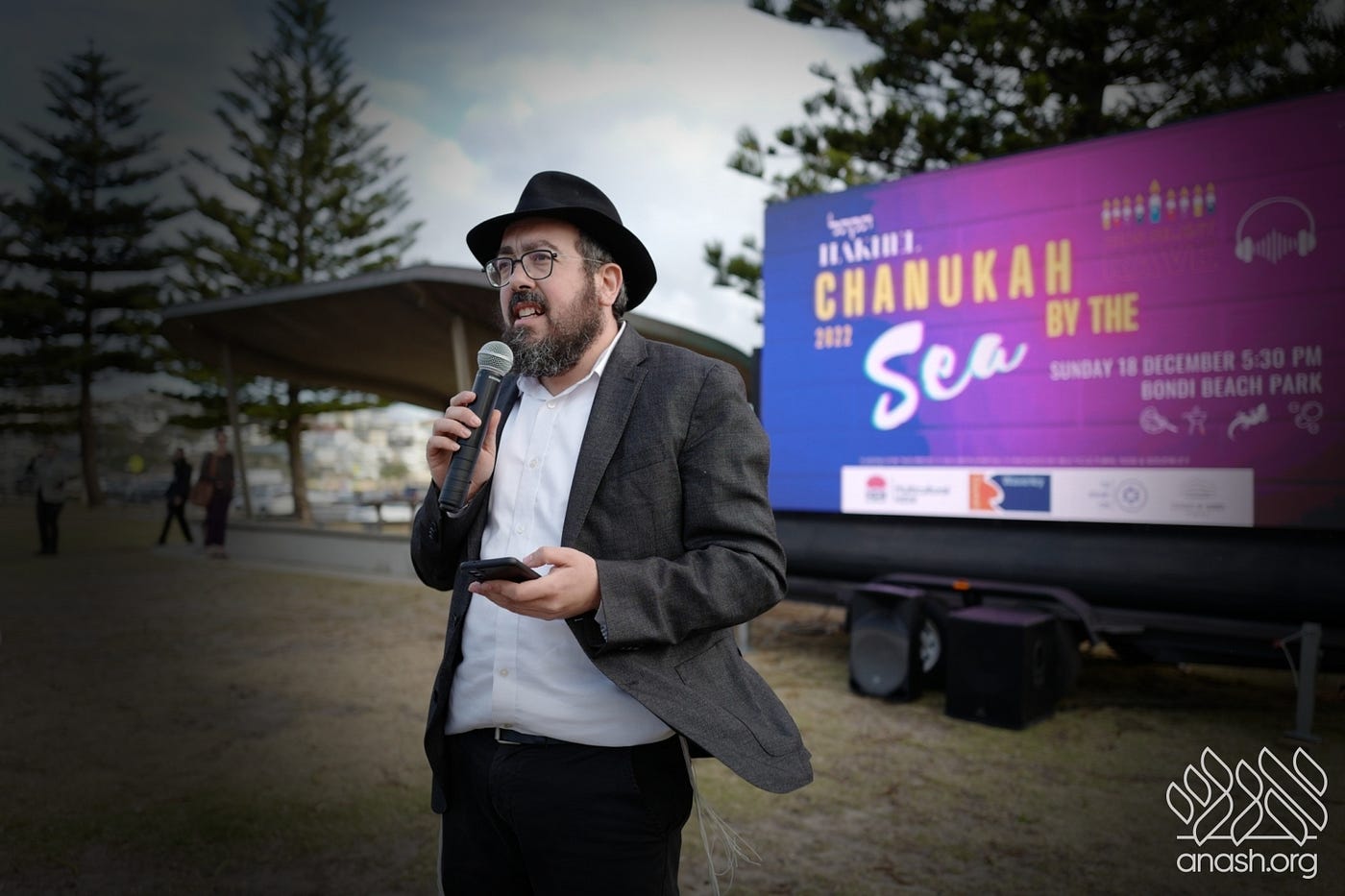
Rabbi Eli Schlanger HY”D at the Chanukah Menorah Lighting on Bondi Beach in 2022.
This one landed differently.
Only now, a few days after Chanukah, am I beginning to unpack how the terrorist attack at the Chabad menorah lighting on Bondi Beach affected me. Two of my colleagues gone, murdered while doing something so defiantly ordinary and so eternally Jewish: lighting a menorah in public.
In 2008, I was a young shliach, three years in the field, when the world watched the horror unfold at the Chabad House in Mumbai. The murder of Rabbi Gabi & Rivky Holtzberg and their guests was the first time many of us realized something we always knew but had never truly felt: being a Chabad shliach isn’t just demanding. It can be fatal.
I hadn’t signed up to be a “career“ rabbi, I signed up for a deeper purpose. But Mumbai was the moment it became clear that the purpose has a price tag, which none of us like to read aloud.
Fast forward to Montreal, just hours after the shooting in Sydney. I’m standing out in the street, leading our own menorah lighting with hundreds gathered, and our newly elected mayor is present. And then it hits me: I’m doing the exact same thing that Rabbi Eli Schlanger HY”D and Rabbi Menachem Dadon were doing on Bondi Beach hours earlier.

Hours after the attack at the Chabad menorah lighting in Bondi, we stood on the steps of Chabad NDG with Montreal’s newly elected mayor, Soraya Martinez Ferrada, lighting our own menorah before a crowd of hundreds, choosing light, publicly and unapologetically, when the darkness tried to speak first.
This is what it means to be a shliach of the Rebbe.
We don’t back down because we might be seen. We show up because we will be seen. We don’t dim Jewish light to avoid drawing attention. We make it brighter.
Over the past week, people have said that if, heaven forbid, someone is taken from this world, there is something profoundly meaningful about being taken while living their deepest values. And they’re right. It is true. Just days after October 7th, I went with Eli and other Chabad shluchim on a solidarity mission to Israel. I watched him never miss an opportunity to put on tefillin with people: soldiers, Shiva houses, anyone, anywhere. He was relentless and mission-driven, but not naïve.

Together with Rabbi Eli Schlanger and a delegation of Chabad rabbis from around the world, just days after October 7, 2023, standing at the Western Wall in Jerusalem, united in prayer, resolve, and responsibility.
And here’s the uncomfortable confession: I know I used to have that drive… but it’s been a while. I’m not always the first one reaching for tefillin anymore. I’ve leaned into depth, into relationships, into meaning over moments. I’ve joked, half-apologetically, about “hit-and-run Judaism,” as if slowing down absolved me from showing up. As if it had to be one or the other.
Then I hear people say, “I wish I could be a Chabad shliach. I wish I had a mission, a purpose.” And I don’t quite know how to hold that. Because mission isn’t a costume you put on when you feel inspired. It’s a life you accept, even when it costs you sleep, comfort, popularity or safety.
Here’s another truth I don’t often articulate: within Chabad, I’ve sometimes stood slightly to the side. My approach hasn’t always fit neatly into expected lanes, and I haven’t always moved in lockstep. That difference has often been noticed — sometimes even celebrated — especially when people say, “You’re not like the others,” and I’ve learned to wear that distinction with a certain pride.
Difference can sometimes turn into distance.
Thinking about mortality has a way of clarifying things. Since October 7th, and now Sydney, that awareness has sharpened. The target feels real. The danger is no longer theoretical. And maybe that’s exactly the moment to ask the harder question: not who am I unlike, but what am I for?
Maybe it’s time to embrace my inner Eli. Maybe it’s time to stop apologizing for the world I chose again and again. Maybe it’s time to see clearly, honestly, and without illusions what so many have always seen in Chabad Shluchim all over the world.

Rabbi Eli Schlanger helping a man wrap tefillin on Bondi Beach — just minutes before the attack. Matilda, the youngest victim of the terror, looks on. A moment of pure mission and innocence, frozen in time.
A mission doesn’t promise safety. It promises meaning. The soul was never sent into this world to be protected, but to illuminate. To show up where you are needed. To bring light not where it is welcomed, but where it is missing. To live in a way that says: my life is not about me alone.
The Rebbe taught that meaning outlives fear. It gives courage its spine. It turns ordinary humans like me, into a messenger of something eternal.
In memory and in honor of Eli, it may be time for me to confront my own hesitations — not only to serve as a shliach in the ways that feel comfortable to me, but to fully embrace the parts of that calling that may seem unfamiliar or even unsettling to the casual onlooker. Eli wasn’t guided by how he appeared to others; he was anchored in purpose. That quiet, unwavering devotion is its own form of mesirus nefesh.
Yes, the world feels darker for Jews right now. But Jewish history has taught us this: when the darkness deepens, the light is asked to shine brighter. And I am proud, deeply proud, to stand among those who choose to be that light.
Stand with us. The mission belongs to all of us.
—
Rabbi Yisroel Bernath is the Senior Rabbi and Shliach at Rohr Chabad NDG in Montreal, Canada. He is the host of Kabbalah for Everyone, one of the most widely listened-to Kabbalah podcasts on Spotify and Apple Podcasts, where ancient wisdom meets real life. He is the author of The Forgiveness Experiment: What Would It Look Like If You Let It All Go? and can be reached at www.theloverabbi.com
메타데이터
- post_id
- 4dd6ca3099c7
- slug
- mission-without-illusions-4dd6ca3099c7
- url
- https://medium.com/@loverabbi/mission-without-illusions-4dd6ca3099c7
- canonical_url
- https://medium.com/@loverabbi/mission-without-illusions-4dd6ca3099c7
- author_url
- https://medium.com/@loverabbi
- status
- ok
- fetched_at
- 2026-07-13 22:28:34