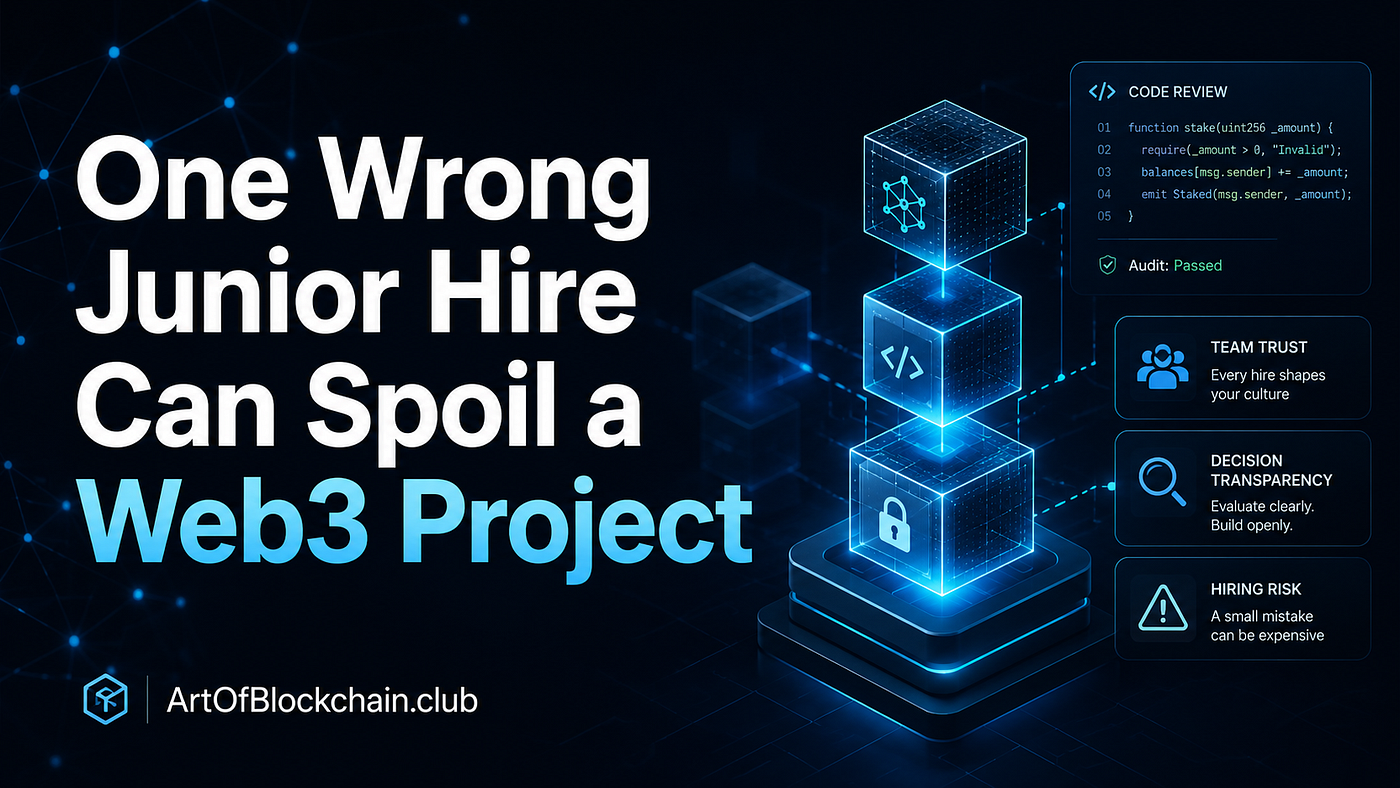
One Wrong Junior Hire Can Spoil a Web3 Project
One wrong junior hire in Web3 does not only mean slow delivery.
One Wrong Junior Hire Can Spoil a Web3 Project
One wrong junior hire in Web3 does not only mean slow delivery.
In a normal software team, a weak hire may create delays, extra review load, or unclear ownership.
In a Web3 team, the risk can be sharper.
A small smart contract mistake can affect user funds.
A wallet-flow bug can block real users.
A weak test can create false confidence.
A wrong assumption in DeFi, infra, protocol logic, or token handling can move from “small internal mistake” to “public project risk” very quickly.
That is why junior Web3 hiring cannot be evaluated only through technical keywords.
- Solidity matters.
- Rust matters.
- Smart contract testing matters.
- GitHub matters.
- Protocol knowledge matters.
But for junior blockchain developers, smart contract interns, Web3 freshers, and early-career crypto engineers, one more signal is becoming equally important:
Decision transparency.
Decision transparency means the candidate can make their thinking visible before the team trusts their code.
- Can they explain what they assumed?
- Can they show what they tested?
- Can they separate facts from guesses?
- Can they flag production risk?
- Can they say where senior review is needed?
This matters because junior hires rarely know everything. That is expected.
The real risk is not lack of complete knowledge.
The real risk is hidden confusion.
In distributed Web3 teams, seniors are busy, founders are stretched, reviewers are overloaded, and juniors are expected to become useful faster than before.
A junior who writes code but hides uncertainty can become risky.
A junior who communicates clearly, even while learning, becomes easier to trust.
Why predictability matters
Predictability does not mean the junior has all the answers.
It means the team always knows where things stand.
A predictable junior says:
- “I am blocked here.”
- “I tried this approach.”
- “This test is failing.”
- “I am not sure whether the issue is contract-side, frontend-side, wallet-side, or RPC-side yet.”
- “I need review before this goes further.”
This kind of communication protects the project.
It also protects the junior.
When thinking is visible, seniors can correct direction early.
When thinking is hidden, the team discovers problems late.
For junior blockchain developer hiring, predictability is not a soft skill.
It is a project-safety signal.
Why reviewable work matters
A junior’s work should be easy to review.
This is where many technically decent candidates lose trust.
- They open large pull requests.
- They mix unrelated changes.
- They do not explain why something changed.
- They do not mention what was tested.
- They leave seniors to guess intent.
- That creates review fatigue.
A small pull request with a clear note is often more valuable than a large pull request that looks impressive but is hard to verify.
In smart contract work, reviewability matters even more.
The reviewer is not only checking whether the code runs.
They are checking assumptions, edge cases, access control, storage impact, test coverage, gas behavior, upgradeability risk, protocol logic, and possible user impact.
This is why proof-based hiring in Web3 should not stop at asking for GitHub links.
Hiring teams should look at how the candidate explains the work.
Is the README clear?
Are tests visible?
Are assumptions documented?
Are limitations admitted?
Can a senior engineer understand the candidate’s thinking without decoding the whole project?
A junior who makes work reviewable reduces team risk.
That is a stronger signal than a resume full of blockchain keywords.
Why fact-vs-guess clarity matters
One underrated junior Web3 signal is the ability to separate facts from guesses.
Many juniors say:
- “I think the RPC is broken.”
- “I think the contract is not deploying.”
- “I think the wallet is the issue.”
A stronger junior says:
- “The transaction reverts with this error.”
- “The same wallet flow works on testnet A but fails on testnet B.”
- “The test fails only after this state change.”
- “This is my assumption, not a verified fact.”
That difference matters.
Blockchain debugging can move across many layers: frontend, wallet, smart contract, RPC, indexer, backend, bridge, oracle, subgraph, and protocol logic.
If a junior cannot separate what is known from what is assumed, the senior reviewer has to clean up the thinking before reviewing the code.
That slows the team.
For a junior blockchain developer, fact-vs-guess clarity is a technical trust signal.
Why production-risk thinking matters early
Juniors do not need to behave like senior security engineers from day one.
But they should understand that Web3 production risk is real.
- A small contract change may affect user funds.
- A wrong token decimal assumption may break balances.
- A missing validation may create exploit paths.
- A careless deployment may damage community trust.
This is why junior Web3 hiring should not only ask:
- “Can this person code?”
It should also ask:
- “Can this person notice risk before the team gives them ownership?
A strong junior can say:
- “This part needs senior review.”
- “This is not tested enough.”
- “This may affect user balances.”
- “This assumption should be verified before deployment.”
- That is not weakness.
- That is maturity.
In Web3, overconfidence can be more dangerous than asking for help.
What candidates should learn from this
Many juniors think public proof means only GitHub.
GitHub helps, but it is not the full proof stack.
A stronger junior Web3 profile may include:
Small but complete GitHub projects
Clear README files
Test notes
Pull request explanations
Debugging writeups
Smart contract walkthroughs
Audit-learning notes
DeFi case studies
Wallet-flow explanations
Protocol research notes
Lessons from failed builds
This kind of public proof shows how the candidate thinks.
That is where Web3 hiring is slowly moving.
Not only:
“Can this person list Solidity, Rust, EVM, Foundry, Hardhat, DeFi, audits, or protocol engineering?”
But:
“Can this person make their work, thinking, risk awareness, and learning process reviewable?”
For candidates, a blockchain resume for junior Web3 developer roles should not only list tools and skills.
It should show proof that your work is explainable, testable, reviewable, and safe enough for recruiters, founders, CTOs, and hiring teams to trust.
What hiring teams should change
A blockchain job description should not only say:
- “Solidity developer required.”
- “Strong smart contract experience.”
- “Good GitHub profile.”
- “DeFi knowledge preferred.”
That kind of JD attracts keyword-matched applicants.
A stronger blockchain job description defines what proof actually matters.
- Do you want test coverage?
- Audit-readiness?
- Protocol debugging?
- Gas optimization?
- Frontend-wallet integration experience?
- PR communication?
- Production-risk thinking?
- First-90-days ownership?
For hiring teams, this means a blockchain job description for junior Web3 developers, smart contract interns, DeFi engineers, wallet engineers, or protocol trainees should define the exact proof signals expected before the interview, during the take-home task, and inside the first 90 days.
This is where proof-based hiring in Web3 becomes practical.
It does not replace technical skill.
It makes technical skill easier to verify.
The real question junior Web3 hiring should ask
The real question is no longer only:
“Can this junior code?”
The better question is:
“Can this junior make their thinking reviewable before trust is given?”
Because in Web3 teams, trust is not built only through speed.
Trust is built through predictability, clarity, reviewability, and risk awareness.
One wrong hire in a smart contract, DeFi, wallet, infra, or protocol team can cost much more than a delayed sprint.
It can overload seniors.
It can create avoidable risk.
It can damage team trust.
That is why decision transparency should become a regular part of junior Web3 hiring.
Not after the person joins.
Before the offer is made.
A candidate who can show decision transparency is easier to mentor, review, and trust.
A hiring team that evaluates decision transparency reduces wrong-fit risk early.
And a Web3 ecosystem that rewards reviewable thinking will create better juniors, better teams, and safer products.
Author note
I am Shubhada Pande, founder of ArtOfBlockchain.club, a discussion-first platform for Web3 careers, blockchain jobs, crypto hiring signals, and proof-based hiring in Web3.
At AOB, we study real questions from candidates, juniors, recruiters, founders, and hiring teams to understand what actually gets trusted before and after the interview.
For candidates:
AOB CV Review helps check whether your blockchain resume, GitHub proof stack, project explanation, and interview positioning are clear enough for Web3 recruiters and hiring teams.
For hiring teams:
AOB Job Description Review helps make blockchain roles sharper, more specific, and easier to screen for proof-based hiring.
https://artofblockchain.club/article/blockchain-job-description-review-service-for-web3-hiring-teams
메타데이터
- post_id
- 4ddc05c6676a
- slug
- one-wrong-junior-hire-can-spoil-a-web3-project-4ddc05c6676a
- url
- https://coinsbench.com/one-wrong-junior-hire-can-spoil-a-web3-project-4ddc05c6676a
- canonical_url
- https://coinsbench.com/one-wrong-junior-hire-can-spoil-a-web3-project-4ddc05c6676a
- author_url
- https://medium.com/@artofblockchain.club
- status
- ok
- fetched_at
- 2026-06-17 08:20:12