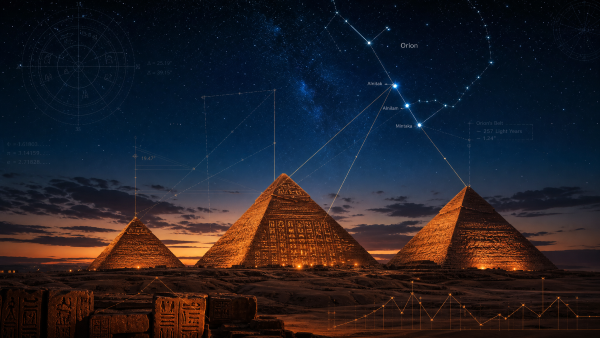
The Science of “Disclosure Day”: Why Information Theory Suggests Aliens Aren’t Actually Visiting…
A deep dive into why Spielberg’s new film might be wrong about our cosmic neighbors — and what current physics actually tells us.
The Science of “Disclosure Day”: Why Information Theory Suggests Aliens Aren’t Actually Visiting Earth
A deep dive into why Spielberg’s new film might be wrong about our cosmic neighbors — and what current physics actually tells us.
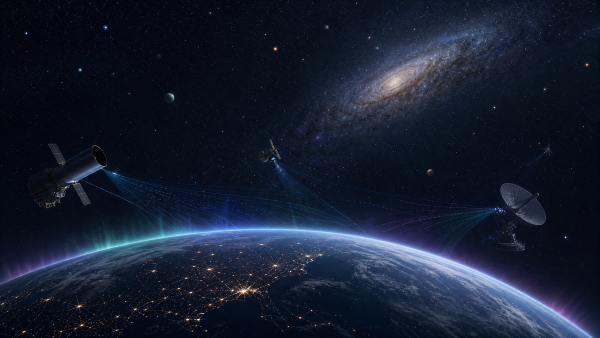
Aliens, the Fermi Paradox, and information theory: Earth glows in the dark while distant observer satellites and telescopes quietly collect data — suggesting advanced extraterrestrial civilizations may prefer remote sensing over visiting, a calmer counterpoint to Spielberg’s “Disclosure Day” style of dramatic contact.
With Steven Spielberg’s recent film “Disclosure Day” sparking fresh excitement about alien contact, conversations about extraterrestrials are once again everywhere.
It’s easy to see why.
The universe contains hundreds of billions of stars. Astronomers have discovered thousands of planets orbiting distant suns, and many scientists believe life could exist elsewhere in the cosmos. Given those staggering numbers, a natural question follows:
If intelligent civilizations exist, why haven’t we found convincing evidence that they’re here?
Popular answers usually fall into two camps. Believers point to UFO sightings, unexplained aerial phenomena, and the possibility of government secrecy. Skeptics counter that there is no verifiable evidence of alien spacecraft, alien technology, or extraterrestrial biology on Earth.
But there’s a lesser-known scientific perspective that rarely makes headlines. It doesn’t argue that aliens don’t exist. It doesn’t rely on conspiracy theories. And it doesn’t even depend primarily on the enormous distances between stars.
Instead, it asks a simpler question:
Why would an advanced civilization choose to visit Earth in person at all?
The answer may be far less dramatic than science fiction suggests.
We Assume Exploration Is the Natural Goal
Humans have a tendency to project our own motivations onto hypothetical alien civilizations.
Historically, exploration has been one of our defining traits. We crossed oceans, climbed mountains, and eventually sent probes beyond our solar system. It feels natural to assume that any advanced civilization would do the same on a much grander scale.
But history also reveals something else.
As technology advances, direct exploration often gives way to remote observation.
We no longer need to physically visit every corner of the planet to understand it. Satellites monitor weather patterns. Drones inspect dangerous environments. Telescopes study distant worlds without leaving Earth.
The better our technology becomes, the less we need to be physically present.
This trend may not be uniquely human.
It may be a universal consequence of efficiency.
Earth Is More Complicated Than We Realize
Imagine, for a moment, that an alien civilization successfully reaches Earth.
The hard part should be over, right?
Not necessarily.
Arriving is one thing. Understanding what you’ve arrived at is another.
Earth is extraordinarily complex.
More than eight billion people interact through thousands of cultures and languages. Millions of species occupy interconnected ecosystems. Climate systems, geological processes, biological evolution, economics, politics, and technology all operate simultaneously.
Every second, vast amounts of new information are generated.
To truly understand Earth would require analyzing an astonishing quantity of data.
And this brings us to a concept that physicists increasingly recognize as fundamental: information itself is a physical resource.
Information Has Limits
One of the most important insights in modern physics is that information isn’t free.
It must be collected, stored, transmitted, and processed.
These activities consume energy and are constrained by physical laws.
Concepts such as Landauer’s Principle and the Bekenstein Bound suggest that even highly advanced civilizations cannot process unlimited information. The universe imposes restrictions on computation and information storage.
That doesn’t mean advanced aliens would struggle to understand Earth.
Far from it.
But it does mean they would face the same fundamental challenge every intelligent species faces: deciding where to focus their attention.
The issue isn’t whether they could gather information.
The issue is whether gathering more information from Earth would justify the cost.
The Real Question Is Return on Investment
Here’s where many discussions about alien visitation miss an important point.
Information-processing costs exist whether a civilization studies Earth remotely or in person.
An alien society observing our planet from afar would still need to analyze enormous amounts of data.
Visiting Earth doesn’t eliminate that challenge.
It adds new ones.
Travel requires resources.
Maintaining a presence requires resources.
Operating equipment requires resources.
Managing risks requires resources.
If a civilization can answer most of its questions through advanced remote sensing, the value of a physical visit decreases dramatically.
Think of it this way.
Marine biologists don’t need to swim alongside every whale in the ocean to understand whale populations. They use satellites, tracking devices, underwater microphones, and statistical models.
Could they gather slightly better information through constant direct observation?
Perhaps.
But the improvement often isn’t worth the additional effort.
The same logic may apply on an interstellar scale.
Remote Observation May Be Surprisingly Powerful
Humans are already beginning to demonstrate this principle.
Using modern telescopes, scientists can analyze the atmospheres of planets dozens or even hundreds of light-years away.
Without ever visiting these worlds, researchers can estimate temperatures, identify atmospheric chemicals, and search for potential biosignatures.
That’s an astonishing achievement.
Now imagine a civilization that has had thousands, hundreds of thousands, or even millions of additional years to develop its technology.
Their observational capabilities could be beyond anything we currently imagine.
They might detect industrial pollution, artificial lighting, radio transmissions, or other indicators of intelligent life from vast distances.
If so, they could learn an extraordinary amount about Earth without ever needing to land here.
Earth May Not Be Unique
There’s another reason advanced civilizations might not prioritize visiting us.
We tend to view Earth as special because it’s our home.
From our perspective, it’s the most important planet in the universe.
But the universe doesn’t necessarily share our perspective.
The Milky Way alone contains hundreds of billions of stars. Current estimates suggest there may be billions of potentially habitable planets.
Even if intelligent life is rare, there could still be countless civilizations scattered throughout the galaxy.
An advanced society would face a problem familiar to every researcher: limited attention.
No matter how sophisticated they become, they cannot study everything equally.
Choices must be made.
Earth would be competing for attention against potentially millions of other interesting worlds.
When viewed through that lens, our planet may not be the obvious destination we imagine it to be.
The Fermi Paradox Looks Different
This idea offers a fresh perspective on the famous Fermi Paradox.
Physicist Enrico Fermi famously asked:
“Where is everybody?”
The paradox arises because the universe appears large enough and old enough that intelligent civilizations should have spread widely by now.
Yet we see no clear evidence of them.
Many proposed solutions focus on technological barriers, self-destruction, or the rarity of life.
But perhaps the answer is simpler.
Maybe most advanced civilizations discover that physically visiting other worlds is rarely the most efficient way to learn about them.
If so, the absence of alien visitors becomes less mysterious.
It’s not that they can’t come.
It’s that they often don’t need to.
What About UFOs?
This argument doesn’t explain every reported sighting.
Nor does it claim that every unidentified aerial phenomenon has a mundane explanation.
Some observations remain unexplained.
Scientists acknowledge that openly.
However, “unexplained” and “extraterrestrial” are not synonymous.
After decades of observations, investigations, satellite monitoring, radar tracking, and scientific scrutiny, we still lack unambiguous evidence that non-human civilizations are operating on Earth.
That’s a significant fact.
If advanced civilizations frequently visited inhabited planets, we might reasonably expect stronger evidence than we currently possess.
The continued absence of such evidence becomes easier to understand if visitation itself is uncommon.
A Different Way to Watch Disclosure Day
This is what makes Disclosure Day particularly interesting.
The movie explores one of humanity’s favorite possibilities: the revelation that extraterrestrials are already among us.
It’s a fantastic premise for storytelling because it places humanity at the center of a cosmic drama.
Science, however, often leads us toward less dramatic but more intriguing possibilities.
Perhaps intelligent life is abundant.
Perhaps advanced civilizations are common.
Perhaps some have known about Earth for centuries or even millennia.
And perhaps none of that implies they have ever set foot here.
The universe may be full of observers who prefer observation over participation.
The Humbling Possibility
The strongest scientific argument against aliens visiting Earth may not be that interstellar travel is impossible.
It may not even be that intelligent life is rare.
Instead, it may be that advanced civilizations, like all intelligent systems, must make choices about where to invest their resources, attention, and curiosity.
Earth is undoubtedly fascinating.
But in a galaxy that may contain billions of worlds, fascination alone may not justify a visit.
That’s a humbling thought.
Not because it suggests we’re alone.
But because it suggests we may not be the main characters in the universe.
And if that’s true, the silence we’ve observed for so long might not be evidence of emptiness at all.
It may simply be the sound of a crowded cosmos looking elsewhere.
메타데이터
- post_id
- 4df3605ea463
- slug
- the-science-of-disclosure-day-why-information-theory-suggests-aliens-arent-actually-visiting-4df3605ea463
- url
- https://medium.com/@omarvferro/the-science-of-disclosure-day-why-information-theory-suggests-aliens-arent-actually-visiting-4df3605ea463
- canonical_url
- https://medium.com/@omarvferro/the-science-of-disclosure-day-why-information-theory-suggests-aliens-arent-actually-visiting-4df3605ea463
- author_url
- https://medium.com/@omarvferro
- status
- ok
- fetched_at
- 2026-06-18 00:10:23