Georges Chahwan: The Marketing Director Rewriting the Rules of Omnichannel Strategy
Most marketing directors speak one language — figuratively and literally. They build campaigns around a single culture, one set of consumer…
Georges Chahwan: The Marketing Director Rewriting the Rules of Omnichannel Strategy
Most marketing directors speak one language — figuratively and literally. They build campaigns around a single culture, one set of consumer habits, and one digital playbook. Then they wonder why their results plateau.
Georges Chahwan doesn’t have that problem.
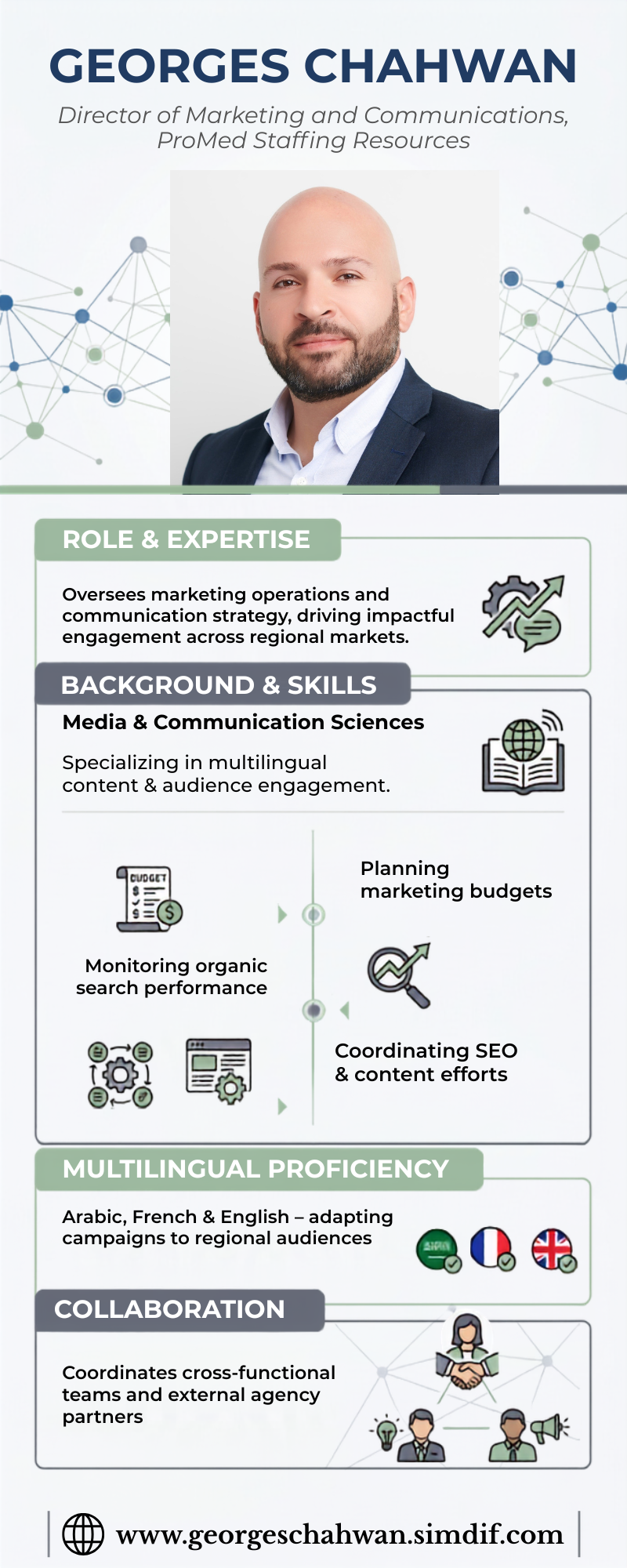
As Director of Marketing and Communications at ProMed Staffing Resources, Chahwan operates simultaneously across Arabic, French, and English-speaking markets — designing integrated strategies that don’t just translate words but translate intent, culture, and buyer psychology. That’s a rare skill set, and it’s reshaping what modern omnichannel marketing can actually achieve.
In this article, we unpack the principles behind Chahwan’s approach — and what every marketing leader can learn from them.
Why Omnichannel Marketing Is Harder Than It Looks
The Gap Between Strategy and Execution
Omnichannel marketing sounds simple on paper: show up consistently across every channel your audience uses. But in practice, most brands fail at the basics. They push the same message across email, social, search, and paid ads — and then call it integration.
Real omnichannel strategy means understanding how a customer in one channel thinks differently from the same customer in another. A prospect reading a LinkedIn article is in a different mindset than someone clicking a Google ad at 11pm. Messaging must shift accordingly.
What makes Georges Chahwan’s work distinctive is that he adds a third dimension most marketers ignore entirely: cultural context. When your audience speaks different languages, channel behavior shifts dramatically. A French-speaking professional and an Arabic-speaking one may use the same platform but respond to entirely different communication styles, formats, and tones.
The Cultural Fluency Advantage in Modern Marketing
Treating Audiences as Cultures, Not Segments
Most marketing teams segment audiences by age, income, or behavior. Chahwan segments by cultural lens — and that changes everything downstream.
Consider this: a staffing firm marketing to healthcare professionals across the Middle East, North Africa, and Francophone markets isn’t just dealing with language differences. It’s navigating distinct professional values, trust signals, content consumption habits, and decision-making hierarchies.
Chahwan’s background in media and communication sciences gave him a framework for this. Rather than building one campaign and translating it, his teams build market-native strategies — content that feels local because it was conceived locally, not retrofitted.
Here’s why that matters: audiences can sense inauthenticity. A translated tagline that doesn’t resonate with local idiom doesn’t just fail — it signals that the brand doesn’t truly understand the reader. Trust evaporates before the message lands.
How Data-Informed Leadership Drives Growth
The Analytics Layer That Most Directors Skip
Cultural fluency without analytical rigor is intuition. Analytical rigor without cultural fluency is noise. Chahwan’s edge is the combination of both.
Under his leadership, ProMed Staffing Resources has seen sustained growth in organic search performance — not by accident, but through deliberate keyword strategy mapped to market-specific search intent. A phrase that drives traffic in English may have no search volume in Arabic, but a culturally equivalent phrase might rank with far less competition.
This is multilingual SEO done correctly. It’s not translation — it’s keyword research rebuilt from scratch for each market, grounded in how native speakers actually search.
Turning Marketing Teams Into Performance Engines
Data-informed leadership also means building teams that interpret numbers, not just report them. Chahwan’s approach prioritizes marketing intelligence — using performance data to make faster, smarter decisions across campaigns.
In practice, that looks like weekly channel performance reviews tied directly to strategic adjustments, not quarterly retrospectives that come too late to change outcomes.
Brand Reputation in a Multilingual World
Why Consistency Looks Different Across Languages
Brand reputation is often discussed as if it were a single thing. In multilingual markets, it’s plural. Your brand has a reputation in each language community it touches — and those reputations can diverge if you’re not intentional.
Georges Chahwan addresses this by establishing unified brand values that express differently per market. The core identity — what ProMed stands for, the trust it builds, the expertise it offers — remains constant. But the voice, the examples, the proof points, and even the calls to action adapt to what resonates locally.
Think of it like a musician performing the same song in different venues. The melody is the same, but the arrangement shifts depending on the acoustics and the crowd.
Three Principles Any Marketing Leader Can Apply Today
You don’t need to operate across three languages to benefit from Chahwan’s playbook. These principles transfer directly:
• Build audience understanding before building content. Invest time in how your audience thinks before deciding what to say. Demographics tell you who they are; cultural and behavioral research tells you what they actually respond to.
• Let data inform, not dictate. Numbers reveal patterns — but it takes human judgment to understand why those patterns exist. Combine your analytics dashboard with qualitative insight for decisions that hold up over time.
• Design for channel mindset, not just channel presence. Each platform your audience uses has its own psychology. Match your content’s format, length, and tone to where it’s being consumed — not just to your brand guidelines.
Frequently Asked Questions
What is multilingual omnichannel marketing?
It’s the practice of delivering consistent brand experiences across multiple channels and multiple language markets simultaneously — adapting tone and content to each culture while maintaining a unified brand identity.
How does multilingual SEO differ from standard SEO?
Standard SEO targets search intent in one language. Multilingual SEO rebuilds keyword research from scratch for each language, accounting for how native speakers actually search — not just translated versions of English queries.
What does data-informed leadership mean in marketing?
It means using performance data to guide strategic decisions — without letting numbers replace human judgment. Data informs the direction; experience and cultural understanding determine the execution.
Final Thoughts
Georges Chahwan represents a new model of marketing leadership — one where cultural intelligence and analytical rigor aren’t separate skill sets, but one integrated capability.
In a world where audiences are more fragmented, more culturally aware, and more resistant to generic messaging than ever before, that combination is genuinely transformative. The brands winning in multilingual markets aren’t the ones with the biggest budgets — they’re the ones with the deepest understanding of who they’re talking to.
Key takeaways from Chahwan’s approach:
• Cultural fluency is a competitive advantage, not a soft skill.
• Multilingual SEO requires market-native keyword strategy, not translation.
• Omnichannel success demands channel-specific mindset, not just channel presence.
• Data informs — but human judgment and cultural insight drive results.
• Brand reputation is plural in multilingual markets — manage each with intention.
The real question for any marketing leader reading this: are you building campaigns for audiences — or for cultures? The answer to that question determines how far your strategy can actually scale.
메타데이터
- post_id
- 4df805c643ca
- slug
- georges-chahwan-the-marketing-director-rewriting-the-rules-of-omnichannel-strategy-4df805c643ca
- url
- https://medium.com/@georgeschahwanusa/georges-chahwan-the-marketing-director-rewriting-the-rules-of-omnichannel-strategy-4df805c643ca
- canonical_url
- https://medium.com/@georgeschahwanusa/georges-chahwan-the-marketing-director-rewriting-the-rules-of-omnichannel-strategy-4df805c643ca
- author_url
- https://medium.com/@georgeschahwanusa
- status
- ok
- fetched_at
- 2026-07-30 09:18:59