ECRI’s 2026 AI Warning Moves the Demo Into the ICU
Dräger’s 64-patient alarm view and FDA’s 2026 CDS guidance show why buyers must test judgment under pressure, not visual polish.
Alarm Proof Gates
ECRI’s 2026 AI Warning Moves the Demo Into the ICU
Dräger’s 64-patient alarm view and FDA’s 2026 CDS guidance show why buyers must test judgment under pressure, not visual polish.
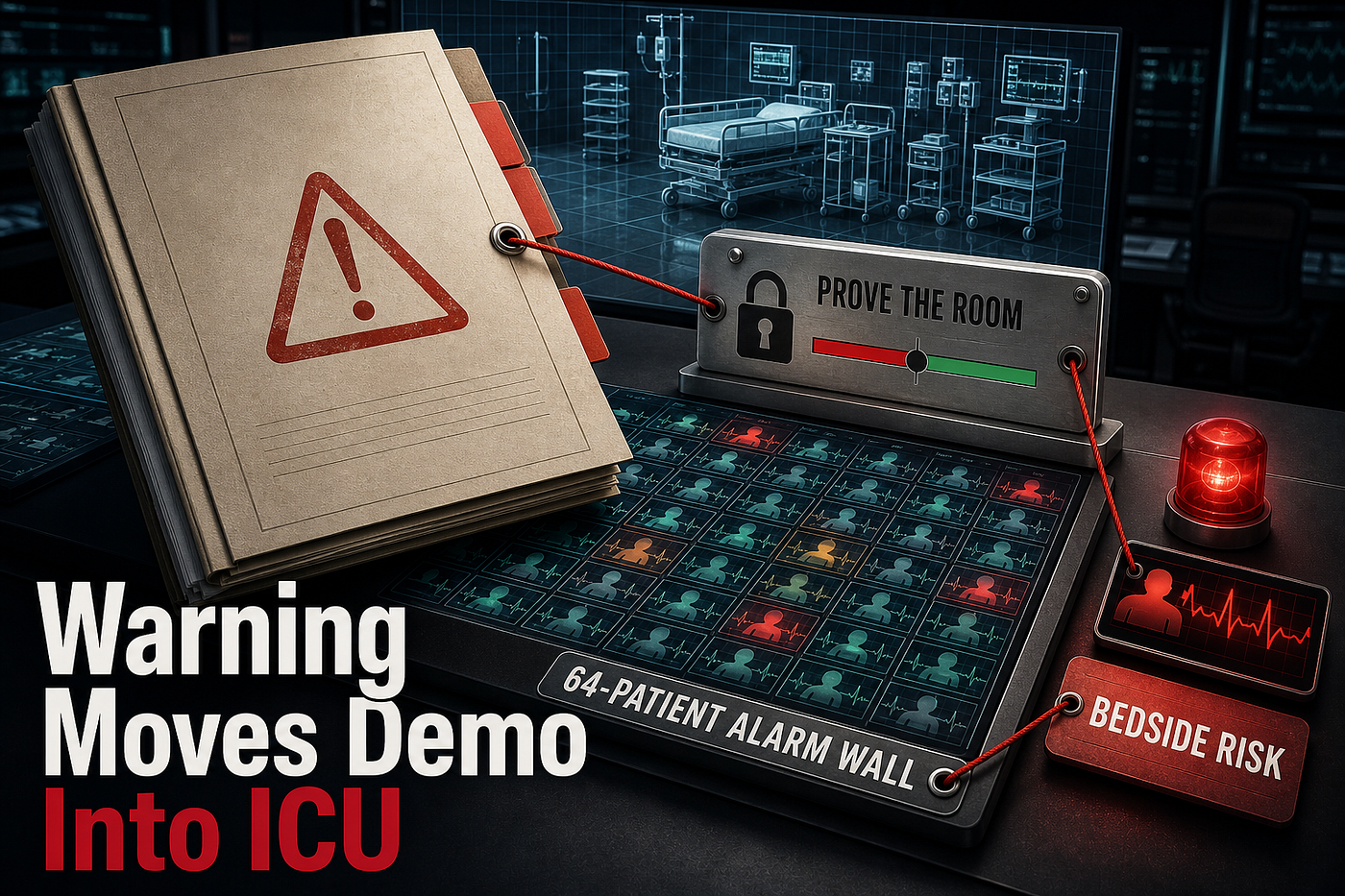
ECRI’s 2026 AI Warning Moves the Demo Into the ICU: Dräger’s 64-patient alarm view and FDA’s 2026 CDS guidance show why buyers must test judgment under pressure, not visual polish. Image created by the author with diffusion-synthesis and Python post-processing.
ECRI’s 2026 patient-safety warning should sit beside the central monitor, where the alarms blink and the handoff is already half underway. Approve the wrong clinical AI pilot in that room, and liability can slide from the committee table to the nurse deciding whether a flashing screen is signal or noise.
The evidence is compact: ECRI’s March 9, 2026 warning about dependence on AI diagnosis, Dräger Infinity CentralStation Wide watching up to 32 monitored patients and 64 patients under alarm surveillance, and the polished promise of Unreal-style clinical simulation. Together, they change the buyer’s test. Not whether the model looks impressive.
Not whether the demo feels cinematic. Not whether the dashboard wins the room. The real test is whether a clinician can still stay in command when the unit gets loud.
The bedside does not clap for cinematic lighting.
For health-tech founders, clinical AI product leads, and hospital innovation buyers, that is the line: a beautiful demo can win the committee room and still fail the room that matters.
The Demo Is Not The Test
A clinical AI pilot has two audiences. One audience wants confidence: the founder, the sponsor, the innovation buyer, the board member who wants the hospital to stop looking slow. The other audience has to absorb the risk: the physician, nurse, respiratory therapist, or technician standing near the monitor when a recommendation competes with alarms, family questions, and a shift-change handoff.
Those incentives are not equal. The seller wins when the tool looks inevitable. The hospital buyer wins when the tool looks governed.
The clinician loses when “assistive” becomes a soft command with no clear basis, no protected override, and no audit trail that survives Monday morning.
That is why the FDA’s January 2026 Clinical Decision Support Software guidance matters. FDA’s non-device CDS line depends on the health professional being able to independently review the basis for a recommendation and avoid relying mainly on the software output. Strip that down to plain English: if the tool cannot show why it is nudging a clinical decision, it is not merely helpful.
It is asking for borrowed authority.
The buyer burden rises again when the product touches signals, images, or repeated patterns from acquisition systems. FDA’s guidance treats those inputs differently because the software is no longer just displaying clinical information. It is interpreting the machinery of the body.

Figure 2. Proof of source-backed strategy: The cited source, FDA’s January 2026 Clinical Decision Support Software guidance, gives the article a primary source readers can inspect. Source: FDA
That is the first gate for any AI or VR-enabled clinical demo: make the basis visible under pressure. Not in the investor deck. Not in the rehearsed workflow.
On the screen where the clinician has to decide.
Alarm Load Exposes The Hidden Command
Alarm-heavy rooms are where polite product language goes to lose its manners. A dashboard says “recommendation.” A nurse hears another demand.
AHRQ PSNet’s alert fatigue primer, last reviewed in 2024, points to a 2014 study in which physiologic monitors across 66 adult ICU beds generated more than 2 million alerts in one month. That worked out to 187 warnings per patient per day. That number should make every AI pilot committee sit up straighter.
It is not a background detail. It is the operating environment.
Now place Dräger’s 64-patient alarm-surveillance frame next to that evidence. The central station is useful because it concentrates visibility. The same concentration also creates a dangerous social force.
When a central monitor, an AI layer, and a clinical workflow all point in one direction, “support” can become the path of least resistance.
That is the hidden mechanism. Humans do not need to be lazy for automation bias to bite. They need to be busy, accountable, and surrounded by systems that punish the wrong miss more visibly than the wrong overreaction.
A founder can optimize for sensitivity because missed detections look catastrophic in a sales meeting. A hospital can favor escalation because nobody wants to explain why an alert was suppressed. A clinician then gets squeezed between false positives, policy fear, and bedside reality.

Figure 3. Proof of source-backed strategy: The cited source, alert fatigue primer, gives the article a primary source readers can inspect. Source: Ahrq
Judgment dies by queue pressure.
The pilot has to show what happens when the AI is wrong during alarm load. Who sees the error? How fast can the clinician reject it?
Does the override require a paragraph, a password, a second witness, or a quiet act of courage? Does the next shift see the reasoning, or only the machine’s final answer?
If the demo cannot answer those questions, the buyer is not approving safety. The buyer is approving a beautiful way to move risk downstream.
Simulation Has To Prove Handoffs
Unreal Engine-style simulation has a real place here. Visual realism can help teams rehearse rooms, devices, timing, motion, and stress. The mistake is treating realism as proof.
Healthcare simulation has known this for years. The 3DiTeams project, developed by Duke University Medical Center and Virtual Heroes in 2007 using Unreal Engine 2, was not only a visual hospital scene. It included team roles, patient assessment, telephone handoff, and after-action review.
The old lesson still bites: the point of simulation is not the room. It is the coordination failure the room reveals.
A VR hospital demo that shows a perfect response path is a commercial asset. A simulation that breaks the handoff is a safety asset.
That difference matters because the best-looking clinical AI systems are built to reduce friction. They summarize. They rank.
They highlight. They compress the messy patient into a cleaner decision surface. Every one of those moves can help a clinician.

Figure 4. Proof of source-backed strategy: The cited source, Wiki 3DiTeams, gives the article a primary source readers can inspect. Source: Wikimedia Commons
Every one can also hide the uncertainty a clinician needs to see before taking responsibility.
The simulation test should force ugly conditions. Run the tool through a shift change. Add a noisy alarm cluster.
Remove one piece of context. Put the recommendation in front of a clinician who has competing tasks and a patient family asking a direct question. Then watch whether the tool preserves authority or quietly steals it.
The FDA’s August 2025 guidance on predetermined change control plans adds another pressure point. AI-enabled device changes need planned modifications, validation methods, and impact assessment. Buyers should steal that discipline even when a pilot sits outside a formal submission path.
The operating question is the same: what changes, who validates it, and how does the bedside know?
A demo can show potential. A handoff test shows liability.
The Rollout Gate Belongs At The Bedside
FDA’s AI-enabled medical devices list shows the market moving through real authorization pathways, with 2026 final-decision entries across clinical categories. That does not make every hospital AI pilot mature. It means buyers have fewer excuses for treating clinical AI as a clever side project.
The practical decision gate is short enough to use before the next pilot meeting.
- The pilot must prove performance during realistic alarm load, not only on clean retrospective cases.

Figure 5. Proof of source-backed strategy: The cited source, FDA’s August 2025 guidance on predetermined change control plans, gives the article a primary source readers can inspect. Source: FDA
-
The interface must show the recommendation’s basis fast enough for independent clinical review.
-
The workflow must protect override without social punishment, buried menus, or silent blame transfer.
-
The audit trail must capture escalation, rejection, handoff, and model uncertainty in language the next clinician can use.
Those four gates separate a persuasive pilot from a bedside liability. They also change the founder’s product roadmap. Accuracy still matters.
Visual realism still matters. But the sale becomes stronger when the product can show how clinicians remain the authority when the tool is confident, wrong, or incomplete.
That is the end-state test. Scale a weak AI pilot across units, add alarms, add staff turnover, add throughput pressure, and the phrase “clinician in the loop” can become theater. Scale a strong one, and the loop has teeth: visible basis, protected refusal, clean handoff, and reviewable evidence.
The buyer does not need to hate innovation. The buyer needs to stop rewarding demos that perform only in the room where nobody can be harmed.
Return to the central monitor. Sixty-four surveillance slots are not just a product capability. They are a reminder that clinical authority is exercised under load, often by people who do not get a second take.
If a pilot cannot preserve judgment under alarm load, handoffs, and bedside pressure, reject the rollout and thank the clinicians who kept the risk from reaching the bed.
If you’re carrying this work right now, thank you for reading and for doing the careful work most people never see.

Figure 6. Proof of source-backed strategy: The cited source, AI-enabled medical devices list, gives the article a primary source readers can inspect. Source: FDA
Related reading
메타데이터
- post_id
- 4dfa1c5ba529
- slug
- ecris-2026-ai-warning-moves-the-demo-into-the-icu-4dfa1c5ba529
- url
- https://medium.com/kairi-ai/ecris-2026-ai-warning-moves-the-demo-into-the-icu-4dfa1c5ba529
- canonical_url
- https://medium.com/kairi-ai/ecris-2026-ai-warning-moves-the-demo-into-the-icu-4dfa1c5ba529
- author_url
- https://medium.com/@james.kuhman
- status
- ok
- fetched_at
- 2026-07-17 15:23:30