Design-time orchestration in Kubernetes: why architecture must be constrained before YAML
Kubernetes provides powerful primitives, but it deliberately avoids enforcing architectural intent. This design choice gives flexibility…
Design-time orchestration in Kubernetes: why architecture must be constrained before YAML
Kubernetes provides powerful primitives, but it deliberately avoids enforcing architectural intent. This design choice gives flexibility, but it also introduces a structural problem:
Kubernetes validates objects, not architectures.
As a result, many production issues originate not from invalid manifests, but from architecturally incoherent configurations that are syntactically correct.
This article explores why this happens and how design-time orchestration, as implemented in Izykube, addresses a gap that runtime tooling cannot fully cover.
The architectural blind spot in Kubernetes
Kubernetes validates resources independently:
- a
Serviceis valid on its own - a
Deploymentis valid on its own - an
Ingressis valid on its own
However, the correctness of their relationships is implicit, not enforced.
Examples of architecturally invalid but Kubernetes-valid states include:
- a Service exposing workloads without an explicit architectural owner
- an Ingress referencing Services that were never meant to be public
- Secrets shared across unrelated workloads due to convenience
- orphaned resources whose original intent is no longer known
From Kubernetes’ point of view, these states are acceptable. From a system architecture perspective, they are latent risks.
Why YAML cannot encode architectural intent
YAML is a configuration serialization format. It has no native concept of:
- ownership
- intent
- architectural constraints
- semantic relationships beyond labels and selectors
While labels and annotations are often used to encode intent, they are:
- optional
- informal
- unenforced
- easy to drift over time
As systems grow and teams change, the original architectural reasoning becomes progressively harder to reconstruct from manifests alone.
Deploy-time validation is necessary but insufficient
The Kubernetes ecosystem provides strong deploy-time controls:
- schema validation and linters
- admission controllers
- policy engines (OPA, Kyverno)
- runtime security and observability
These tools are essential, but they operate after architectural decisions have already been made.
They answer questions like:
- “Is this allowed?”
- “Does this violate a policy?”
They do not answer:
- “Does this architecture make sense?”
- “Is this relationship intentional or accidental?”
At that point, the system already exists.
Design-time orchestration as a missing layer
Design-time orchestration addresses a different problem:
preventing invalid architectures from being expressible at all
This is not about blocking deployments. It is about constraining design choices before implementation begins.
In this model:
- architecture is a first-class artifact
- YAML is a derived output
- relationships are explicit and enforced
How Izykube models Kubernetes architecture
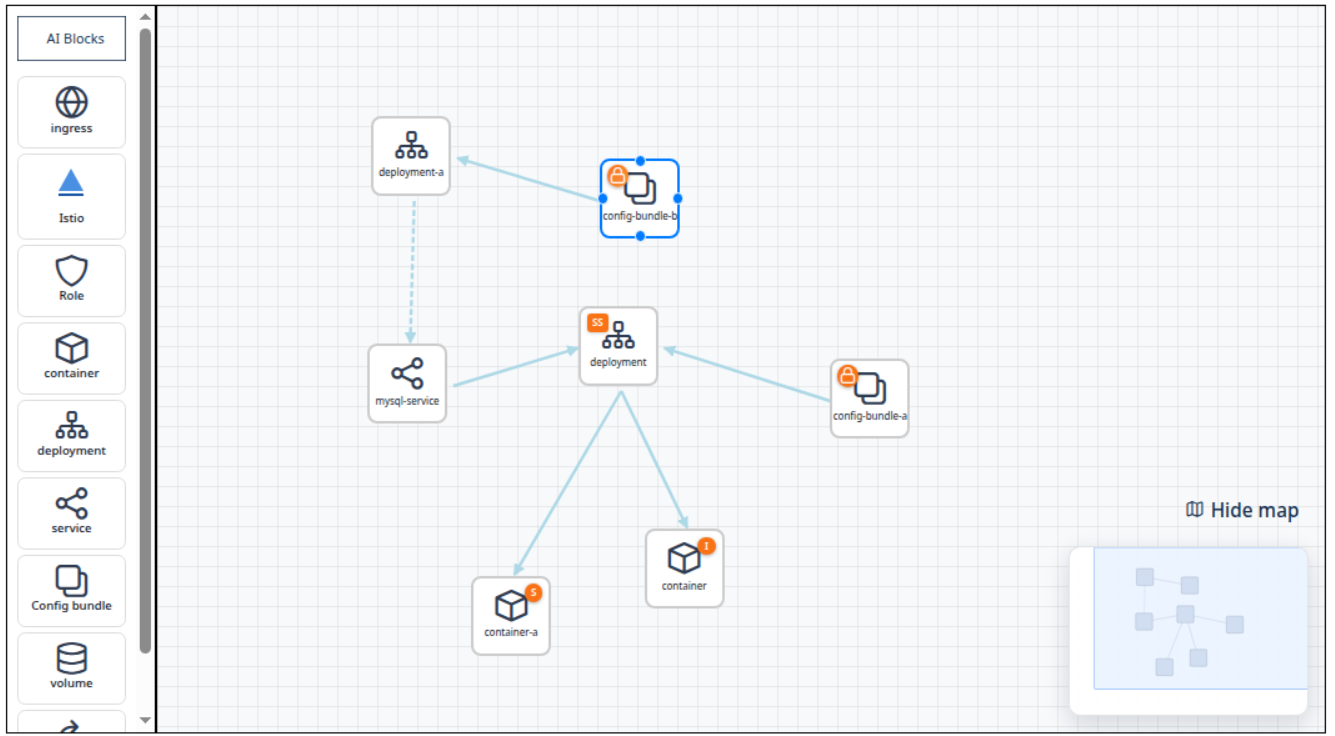
Izykube Graphical Dashboard
Izykube approaches Kubernetes design as a constrained graph of resources.
Each Kubernetes primitive (Deployment, Service, Ingress, ConfigMap, Secret, etc.) is represented as a node with:
- a defined role
- allowed connections
- enforced constraints
Relationships between nodes are explicit, not inferred.
Examples:
- a Service must be connected to a specific workload it exposes
- an Ingress can only reference Services explicitly marked as public
- Secrets and ConfigMaps have explicit ownership and scope
- resources without a valid architectural role cannot exist
If a relationship does not make sense architecturally, it cannot be modeled.
YAML as a generated artifact, not a design surface
In Izykube, YAML is generated after the architecture has been validated.
This inversion has important consequences:
- architectural intent is explicit before implementation
- reviews focus on design, not manifests
- generated YAML is consistent by construction
- accidental exposure or misconfiguration becomes harder
The goal is not abstraction, but intent preservation.
Architectural drift and human factors
Many Kubernetes risks are not caused by lack of knowledge, but by:
- time pressure
- incremental changes
- team turnover
- emergency fixes that become permanent
Design-time orchestration reduces reliance on tribal knowledge by embedding constraints directly into the design model.
This is particularly relevant for:
- platform teams
- public-sector environments
- regulated systems
- multi-team clusters
Design-time vs runtime: complementary layers
Design-time orchestration is not a replacement for runtime security, policy enforcement, or observability.
It addresses a different phase of the lifecycle:
PhaseFocusDesign-timeArchitectural correctnessDeploy-timePolicy complianceRuntimeBehavior and detection
Removing architectural ambiguity early simplifies everything downstream.
Closing considerations
Kubernetes does not fail because engineers write bad YAML. It fails because architectural decisions are invisible and unenforced.
Making architecture explicit, constrained, and reviewable before YAML exists is a pragmatic way to reduce risk without adding runtime complexity.
Design-time orchestration is not a new runtime tool. It is a missing layer in how Kubernetes systems are designed.
Author note
Giuseppe Cassata — Software Architect working on cloud-native platforms, Kubernetes, and security-aware system design.
메타데이터
- post_id
- 4e003a5b72ee
- slug
- design-time-orchestration-in-kubernetes-why-architecture-must-be-constrained-before-yaml-4e003a5b72ee
- url
- https://medium.com/@giuseppe.cassata74/design-time-orchestration-in-kubernetes-why-architecture-must-be-constrained-before-yaml-4e003a5b72ee
- canonical_url
- https://medium.com/@giuseppe.cassata74/design-time-orchestration-in-kubernetes-why-architecture-must-be-constrained-before-yaml-4e003a5b72ee
- author_url
- https://medium.com/@giuseppe.cassata74
- status
- ok
- fetched_at
- 2026-06-23 03:48:11




