36 Years of the Pale Blue Dot: When Earth Became a Speck in the Cosmos
14th February 1990. Just another normal day in the calendar, a day that may not have seemed all that special to anyone back then. No loud…
36 Years of the Pale Blue Dot: When Earth Became a Speck in the Cosmos
14th February 1990. Just another normal day in the calendar, a day that may not have seemed all that special to anyone back then. No loud announcements, no global celebrations. But somewhere far away in the vast darkness of space, a photograph was taken which would slowly but surely become a part of the collective memory of humanity. A photograph that wasn’t just a record of science, but an emotional reminder that what we consider as our vast world, is nothing but just a tiny blue speck on the scale of the universe. It was on this day, 36 years ago, that we got our first glimpse of home from a distance which made all its details disappear, all its boundaries invisible, and all that was left was only a faint glow. Maybe that’s why this day has become not only a part of history but also a moment of reflection for humanity. Every time we look at that picture, we see not just our home… but our memories, our civilizations, our stories and our duties all packed into one small dot — “The Pale Blue Dot”.
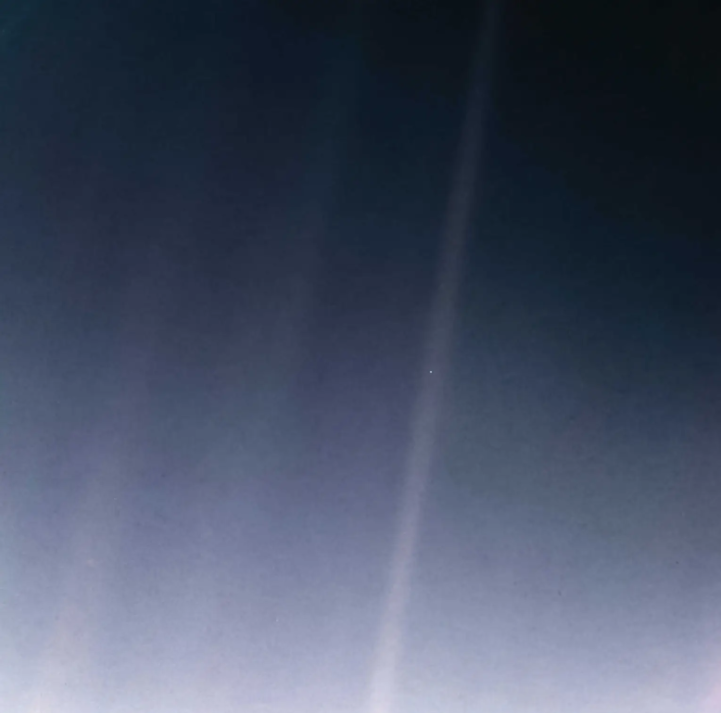
The Pale Blue Dot, photograph taken on 14th February,1990 by Voyager 1
Voyager 1 was launched by NASA on 5th September, 1977 as part of the Voyager programme. Armed with the famous Golden record, Voyager 1 set out on its voyage to explore the outer solar system as well as interstellar space i.e. the region beyond the Sun’s heliosphere. The probe made a flyby of Jupiter and Saturn. It was also used to study Titan, Saturn’s largest moon, to understand Titan’s substantial atmosphere. As the spacecraft was leaving the solar system, it was turned to take one last look at its “planet of origin”. The probe took a series of 60 photographs which were combined to form an image of the entire solar system, although some planets are not visible in the photograph due to the Sun’s glare. The Earth is only 0.12 pixels in size, described by Carl Sagan as “a mote of dust suspended in a sunbeam”.
Voyager 1 entered interstellar space on 25th August, 2012. It continues on its voyage, thus living up to its name. While it is hoped that the probe will find new worlds, Voyager 1 has left us a glimpse of our own legacy of 4.54 billion years.
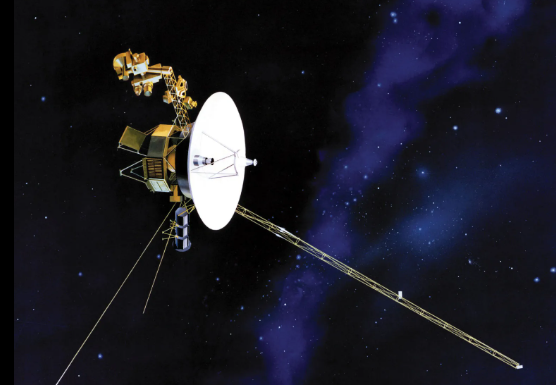
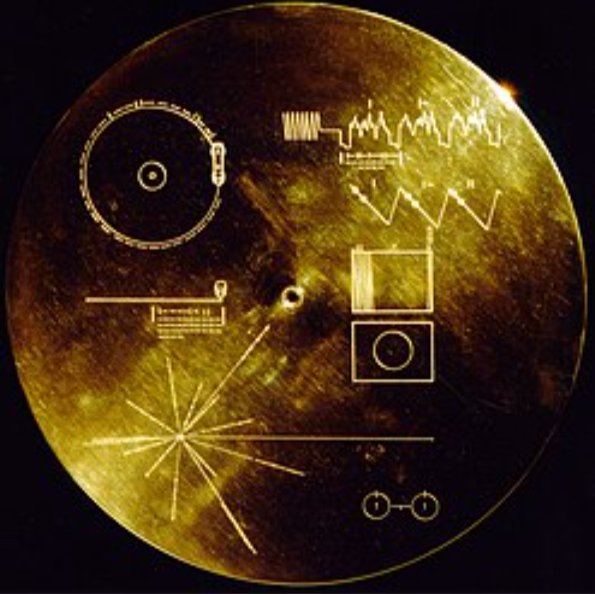
a) Voyager 1; b)The Golden Record
That the photos were clicked using a narrow-angle camera which was, in fact, a Cassegrain telescope, slowly scanned using a vidicon tube to store a black and white image, colorised using three different color filters and finally all the photos were processed together to form one single final image is itself a technological feat. And technological feats usually boost our self-imagined superiority! But no, this photo does not do that. Merely looking at the photograph is a humbling experience. Astronomy is a beautiful discipline. Yes, yes, because the stars and other celestial bodies are beautiful to look at, but also because it helps us realise the vanity of our ego and desires!
From ground level, we can look up to the sky, look at the tall mountains, as well as the skyscrapers we have built, and get the impression that the Earth is huge! Or on a more relatable level, that the property we own is huge! Since times immemorial, some ruler or the other keeps getting the impression that a certain piece of land is huge, and conquering it would bring him wealth and happiness! And these rulers would not hesitate to kill innocent fellows of the same species as themselves to conquer this piece of land! But no! Look at that dot again! All the land that you can ever wish to have is limited to that dot. And, at least for now, there is no way you can own anything beyond it! Everything i.e. other planets, dwarf planets, comets, meteors, the Sun, other stars, as well as the void, belongs to Nature, not to us! Then why do we cling to our self-imagined importance, if we can clearly see that we are nothing but a tiny speck when compared to the Universe? Or, if I were allowed to introduce some Mathematical jargon, if our size “tends to zero” when compared to the size of the Solar system, why is our impertinence while exploiting the natural resources of our planet “unbounded”?
In fact, it is important to realise that we don’t own anything even on our own planet Earth! No, we don’t own that piece of land, that river, that hill or that plateau! Rather we should consider that we are owned by them. For they have sustained our forefathers, are sustaining us, and will sustain our future generations. The planet has seen us evolve from a bunch of molecules to simple cells, from cells to small organisms, then to bigger and more complex life forms, and finally, from apes to homo sapiens. Every person who has ever lived, lived on this planet. Every hunter, every gatherer, every blacksmith, every mason, every chef, every painter, every warrior, ruler, businessman, teacher, father and mother, every engineer, doctor, researcher, scientist, social activist, lived on this planet. Every stroke of genius that is known to have changed the world, occurred on THIS world!
The Earth provides and nourishes us, but not only us! The planet is home to millions of species. Exploiting natural resources without thinking about other species is not only selfish, but also cruel! It is not only a saying, but a duty to live and let live. If Nature has provided life forms homes in the jungles, the rivers, the seas or the snow-laden mountains, it is our duty to ensure that our developmental activities don’t destroy their homes. It is our duty to ensure that other species do not become extinct because of our activities!
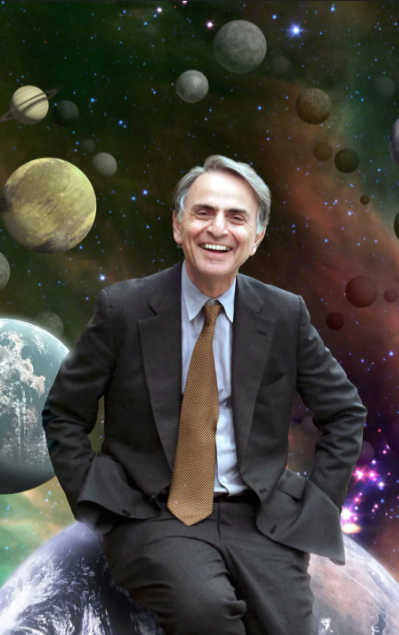
Carl Sagan, the writer of the 1994 book Pale Blue Dot. He described the image as “a mote of dust suspended in a sunbeam”. He was a scientist in the Voyager 1 mission. He worked on the Golden Record as well as gave the idea of clicking the picture.
Sometimes, it feels like we’re constantly chasing after such big things; achievements, fame, places, possessions… and then a single photograph quietly reminds us that the entire story of our lives is written on just a tiny blue dot. Maybe that is why this picture is not just a space picture. It becomes something much more personal to make us understand that no matter how far we’ve gone, no matter how much progress we’ve made, at the end, we are all tied back to that one dot. That’s the dot where we all started. In the midst of endless space, that pale blue light is not just a planet, “That’s here, that’s home, that’s us…”
Saanvi Dubey(MNC’25)
메타데이터
- post_id
- 4e009db386ba
- slug
- 36-years-of-the-pale-blue-dot-when-earth-became-a-speck-in-the-cosmos-4e009db386ba
- url
- https://medium.com/@researchcell.iitbhu/36-years-of-the-pale-blue-dot-when-earth-became-a-speck-in-the-cosmos-4e009db386ba
- canonical_url
- https://medium.com/@researchcell.iitbhu/36-years-of-the-pale-blue-dot-when-earth-became-a-speck-in-the-cosmos-4e009db386ba
- author_url
- https://medium.com/@researchcell.iitbhu
- status
- ok
- fetched_at
- 2026-07-20 00:00:04