Robert Harris’s Fatherland Explores Fascism as Normal
Some of us probably wouldn’t mind living in big beautiful Germania
Virtual Nazi Reality
Robert Harris’s Fatherland Explores Fascism as Normal
Some of us probably wouldn’t mind living in big beautiful Germania
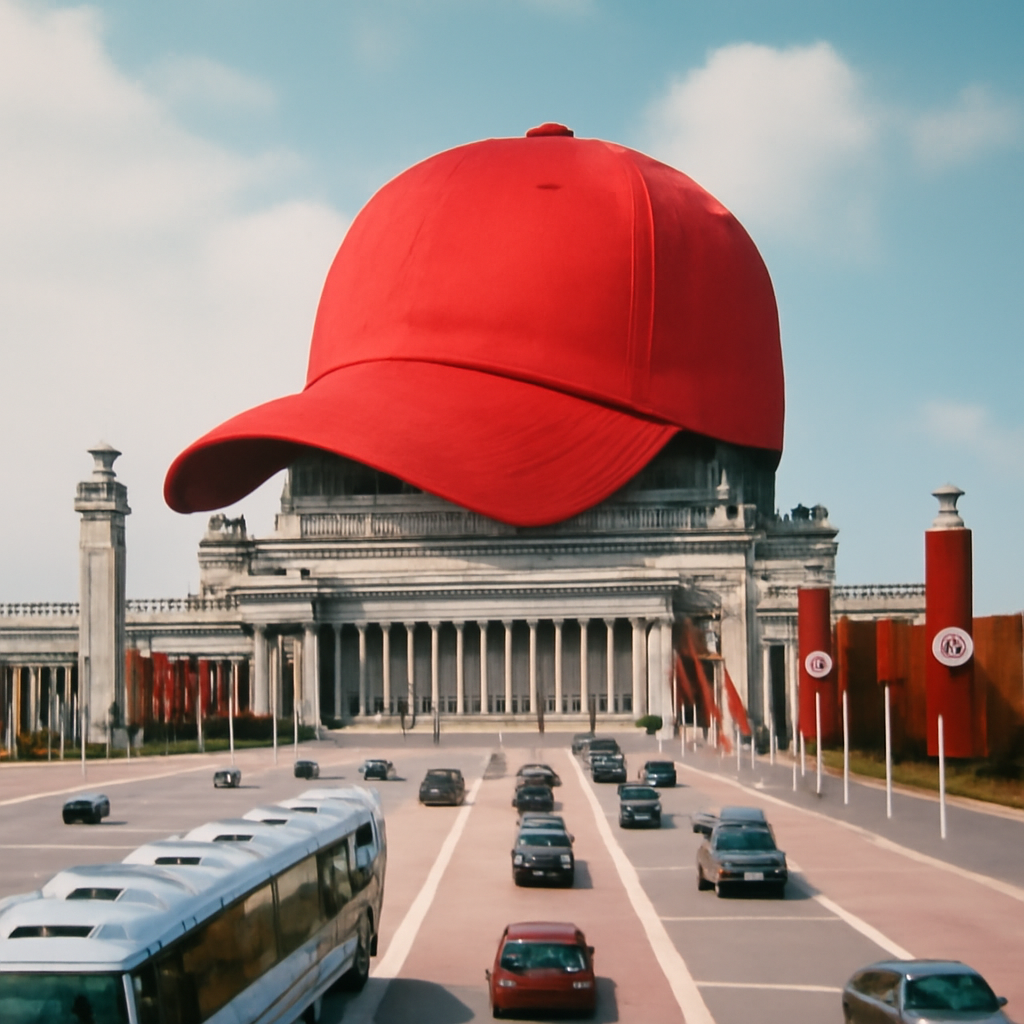
Trumpania? Someone keep Albert Speer’s plans away from him. (Image by DeepAI and author)
In the late 1930s, the Fuhrer had his favorite architect and minister of armaments, Albert Speer, draw up plans that would turn Berlin into something like the Caesars’ Rome with modern conveniences. The new megalopolis would be called Germania and become the capital of a nazified Europe. The doomed Nazi war effort eventually forced resources away from Germania — thank you, General Eisenhower — and Speer’s drawings were never realized.
Hitler and Speer’s plans can be still viewed, and you can nauseate over their atrocious and garish tastes. Everything is designed on a super-sized scale to make humans feel small, and Herr Fuhrer and his goons appear as übermensch. At the center of his concrete and granite-clad building plans was the Volkshalle or People’s Hall, a dome of ridiculous proportions. It was designed with a 700-foot diameter base, and topped at its 1000-foot apex by a giant eagle clutching a globe.
This great dome was based on Rome’s Pantheon, which Hitler admired, and would also dwarf in size St. Peters’ large and magnificent basilica. Hitler’s ego would have nothing less, and he had crazed dreams the Hall would become a pilgrimage spot in the future. And probably with a gift shoppe off the side.
It’s hard to imagine this future, but Robert Harris’s *Fatherland, published in 1992, is worth a read just to see what this timeline might look and feel like. You may know Harris from Conclave*, last year’s surprise hit movie which was based on his 2016 novel on the political scheming of cardinals after the death of a pope — worth streaming and a solid if understated performance by Ralph Fiennes.
In his alternate history, the Allies’ Normandy invasion fails and the Nazis are able to defeat the Soviets at Stalingrad.
As in our timeline, the US developed an atomic bomb, using it against the Japanese and ending the Pacific war. But in Harris’s novel, the Nazis also have their own bomb, which they threaten to use against America via V2 rockets.
Roosevelt is eventually forced to sign a peace treaty in 1946 with Germany while the battered Soviets continue to fight a guerrilla war further east. Europe forms a kind of EU but under the thumb of the Germans. And eastern Europe no longer exists, absorbed into the greater German state.
When the novel opens, it’s 1964, and relations are beginning to thaw between the two remaining superpowers.
Our hero in Fatherland is Xavier March, a former U-boat commander and now a captain in the Berlin police force. He’s put in charge of investigating a murder of a high-level Nazi official. The novel takes off when March begins to uncover a wartime plot to hide … what really happened to the missing German Jews.
Spoiler alert: In Fatherland, Herr Fuhrer has kept the Holocaust a secret from the Germans and the rest of the world.
Germany is just another superpower like the US. Its post-war era sees veterans also return to civilian life to start families and enjoy the new prosperity — BMW cars, jet travel, French champagne, and other Euro consumer comforts. It’s all very creepy and expertly realized by Harris.
The brilliance of Fatherland is in depicting how citizens of this alternate Germany accept life under a dictatorship as if it were all normal. By the way, Hitler is still alive, loved, and has become a kind of grandfatherly presence over the German volk.
Unlike a Soviet-style dictatorship, the Germans have free enterprise, and brands like Siemens, Mercedes Benz, and Bayer trade on their stock exchange. Harris’s victorious Germany seems to be structured more like a super-capitalist state with a merging of private industry and the government. Corruption and bribery are rampant.
Joe Kennedy is the US President; Herr Hitler an admired political leader, and Reinhard Heydrich, head of the Nazi equivalent of the CIA and FBI. This is what history buffs call a horror story.
However, there is always the presence of the SS and its agents. Although March is a respected high-ranking officer, even he is in fear of Heydrich’s secret police, charged with protecting the state from internal threats and terrorists — Poles and Ukrainians still pissed off their countries were effectively erased.
For a history refresher, that would be Herr Reinhard Heydrich, head of the Nazi Gestapo, the butcher of Prague, and the man Hitler said “had an iron heart”. He was assassinated by Czech partisans in 1941. In Fatherland, though, Heydrich survives the assassination and the war, and eventually becomes head of all state security forces after his rival and SS head, Heinrich Himmler, died in a mysterious plane crash in the early 1960s
Back in the US, New Dealer and noted antisemite Joseph Kennedy, John’s maniac father, is now President of the United States!
But Harris makes all this seem like just another ho-hum day in the life, which is part of the brilliance of the novel.
The other brilliant aspect is the slow realization by Xavier March — officially, Sturmbannfuhrer March — that something is not quite right in the state of Germany.
He grew up in the pre-Hitler era and remains uncomfortable that school children now say a kind of Nazi grace before meals starting with the words “Fuhrer, my Fuhrer, bequeathed to me by the Lord.” Even his own young son Pili is ashamed that March doesn’t ‘Heil Hitler’ enough.
It’s on a trip to neutral Switzerland to inquire about a mysterious wartime Zurich bank account that March finally understands his nightmarish life in Berlin. In plain clothes, March fits in with the other Swiss, and is stunned to see they enjoy life without Hitler overseeing them, and are free to say whatever they wish.
Zurich is human sized and pretty, the complete anti-particle to Germania. March finally realizes he doesn’t feel oppressed by the streetscape. He likes it here!
He also meets an American journalist who is the complete opposite of all the German women he has ever known — independent, curious, and knowledgeable of history that was kept from Germans by the censoring authorities.
It’s a depressing but ultimately rewarding reader experience to watch March, a semi-loyal Nazi, realize he’s been lied to and living in an uncivilized hellhole led by gangsters in fancy suits and black SS uniforms.
We’re not at the point of one party rule and a secret police. But with the Trump Justice Department looking to investigate elections and ICE given a larger budget than the FBI, we’re goose-stepping closer every day.
I’ve been around long enough to know that even in the liberalish community where I live, many would have no problem with one-party rule, loss of freedoms, and occasional disappearance of friends and workers. That is, as long as they can keep making money and go on fancy vacations.
While there’s a lot of Nazi thinking in the MAGA world, there’s just enough in the liberal world to make me wonder about myself.
메타데이터
- post_id
- 4e026366f0f0
- slug
- robert-harriss-fartherland-explores-fascism-as-normal-4e026366f0f0
- url
- https://medium.com/@agreenjay/robert-harriss-fartherland-explores-fascism-as-normal-4e026366f0f0
- canonical_url
- https://medium.com/@agreenjay/robert-harriss-fartherland-explores-fascism-as-normal-4e026366f0f0
- author_url
- https://medium.com/@agreenjay
- status
- ok
- fetched_at
- 2026-06-21 15:33:18