10 Questions About Reality
Q&A about time, space, gravity, and the nature of existence
Photo by Laurin Steffens on Unsplash
10 Questions About Reality
Q&A about time, space, gravity, and the nature of existence
There once was a children’s book called Tell Me Why.
Written by playwright Arkady Leokum and first published in 1958, it spanned the decades and found its way into the hands of kids like me growing up in the 1970s.
It was packed with simple answers to difficult questions. Questions like: why is the sky blue? Why do magnets attract? Why do things fall?

Tell Me Why, by Arkady Leokum
For many young kids at the time, including me, it was our first experience of the feeling that reality could be understood.
This article follows in the same spirit.
Using the Phase Manifold Model (PMM), we will attempt to answer ten of the oldest questions humans ask about reality:
- What is time?
- What is space?
- What is gravity?
- Why does gravity attract?
- Why does time move forward?
- What is depth?
- What is an event?
- What is the smallest unit of time?
- Why is gravity incompatible with quantum mechanics?
- Why does light go outward while gravity goes inward?
To answer these questions, we must first understand time.
1. What is Time?
In PMM, time is not a line, but a geometric object composed of three angles.
These angles are based on contact.
There is an angle before contact, during contact, and after contact.
Each angle follows different rules found in modern physics.
See the following article to learn more about time:
[embed]The Molecule of Time How duration is built and why time flowsmedium.com
2. What is Space?
PMM describes space as the place where interactions happen.
It is the stage that appears during contact — the moment when motion, distance, and position become real.
Before contact, there are just possibilities. After contact, possibility is eliminated and becomes a fixed result.
This is why space feels permanent: interactions are happening constantly, everywhere.
But space isn’t permanent. It’s a temporary activity. Without contact, there is no space.
See the following article to learn more about how space is emergent:
[embed]Space Is the Guest The structure of reality has been hiding in plain sightmedium.com
3. What is Gravity?
In PMM, gravity is the result of past interactions between time and space.
Every time two objects meet, that meeting leaves a mark on reality.
As these marks build up, some paths become stronger and easier to follow — more deeply etched.
Reality naturally moves along these well-worn paths.
See the following article to learn more about gravity:
4. Why Does Gravity Attract?
Gravity attracts because reality naturally follows the strongest and most established paths.
As interactions build up over time, they carve stronger patterns into space and time.
Objects move toward these regions the same way water flows into channels worn into rock.
Attraction is the path of least resistance.
See the following article to learn more about gravitational attraction:
[embed]The Grand Canyon of the Universe Entropy, gravity, and time, and the universe’s carvingmedium.com
5. Why Does Time Move Forward?
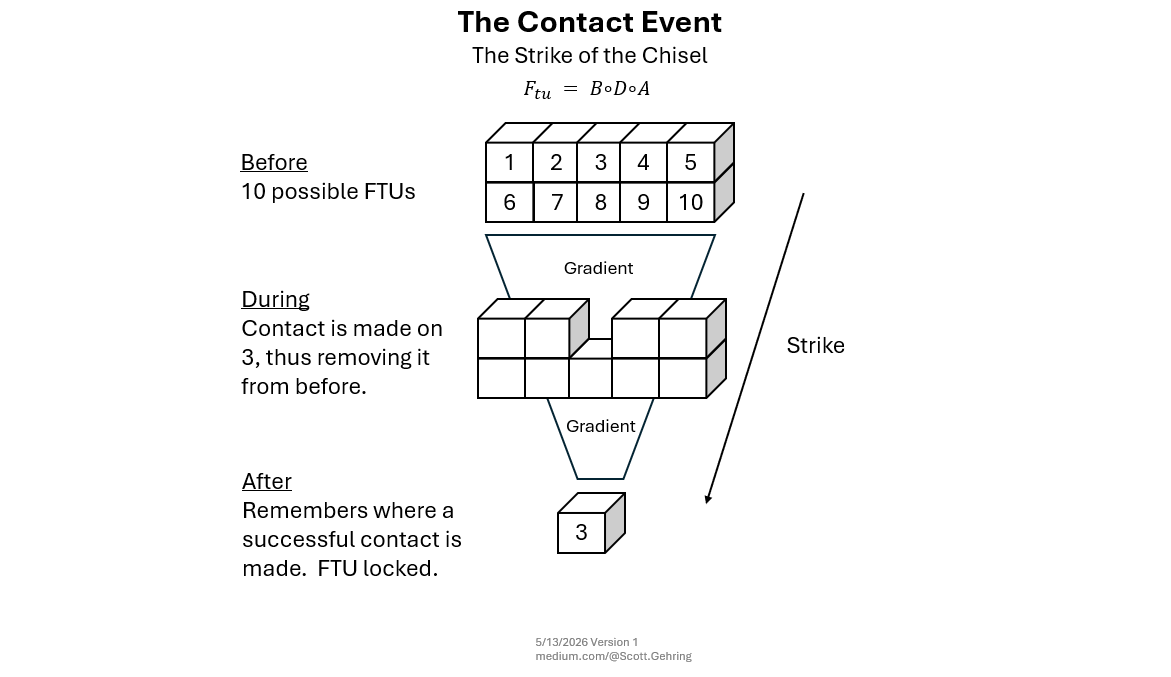
In PMM, the Before contains possibilities. The During contains interaction. The After contains the result.
Before an interaction, many outcomes are possible. After the interaction, only one result remains.
Time moves forward because when contact between objects occurs, possible outcomes are reduced.
Reduction is what we experience as the direction of time.
Contact bends the reduction pathway.
See the following article to learn more about how time moves forward:
[embed]Time, Gravity, and the Sculpture of Infinity Nature is Michelangelo, the Universe is Davidmedium.com
6. What is Depth?
Depth is one of the three dimensions of space, along with height and width.
However, depth is not the same as height and width.
Height and width are configurations of reality. They describe the contact surface area.
Depth, on the other hand, defines the relationship of surfaces. It is more than just configuration. It is also the carrier of configuration.
See the following article to learn more about how depth is different:
7. What is an Event
An event is a completed interaction.
It begins before contact, passes through it, and leaves a result behind afterward.
An event is the full transition between these three angles: Before, During, and After.
See the following article to learn more:
8. What is the Smallest Unit of Time
The smallest unit of time is a completed interaction.
Time is not made from tiny ticking seconds.
It is built on the full transition between Before, During, and After contact.
This complete transition is called a Field Transition Unit (FTU).
See the following article to learn more:
[embed]Wave-Particle Duality: The False God Of waves, particles, and cubesmedium.com
9. Why is Gravity Incompatible with Quantum Mechanics?
In PMM, gravity is not incompatible with Quantum Mechanics.
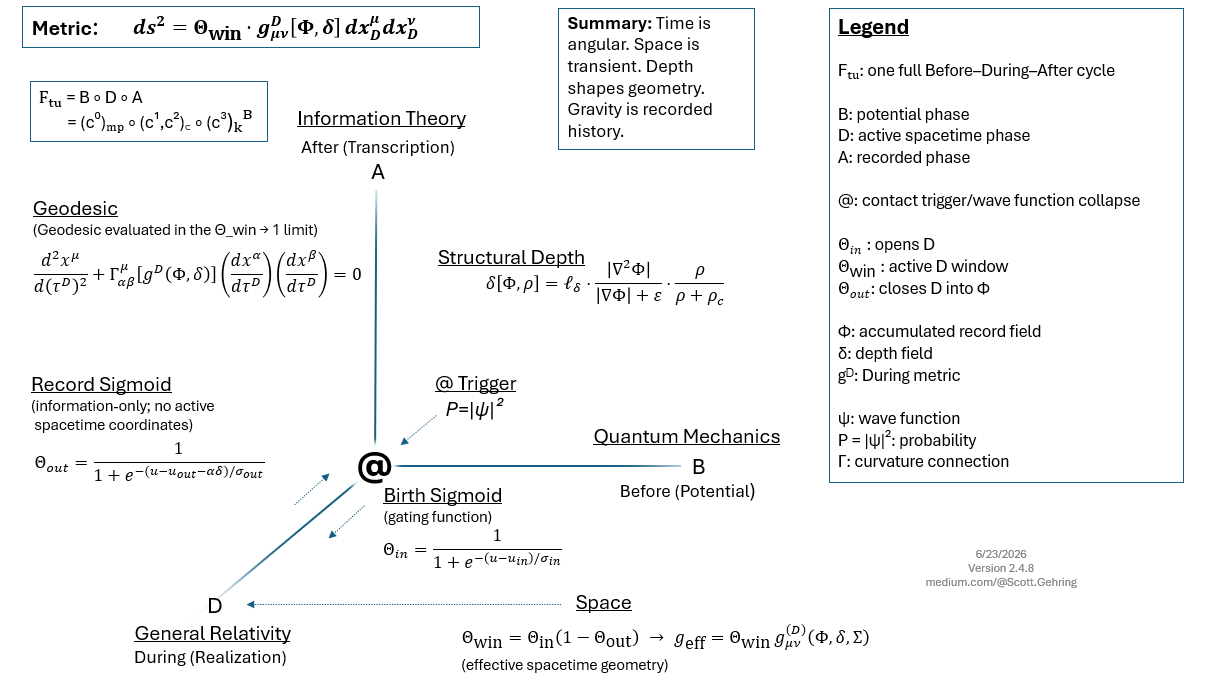
Rather, gravity and quantum mechanics describe different angles of the same interaction.
Quantum mechanics describes reality before contact, when many outcomes remain possible. Maximum uncertainty.
Gravity describes the accumulated structure left behind after many completed interactions. Complete certainty.
They appear incompatible because they are observing different parts of the same process.
[embed]Contact is the Key🔑 Gravity. Quantum Mechanics. Time and Space.medium.com
10. Why Does Light Go Outward While Gravity Goes Inward?
In PMM, light and gravity belong to opposite sides of an interaction.
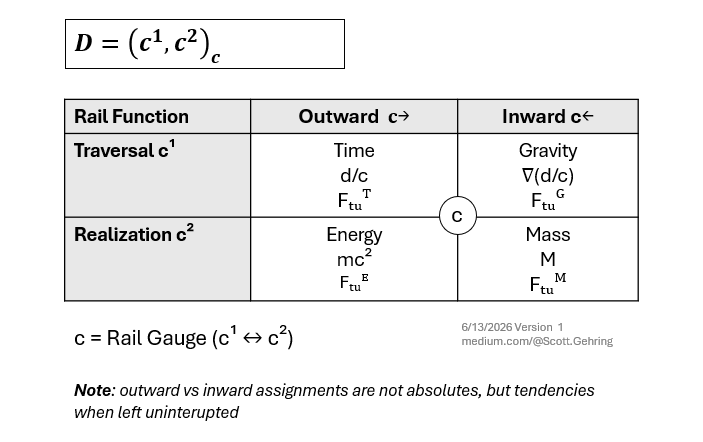
Light is produced during contact. It moves outward through space as the interaction unfolds.
Gravity arises from what remains after contact. It is the accumulated record of past interactions pulling reality toward established paths.
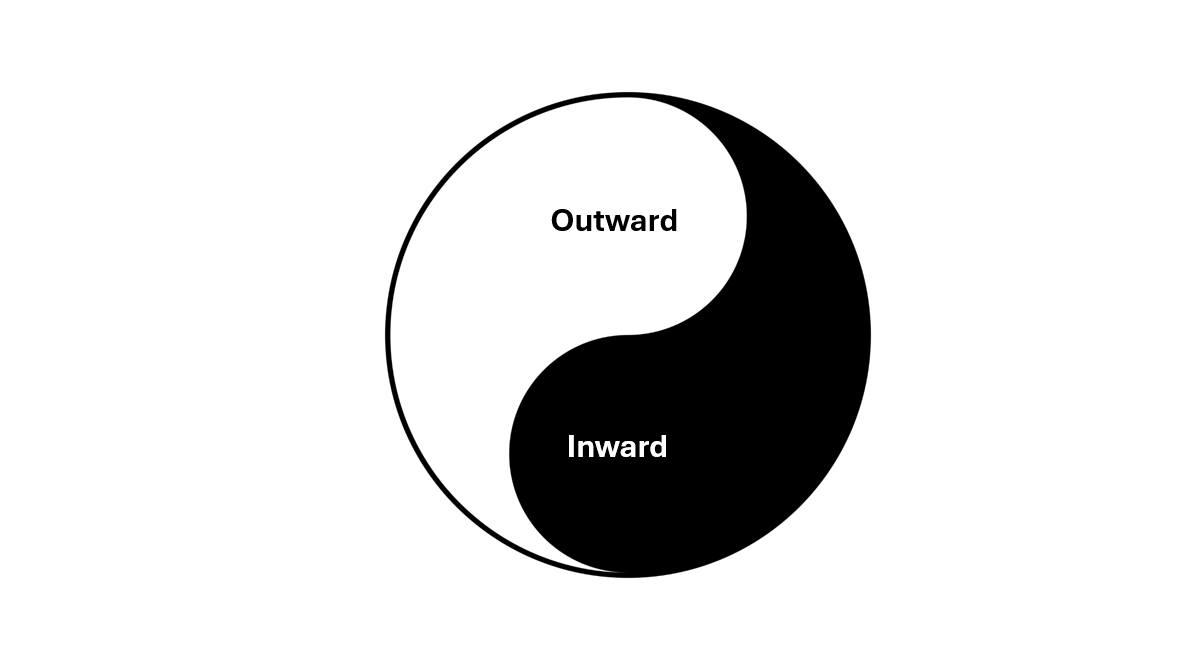
Light expands possibility outward. Gravity pulls the completed reality inward.
One belongs to the active event. The other belongs to the memory of the event.
Light is propagation, and gravity is counter-propagation.
In many ways, they are asymmetrical opposites.
For the formal PMM mathematics, see the following essay:
[embed]Phase Manifold Model Total Model Summarymedium.com
Wrap up
The old Tell Me Why books never tried to explain everything.
They just reminded us that, as adults, questioning the world through the eyes of a kid sometimes yields powerful answers.
PMM follows that same instinct.
To keep asking why, how, and what. To keep looking for patterns.
And keep believing the universe is understandable.
About the Author
Scott grew up asking questions nobody around him could answer.
He found partial answers in dojos, in engineering labs, and in the back seats of cars staring at ancient light.
Technologist. Inventor. Martial artist.
linktr.ee/StrategicEngagementofForce
About — Scott Gehring — Medium
They Get Their Kicks — YouTube
TheyGetTheirKicks (@GetTheirKicks) / X (twitter.com)
Strategic Engagement of Force (@force_strategic) / X (twitter.com)
메타데이터
- post_id
- 4e063a45e64e
- slug
- 10-questions-about-reality-4e063a45e64e
- url
- https://medium.com/phase-manifold-model/10-questions-about-reality-4e063a45e64e
- canonical_url
- https://medium.com/phase-manifold-model/10-questions-about-reality-4e063a45e64e
- author_url
- https://medium.com/@Scott.Gehring
- status
- ok
- fetched_at
- 2026-06-14 13:58:26