J.C.R. Licklider: Who Was He?
J.C.R. Licklider: What He Did
J.C.R. Licklider: Who Was He?
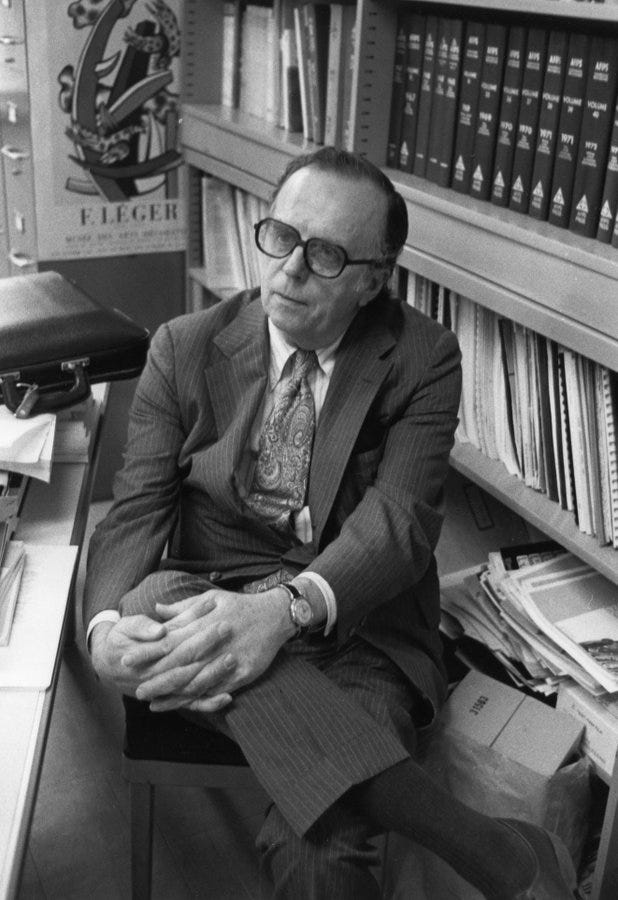
J.C.R. Licklider: What He Did
- J.C.R. Licklider was a psychologist, not a computer scientist.
- Studied how the brain processes sound.
- Used computers as research tools (when they filled a whole room).
The Observation That Changed Everything
- Measured how his work hours were spent.
- Found that most of his time was not spent thinking.
- Time was consumed by:
- Collecting data.
- Reformatting information.
- Plotting graphs.
- Preparing analyses.
- Realized the bottleneck was not human intelligence.
- Humans and machines were doing the wrong jobs.
J.C.R. Licklider’s BIG Idea
- Humans should focus on questions, judgment, and insight.
- Computers should handle repetitive processing.
- Envisioned humans and computers working together in real time.
- Described this concept in “Man-Computer Symbiosis” (1960). https://groups.csail.mit.edu/medg/people/psz/Licklider.html
What He Predicted
- Computers that respond instantly.
- A screen-based interface.
- Interactive computing.
- Easy access to information.
- Machines that assist thinking and decision-making.
- Concepts resembling personal computers, the internet, and AI assistants.
The Opportunity
- In 1962, joined Advanced Research Projects Agency (ARPA) as head of a research office.
- Received a significant budget and unusual freedom.
- Could decide which technologies and researchers to support.
What Made J.C.R. Licklider Different
- Most people would have funded proven ideas.
- He funded a future that did not yet exist.
- Invested in researchers who shared his vision.
- Focused on long-term possibilities rather than short-term results.
Building the Foundation
- Funded time-sharing computers. *
- Supported interactive computing research.
- Helped establish new computer science programs.
- Backed laboratories that later developed:
- The mouse.
- Graphical interfaces.
- Screen-based computing.
- Built a network of researchers working toward a common future.
*As director of ARPA’s Information Processing Techniques Office (IPTO) from 1962–1964, Licklider controlled research funding to allocate government money to researchers and universities pursuing interactive computing. He funded experiments in time-sharing, allowing multiple users to work with a computer in real time rather than submitting punch cards and waiting for results.
The Internet Vision
- In 1963, sent a memo to the “Members and Affiliates of the Intergalactic Computer Network.”
- Asked whether separate computers could be connected.
- Imagined people sharing information across a network.
- Described the basic idea of the internet years before it existed.
- Had clear “enhavim” purpose and mission led by vision.
What Happened Next
- Left ARPA in 1964.
- Did not personally build the systems he envisioned.
- The researchers he funded carried the work forward.
- His successors developed ARPANET (Advanced Research Projects Agency Network)
- Teams he supported helped create the foundations of:
- The internet.
- Personal computing.
- Modern human-computer interaction.
J.C.R. Licklider Philosophy
- Did not seek personal recognition.
- Wanted the vision to survive beyond his involvement.
- Focused on enabling others to succeed.
- Measured success by whether the idea lived on.
The Irony
- Many people know the names of those who built the technologies.
- Few know the name of the person J.C.R. Licklider who imagined them first.
- He: Saw the future. Described it. Funded it. Connected the people who built it.
Legacy Worthy
- J.C.R. Licklider born March 11, 1915, in St. Louis, Missouri.
- Died June 26, 1990, in Arlington, Massachusetts, at age 75.
- Never experienced the modern web.
- Never fully saw the world he imagined: the internet part of everyday life.
- Never used a personal computer that fully reflected the vision he described in 1960.
- Yet much of today’s digital world traces back to ideas he articulated decades earlier.
- Helped shape: Personal computing. Computer networking. Human-computer interaction. The foundations of today’s AI-assisted tools.
Lasting Insight
- Yet much of today’s digital world traces back to a single insight:
People should spend less time preparing to think and more time thinking.
- Computers should help people think better.
- That simple observation led to a vision that helped inspire the personal computer, the internet, and eventually AI assistants.
- J.C.R. Licklider did not seek recognition for the future he imagined.
- He focused on making that future possible.
#legacyworthy J.C.R. Licklider Joseph Carl Robnett (“J.C.R.”) Licklider (1915–1990) was an American psychologist, computer visionary, and research leader whose ideas and funding helped lay the groundwork for personal computing, the internet, and interactive human-computer collaboration.
During Licklider's tenure (1962–1964), he worked out of ARPA headquarters in Washington, operating as part of the U.S. Department of Defense.
Reframed and reordered with thanks from post source: https://x.com/MillieMarconnni/status/2062510485971546294?s=20
메타데이터
- post_id
- 4e097595adaa
- slug
- j-c-r-licklider-who-was-he-4e097595adaa
- url
- https://medium.com/@legacyworthy/j-c-r-licklider-who-was-he-4e097595adaa
- canonical_url
- https://medium.com/@legacyworthy/j-c-r-licklider-who-was-he-4e097595adaa
- author_url
- https://medium.com/@legacyworthy
- status
- ok
- fetched_at
- 2026-06-13 07:35:29
