THE ROMANTIC LIGHTS OF NATURE: FIREFLIES AND THEIR ENDANGERED LIVES
(Yazının Türkçe versiyonuna buradan ulaşabilirsiniz.)
THE ROMANTIC LIGHTS OF NATURE: FIREFLIES AND THEIR ENDANGERED LIVES
On warm summer evenings, those tiny lights glowing among the bushes and tall grass rarely fail to catch our eye. But have you ever wondered why they emit this glow, or what purpose they serve in the ecosystem?
These tiny creatures, turning the night into a sky full of wild stars, belong to the species Lampyris noctiluca — commonly known as fireflies or glow-worms. While they have long been symbols of romance in songs and movies, let’s look past the poetry and dive into their real biological world. Their homes span the grasslands, forest edges, and fields of Asia and Europe, where they usually prefer damp and dark places.
A Striking Difference: Males vs. Females
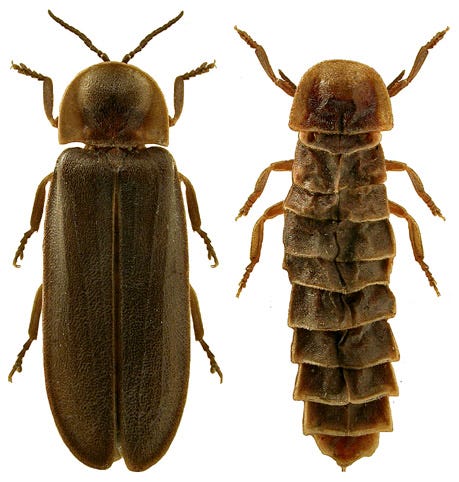
Female fireflies look a lot like larvae and completely lack wings. Because of this unique look, they are often confused with actual larvae and are colloquially called “glow-worms.” Since they cannot fly, they spend their lives crawling on leaves and grass. Their bodies display various shades of brown. At the very tip of their abdomen sits a specialized light organ. The main evolutionary reason they flash this light is simple: the flightless female is calling out to attract flying males for mating.
Unlike the females, male fireflies have fully developed wings. Their front wings are modified into hardened, protective covers called elytra, while their back wings are thin and membranous. Even though they seem to have two different types of wings, their actual flight is powered entirely by those thin back wings. By rapidly vibrating them, males can travel impressive distances to find a signaling female.
Interestingly, while male fireflies also possess light organs, they are mostly non-functional or vestigial in this species. The same evolutionary twists happen to females too; in some individuals, wings have completely degenerated or never developed at all.
Their Place in the Food Web
When we look at their ecological niches, their feeding habits reveal some fascinating survival strategies. Depending on the species, adult male fireflies often do not eat anything at all this is especially common in species with very short adult lifespans. Other species, however, feed on soft terrestrial mollusks like snails and slugs during their larval stage, or sip on flower nectar as adults.
Within the food chain, fireflies act as both predators and prey. They are an essential food source for nocturnal hunters, including bats, insect-eating birds, and spiders.
The Chemistry Behind the Magic: Bioluminescence
Now we come to the defining feature that makes a firefly a firefly: bioluminescence. What is the secret source of this mysterious light?
Bioluminescence is simply the ability of certain living things to produce light through chemical reactions inside their bodies without releasing any heat. In this metabolic process, a substance called luciferin reacts with oxygen, catalyzed by the enzyme luciferase.

The resulting energy is emitted as “cold light.” This means nearly 100% of the energy turns directly into visible light without wasting any heat. Fireflies use this brilliant mechanism primarily as a courtship call or as a warning signal to scare away predators. Furthermore, bioluminescence isn’t just for fireflies; nature also gives this trait to certain deep-sea fish, fungi, and even bacteria.

The Fading Lights: Anthropogenic Threats
Despite their ecological importance, the balance of our ecosystems has been slowly breaking down since the Industrial Revolution. Today, human activities heavily threaten firefly populations worldwide.
- Light Pollution: Rapid urbanization and excessive artificial lights are among the biggest threats. Artificial glows make it incredibly hard for males to notice the shifting flashes of females. This disrupts their mating cycles, putting the future of the species at risk.
- Chemical Pollution: The heavy use of pesticides in agriculture ruins the soil where firefly larvae live and grow. Thriving in damp meadows and forest edges, these sensitive creatures are highly vulnerable to chemical pollution.
- Habitat Loss and Forest Fires: Urban sprawl and intense farming cause severe habitat loss. On top of that, worsening forest fires mean almost certain death for female fireflies. Because they lack wings and cannot fly away like the males, the tiny lights hiding in the grass and leaves are quietly put out by the flames.
It is a harsh truth: without immediate conservation efforts, the romantic lights of nature may soon fade into permanent darkness.
References
- Lewis, S. M., et al. (2021). A global perspective on firefly extinction threats. MDPI Insects, 12(8), 734. https://doi.org/10.3390/insects12080734
- Lampyris noctiluca species profile. Animal Diversity Web (ADW).
- The Wildlife Trusts. Glow-worm (Lampyris noctiluca) conservation notes.
- Verschuur, M. (2020). Why the lights are going out for fireflies. The Guardian.
메타데이터
- post_id
- 4e0e10ec5fc1
- slug
- the-romantic-lights-of-nature-fireflies-and-their-endangered-lives-4e0e10ec5fc1
- url
- https://medium.com/@kardelentuannabakir29/the-romantic-lights-of-nature-fireflies-and-their-endangered-lives-4e0e10ec5fc1
- canonical_url
- https://medium.com/@kardelentuannabakir29/the-romantic-lights-of-nature-fireflies-and-their-endangered-lives-4e0e10ec5fc1
- author_url
- https://medium.com/@kardelentuannabakir29
- status
- ok
- fetched_at
- 2026-07-09 20:10:33