THE CRAFTSMANSHIP OF MEMORY AND A SILENT CRY
“AN ECHO IN THE ARCHIVE”

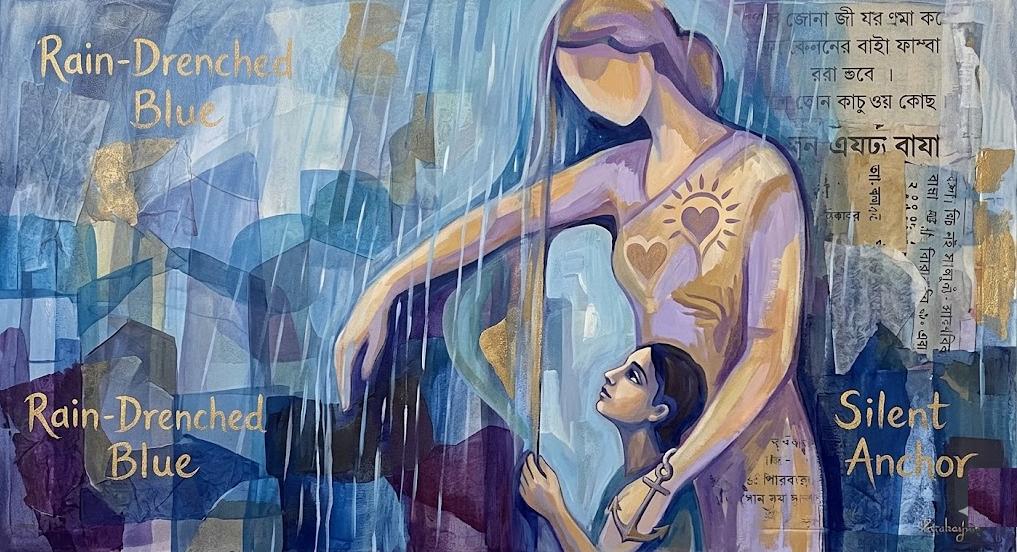
Image created by Golam Mohiuddin | AI-Generated(Gemini)
THE CRAFTSMANSHIP OF MEMORY AND A SILENT CRY
“AN ECHO IN THE ARCHIVE”
Last night, around 1:00 or perhaps 2:00 AM, I suddenly woke up. And there it was — that scent of damp earth. My childhood, the Pal Bari (the potter’s house), and that cluster of huts belonging to the potters at the very edge of the village.
I don’t know how many more times — perhaps for eternity — the gates of these memories will play host to my dreams. Is it the dream’s fault? I am the one who never wants to forget this dream. In it, I can still hear the sound of Hari Kaka’s wheel spinning. Ghur-ghur… ghur-ghur… ceaseless. From a simple lump of ordinary clay, something flawlessly beautiful emerges — a few pitchers or a pot to hold both water and life.
I often think we are just like that clay. But unlike earthen vessels, we are never truly “finished.” We are molded, broken, and reshaped again. And sometimes, when we break, no one knows how to put us back together.
Moni Mashi — my soul’s own Moni Mashi — would call out to me the moment she saw me wandering outside. With an exquisite, wide smile, she’d say, “Hey, Sarkar’s grandson — my crazy Gopal — come here! I’ve made Goja (sweet snacks) for you.” With boundless joy and an unconscious sense of belonging, I would eat them. What a taste those Gojas had! Truly, how can one compare the flavor of something infused with Moni Mashi’s love? Why should one even try? There is no comparison for the magic of love. In reality, it was the taste of care — something that cannot be bought.
I was so restless that I understood nothing but play. Dust was my constant companion. And Maya Boudi… before I could return to my own house covered in dirt, she would quietly wipe my face with the end of her saree. Not a word spoken — just a touch of affection that made everything feel safe in an instant.
Sunil Da was different. He was my teacher — not the conventional kind. He taught me how to notice the smallest details: how dragonflies hover in the sky like tiny stray thoughts, the scent of Kadam flowers just before the rain, and how even silence can be so vibrantly alive. None of this was in the books. Yet, in my later life, these memories have endured far longer than anything I ever studied.
Suddenly, a suppressed unrest seemed to grip our village and the entire region. I was young; I didn’t understand. Then, one day, everything changed. The village looked the same, but it wasn’t the same anymore. I don’t know what happened, but suddenly the courtyard of the Pal Bari went empty, as if its soul had been snatched away overnight. Even the sky that day felt heavy, as if it had forgotten how to be blue.
I wasn’t old enough then to understand what a “border” meant. I didn’t understand why people who had always been right here suddenly had to leave without any warning — why Hari Kaka had to go, clutching whatever he could under his arm, leaving everything else behind.
“Motherland” doesn’t just mean a map — I once heard someone say. Motherland is the people who laugh together under the same sky and silently share each other’s sorrows when the night grows heavy.
I am 47 now. Life moves in an ordinary rhythm, as it usually does. Work, paying bills, and the repetition of the same events day after day. This city runs so fast that there is no time to remember anything properly.
But memory doesn’t follow the clock. Sometimes, when I stand alone for a long time, I find myself back in that courtyard. I wonder, does Hari Kaka’s wheel still spin somewhere else? I wonder if Sunil Da still teaches someone to look at the world the way he taught me? Or are they now just names — people who were forced to leave before they could finish being a part of this soil, names that now drift silently through people’s minds?
I am an ordinary man now. I claim nothing special. I work, I survive, and I try to stay within the boundaries life has drawn. But there is something I simply cannot let go of. In a small corner inside me, that scent of the Pal Bari still lingers — the damp earth, the sound of the wheel, and the voices that felt like home.
Sometimes my heart wants to scream, even if no one listens: “An entire country is lost inside of me.” A country where people like Hari Kaka or Sunil Da were never considered outsiders. A country without barbed wire, where there was no need to prove one’s existence.
And even now, I believe this is the truth: some departures are never recorded. They aren’t in any documents, not in newspaper headlines, nor in any official archives. But they live on in people like me — in silent moments, in the sudden scent of earth, and in memories that refuse to fade. And perhaps, that is the only justice they will ever receive.
메타데이터
- post_id
- 4e1a5d9937c2
- slug
- the-craftsmanship-of-memory-and-a-silent-cry-4e1a5d9937c2
- url
- https://medium.com/the-gravity/the-craftsmanship-of-memory-and-a-silent-cry-4e1a5d9937c2
- canonical_url
- https://medium.com/the-gravity/the-craftsmanship-of-memory-and-a-silent-cry-4e1a5d9937c2
- author_url
- https://medium.com/@mohiuddin10121981
- status
- ok
- fetched_at
- 2026-06-22 08:33:11