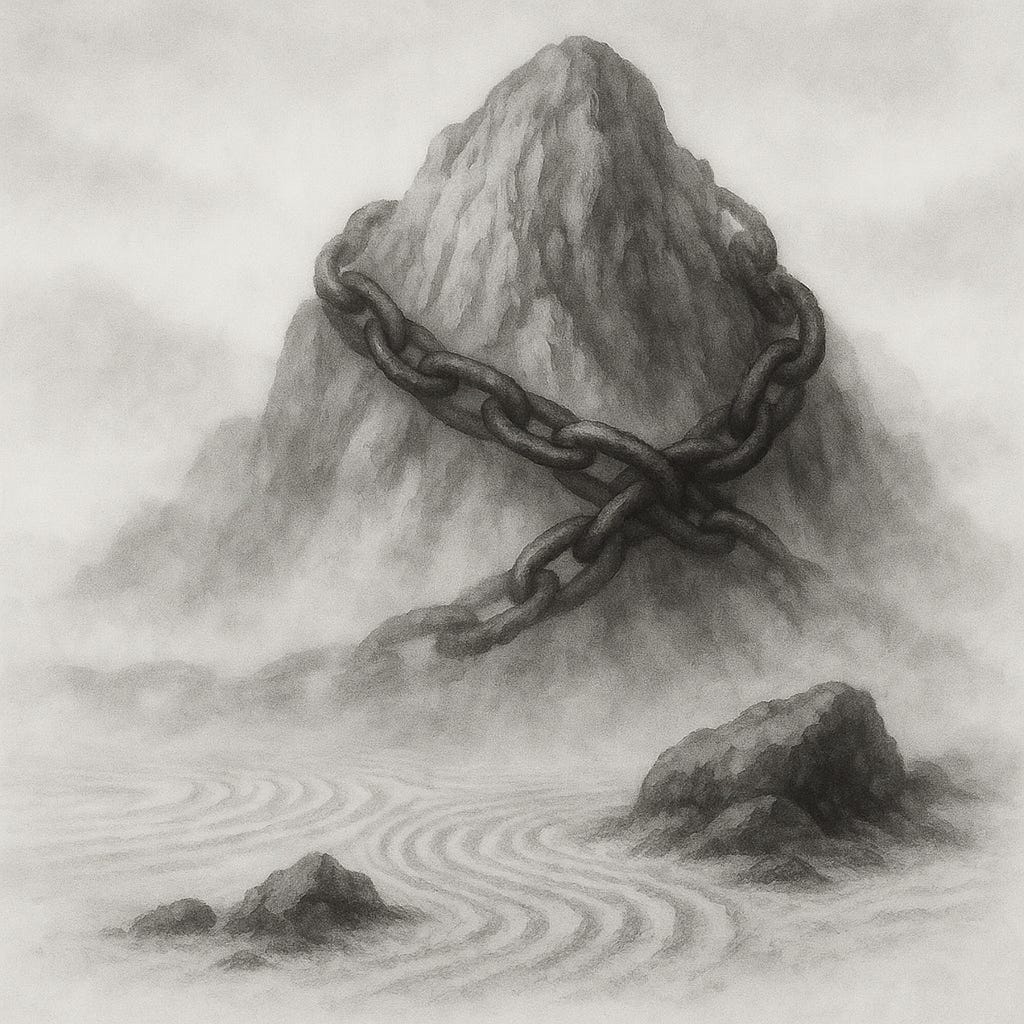
From Solitude to Attention
A Phenomenology of Self and Other
From Solitude to Attention
A Phenomenology of Self and Other

This essay reads four thinkers — Thoreau, Lispector, Murdoch, and Stein — as stages in a phenomenological progression from solitude to empathy. However, the movement between them is not merely sequential. It is ontologically grounded.
Freya Mathews’ relational cosmophysicism, developed in The Ecological Self (1991), provides that ground. Mathews argues that every entity — from inorganic physical processes through organisms to human consciousness — possesses an innate conatus: an intrinsic striving to persist and realize itself according to its own nature. This conatus is not a property of isolated selves but a relational process, constituted through and within a larger field. An undisturbed self is one whose conatus unfolds according to its intrinsic dispositions; a disturbed self is one whose conatus has been redirected — whether by external intervention, internal fracture, or the distorting pressure of abstractly conceived ends substituted for the actual.
Read through this lens, the four thinkers in this essay are not simply describing different aspects of presence. They are each describing a different configuration of conative unfolding — its relative transparency in Thoreau, its temporal disruption in Lispector, its active redirection in Murdoch, and its asymmetrical limit in Stein. The movement from solitude to empathy is the movement from an undisturbed conative field to the encounter with a conatus that cannot be absorbed, redirected, or made to coincide with another’s understanding.
This is not a resolution. It is a deepening of the relational complexity that was always already there.
I. Introduction — The Question of Presence
There are moments when nothing separates oneself from the world. The air is not an object, the sound a signal, and the light not an interpretation. One doesn’t think of being present; one simply is, and the world is there in the same unbroken sense. Nothing returns inward to confirm it; nothing asks. Presence is neither achieved nor maintained, but simply given.
However, this state doesn’t last.
Something within us shifts. Not visibly or decisively, but enough to disturb what had no need of support. The world remains, but no longer arrives untouched. It is met, taken up, adjusted, and reframed. What was given begins to pass through something that doesn’t simply receive. And from that moment, presence is no longer simple.
Somehow it thins, hesitates, and no longer coincides with itself.
Initially, this appears as fragility: a life that doesn’t fully gather into a center, a self that cannot secure its own experience. Nothing dramatic is lost, yet nothing settles. What is lived doesn’t return as possession but remains immediate, though without weight.
Then the disturbance deepens. The self doesn’t merely fail to hold presence; it actively reshapes it. The world is not merely unstable; rather, it is obscured. What appears is filtered through concern, expectation, and a quiet insistence that things be otherwise than they are. One no longer fails to receive reality; one mis-sees it.
At that point, the question is no longer what is given, but how to undo what has been done to it.
Yet even this effort remains incomplete. For what stands before us is not exhausted by how we see it. There are presences that do not yield to correction, or become clear through attention alone. The other is not clarified into view. The other remains, in a sense that cannot be absorbed, outside the reach of any effort to make it coincide with understanding.
What starts as a simple field transforms into a series of tensions: the presence of it, its fracture, its distortion, and what surpasses both.
This essay follows that progression — not to resolve it, but to remain within it, where what is given is never entirely secure, and what appears is never entirely ours.
II. Thoreau — Presence Without Fracture
Henry David Thoreau stands at the threshold of presence before it fractures. In Walden, the world is not something to be interpreted; it is something to be encountered. Nature is not an object but a companion. Solitude is not deprivation but a form of clarity. He writes, “I am no more lonely than the loon in the pond,” and this line is not bravado but ontology — a statement about the continuity between self and world.
For Thoreau, the self does not obstruct, refract, or insist. The world arrives whole, and the self is porous enough to receive it. Meaning is not constructed; it is encountered. The world is already articulate.
However, this vision carries its own condition quietly within it. It presupposes a self that does not interfere. It assumes that the inward turn - the subtle movement that fractures presence - is accidental, not structural. Thoreau presents us with the world before fracture.
But what appears without resistance does not remain so. Nothing withdraws, nothing breaks, and still something begins to fail. The world no longer gathers, although it isn’t lost. What is given does not return as possession. Presence persists, but without weight.
It is not that the world has withdrawn. Nothing in it has changed. What changes is less visible, and for that reason more difficult to locate. The failure does not occur in what appears, but in the one to whom it appears.
What is given no longer gathers into a center nor does it return as something that can be held, or even fully registered. The self remains, but without the cohesion required to receive what is there. It does not distort, it does not yet impose, and it simply fails to coincide.
And so, the problem has shifted from how the world appears to how it is lived without securing itself within a self that can contain it.
III. Lispector — Fracture Within Presence
Clarice Lispector writes from within the moment when presence ceases to coincide with itself. In Água Viva, she describes consciousness as something that “does not hold itself together,” a self that “is and is not” simultaneously (Lispector 2012, 7). The world remains immediate, but the self cannot gather it into unity. It becomes a site of oscillation rather than reception. Experience appears without settling; it touches without taking root.
Fracture is not the loss of the world but the instability of the one who receives it. The self does not coincide with itself, unable to secure its own openness. The problem is fragility more than absence.
Presence becomes an event that cannot be held.
Água Viva does not merely describe this condition — it enacts it. The prose itself refuses to settle. Sentences begin and dissolve; the narrator circles back to what she has just said and finds it already changed. This is not stylistic restlessness but philosophical precision: Lispector is showing, from the inside, what it is to inhabit a consciousness that cannot coincide with its own moments. The text performs what Husserl theorizes.
What this means for lived experience is quietly devastating. If the self cannot gather its own temporal flow, then nothing that passes through it is fully received. Experience arrives — vivid, immediate, undeniable — and yet does not return as something possessed. It is lived without being held. The world is not yet distorted, not yet overlaid with fantasy or self-concern; it is simply not retained. Presence leaks.
This is why a novelist rather than a phenomenologist illuminates this particular fracture most precisely. Husserl can describe the structure of inner time-consciousness from without; Lispector inhabits it from within, and the difference is not merely rhetorical. What she renders is the texture of a self that is constitutively too late for its own experience.
The world has not withdrawn, but something within us has loosened. The question is no longer how to enter presence but how to remain in it when the self itself is unsteady.
If presence is no longer secure, the problem is not the absence of the world but the distortion introduced by the self.
What cannot be held does not yet mislead. The failure here is not a falsification but an inability to gather what is given. Nothing has been altered or imposed. The world remains intact, even if it no longer settles.
However, this condition does not remain neutral. What cannot be held begins, gradually, to be replaced. What fails to take root gives way to what is supplied in its place. The instability of reception turns, almost imperceptibly, into a quiet activity. The self does not yet dominate, but it no longer merely fails; it begins to intervene.
Yet the fracture Lispector describes is not only temporal. It is linguistic as well. Água Viva is a text that strains against its own medium. Lispector writes persistently toward something that language cannot quite reach, and she knows it. The living present dissolves before it can be named; by the time a word arrives, what it was meant to capture has already shifted. This is not a failure of Lispector’s language but a revelation of language’s structural condition: it reaches for the pre-linguistic ground of experience and finds it already receding. The need to name and the impossibility of naming coincide in the same gesture. What Água Viva enacts, then, is not merely a self that cannot hold its temporal flow but a self that cannot hold it into words — and this double fracture, temporal and linguistic simultaneously, is what makes the transition to distortion not merely possible but inevitable. A self that cannot gather experience into coherent time, and cannot name what it nonetheless lives, will begin - almost without knowing it - to substitute. And substitution is where distortion begins.
Água Viva enacts this condition instead of merely describing it. The prose itself refuses to settle. Sentences begin and dissolve; the narrator circles back to what she has just said and finds it already changed. This is not stylistic restlessness but philosophical precision: Lispector is showing, from the inside, what it is to inhabit a consciousness that cannot coincide with its own moments. The text performs what Husserl theorizes (Husserl, 1964).
What this means for lived experience is quietly devastating. If the self cannot gather its own temporal flow, then nothing that passes through it is fully received. Experience arrives: vivid, immediate, undeniable and yet does not return as something possessed. It is lived without being held. The world is not yet distorted, not yet overlaid with fantasy or self-concern; it is simply not retained. Presence leaks.
This is why a novelist rather than a phenomenologist illuminates this particular fracture most precisely. Husserl can describe the structure of inner time-consciousness from without; Lispector inhabits it from within, and the difference is not merely rhetorical. What she renders is the texture of a self that is constitutively too late for its own experience.
Yet the fracture Lispector describes is not only temporal. It is linguistic. Água Viva is a text that strains against its own medium — Lispector writes persistently toward something that language cannot quite reach, and she knows it. The living present dissolves before it can be named; by the time a word arrives, what it was meant to capture has already shifted. This is not a failure of Lispector’s language but a revelation of language’s structural condition: it reaches for the pre-linguistic ground of experience and finds it already receding. The need to name and the impossibility of naming coincide in the same gesture. What Água Viva enacts, then, is not merely a self that cannot hold its temporal flow but a self that cannot hold it into words — and this double fracture, temporal and linguistic simultaneously, is what makes the transition to distortion not merely possible but inevitable. A self that cannot gather experience into coherent time, and cannot name what it nonetheless lives, will begin — almost without knowing it — to substitute. And substitution is where distortion begins.
IV. Murdoch — The Need to Correct Distortion
For Iris Murdoch, the obstacle to presence is not merely fracture but active distortion. The self does not simply fail to hold its temporal flow; it intervenes, substituting its own preoccupations for what is actually there. Her “fat relentless ego” overlays reality with fantasy, self-concern, and interpretive habit — not through deliberate falsification but through a constitutive tendency to replace the actual with the abstractly imagined.
This tendency, however, is not merely a moral failing. It operates at a deeper ontological level. The ego flees from what is factically given — from existence as it is actually thrown — toward end-states of its own abstract construction. What Murdoch describes as the ego’s distorting fantasy is, at its root, a refusal of the actual: a redirection of what Mathews would call the self’s innate conatus away from its intrinsic unfolding toward abstractly conceived substitutes. The self does not simply misperceive reality; it actively replaces the unfolding of things according to their own nature with projections that serve its own needs.
Attention, for Murdoch, is the discipline through which this substitution is undone. To attend properly is to allow reality — independent, resistant, unyielding — to emerge on its own terms rather than on the ego’s. This is not merely an epistemological correction but something closer to an ontological reorientation: a return to the factical actual from which the ego has fled. Genuine attention does not impose; it allows. It restores, however partially and provisionally, the undisturbed unfolding that distortion interrupted.
Yet even this disciplined attention operates within a constitutive limit. It can correct what the ego has overlaid, but it cannot reach what lies beyond the act of seeing entirely. The self remains, even in its most disciplined state, the locus of correction — the one who attends, adjusts, and strives to perceive without distortion. And what stands before us is not always something that yields to more careful looking.
V. Stein — Encounter With Irreducible Otherness
Edith Stein breaks the circle of the self’s vision. She argues that empathy (Einfühlung) is a sui generis act — neither a projection of my feelings nor a mere analogy of my own experience. In empathy, the Other’s experience is given as “there for me” without being “in me”.
This is not a “mystical loosening” of the self but a sharp epistemological limit. Because the Other is phenomenologically original and not derived from my own consciousness, they are irreducible. This irreducibility generates an immediate ethical obligation: we are commanded to act rightly toward what we cannot fully understand.
At this limit, language itself begins to fail. As both Lispector and Stein suggest, language is often the very source of the fracture, attempting to categorize a presence that refuses to be “named”. The Other’s presence is not a “given” for us to consume, but a “demand” that stands outside our comprehension.
This is where language encounters not its inadequacy but its constitutive impossibility. When we fail to describe a complex emotion precisely, language is inadequate. A better word, a more careful sentence, might yet succeed. But before the other’s irreducible presence, the failure is of a different order entirely. No refinement of language would resolve it. The other is not a phenomenon that awaits a more precise description; they are a presence that exceeds the descriptive act as such. Lispector’s self could not hold experience into words because the living present dissolved before language arrived. Here the problem is not temporal but ontological: the other simply is outside the reach of any naming. What language encounters in Lispector is its own lateness; what it encounters in Stein is its own limit. These are related but distinct failures, and together they mark the boundaries of what the self can do with presence, whether its own or another’s.
In this perspective, the world is no longer the primary site of presence; the other is. (Levinas, 1969).
Furthermore, the other cannot be mastered by attention. No matter how refined a discipline of perception, it cannot make the other coincide with understanding. The encounter with another person reveals a presence that surpasses the self’s capacity to receive, correct, or comprehend.
This movement does not resolve but comes to rest:
world self correction encounter
The tone shifts to a quiet, precise, almost reverent state. What initially seems tangible becomes intangible.
VI. Conclusion — The Loosening of the Self
The movement from Thoreau’s solitude to Stein’s empathy does not solve the problem of the self but rather deepens it. What begins as a world given without friction ends as an encounter that exceeds every effort to receive it fully. And what runs beneath this entire progression, quietly and persistently, is the failure of language to hold what the self lives.
Thoreau’s world is already articulate. Language and presence coincide for him without friction; the world arrives named and the self receives it without remainder. But this coincidence, the essay has shown, is fragile because the self cannot sustain the transparency that Thoreau’s solitude requires. Lispector shows what happens when that transparency fails: the living present dissolves before language arrives, and the self finds itself always too late for its own experience. The fracture is temporal, but it is also linguistic — the need to name and the impossibility of naming coincide in the same gesture.
Murdoch’s discipline of attention attempts to correct what has been distorted in that gap. But attention, however refined, operates within language: and language, as Stein makes clear, reaches its constitutive limit before the other’s irreducible presence. The other is not a phenomenon awaiting more precise description. They are a presence that exceeds the descriptive act entirely. Where Lispector’s self encounters language’s lateness, Stein’s other reveals language’s limit. Together they mark the boundaries of what the self can do with presence, whether its own or another’s.
What remains, then, is not a resolution but a condition. The self continues to name what it cannot hold and cannot reach: its own dissolving present, the other’s irreducible presence; and this gesture, repeated and always incomplete, is not a failure to be overcome but the very structure of a life lived among others. Solitude was always already a preparation for an encounter that no amount of attention, discipline, or language could fully absorb.
To inhabit this condition doesn’t require mastering but remaining within it . Naming, failing to name, and continuing nonetheless.
References
Husserl, Edmund. 1964. The Phenomenology of Internal Time-Consciousness. Translated by James S. Churchill. Indiana University Press.
Levinas, Emmanuel. 1969. Totality and Infinity. Translated by Alphonso Lingis. Duquesne University Press.
Lispector, Clarice. 2012. Água Viva. Translated by Stefan Tobler. New Directions.
Mathews, Freya, 1991. The Ecological Self. Routledge.
Murdoch, Iris. 1970. The Sovereignty of Good. Routledge.
Stein, Edith. 1989. On the Problem of Empathy. Translated by Waltraut Stein. ICS Publications.
Thoreau, Henry David. 1854. Walden. Ticknor and Fields.
메타데이터
- post_id
- 4e1b1c45a51b
- slug
- from-solitude-to-attention-4e1b1c45a51b
- url
- https://medium.com/phenomenal-field/from-solitude-to-attention-4e1b1c45a51b
- canonical_url
- https://medium.com/phenomenal-field/from-solitude-to-attention-4e1b1c45a51b
- author_url
- https://medium.com/@tricksteratheart
- status
- ok
- fetched_at
- 2026-07-14 02:11:20