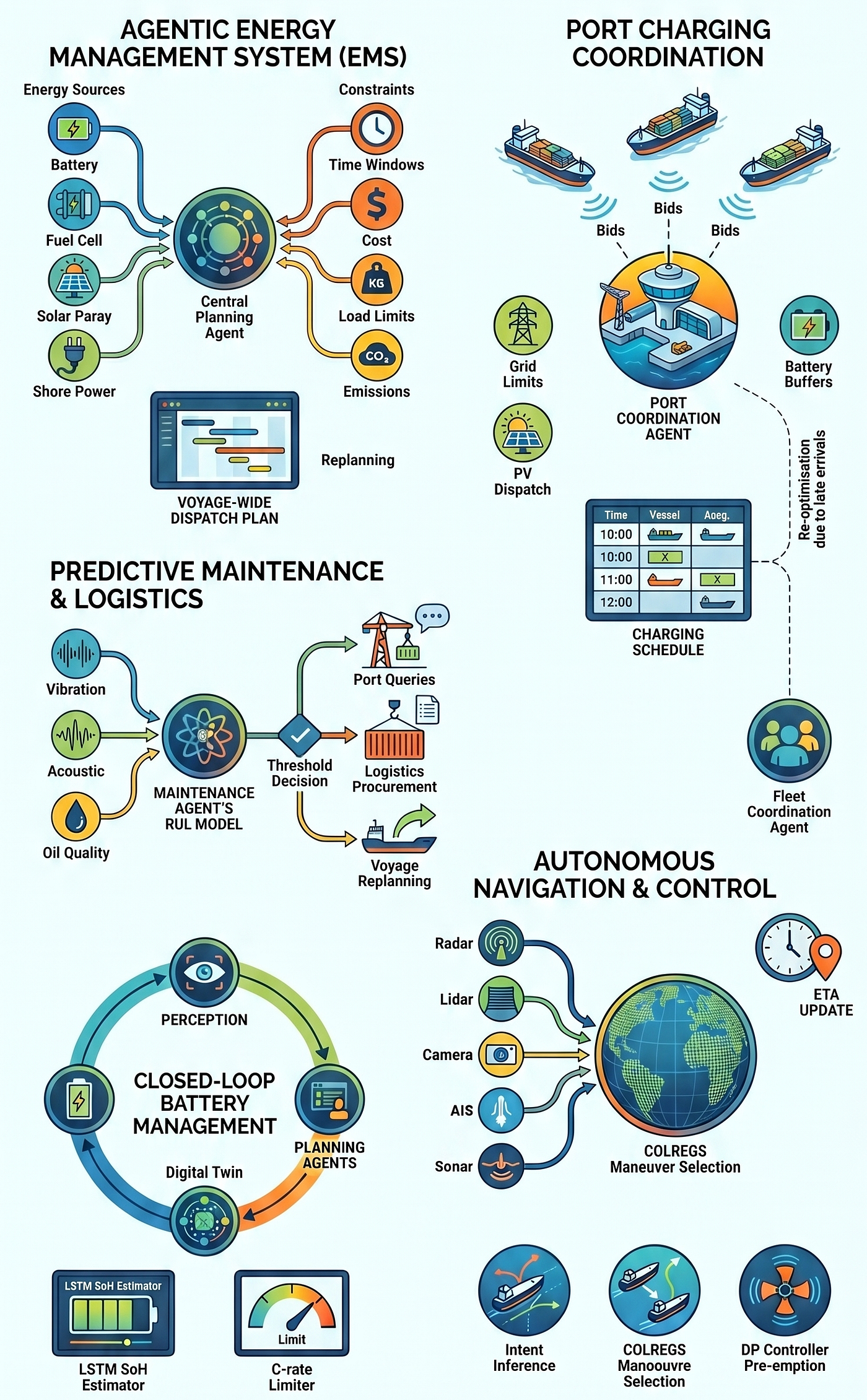
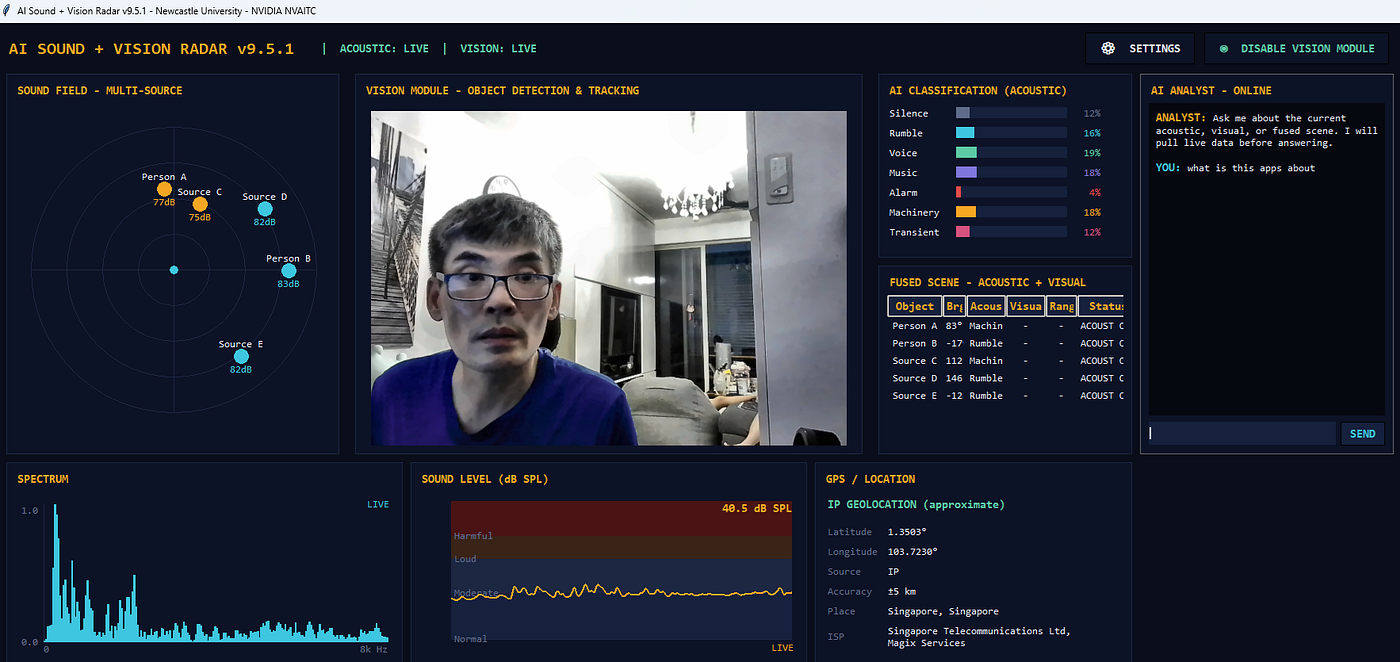
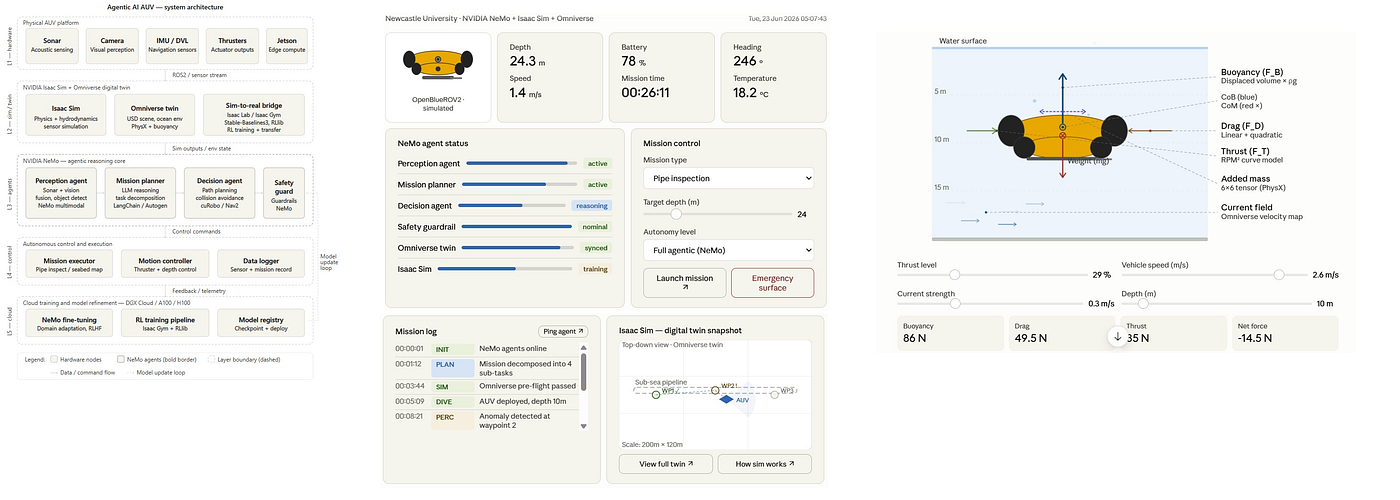
ROV Digital Twin: Physics-Informed AI Dynamics Platform for Real-Time Autonomous Underwater Vehicle…
I wanted to see how far I could get on a research-grade ROV digital twin without touching a database, an auth system, or Docker. Just the…
ROV Digital Twin: Physics-Informed AI Dynamics Platform for Real-Time Autonomous Underwater Vehicle Monitoring, Prediction, and Control
I wanted to see how far I could get on a research-grade ROV digital twin without touching a database, an auth system, or Docker. Just the core: real 6-DOF vehicle dynamics, a neural network that respects those dynamics while it learns, a reinforcement learning agent training alongside it, and a dashboard that shows all three arguing with each other in real time.

ROV Digital Twin: Physics-Informed AI Dynamics Platform for Real-Time Monitoring, Prediction, and Autonomous Control. The dashboard integrates a high-fidelity digital twin with Physics-Informed Neural Networks (PINNs), reinforcement learning (RL), and state estimation to provide comprehensive situational awareness of an underwater vehicle. The interface displays real-time vehicle states, including position, velocity, orientation, angular rates, battery status, power consumption, and hydrodynamic drag, alongside a 3D digital twin visualization of the vehicle trajectory. Physics-based predictions are continuously compared with measured sensor data to evaluate model accuracy, while dedicated panels monitor physics constraints, training convergence, prediction errors, residuals, and RL performance. Additional visualizations include thruster health, ocean environmental conditions, trajectory tracking, phase portraits, residual heatmaps, and correlation matrices, enabling interpretable analysis, model validation, and intelligent decision support for autonomous underwater operations.
The short answer is: further than I expected, and the most convincing part of the whole thing turned out to be a $2,700 camera-ready ROV photo with its background cut out.
Why not just simulate a blob
Most “digital twin” demos fake the physics. A dot moves on a screen, a chart ticks up, everyone nods. I wanted the underlying model to actually be the Fossen marine-craft equation:
M·ν̇ + C(ν)·ν + D(ν)·ν + g(η) = τ
That’s a rigid-body mass matrix plus added mass, a Coriolis-centripetal term that mixes rigid-body and added-mass contributions, linear and quadratic hydrodynamic damping, gravity and buoyancy restoring forces, and a six-thruster vectored allocation matrix mapping normalized thrust commands to generalized forces. I used BlueROV2-Heavy-class parameters (11.5 kg mass, slightly positive 114.8 N buoyancy against 112.8 N weight, the usual added-mass coefficients from the drone/ROV literature) and integrated with RK4 at a 0.05s step. No shortcuts on the physics, because everything downstream depends on it being right.
Teaching a network to respect the equation it’s approximating
The PINN maps (η, ν, thrust) to ν̇, the same thing the physics engine computes analytically. Its loss is a weighted sum of three terms: a standard MSE against the physics engine’s own output (acting as the labeled data source here, since there’s no real sensor feed yet), a physics residual computed by plugging the network’s prediction back into the Fossen equation and measuring how far off M·ν̇_hat lands from τ — C — D — g, and a boundary penalty that discourages implausible accelerations. All three terms are differentiable end to end, so the physics residual actually shapes the gradients during training rather than sitting there as a post-hoc sanity check.
One training step runs in about 5 milliseconds on CPU. That number matters more than it sounds: it’s what makes it possible to train the network incrementally, one mini-batch per simulation tick, and stream the loss curves live instead of running a separate offline training job and importing results afterward.
A PPO agent training in the background
Alongside the PINN, a Stable-Baselines3 PPO agent trains on a Gymnasium environment wrapping the same physics engine, with a waypoint-tracking reward (negative distance to goal, a velocity penalty, an effort penalty, plus a completion bonus inside 0.3m of the target). Ten scenario presets swap in different goals and disturbances, including a current push and a thruster kill triggered at the halfway point of an episode. The trainer exposes train_chunk() so it can advance a few hundred timesteps per dashboard tick rather than blocking on a full model.learn() call, and the RL Monitor panel shows reward, policy loss, value loss, and entropy as they update.
The dashboard, and the bug that almost shipped
The dashboard itself runs on Dash: a dark, single-page layout with a header status bar, twelve KPI cards, a 3D trajectory view, side-by-side physics-vs-PINN-vs-measured charts across all six degrees of freedom, a physics-constraints panel showing momentum and energy residuals as a live satisfaction percentage, training and RL monitors, thruster gauges, an ocean-environment readout, a residual heatmap, and a correlation matrix. All of it polls a single in-process simulation engine every 500 milliseconds through a Dash Store, which ticks the physics, runs one PINN step, and runs a PPO chunk every fifth tick.
I tested this the way I’d want someone testing code I depend on: not by eyeballing the browser, but by hitting Dash’s internal _dash-update-component endpoint directly with curl, feeding it real engine state, and checking every one of the thirteen callbacks returns 200 with sane numbers. That's how I caught a genuine bug before it shipped: two of the Plotly figures were passing margin twice, once inside a shared base layout dict and once explicitly, which Python's **kwargs unpacking correctly refused to allow. A five-minute fix, but the kind of thing that's invisible until you actually exercise the code path with real data instead of trusting that it "looks right" in the editor.
Where the real photo comes in
The 3D trajectory plot is honest but abstract: lines and a cone marker in Plotly’s WebGL renderer. It tells you where the vehicle is, not what it looks like. So I took an actual product photo of a BlueROV2-Heavy, thresholded out the white studio background by brightness and saturation, feathered the edges, and dropped the cutout into a small HUD panel beneath the 3D plot.
The trick is that the sprite isn’t decorative. Its CSS transform, rotateX for pitch, rotateY for roll, rotateZ for negative yaw, reads directly from the same live orientation state driving every other panel. I checked this against the engine's own numbers before calling it done: at a genuine pitch of 19.6 degrees, roll of 2.8 degrees, and yaw of -21.6 degrees, the rendered transform matched exactly. A brightness falloff tied to depth adds a cheap but effective sense of the vehicle sinking away from the surface.
It’s not a rigged 3D model. It won’t hold up from an arbitrary camera angle, and if you wanted this in a client demo, a proper Three.js mesh is the honest next step. But for the cost of fifteen minutes of image thresholding, it does something the vector graphics couldn’t: it makes the pose indicator legible at a glance, because your eye already knows what a BlueROV2 rolling five degrees to starboard looks like.
What’s still missing, on purpose
There’s no database, so training history and scenario runs vanish on restart. There’s no auth, so anyone with the URL can hit Start, Reset, or the PPO toggle. The update cadence is 500ms, not the 100ms a production telemetry system would want, because a full tick, physics plus a PINN step plus a periodic PPO chunk, runs 50 to 80 milliseconds on CPU before Dash’s polling overhead even gets added. Getting to genuine 100ms means moving simulation and training off the request thread and pushing updates over a WebSocket instead of polling for them. That’s the next layer: FastAPI wrapping the same engine, then Postgres for persistence, then auth, then Docker once there’s something worth containerizing.
None of that changes what’s already true here, which is that the physics is real, the PINN’s loss function is genuinely constrained by that physics rather than faking it, the RL agent is actually learning rather than playing back a script, and every callback in the dashboard has been checked against live data rather than assumed to work.
메타데이터
- post_id
- 4e1cc174345e
- slug
- rov-digital-twin-physics-informed-ai-dynamics-platform-for-real-time-autonomous-underwater-vehicle-4e1cc174345e
- url
- https://medium.com/@mcschin75/rov-digital-twin-physics-informed-ai-dynamics-platform-for-real-time-autonomous-underwater-vehicle-4e1cc174345e
- canonical_url
- https://medium.com/@mcschin75/rov-digital-twin-physics-informed-ai-dynamics-platform-for-real-time-autonomous-underwater-vehicle-4e1cc174345e
- author_url
- https://medium.com/@mcschin75
- status
- ok
- fetched_at
- 2026-09-07 18:01:18