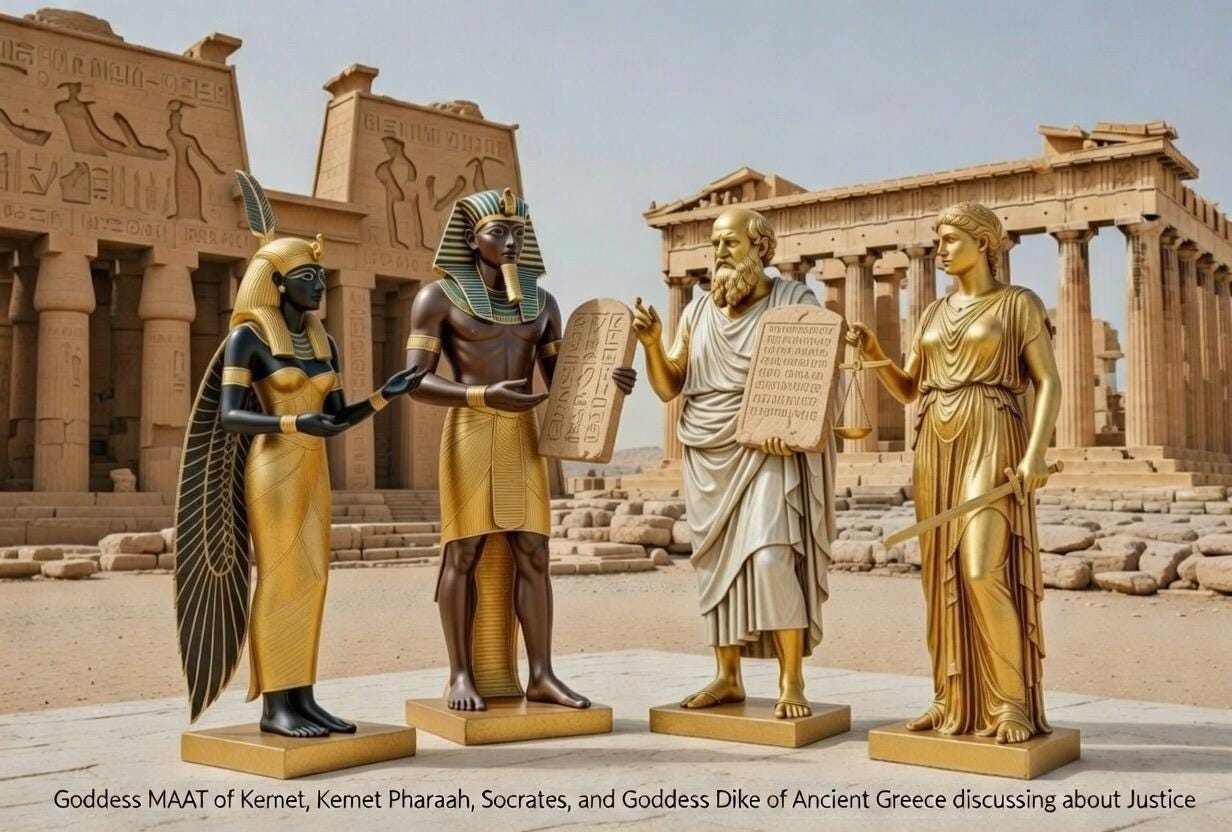
Ancient Greek Testimonies on Kemet Science: Restoring Facts over Speculations
Ancient Greek Testimonies on Kemet Science: Restoring Facts over Speculations

Abstract
This study reexamines the longstanding testimonies of ancient Greek authors concerning the intellectual traditions of Kemet (ancient Egypt) and their influence on Greek science, philosophy, and cultural institutions. Drawing on primary sources from writers such as Herodotus, Plato, Isocrates, Strabo, and later Neoplatonists, the paper analyzes the consistency of Greek acknowledgments that Egyptian priestly traditions contributed to early developments in geometry, astronomy, cosmology, and religious thought. The study also reviews the historiographical evolution of modern interpretations — from the nineteenth-century “Greek Miracle” paradigm to contemporary hybridity models — which often treat these testimonies with skepticism due to the lack of direct Egyptian corroboration.
Through textual analysis, comparative historical evaluation, and examination of institutional developments such as the Alexandrian Mouseion, this research argues that modern scholarship frequently applies asymmetrical evidentiary standards when assessing Greek statements about Egypt. Rather than presenting Greek achievements as either wholly independent or entirely derivative, the article proposes a balanced interpretation that recognizes the Greeks’ own self-attested intellectual debts while preserving their role as transformative innovators. By restoring methodological weight to ancient testimonies and situating them within the broader network of Mediterranean cultural exchange, the study contributes to a more nuanced understanding of how knowledge developed across interconnected civilizations.
Ancient Greek sources spanning more than six centuries — from Herodotus and Plato to Strabo, Diodorus Siculus, Iamblichus, and Porphyry — consistently credit Kemet (ancient Egypt) with foundational contributions to geometry, astronomy, mathematics, concepts of soul immortality and transmigration, and philosophical seeds (Herodotus, Histories 2.109; Plato, Timaeus 21e–25d; Isocrates, Busiris 28). Greek thinkers (Thales, Pythagoras with extended stays, Plato, Eudoxus) are reported to have studied under Egyptian priests, even as they explicitly differentiated their own dynamic, rational, and dialectical civilization from Kemetic stability, antiquity, and priestly tradition (Herodotus, Histories 2.35–36, 2.80; Plato, Laws 656d–657b). The Greeks encountered a Kemet already in political decline during the Late Period, yet they recognized its enduring institutional depth and systematic production of knowledge through state-supported temple centers such as the Houses of Life (Per Ankh) (Ritner 2021; Stocks 2023).
Modern scholarship, shaped by 19th–20th-century paradigms (“Greek Miracle,” post-Champollion source criticism, Aryan Model legacies), has often heavily qualified these accounts as exaggerated, legendary, rhetorical, or unverifiable, citing the absence of explicit Egyptian corroboration (Lefkowitz 1996; Bernal 1987–2006). Such absence is historically explicable given the oral and esoteric nature of priestly knowledge and substantial record loss during the Late Period (Huff 2017). Post-20th-century archaeology (Naucratis as a Greco-Egyptian hub from the 7th century BCE, mercenary settlements, Ptolemaic syncretism) has confirmed the structural context of sustained exchange (Villing 2006; British Museum Naukratis Project 2020s updates), making continued heavy skepticism increasingly speculative rather than strictly evidential.
This study affirms Greek ownership, agency, and transformative originality while arguing that modern interpretations denying or heavily qualifying the Greeks’ explicit, consistent, and long-sustained self-attributions of Kemet as the foundation of their own creations and development rest on more speculative grounds than the primary testimonies themselves. It highlights persistent interpretive asymmetries: generous “historical kernel” treatment for Homeric epic despite uncertain authorship and minimal corroboration (Latacz 2004), acceptance of Roman claims of Greek heritage despite incomplete Greek confirmation, and detailed acceptance of Alexander’s campaign in Egypt despite limited Egyptian narrative support (Bosch-Puche 2014) — contrasted with stricter demands placed on Greek prose about intellectual debts to Kemet. Recent scholarship (2010s–2026) increasingly recognizes hybridity and mutual enrichment without denying Greek qualitative leaps (Trnka-Amrhein 2022; Meccariello EduGRE project 2024–2029). The aim of this study is to restore factual balance: treat the ancient Greeks’ own candid recognitions of Kemet as primary evidence deserving serious weight, honoring their intelligence and honesty rather than subordinating them to selective modern caution.
Keywords: Ancient Greek testimonies, Kemet (Ancient Egypt), Greek philosophy, cultural transmission, historiography, Hellenistic science; Alexandria; intellectual exchange, classical scholarship, Intellectual influence, Greek Miracle paradigm, Afrocentrism critique, Ptolemaic synthesis, Mouseion, cultural hybridity, Eurocentrism, scholarly asymmetry, Herodotus, Pythagoras, Plato, stoneworking technology, historical humility.
Introduction
The relationship between ancient Greek intellectual traditions and earlier civilizations of the eastern Mediterranean and North Africa has long been a subject of historical debate. Greek philosophy, mathematics, and science are widely regarded as foundational developments in the history of human thought, yet many ancient Greek authors themselves repeatedly acknowledged earlier traditions of knowledge originating in Kemet (ancient Egypt). Writers such as Herodotus, Plato, and Isocrates described Egypt as a repository of ancient wisdom where Greek thinkers encountered advanced traditions in mathematics, astronomy, religion, and philosophical speculation. These testimonies, preserved across centuries of Greek literature, suggest that early Greek intellectual life emerged within a broader environment of intercultural contact and exchange.
Despite the prominence of these statements in classical sources, modern historiography has often approached them with caution or skepticism. Since the nineteenth century, influential interpretive frameworks — especially those associated with the “Greek Miracle” paradigm — have tended to emphasize the autonomy and originality of Greek civilization. Within this framework, Greek accounts of Egyptian intellectual influence are frequently interpreted as rhetorical admiration, legendary tradition, or cultural idealization rather than as historically credible testimony. As a result, a tension has emerged between the explicit acknowledgments recorded in ancient sources and the interpretive models commonly employed in modern classical scholarship.
This study addresses that tension by reassessing the credibility of ancient Greek testimonies concerning Kemet and by examining how these testimonies have been interpreted in modern scholarship. Rather than attempting to argue that Greek intellectual achievements were wholly derived from Egyptian knowledge, the article adopts a historiographical approach focused on methodological balance. When numerous independent Greek authors consistently attribute elements of their intellectual heritage to Egyptian traditions, these statements constitute a body of primary historical evidence that warrants careful evaluation rather than automatic qualification.
By returning to the ancient sources themselves and situating them within the broader context of Mediterranean cultural exchange, this research aims to clarify how Greek intellectual traditions interacted with earlier systems of knowledge. Recognizing such interactions does not diminish the originality of Greek thought; instead, it places that originality within the historical processes through which knowledge has always developed — through observation, adaptation, and cross-cultural transmission.
The ancient Greeks engaged with Kemet during a period when pharaonic civilization, once at its zenith in the New Kingdom, had entered long-term political decline (Late Period, c. 664–332 BCE). After the New Kingdom’s peak, Egypt experienced fragmentation, the brief Saite renaissance, and two periods of Persian domination (Huff 2017). Greek thinkers who reportedly studied there — Thales (c. 624–546 BCE), Pythagoras (c. 570–495 BCE), Plato (c. 428–348 BCE), and Eudoxus (c. 408–355 BCE) — encountered a civilization weakened politically yet still possessing deep institutional continuity, monumental legacy, and systematic production of knowledge.
Despite this decline, Greek testimonies consistently portray Kemet as a profound repository of ancient wisdom. Herodotus credits Egyptians with originating geometry for Nile surveying and ideas of soul immortality (Histories 2.109, 2.123). Plato praises Egyptian educational stability and preservation of records lost elsewhere due to catastrophes (Timaeus 21e–25d). Isocrates states that Pythagoras brought philosophy to Greece after studying in Egypt (Busiris 28). These accounts appear across genres (historiography, philosophy, rhetoric) and span more than six centuries, from the Archaic and Classical periods through Hellenistic and Roman times. Later compilers (Strabo, Diodorus Siculus, Diogenes Laërtius, Iamblichus, Porphyry) transmit the same core narrative (Iamblichus, On the Pythagorean Life 3–4).
Crucially, the Greeks were not uncritical admirers. They demonstrated acute self-awareness and intellectual honesty by explicitly differentiating their own dynamic, rational, and dialectical civilization from Kemetic stability, antiquity, and priestly tradition. Herodotus contrasts customs (gender roles, priestly appearance, monarchy versus freedom) (Histories 2.35–36, 2.80). Plato uses Egypt as a foil to critique Athenian flux while implying Greek philosophy achieves higher rational development (Laws 656d–657b). This dual stance — sharp differentiation combined with candid recognition of debts — reflects confident thinkers secure enough to credit predecessors without diminishing their own innovations. They transformed borrowed elements (geometry, astronomical observations, soul concepts) into deductive proof, rational naturalism, and dialectical inquiry (Huffman 2014).
The Greeks also observed something striking about Kemet’s society: knowledge and wisdom were systematically institutionalized. Unlike Greek private schools dependent on sponsors and often operating in politically hostile or unstable environments, Kemetic priests were public servants supported by the pharaonic crown. The Houses of Life (Per Ankh) in major temples functioned as state-supported scriptoria, observatories, medical schools, and centers for mathematics, astronomy, and theology (Ritner 2021; Stocks 2023). Greek visitors could not have missed this mature, royally integrated system of knowledge production. Their emphasis on Egyptian priestly learning was therefore not casual admiration but a reasoned comparative judgment. Several early Greek schools (Plato’s Academy, Aristotle’s Lyceum, Pythagorean communities) appear to have drawn organizational inspiration from the Kemetic temple model — communal study, master-disciple transmission, sustained multidisciplinary pursuit — while innovating by secularizing both the institutional form and much of the content.
The “Ancient Model” of Egyptian priority dominated classical antiquity. However, 19th–early 20th-century historiographical shifts — Enlightenment rationalism, Romantic historiography, nationalism, racial theories, and the Aryan Model — reframed Greek philosophy as an autochthonous “miracle,” treating Egypt as myth-bound and static (Bernal 1987). Greek testimonies were reinterpreted as projections or exaggerations. Post-Champollion decipherment emphasized the absence of explicit Egyptian records (understandable given orality, esotericism, and prior Late Period losses), reducing claims to legendary tradition (Lefkowitz 1996).
Recent scholarship (2010s–2026) shows genuine progress toward recognizing hybridity via Naucratis trade and mercenaries, Ptolemaic syncretism, proto-philosophical parallels (Ma’at and cosmology), and institutional continuities (Trnka-Amrhein 2022; Meccariello EduGRE project 2024–2029). Post-20th-century archaeology has confirmed the structural context of sustained Greco-Egyptian exchange (Villing 2006; British Museum Naukratis Project 2020s), making continued heavy skepticism increasingly speculative. Ptolemaic Alexandria itself institutionalized this flow: the Mouseion and Library adapted Kemetic temple traditions (Per Ankh) into a Hellenistic framework, preserving what survived earlier losses and validating the substance of earlier Greek admiration (Erskine 1995).
This study adopts a corrective tone because the issue is direct: the Greeks candidly recognized debts using consistent inquiry methods they applied across topics, yet modern interpretations often subordinate those recognitions to asymmetrical caution. It highlights double standards — generous “historical kernel” treatment for Homeric epic despite uncertain authorship and minimal corroboration (Latacz 2004), acceptance of Roman claims of Greek heritage despite incomplete Greek confirmation, and detailed acceptance of Alexander’s campaign in Egypt despite limited Egyptian narrative support (Bosch-Puche 2014) — contrasted with stricter demands placed on Greek prose about intellectual debts to Kemet. The aim is not to deny Hellenic genius but to restore factual status to the Greeks’ own historical self-understanding against layers of modern speculation, honoring their intelligence and honesty in both distinguishing and crediting.
0. 0. Aim, Scope and Methodology
0. 1. Aim and Scope of the Study
The aim of this article is neither to diminish the originality of ancient Greek civilization nor to endorse interpretations that attribute Greek intellectual achievements exclusively to external sources. Greek philosophy, mathematics, science, and political thought remain among the most significant developments in the history of human knowledge, and their originality and transformative impact are widely recognized. The purpose of this study is instead more specific and methodological: to reassess the credibility of ancient Greek testimonies that refer to the intellectual traditions of Kemet (ancient Egypt) and to examine how those testimonies have been treated in modern historiography.
The sole and explicit aim of this work is narrower and more precise: to demonstrate that modern interpretations which heavily qualify, downplay, reframe as “legendary,” “exaggerated,” “rhetorical,” or “unverifiable” the explicit, consistent, and repeated ancient Greek recognitions of debts to Kemet are — in many cases — not strictly factual, but speculative. When multiple independent Greek authors across centuries (Herodotus, Plato, Isocrates, Strabo, Diogenes Laërtius, Iamblichus, Porphyry, and others) candidly state that they drew geometry, astronomical knowledge, concepts of soul immortality and transmigration, and philosophical seeds from Egyptian priestly traditions — and when these statements are uncontradicted by any contemporary source, converge with archaeological evidence of exchange (Naucratis), and find institutional echoes in Ptolemaic syncretism — the heavier modern skepticism frequently rests on the argument from silence (absence of direct Egyptian corroboration) rather than on positive disproof or contradictory evidence.
Ancient Greek authors themselves repeatedly described Egypt as a civilization possessing ancient and highly developed traditions of knowledge that they recognized as the foundation on which they build their own ones. Writers such as Herodotus, Plato, Isocrates, and Diodorus Siculus referred to Egypt as a repository of learning for Ancient Greeks in areas such as religion, mathematics, astronomy, and philosophy. These references appear across different genres — historiography, philosophy, and rhetoric — and span several centuries of Greek intellectual history. As primary testimonies, such statements constitute an important body of historical evidence concerning how Greek intellectuals themselves understood the origins and development of knowledge.
However, modern interpretations of these testimonies have often been shaped by historiographical frameworks that emerged during the nineteenth and early twentieth centuries. In many of these interpretations, the rise of Greek science and philosophy has been presented as an essentially autonomous phenomenon, sometimes described as the “Greek miracle.” Within such frameworks, references to Egyptian influence found in Greek sources are frequently treated with a degree of skepticism that is not always applied to other aspects of those same sources. The result has been a historiographical tension between the explicit statements of ancient authors and the interpretive models used to explain the development of Greek intellectual traditions.
Given the oral and esoteric character of much Kemetic priestly knowledge, the perishable nature of papyrus records, and the passage of over two millennia, such absence is historically explicable and does not equate to refutation. Yet the same evidentiary standard is not applied with equal rigor to Greek reports on other cultures (e.g., Persian administration or internal Greek affairs), creating an asymmetry that has persisted since 19th-century historiographical shifts. When primary testimony is consistent, multi-sourced, and contextually supported, it is the modern tendency to subordinate or dismiss those candid Greek self-attributions that becomes the more speculative position.
The tone of this article — direct, corrective, at times pointed — is therefore intentional and functional to its purpose. A deliberately restrained or neutral voice would risk softening or conceding ground to the very interpretive caution this work seeks to challenge. The Greeks themselves were unapologetic in crediting older wisdom while asserting their own advancements; this study emulates that candor. By calling attention to asymmetries, historiographical legacies, and the speculative character of certain modern qualifications, the article aims to restore factual balance: the ancient Greeks’ own recognition of Kemet’s role should be treated as primary evidence deserving serious weight, not as a claim to be reflexively hedged or discounted.
This clarification is offered so that readers may engage the argument with full awareness of its intent: not to erase Greek achievement, but to defend the factual status of their own historical self-understanding against layers of modern speculation.
The objective of this study is therefore to examine this tension by returning to the ancient testimonies themselves and by evaluating them within a broader historical context of intercultural exchange in the ancient Mediterranean world. The article does not claim that Greek intellectual achievements were merely derivative of earlier Egyptian knowledge, nor does it attempt to construct a narrative in which Greek science or philosophy is wholly dependent upon Egyptian precedents. Rather, it seeks to restore methodological balance by recognizing that Greek authors themselves acknowledged earlier traditions of learning in Egypt and that these acknowledgments deserve careful consideration.
It is also important to distinguish the approach adopted in this study from certain contemporary debates that have framed the question of Egyptian influence in highly polarized terms. On one side, some interpretations emphasize the absolute originality of Greek civilization and treat external influences as negligible. On the other, certain Afrocentric interpretations have argued for extensive or direct derivation of Greek intellectual traditions from Egyptian sources. The present study does not adopt either of these positions. Instead, it approaches the issue as a historiographical problem concerning the interpretation of ancient sources and the methodological standards applied to them.
The tone adopted in parts of this article reflects the intention to address this historiographical imbalance directly. Because the discussion concerns long-standing assumptions in classical scholarship, the analysis necessarily engages critically with prevailing interpretations. Such critique should not be understood as a dismissal of Greek achievements nor as an attempt to replace one form of historical exaggeration with another. Rather, it reflects the conviction that ancient testimonies — particularly when they are numerous and consistent — should not be discounted without careful methodological justification.
Ultimately, the scope of this study is limited to reassessing the historical credibility of Greek testimonies concerning Egypt and to situating those testimonies within the wider intellectual exchanges of the ancient Mediterranean world. By doing so, the article seeks to contribute to a more balanced understanding of how knowledge developed across interconnected civilizations. Recognizing the possibility of intellectual interactions between Greece and Egypt does not diminish the originality of Greek thought; instead, it situates that originality within the broader historical processes through which human knowledge has always evolved.
0. 2. Scientific Issue of the Study
The study takes seriously the intellectual character of the Greek authors themselves, who were highly observant, analytical, and capable of making clear distinctions between their own civilization and those of other peoples. Greek writers such as Herodotus, Plato, and Isocrates repeatedly demonstrated the ability to compare cultures critically, noting differences in customs, institutions, and intellectual traditions. Precisely because these authors showed such cultural awareness and analytical capacity, their explicit acknowledgments of earlier traditions of learning in Kemet (ancient Egypt) deserve careful consideration.
Ancient Greeks were very intelligent and honest people. What they said is very clear and can be summarized as follows: ‘’we created our own civilization, culture, philosophy and science by innovating, which are different; however we did it thanks to the foundation, inspiration and learning we got from Kemet’’. There is no need to overinterpret or dismiss such very clear testimony made from systematic observations of facts over many centuries by people to whom the modern world owes the foundation of rationality and scientific thinking.
In numerous passages across Ancient Greek historiography, philosophy, and later biographical traditions, these authors openly recognized the primacy and foundation of Egyptian priestly knowledge in fields such as geometry, astronomy, religious thought, and the preservation of ancient records. They explicitly attributed such primacy and foundation to their own creations without deny the ownership of later development of their creations. The study therefore interprets these testimonies not as naïve admiration or rhetorical embellishment, but as systematic observations produced by intelligent and honest observers who applied similar empirical and comparative methods when describing their own society as well as other foreign cultures. From this perspective, Greek testimonies about Kemet constitute a body of primary historical evidence reflecting sustained intercultural contact and intellectual exchange within the ancient Mediterranean world. The central concern of the study is therefore historiographical rather than polemical: it highlights the asymmetrical evidentiary standards often applied in modern interpretations of these sources. While Greek accounts are frequently treated as broadly credible when describing Persian administration, internal Greek affairs, or other historical matters; their statements crediting Egyptian intellectual traditions are often subjected to heightened skepticism or reinterpreted as purely symbolic admiration. By drawing attention to this interpretive imbalance, the study argues for a more methodologically consistent approach that acknowledges both Greek originality and the Greeks’ own candid recognition of earlier traditions of knowledge in Kemet as the foundation and inspiration of their own creations, development and innovations.
A central methodological issue in the interpretation of ancient historical testimony concerns the evidentiary standards applied to sources from Antiquity. Much of modern historical methodology developed in the nineteenth and twentieth centuries within scholarly environments that benefited from abundant documentation, archival records, and multiple independent sources. These conditions allowed historians to establish rigorous criteria of corroboration, including contemporaneous documentation, cross-referencing of independent accounts, and material or archaeological confirmation. While such standards are valuable tools for historical inquiry, their strict application to the study of Antiquity can produce significant methodological challenges. The historical record of the ancient world is inherently fragmentary, shaped by the uneven survival of texts, the destruction of archives, and the transmission of knowledge through literary traditions rather than systematic documentation. As a result, many events and intellectual interactions from the ancient Mediterranean cannot be corroborated according to modern evidentiary expectations.
For this reason, the study of ancient history has always required historians to work with incomplete and often singular sources of testimony. Classical authors such as Herodotus, Thucydides, and later writers such as Tacitus remain indispensable to historical reconstruction despite the limitations of their evidence and the literary conventions of their time. Their works contain reconstructed speeches, transmitted traditions, and observations derived from earlier sources that are not always independently verifiable. Yet historians continue to engage with these texts because they represent some of the most valuable surviving voices from the ancient world. To dismiss such testimony solely because it lacks modern forms of corroboration would render large portions of ancient history inaccessible.
This methodological tension becomes particularly evident when interpreting ancient accounts of intercultural contact and intellectual exchange. The historical realities of the ancient Mediterranean involved extensive travel, diplomatic interaction, and the circulation of knowledge across cultural boundaries. However, the documentation of such exchanges rarely survives in a form that satisfies modern historiographical expectations. Consequently, when ancient authors report encounters with foreign traditions of knowledge, their testimony must be evaluated within the broader context of ancient literary practices and historical memory. To impose modern evidentiary standards too rigidly on such accounts risks introducing anachronism into historical interpretation, judging ancient forms of documentation according to criteria that did not exist within the intellectual frameworks of the ancient world.
A balanced historiographical approach therefore requires recognizing both the limitations and the value of ancient testimony. Rather than dismissing such accounts due to the absence of modern corroboration, historians must interpret them critically while acknowledging the historical contexts in which they were produced. Ancient texts frequently preserve cultural memory, scholarly traditions, and observations that may reflect genuine historical interactions, even when direct documentary evidence is no longer available. In this sense, the challenge for historians of Antiquity is not to apply modern standards uncritically, but to develop interpretive frameworks that respect the nature of ancient sources while remaining attentive to the complexities of historical reconstruction.
A further dimension of the evidentiary debate concerns the broader methodological asymmetry that can emerge when interpreting ancient sources across different cultural contexts. Much of what is known about early Greek history itself depends on traditions that were transmitted through oral memory before being preserved in written form. The epic poems attributed to Homer — most notably the Iliad and the Odyssey — are widely recognized by scholars as products of a long oral tradition that preceded their eventual textualization. These works preserve cultural memory, genealogies, accounts of conflicts, and descriptions of social structures that cannot always be corroborated through independent written documentation. Yet despite the absence of contemporaneous records for many of the events described, such traditions remain foundational sources for reconstructing aspects of early Greek society, identity, and historical consciousness.
This methodological reliance on oral tradition and memorial transmission is not unique to the Greek world. In many regions, including large parts of Africa, historical knowledge has likewise been preserved through sophisticated systems of oral narration, genealogical memory, and institutionalized storytelling. Such traditions often served as mechanisms through which communities transmitted collective knowledge across generations long before the establishment of widespread written documentation. In both contexts, the preservation of historical memory depended on trained narrators, cultural custodians, and communal structures designed to maintain continuity with the past. Consequently, oral traditions have become an essential component of historical reconstruction in societies where written archives are fragmentary or were never systematically produced.
When different evidentiary standards are applied unevenly to such traditions, a methodological asymmetry can arise. If oral or memorial transmission is considered an acceptable foundation for reconstructing significant aspects of early Greek history, while similar forms of historical memory in other cultural contexts are treated with greater skepticism, the resulting interpretive framework risks creating an artificial imbalance in historical methodology. The consequence of such asymmetry is not merely theoretical: if the strictest modern evidentiary standards were applied uniformly and without contextual flexibility, large portions of both early Greek history and many African historical traditions would become extremely difficult to reconstruct. Much of the historical narrative of the ancient world would simply disappear due to the scarcity of surviving documentation.
Recognizing this methodological challenge does not require abandoning critical evaluation of sources. Rather, it highlights the need for a consistent and contextually sensitive approach to the interpretation of ancient evidence. Oral traditions, memorial transmission, and literary testimonies represent different forms of historical preservation that must be analyzed within their cultural and historical environments. When approached carefully, such sources can provide valuable insights into past societies, even when they do not conform to modern archival standards. A balanced historiographical methodology therefore requires both critical scrutiny and an awareness of the diverse ways in which human societies have preserved and transmitted knowledge about their past.
A central methodological issue in the interpretation of ancient historical testimony concerns the evidentiary standards applied to sources from Antiquity. Much of modern historical methodology developed in the nineteenth and twentieth centuries within scholarly environments that benefited from abundant documentation, archival records, and multiple independent sources. These conditions allowed historians to establish rigorous criteria of corroboration, including contemporaneous documentation, cross-referencing of independent accounts, and material or archaeological confirmation. While such standards are valuable tools for historical inquiry, their strict application to the study of Antiquity can produce significant methodological challenges. The historical record of the ancient world is inherently fragmentary, shaped by the uneven survival of texts, the destruction of archives, and the transmission of knowledge through literary traditions rather than systematic documentation. As a result, many events and intellectual interactions from the ancient Mediterranean cannot be corroborated according to modern evidentiary expectations.
For this reason, the study of ancient history has always required historians to work with incomplete and often singular sources of testimony. Classical authors such as Herodotus, Thucydides, and later writers such as Tacitus remain indispensable to historical reconstruction despite the limitations of their evidence and the literary conventions of their time. Their works contain reconstructed speeches, transmitted traditions, and observations derived from earlier sources that are not always independently verifiable. Yet historians continue to engage with these texts because they represent some of the most valuable surviving voices from the ancient world. To dismiss such testimony solely because it lacks modern forms of corroboration would render large portions of ancient history inaccessible.
This methodological tension becomes particularly evident when interpreting ancient accounts of intercultural contact and intellectual exchange. The historical realities of the ancient Mediterranean involved extensive travel, diplomatic interaction, and the circulation of knowledge across cultural boundaries. However, the documentation of such exchanges rarely survives in a form that satisfies modern historiographical expectations. Consequently, when ancient authors report encounters with foreign traditions of knowledge, their testimony must be evaluated within the broader context of ancient literary practices and historical memory. To impose modern evidentiary standards too rigidly on such accounts risks introducing anachronism into historical interpretation, judging ancient forms of documentation according to criteria that did not exist within the intellectual frameworks of the ancient world.
A balanced historiographical approach therefore requires recognizing both the limitations and the value of ancient testimony. Rather than dismissing such accounts due to the absence of modern corroboration, historians must interpret them critically while acknowledging the historical contexts in which they were produced. Ancient texts frequently preserve cultural memory, scholarly traditions, and observations that may reflect genuine historical interactions, even when direct documentary evidence is no longer available. In this sense, the challenge for historians of Antiquity is not to apply modern standards uncritically, but to develop interpretive frameworks that respect the nature of ancient sources while remaining attentive to the complexities of historical reconstruction.
A further dimension of the evidentiary debate concerns the broader methodological asymmetry that can emerge when interpreting ancient sources across different cultural contexts. Much of what is known about early Greek history itself depends on traditions that were transmitted through oral memory before being preserved in written form. The epic poems attributed to Homer — most notably the Iliad and the Odyssey — are widely recognized by scholars as products of a long oral tradition that preceded their eventual textualization. These works preserve cultural memory, genealogies, accounts of conflicts, and descriptions of social structures that cannot always be corroborated through independent written documentation. Yet despite the absence of contemporaneous records for many of the events described, such traditions remain foundational sources for reconstructing aspects of early Greek society, identity, and historical consciousness.
This methodological reliance on oral tradition and memorial transmission is not unique to the Greek world. In many regions, including large parts of Africa, historical knowledge has likewise been preserved through sophisticated systems of oral narration, genealogical memory, and institutionalized storytelling. Such traditions often served as mechanisms through which communities transmitted collective knowledge across generations long before the establishment of widespread written documentation. In both contexts, the preservation of historical memory depended on trained narrators, cultural custodians, and communal structures designed to maintain continuity with the past. Consequently, oral traditions have become an essential component of historical reconstruction in societies where written archives are fragmentary or were never systematically produced.
When different evidentiary standards are applied unevenly to such traditions, a methodological asymmetry can arise. If oral or memorial transmission is considered an acceptable foundation for reconstructing significant aspects of early Greek history, while similar forms of historical memory in other cultural contexts are treated with greater skepticism, the resulting interpretive framework risks creating an artificial imbalance in historical methodology. The consequence of such asymmetry is not merely theoretical: if the strictest modern evidentiary standards were applied uniformly and without contextual flexibility, large portions of both early Greek history and many African historical traditions would become extremely difficult to reconstruct. Much of the historical narrative of the ancient world would simply disappear due to the scarcity of surviving documentation.
Recognizing this methodological challenge does not require abandoning critical evaluation of sources. Rather, it highlights the need for a consistent and contextually sensitive approach to the interpretation of ancient evidence. Oral traditions, memorial transmission, and literary testimonies represent different forms of historical preservation that must be analyzed within their cultural and historical environments. When approached carefully, such sources can provide valuable insights into past societies, even when they do not conform to modern archival standards. A balanced historiographical methodology therefore requires both critical scrutiny and an awareness of the diverse ways in which human societies have preserved and transmitted knowledge about their past.
0. 3. Methodology
This research employs a qualitative historical and historiographical analysis grounded in primary and secondary sources. The methodological approach consists of several complementary components.
Textual Analysis of Ancient Sources: Primary Greek texts are examined to identify explicit references to Egyptian knowledge and influence. These include writings by Herodotus, Plato, Isocrates, Diodorus Siculus, and Strabo. Their testimonies are analyzed within their historical and literary contexts to assess how they described Egyptian knowledge systems.
Historiographical Review: Modern scholarly interpretations — from nineteenth-century “Greek miracle” models to contemporary discussions influenced by works such as Black Athena — are reviewed to identify dominant paradigms and methodological assumptions in classical studies and Egyptology.
Comparative Historical Analysis: The study compares Greek testimonies with archaeological evidence and institutional developments, particularly the intellectual environment of Alexandria during the Hellenistic period. Scholars such as Euclid, Eratosthenes, and Claudius Ptolemy are examined within the context of Alexandria’s scholarly institutions and their integration of Egyptian and Near Eastern knowledge.
Evaluation of Interpretive Bias: The study also assesses methodological asymmetries in modern scholarship, particularly differences in how Greek sources are treated when discussing Egypt compared with other cultures such as Persia. This step aims to determine whether interpretive frameworks reflect consistent evidentiary standards.
Through these combined approaches, the research seeks to reconstruct a historically balanced understanding of intellectual exchange between ancient Greece and Kemet.
1. 0. Synopsis on Interpretative Theories Criticizing Ancient Greek Testimonies on Kemet
The main interpretive theories and models in modern scholarship that criticize or downplay ancient Greek testimonies regarding the influence of Kemet (ancient Egypt) on Greek philosophy, science, mathematics, and culture emerged primarily in the 19th and 20th centuries. These approaches contrast sharply with the “Ancient Model” prevalent in classical antiquity and much of pre-modern European thought, which accepted Greek attributions of intellectual debts to Egypt as largely credible (e.g., Herodotus on geometry and religious ideas, Plato on priestly wisdom in Timaeus, Isocrates on Pythagoras, and later Neoplatonists like Iamblichus and Porphyry).
The dominant modern frameworks emphasize Greek originality and treat ancient claims of Egyptian priority as exaggerated, legendary, or culturally biased, often requiring direct Egyptian textual corroboration that rarely exists due to the oral and esoteric nature of priestly knowledge and the loss of records.
1. 1. The “Greek Miracle” Paradigm (19th–Early 20th Century)
This foundational model, associated with Enlightenment and Romantic historiography (e.g., Hegel, who dismissed Africa as having “no historical part” in world development), portrayed Greek philosophy and rational science as a sudden, autochthonous breakthrough from myth to logos. Egypt was viewed as a static, myth-bound civilization lacking systematic rational inquiry. Greek testimonies (e.g., Herodotus’ claims that Egyptians originated geometry or soul immortality ideas) were reinterpreted as Hellenic projections or idealizations of an exotic “other.” Scholars like those in the Aryan Model tradition minimized Near Eastern and African influences to emphasize Indo-European uniqueness, influenced by emerging racial theories and nationalism.
1. 2. Post-Decipherment Egyptology and Source Criticism (Post-1830s)
After Jean-François Champollion’s decipherment of hieroglyphs (1822–1830s), Egyptologists gained direct access to native texts. No evidence emerged of a formal “mystery school” system educating foreigners en masse, nor of explicit records naming Greek visitors like Pythagoras or Plato. This led to widespread skepticism toward ancient Greek accounts. The Routledge Encyclopedia of Philosophy notes that pre-decipherment beliefs in Greek philosophers studying in Egypt derived partly from ancient sources but were amplified by 18th-century novels like Abbé Terrasson’s Séthos (1731), which invented elaborate educational programs. Once Egyptian sources were readable, the absence of confirmation was taken as disproof, reducing Greek claims to “legendary tradition” or rhetorical device.
1. 3. The “Afrocentrism” Backlash and Polemical Dismissal (1990s–2000s)
Martin Bernal’s Black Athena series (1987–2006) revived the Ancient Model by arguing for substantial Egyptian (and Phoenician) cultural-linguistic influence on archaic Greece, citing Greek testimonies as evidence and attributing modern denial to 19th-century racism and romantic nationalism. Critics, including Mary Lefkowitz in Not Out of Africa (1996) and the edited volume Black Athena Revisited (1996), rejected Bernal’s claims as overstated or fringe, often linking them to Afrocentric narratives (e.g., Molefi Kete Asante). They accused such views of inconsistent textual interpretation and anachronistic assertions (e.g., claims Aristotle plundered the Library of Alexandria, built after his death). Mainstream classicists and Egyptologists dismissed substantial Egyptian philosophical influence, arguing Egyptians dealt in myth and ritual while Greeks developed logic and proof-based inquiry. Lefkowitz framed the debate as myth vs. reason, portraying Egyptian-origin claims as politically motivated rather than evidence-based.
1. 4. Mainstream Consensus in Classics and Philosophy (Late 20th–Early 21st Century)
Standard reference works (e.g., Stanford Encyclopedia of Philosophy on Pythagoras, Internet Encyclopedia of Philosophy) acknowledge Greek visits to Egypt (e.g., Herodotus and Isocrates on Pythagoras) but treat them as inspirational or adaptive, not foundational. Egyptian thought is seen as wisdom literature or religious cosmology (e.g., Ma’at as cosmic order), lacking the systematic, dialectical abstraction of Greek philosophy. Influences are conceded in practical domains (geometry for surveying, astronomy observations) but denied for core philosophical leaps (e.g., Thales’ rational naturalism, Pythagorean number mysticism as Greek innovation). The Routledge entry on “Egyptian philosophy: influence on ancient Greek thought” concludes that no formal mystery system existed, and Greek accounts reflect admiration rather than direct derivation.
1. 5. Recent Nuanced Critiques and Hybridity Models (2010s–2026)
Contemporary scholarship increasingly recognizes cultural exchange via trade (Naucritics), mercenaries, and Ptolemaic syncretism, but maintains skepticism toward maximalist interpretations of Greek testimonies. Discussions in Philosophy Now (2020s issues) and comparative mythology studies note possible proto-philosophical parallels (e.g., New Kingdom ideas influencing early Greek cosmology) but emphasize Greek transformation into rational systems. Critiques of Eurocentrism (e.g., decolonizing classics) acknowledge 19th-century biases but argue Bernal-style models overcorrect, lacking linguistic and archaeological rigor. The consensus holds that while Greeks borrowed and admired, their intellectual “miracle” was a qualitative shift, not mere transmission.
Recent scholarship (2010s–2026) embraces hybridity: exchange, proto-parallels (Ma’at-cosmology) and Ptolemaic syncretism. This study engages these: ancient testimonies warrant weight as consistent primary data, especially with institutional continuity (Mouseion–Kemetic models) and archaeology. Avoiding double standards rooted in legacies by reintegrating Greek self-attestation is what this study aims to highlight. As of March 2026, scholarship on Greek-Egyptian exchange trends toward hybridity and mutual influence, aligning with emphasis on substantive recognition.
In summary, the interpretive models prioritize methodological caution (absence of Egyptian corroboration, potential exaggeration in Greek sources) and Greek exceptionalism over literal acceptance of ancient testimonies. Critics argue this creates an asymmetrical standard — Greek accounts of Persia or internal history face less stringent doubt — rooted in historical biases rather than pure evidence. Recent work shows gradual openness to hybrid influences, but the dominant view remains that Greek philosophy and science represent a transformative innovation, not direct derivation from Kemet.
2. 0. Factual Evidence from Ancient Greeks on Kemet
2. 1. Monuments and Arts as Part of Factual Evidence
The ancient civilization of Kemet (the indigenous name for Egypt, meaning “Black Land”) produced some of the most enduring monumental artworks in human history, particularly colossal hard-stone statues carved from granite, diorite, quartzite, and basalt. These include the seated figures of Khafre (Old Kingdom, ca. 2558–2532 BCE), the massive Ramses II colossi (New Kingdom, ca. 1279–1213 BCE), and Amenhotep III statues, often exceeding 10–20 meters in height and weighing hundreds of tons. Crafted with remarkable precision — near-perfect bilateral symmetry, flowing anatomical contours, and polished surfaces — these works continue to provoke scholarly debate about the techniques employed, given the hardness of the materials (Mohs 6–7) and the limitations of known Bronze Age tools.
Mainstream Egyptology attributes their creation to a labor-intensive combination of percussion and abrasion: dolerite pounders for rough quarrying and shaping (producing characteristic scoop-like depressions visible on the Unfinished Obelisk at Aswan), followed by copper or bronze saws, chisels, and tubular drills used with quartz sand (or occasionally corundum and emery) slurries as the active abrasive agent. Polishing involved finer grits and rubbing stones. This model draws from excavated tools, tool marks preserved on artifacts (e.g., spiral grooves in drill cores, parallel striations from sawing), pictorial evidence in tombs, and experimental archaeology.
Denys A. Stocks, a leading experimental archaeologist with a mechanical engineering background, has been central to validating this approach. His reconstructions and tests — detailed in Experiments in Egyptian Archaeology: Stoneworking Technology in Ancient Egypt (original 2003; updated edition 2022/2023 with over 250 tools tested) — reproduce matching tool marks on hard stones: pounding scoops identical to Aswan quarries, spiral grooves from bow-driven tubular drills with sand slurry, and saw cuts aligning with ancient striations. These component-level replications demonstrate feasibility for drilling, sawing, and surface finishing, though full-scale end-to-end recreation of a colossus remains unattempted due to logistical, financial, and temporal barriers (potentially years and decades with ancient workforce scales).
Despite these convergences — tool marks matching replications, residues (quartz sand, occasional corundum traces), and pictorial corroboration — the explanatory model faces limitations. Precision aspects, such as extreme bilateral symmetry on facial features (documented via modern metrology scans on Ramses statues) and tight geometric tolerances, strain the plausibility of purely hand-guided abrasion at monumental scale. Engineers and precision-manufacturing experts note that cumulative material removal on curved, contoured surfaces, while theoretically possible with massive labor and patience, pushes efficiency boundaries without undocumented enhancements (e.g., optimized abrasive mixtures or organizational efficiencies). No experiment has replicated a complete colossus under realistic ancient constraints, leaving gaps in proving the full workflow for the grandest masterpieces.
This interpretive caution parallels broader patterns in Egyptology when addressing cross-cultural debts. Ancient Greek sources — Herodotus (Histories Book II), Plato (Timaeus, Laws), Isocrates (Busiris), Strabo, Diodorus Siculus, and later Neoplatonists — consistently credit Kemet with originating geometry (from Nile surveying), astronomy, religious concepts (soul immortality), and philosophical seeds. Greeks describe visits to priestly centers (Heliopolis, Memphis, Thebes) for learning, with figures like Thales, Pythagoras (22 years), Plato (13 years), and Eudoxus studying under priests.
These primary testimonies receive asymmetrical treatment in modern scholarship. Greek accounts of Persia (e.g., Herodotus on Achaemenid administration, royal intrigue, or campaigns) are accepted as broadly reliable primary evidence, corroborated where possible by inscriptions or archaeology, with skepticism limited to biases or exaggerations. In contrast, the same sources’ attributions to Kemet face heavier doubt: labeled “exaggerated,” “legendary,” “rhetorical idealization,” or “unverifiable” due to absent Egyptian records naming visitors or formal teaching systems. Post-decipherment Egyptology (after 1820s) emphasized this absence, while 19th-century “Greek Miracle” paradigms (influenced by Hegel and Aryan models) prioritized Greek rational innovation over Egyptian myth-bound wisdom.
The Ptolemaic period (305–30 BCE) exemplifies continuity: the Mouseion (Museum) and Library of Alexandria adapted Kemetic temple-based scholarship — Houses of Life (Per Ankh) as scriptoria, scribal schools, and knowledge centers supporting ritual, administration, and science — into a Hellenistic framework. Royal patronage mirrored pharaonic support for temples; the institution collected and transmitted Egyptian records (e.g., Manetho’s Aegyptiaca, astronomical data in Ptolemy’s Almagest), yet achievements are framed as “Greek” science, backgrounding the Egyptian substrate.
This pattern of selective skepticism extends to Islamic Golden Age transmission of Greek texts via the Bayt al-Hikma, where prior knowledge was synthesized but credited primarily to the receiving culture. In all cases, ancient sources provide converging evidence of influence and adaptation, yet modern interpretive models often apply uneven caution — demanding corroboration for non-Greek origins while accepting Greek self-narratives or rival accounts more readily.
Scholarly humility requires acknowledging these asymmetries: ancient testimonies are primary data deserving weight when consistent and uncontradicted. Over-caution on Kemetic influence risks prioritizing ideological precedents over evidence, while component validations (e.g., Stocks’ experiments) support core techniques without claiming exhaustive explanation for every monumental feat. The Greeks’ candid attributions to Kemet — both for monumental artistry and intellectual foundations — invite a balanced reading: admiration for a cradle of wisdom, transformed through Greek innovation, without need for modern over-interpretation or downplaying.
2. 2. Ancient Greeks Who lived and Worked in Kemet
Many ancient sources (Greek historians like Herodotus, Plato, Strabo, Iamblichus, and later writers) report that several prominent Greek philosophers and scientists traveled to Kemet (ancient Egypt) to study under Egyptian priests, often in centers like Heliopolis (On), Memphis, or Thebes. These accounts describe learning in mathematics, geometry, astronomy, philosophy, medicine, and religious and mystical knowledge.
These reports are often from later traditions (Hellenistic or Roman-era), and modern scholarship views some as exaggerated or legendary — reflecting Greek admiration for Egypt as a source of ancient wisdom — while others have partial corroboration (e.g., trade contacts via Naucratis). No direct Egyptian records confirm these visits, but the cultural exchange is well-attested.
2. 2. 1. Pre-Ptolemaic and Early Periods
Here are the main figures commonly cited as having lived, worked, or developed ideas influenced by time in Kemet.
Thales of Miletus (c. 624–546 BCE) — Often called the first Greek philosopher. Ancient sources (e.g., Herodotus, Diogenes Laërtius, Proclus) say he visited Egypt, studied geometry there (possibly measuring pyramids or learning from priests), and brought back knowledge that influenced his ideas on water as the primary substance and astronomy (e.g., predicting a solar eclipse). He is frequently described as the first Greek to study in Egypt.
Pythagoras (c. 570–495 BCE) — Extensively reported (by Herodotus, Iamblichus, Porphyry, Isocrates) to have spent 22 years in Egypt studying philosophy, geometry, mathematics, medicine, and religious rites with priests in Memphis and Thebes. His doctrines on the soul’s immortality, reincarnation, number mysticism, and harmony of the spheres are linked to Egyptian influences. Thales reportedly encouraged him to go.
Plato (c. 428–348 BCE) — Ancient accounts (e.g., Strabo, Plutarch, Clement of Alexandria) claim he spent about 13 years in Egypt (possibly in Heliopolis) studying with priests, learning metaphysics, astronomy, geometry, and ethics. Plato himself praises Egyptian education in works like Laws and Timaeus (where Egyptian priests recount ancient histories to Solon). He reportedly consulted a priest named Sechnuphis or similar.
Eudoxus of Cnidus (c. 408–355 BCE) — A mathematician and astronomer (Plato’s associate). Sources (e.g., Diogenes Laërtius) say he spent time in Egypt studying astronomy and mathematics with priests, influencing his work on proportions and planetary motions.
Democritus (c. 460–370 BCE) — The atomist philosopher. Some traditions (later sources and Afrocentric interpretations) claim he studied in Egypt, learning about atomism or natural philosophy from Egyptian ideas (though his atomism is more directly tied to Leucippus; Egyptian “atomist” precursors are debated).
Solon (c. 638–558 BCE) — Athenian lawgiver and poet (one of the Seven Sages). Herodotus and Plato report he visited Egypt (Heliopolis and Thebes), learned from priests (e.g., about Atlantis-like ancient histories in Timaeus), and brought back ideas on law and governance.
Hippocrates (c. 460–370 BCE) — “Father of medicine.” Some traditions claim he studied medicine in Egypt for several years, drawing from Imhotep’s legacy (though this is less firmly attested in classical sources and more in later or Afrocentric accounts).
Other mentions in traditions include:
Isocrates (rhetorician) — Influenced or visited.
Lycurgus (Spartan lawgiver) — Said to have brought back Egyptian knowledge.
2. 2. 2. During the Ptolemaic Period (305–30 BCE)
After Alexander the Great’s conquest (332 BCE), Egypt became Hellenistic under the Ptolemaic dynasty (Greek rulers). Alexandria became the intellectual capital with the Museum (Mouseion) and Library of Alexandria, where Greek scholars lived and worked in Egypt (now a Greek-dominated center blending traditions).
Many Greek scientists and philosophers resided there full-time, developing studies under Ptolemaic patronage (not “studying under Egyptian priests” like earlier visitors, but contributing to a Greco-Egyptian synthesis):
- Euclid (fl. c. 300 BCE) — Mathematician; lived and worked in Alexandria, wrote Elements.
- Eratosthenes (c. 276–194 BCE) — Polymath; chief librarian in Alexandria; measured Earth’s circumference using Egyptian geography.
- Aristarchus of Samos (c. 310–230 BCE) — Astronomer; proposed heliocentric model while in Alexandria.
- Apollonius of Perga (c. 240–190 BCE) — Mathematician; worked in Alexandria on conic sections.
- Conon of Samos (c. 280–220 BCE) — Mathematician and astronomer at the Ptolemaic court.
- Hero of Alexandria (c. 10–70 CE, late Ptolemaic and early Roman) — Engineer and inventor; lived in Alexandria.
- Claudius Ptolemy (c. 100–170 CE) — Astronomer, mathematician and geographer; worked in Alexandria (his Almagest synthesized Greek, Egyptian and Babylonian knowledge).
These Ptolemaic-era figures developed their work in Egypt as part of a Greek intellectual hub, often incorporating local knowledge (e.g., astronomy from Egyptian records).
In summary, pre-Ptolemaic visits (Thales, Pythagoras, Plato, etc.) reflect Greeks seeking ancient wisdom in Kemet. Ptolemaic Alexandria reversed this — Egypt became the base where Greeks advanced knowledge. The extent of direct “learning from Egyptians” varies by source and figure, with stronger evidence for some (Pythagoras, Thales) and more legendary for others.
2. 3. Institutional Inspiration: Kemetic Temples and the Greek Private School Model
Ancients Greeks thinkers, philosophers and scientists often worked as private schools depending on the charity of private sponsors, unlike the Kemet priests who were public servants supported by the pharaonic crown. Most of scientific institutions in Ancient Greece were developed by private schools on the model of Kemet temple but under total private ownership. And most of them were working in hostile environments to their governments they often criticized. Few of them like Aristotle were under patronage of politicians in private relations. When Ancient Greek thinkers said that they borrowed the foundation of their science in Kemet, it makes sense: the institutional structure of knowledge production that Ancient Greeks developed was inspired by Kemet. Of course they innovated by secularizing the institution and by developing the content of the knowledge they acquired from Kemet.
This is another dimension of the ancient Greek testimonies on Kemet that concerns not only the content of knowledge but also the very structure of its production. Greek thinkers, philosophers, and scientists typically operated through private schools or academies that depended on the charity of wealthy sponsors, patrons, or personal resources. Plato’s Academy, Aristotle’s Lyceum, the Pythagorean communities, and many smaller philosophical circles functioned as independent institutions, often operating in environments that were politically tense or even hostile to the ruling authorities they frequently criticized.
In striking contrast, Kemetic priests and scholars were public servants supported by the pharaonic crown and integrated into the temple economy. The great temples — especially at Heliopolis, Memphis, and Thebes — hosted the Houses of Life (Per Ankh), which served as scriptoria, training centers, and repositories of knowledge in mathematics, astronomy, medicine, theology, and ritual practice. These were state-supported, long-term institutions with royal patronage, collective continuity, and a sacred yet institutionalized mandate.
When Greek thinkers reported that they studied in Egypt and drew foundational elements of their science and philosophy from Kemetic priests, their statements gain additional plausibility from this institutional contrast. Several early Greek schools appear to have been consciously or unconsciously modeled on the Kemetic temple system — communal living, long-term study under masters, systematic transmission of knowledge, and integration of mathematics, astronomy, and metaphysics — but transformed under private ownership and increasingly secularized orientation.
Plato’s Academy and Aristotle’s Lyceum, for example, adopted features reminiscent of the Per Ankh: dedicated spaces for teaching and research, communal meals and discussion, hierarchical master-disciple relationships, and sustained pursuit of multiple disciplines. Yet the Greeks secularized both the institutional form and much of the content — shifting from temple-based ritual and divine order toward open dialectical inquiry, proof-based demonstration, and philosophical speculation independent of state sponsorship.
This institutional inspiration does not diminish Greek originality; it highlights their creative adaptation. The Greeks took a long-established model of organized, state-supported knowledge production and reconfigured it into privately funded, often politically independent schools that could critique power structures. Their own testimonies about learning in Kemet thus make historical and structural sense: they encountered a mature, royally supported system of scholarship and adapted key organizational and intellectual elements to their own cultural and political context.
Modern interpretations that treat Greek acknowledgments of Kemetic foundations as mere rhetorical flourish or exaggeration overlook this institutional dimension. When the same thinkers who operated in fragile private schools praised the stability and depth of Kemetic learning, their recognition reflects genuine comparative insight rather than uncritical admiration. Far from undermining Greek genius, acknowledging this inspiration underscores their capacity for intelligent synthesis and secular innovation.
2. 4. Factual Testimonies from Acient Greeks on Kemet
The ancient Greeks themselves — through their own writers — openly acknowledged Kemet (Egypt) as a profound source of wisdom, mathematics, astronomy, geometry, philosophy, and even religious or mystical insights. Yet in modern scholarship, especially in mainstream Western academia, there’s often a layer of skepticism, qualification, or downplaying that can make those ancient statements feel treated as “legendary,” “exaggerated,” or “not fully verifiable.”
2. 4. 1. What the Ancient Greeks Themselves Said (Direct Recognition)
Many Greek authors explicitly credit Egypt as the origin or major influence.
Herodotus (5th century BCE, Histories): Describes Egyptian priests as sources of deep knowledge; notes that Greeks learned geometry from them (e.g., for practical land measurement after Nile floods). He attributes ideas like the immortality and transmigration of the soul to Egyptian origins (though he doubts some specifics), and says Pythagoras and others drew from there.
Plato (in Timaeus and Laws): Praises Egyptian education and stability; has Egyptian priests recount ancient histories to Solon (including proto-Atlantis stories), portraying Egypt as preserving older, wiser traditions lost elsewhere.
Isocrates (4th century BCE): Declares that the earliest Greek thinkers traveled to Egypt for knowledge; says Pythagoras “was first to bring to the Greeks all philosophy” after studying there.
Later compilers like Diogenes Laërtius, Strabo, Plutarch, Clement of Alexandria, Iamblichus, and Porphyry: Provide detailed accounts of visits — e.g., Pythagoras spending 22 years in Egypt (Memphis and Thebes), Plato 13 years (Heliopolis), Thales learning geometry there, Eudoxus studying astronomy.
These aren’t fringe claims; they’re from classical Greek and Roman-era texts that treat Egypt as the “cradle of wisdom” (a common ancient trope). The Greeks admired Egyptian antiquity and priestly learning, especially via trade contacts at Naucratis and later Hellenistic ties.
2. 4. 2. The Remarkable Continuity of Greek Testimonies on Kemet across Centuries
The consistency and longevity of Greek testimonies about Kemet across many centuries is one of the strongest arguments against dismissing them as mere “naive idealization,” “rhetorical trope,” or “later Hellenistic invention.” When independent sources from different periods, genres, and philosophical schools all say essentially the same thing, it becomes increasingly difficult to wave it away as collective fantasy.
One of the most compelling features of ancient Greek accounts concerning Kemet is their remarkable consistency over time. From the earliest preserved testimonies in the Archaic and Classical periods through the Hellenistic and Roman eras, Greek thinkers repeatedly emphasized the same core themes: Egyptian priority in geometry and land measurement, astronomical knowledge, concepts of soul immortality and transmigration, and the depth of priestly wisdom.
Herodotus (mid-5th century BCE) already presents these ideas as established tradition. Plato (4th century BCE) reinforces them in Timaeus and Laws, portraying Egyptian priests as guardians of ancient records and stable education. Isocrates (4th century BCE) explicitly states that Pythagoras brought philosophy to Greece after studying in Egypt. Later authors — Strabo, Diodorus Siculus, Diogenes Laërtius, Iamblichus, and Porphyry (1st century BCE to 4th century CE) — continue to transmit the same narrative, often with additional biographical details about extended periods of study (e.g., Pythagoras’ 22 years, Plato’s 13 years).
This continuity spans more than six centuries, crosses multiple philosophical schools (Pre-Socratic, Platonic, Aristotelian, Neoplatonic), and appears in different literary genres (historiography, philosophy, biography, rhetoric). It is not confined to a single author, school, or historical moment. Such long-term consistency makes it highly implausible to dismiss the testimonies as mere “naive idealization,” “rhetorical device,” or “later Hellenistic embellishment.” Collective idealization on this scale, sustained across centuries and intellectual traditions, would require an extraordinary and undocumented conspiracy of exaggeration — an explanation far more speculative than taking the testimonies at face value as reflecting genuine cultural memory and observed reality.
The Greeks themselves were capable of sharp criticism and differentiation when they encountered foreign customs. Their persistent emphasis on Kemetic learning therefore appears less as romantic projection and more as a reasoned, comparative judgment formed through direct contact, oral tradition, and institutional observation. When combined with archaeological evidence of sustained Greco-Egyptian exchange (Naucratis, mercenary settlements, Ptolemaic syncretism) and the institutional parallels between Kemetic temple scholarship and early Greek schools, the continuity of these testimonies gains even greater weight.
Modern interpretations that continue to heavily qualify or downplay this long-standing Greek consensus must explain why the same sources are trusted on other matters (Persian affairs, internal Greek history, or even Homeric “kernels”) but treated with heightened skepticism when they credit Kemet. The durability of the tradition over centuries suggests it was rooted in something more substantial than fleeting idealization.
2. 5. The Systematic Institutionalization of Knowledge in Kemet: Not Mere Coincidence
Ancient Greek thinkers should have been very aware of the way Kemet was deeply and systematically shaped by the production and use of knowledge and wisdom in all aspects of its society. It is not a mere coincidence that they emphasized this fact. The ancient Greeks were not encountering a vaguely “wise” civilization in a romantic or superficial sense. They were observing a society in which knowledge and wisdom were systematically institutionalized, deeply embedded in governance, economy, religion, architecture, medicine, astronomy, and daily administration. That level of integration was striking to them, especially compared to the more fragmented, privately funded, and often politically precarious nature of Greek intellectual life.
The ancient Greek thinkers who reported studying in Kemet were not encountering an exotic or vaguely “mysterious” culture. They were observing a civilization in which knowledge and wisdom were systematically produced, preserved, and applied across virtually every domain of society — a feature that clearly impressed them and shaped their own accounts.
In Kemet, the production of knowledge was not left to private initiative or sporadic patronage. It was a state-supported, temple-centered enterprise. The great temples functioned as major intellectual institutions: the Houses of Life (Per Ankh) served as scriptoria, observatories, medical schools, mathematical training centers, and repositories of astronomical, calendrical, architectural, and theological knowledge. Priests and scribes were public servants, economically supported by royal endowments, temple lands, and grain rations. Knowledge was not only accumulated but systematically transmitted, copied, and applied to practical governance — from Nile flood prediction and land surveying (geometry) to medical papyri, architectural precision, and the maintenance of cosmic order (Ma’at).
Greek visitors — operating in a world of private schools dependent on wealthy sponsors, often working in politically hostile or unstable environments — could not have failed to notice this profound difference. Their repeated emphasis on Egyptian priestly learning, stability of education, and preservation of ancient wisdom was therefore not casual admiration or rhetorical flourish. It was a deliberate comparative observation: they recognized a mature, state-integrated system of knowledge production that had endured for millennia, even as Kemet’s political power waned in the Late Period.
This awareness makes their testimonies more credible, not less. When Herodotus, Plato, Isocrates, and others highlighted Egyptian priority in geometry, astronomy, and philosophical seeds, they were acknowledging a civilization that had institutionalized scholarship in ways their own society had not yet achieved. Their honesty in crediting Kemet while proudly developing their own secular, dialectical, and privately organized models reflects intellectual maturity rather than naive idealization.
Modern interpretations that dismiss or heavily qualify these Greek recognitions as exaggerated or legendary overlook this contextual awareness. The Greeks were astute enough to distinguish their own innovations from Kemetic foundations; they were also honest enough to recognize the systematic depth of the older system. To reduce their accounts to mere rhetorical tropes is to deny them the very intelligence and observational acuity they demonstrably possessed.
2. 6. Greek Self-Awareness and Intellectual Honesty
This study does not deny to Ancient Greeks the ownership of their civilization, culture, philosophy and science. They were very smart intellectual people to distinguish their own civilization with the Kamet one. They even did it by showing such differences in their accounts. At the same time; they were enough honest too in recognizing what they borrowed from Kamet in founding and developing their own civilization, culture, philosophy and science. It is simply not « scientific » to deny them such intelligence and honesty in opposing speculative interpretations to their honest, systematic and intelligent observations of facts on Kemet in their works.
The ancient Greeks were not passive recipients or blind admirers; they were acutely self-aware, comparative, and discriminating thinkers who constantly distinguished their own emerging civilization from older ones (including Kemet), while simultaneously being remarkably candid about what they had learned, adapted, and built upon. This dual quality — sharp differentiation with honest recognition of debts — is one of the most striking features of their surviving literature. It makes the modern habit of downplaying or reclassifying those candid recognitions as “exaggerated,” “idealized,” “legendary,” or “rhetorical” not just asymmetrical, but almost disrespectful to the very intelligence and integrity the Greeks themselves demonstrated.
2. 6. 1. Key Historical Evidence of Greek Self-Awareness & Honesty
Explicit differentiation between Greek and Kemetic ways: Herodotus (Histories II) repeatedly contrasts Greek and Egyptian customs — often with bemusement or explicit comparison (e.g., Egyptians urinate standing while men sit, women the reverse; Greeks bearded priests vs. shaved Egyptian ones; Greek freedom vs. pharaonic monarchy). He does not idealize Egypt uncritically; he notes differences, strangenesses, and even what he finds superior or inferior. Plato (Timaeus 21e–25d; Laws 656d–657b) praises Egyptian stability, education, and preservation of ancient wisdom, but contrasts it with Greek flux and instability — using Egypt as a foil to critique Athenian democracy and praise ordered governance. Isocrates (Busiris) and later authors similarly distinguish Greek rational inquiry from Egyptian priestly tradition while crediting the latter as a foundational source. They saw the differences clearly — and chose to highlight them — precisely because they were proud of their own innovations.
Honest recognition of borrowings without loss of pride: Herodotus credits Egyptians with geometry (for surveying after Nile floods), aspects of religious practice, and soul immortality ideas — yet he still presents Greek culture as dynamic and free. Plato (Timaeus) has Egyptian priests tell Solon that Greeks forget ancient catastrophes and lose knowledge, while Egyptians preserve it — yet Plato positions Greek philosophy as the higher development. Pythagoras, in later traditions (Iamblichus, Porphyry), is said to have studied 22 years in Egypt, learned number mysticism and harmony, then returned to found his own school — synthesis, not copying. The pattern is consistent: acknowledgment of debt and pride in transformation. This is not the behavior of a culture insecure about its originality; it is the behavior of confident intellectuals secure enough to credit predecessors.
It is very important to highlight the fact on the Ancient Greeks’ own self-understanding. They were smart enough to differentiate, honest enough to acknowledge debts, and confident enough to transform borrowings into something new. Modern scholarship should honor that — not explain it away with speculative qualifiers that the ancients themselves never needed.
2. 6. 2. Reframing the Debate on Ancient Greek Testimonies on Kemet
One of the strongest points of this study is to reframe the debate from “who invented what” to “why the modern interpretative theories distrust the Ancient Greeks when they tell exactly what they did?”
The ancient Greeks were not passive or uncritical recipients of foreign knowledge; they were acutely self-aware, comparative, and intellectually discriminating thinkers who consistently distinguished their own emerging civilization from older ones, including Kemet (ancient Egypt), even as they candidly recognized what they had learned, adapted, and built upon. This dual quality — sharp differentiation combined with honest attribution — is one of the most striking features of their surviving literature and undermines modern speculative reinterpretations that downplay or reframe their explicit recognitions as mere idealization or exaggeration.
Herodotus (Histories, Book II) repeatedly contrasts Greek and Egyptian customs with explicit comparative observations, often noting strangeness or superiority and inferiority without romanticizing Egypt. He describes Egyptian gender reversal in urination (women standing, men sitting), shaved priests versus bearded Greek ones, and pharaonic monarchy versus Greek freedom, while crediting Egyptians with originating geometry for Nile surveying and ideas of soul immortality. These distinctions are not incidental; they reflect deliberate cultural self-positioning.
Plato similarly uses Egypt as a foil. In Timaeus (21e–25d), Egyptian priests recount to Solon that Greeks forget ancient catastrophes and lose knowledge, while Egyptians preserve stable records — yet Plato contrasts Egyptian unchanging order with Greek political flux and instability, praising the former for preservation but implying Greek philosophy achieves higher rational development. In Laws (656d–657b), he admires Egyptian educational stability and reverence for law while critiquing Athenian democratic excess. Egypt is not idealized uncritically; it serves as a mirror for Greek self-critique.
Isocrates (Busiris) and later traditions (Iamblichus, Porphyry) follow the same pattern: Pythagoras studies 22 years in Egypt, learns number mysticism and harmony, then returns to found his own school — synthesis and transformation, not mere transmission. The Greeks repeatedly emphasize what is distinctly theirs (deductive proof, rational naturalism, dialectical inquiry) while openly crediting foundational elements (geometry, astronomical observations, soul concepts) to Egyptian priestly wisdom.
This intellectual honesty is not the behavior of a culture insecure about its originality; it is the confident stance of thinkers secure enough to acknowledge predecessors without diminishing their own achievements. They applied consistent standards of inquiry — autopsy, informant cross-checking, candid reporting — across topics, whether internal Greek affairs, Persian administration, or Egyptian wisdom. They distinguished differences precisely because they were proud of their innovations, yet they remained honest about debts.
Modern interpretations that heavily qualify these candid recognitions as “legendary,” “rhetorical,” or “exaggerated” — often relying on absence of individualized Egyptian corroboration — therefore risk denying the Greeks their own intelligence and integrity. When primary testimony is consistent, multi-sourced, uncontradicted, and contextually supported (Naucratis exchange, Ptolemaic syncretism), overriding it with speculative layers that the ancients themselves never required is not stricter science; it is selective reinterpretation. The Greeks were smart enough to differentiate, honest enough to acknowledge, and confident enough to transform. Scholarship should honor that self-understanding rather than explain it away.
2. 7. Modern Interpretive Skepticism
Contemporary scholarship often tempers this with caveats. Many of the detailed stories (e.g., exact years spent, specific priests named) come from later Hellenistic and Roman sources (1st century BCE onward), not contemporary eyewitness accounts. Earlier mentions (Herodotus, Plato) are vaguer or more admiring than biographical.
No direct Egyptian records (hieroglyphic or demotic) confirm these individual Greek visits — though post-decipherment (1830s onward), Egyptologists found no evidence of a formal “mystery school” system educating foreigners en masse, as some 18th–19th-century novels (like Terrasson’s Séthos) romanticized.
Some influences (e.g., metempsychosis and reincarnation) are debated — Herodotus attributes it to Egyptians, but surviving Egyptian texts don’t strongly support it in the form Pythagoras taught, leading some to see it as Greek adaptation or misattribution.
Broader critiques point to 19th–20th-century Eurocentrism and racism: Scholars sometimes minimized African and Egyptian roots to emphasize “pure” Greek innovation (e.g., Bernal’s Black Athena argues this shift happened around the 1840s onward, tied to racial theories and romantic nationalism).
Mainstream view today: Cultural exchange was real (via trade, mercenaries, Naucratis), and Greeks likely absorbed practical knowledge (geometry, astronomy), but core philosophical innovations (systematic rational inquiry, dialectic) are seen as Greek developments. Visits happened, but details are legendary and exaggerated; influence was inspirational and adaptative, not wholesale derivation.
The ancient Greeks left us plenty of “factual proof” in their own words — straight-up recognition and admiration. Modern theories often add layers of doubt (“possibly exaggerated,” “no hard corroboration,” “legendary tradition”) to avoid overclaiming direct transmission or to highlight Greek originality. It’s a classic case of interpretive caution clashing with the ancients’ own straightforward praise. The humility would be to acknowledge the Greek testimony as primary evidence while noting the gaps in cross-cultural confirmation. It’s almost like the ancients were more open about their influences than some later interpreters are willing to be.
2. 8. Modern Speculative Reinterpretation
When multiple independent Greek sources across centuries report the same pattern — “we learned X from Egyptian priests” — using methods they applied consistently elsewhere (autopsy and informants), and no ancient source contradicts them, the default scholarly position should be prima facie credibility unless positive disproof emerges. Yet much modern qualification relies on:
- Absence of Egyptian visitor records (despite oral and esoteric priestly tradition and massive pre-Greek loss during Late Period decline).
- Later Hellenistic embellishment of details (possible, but does not negate the core pattern).
- Projection of modern documentary expectations onto an ancient world that did not keep “study abroad transcripts.”
These are legitimate cautions — but when applied asymmetrically, they cross from caution into speculation. Denying the Greeks their own intelligence and honesty — their capacity to distinguish what was theirs while candidly crediting what was not — requires overriding their explicit self-attestation with layers of modern reinterpretation. That is not stricter science; it is selective skepticism.
3. 0. Intellectual Achievements from the Ptolemaic Period (305–30 BCE)
3. 1. In Modern Scholarship and Popular History Interpretations
Scholars like Euclid, Eratosthenes, Apollonius of Perga, Aristarchus of Samos, Hero of Alexandria, and Claudius Ptolemy (the astronomer and geographer) are almost universally classified as Greek (or Greco-Roman for later ones like Ptolemy). They wrote in Koine Greek. They operated within the Hellenistic intellectual tradition (building on Plato, Aristotle, Hipparchus, etc.). Their works are seen as part of “Greek science” or “Hellenistic science,” even though they lived and worked exclusively in Alexandria, Egypt, under Ptolemaic (Greek and Macedonian) patronage.
The output from the Museum (Mouseion) and Library of Alexandria is routinely described as the pinnacle of Greek learning during the Hellenistic era, with Alexandria positioned as the new intellectual capital that “replaced Athens” for the Greek world.
It’s like crediting Japanese or European scientists working in the modern United States (e.g., at NASA, Silicon Valley labs, or universities) solely to “American discoveries” or “American science,” while downplaying or ignoring their country of origin. Or more pointedly — attributing their breakthroughs back to Japan and Europe as the “true” cultural and national heritage, rather than seeing them as products of the host environment (the U.S. ecosystem of funding, collaboration, resources, and multicultural input).
3. 2. In Reality, Ptolemaic Alexandria as a Hybrid Hub:
The rulers (Ptolemies) were Macedonian and Greek by descent and self-identification — they promoted Greek language, gymnasia, theater, philosophy, and cults (while also adopting pharaonic titles and Egyptian religious iconography for legitimacy with natives).
The scholars were overwhelmingly of Greek (or Hellenized) background, often immigrants or descendants of Greek settlers.
But the setting was Egyptian soil, with massive royal funding from Egyptian resources (grain, taxes, Nile-based wealth), access to ancient Egyptian and Babylonian astronomical records (Ptolemy explicitly used Babylonian data), and a multicultural milieu (Greeks, Egyptians, Jews, others collaborating or coexisting).
Some fields (e.g., medicine in Alexandria) drew heavily from earlier Egyptian knowledge (Imhotep traditions, specialized native physicians), even if the output was written in Greek and framed in Greek terms. Yet mainstream histories rarely call these figures “Egyptian scientists” or the era’s achievements “Egyptian discoveries” — even when noting “of Greek descent who flourished in Alexandria, Egypt.” Britannica calls Ptolemy an “Egyptian astronomer… of Greek descent”; Wikipedia and math histories label him Greco-Roman or Greek. The emphasis stays on Greek ethnicity, culture and language over the place of production.
This attribution is another case where interpretive choices lean toward emphasizing “Greek originality and continuity” (Hellenistic as extension of classical Greece) while the host land (Kemet) gets backgrounded as the “setting” rather than a co-creator. The Ptolemies themselves reinforced this by styling Alexandria as a Greek polis (“Alexandria by Egypt,” not fully “in” Egypt culturally), and modern Eurocentric traditions in classics and ancient science amplified it.
If we flipped the lens for humility’s sake: these were Alexandrian (Ptolemaic Egyptian) achievements — produced in Egypt, funded by Egyptian wealth, blending traditions in a Greek-dominated but multicultural environment. Crediting them purely to “Greek” heritage is accurate for the individuals’ origins and language, but incomplete for the full context — just like calling Einstein’s relativity a purely “German” or “Swiss” discovery ignores his later U.S. base, or crediting von Braun’s rocketry only to Germany post-WWII NASA work.
It’s not wrong, but it’s selective. The ancients (Greeks included) were often more candid about cross-cultural debts than the modern world is today.
3. 3. Ptolemaic Intellectual Production as the Validation of Ancient Greek Testimonies on Kemet
By looking at the historical context without forcing a binary “either/or” view; the Ptolemaic scholars were ethnically and culturally Greek (or Hellenized), writing in Greek, building on Greek philosophical traditions (Aristotle, Plato, etc.), and contributing to what is called “Greek” or “Hellenistic” science. No one’s denying that — their output did advance and define ancient Greek intellectual culture in profound ways.
At the same time, their presence and achievements in Alexandria (not in Ancient Greek cities) serve as factual evidence validating the earlier Greek testimonies (Herodotus, Plato, Isocrates, etc.) about Kemet as a deep wellspring of knowledge. The Ptolemaic period didn’t erase that debt; it transformed it into a structured, institutionalized synthesis on Egyptian soil. Here’s how that plays out.
3. 3. 1. The Library and Museum as a “Collector Hub” of Local (and Global) Knowledge
The Library of Alexandria (and the associated Mouseion or Museum) was explicitly designed as a universal repository — “all the writings of all men,” as ancient sources describe it. Ptolemy I and II aggressively collected texts: ships docking in Alexandria had books seized and copied (a famous anecdote), and royal agents scoured the Mediterranean.
Non-Greek material was a major part: Of languages other than Greek, Egyptian had the largest section (per Britannica and other sources). Ptolemy I encouraged Egyptian priests to compile and make available their records of history, traditions, and knowledge for Greek scholars. Examples of incorporation and translation:
· Manetho (Egyptian priest writing in Greek): Compiled Egyptian king lists and history (Aegyptiaca), preserving native traditions in a form accessible to Greeks — directly feeding into Greek historiography.
· Astronomy and math: Scholars like Eratosthenes (chief librarian) used Egyptian and Babylonian data for Earth’s circumference calculation. Ptolemy (the astronomer) synthesized Greek methods with Babylonian and Egyptian observational records in the Almagest.
· Medicine: Alexandrian advances (Herophilus’ dissections, Erasistratus’ anatomy) built on earlier Egyptian medical traditions (Imhotep’s legacy, surgical knowledge), though framed in Greek terms.
· Broader blending: Texts from Persian, Indian, Jewish (Septuagint translation happened in Alexandria), and other cultures were translated into Greek, creating a fusion hub.
This wasn’t just passive storage — it was active engagement: Greek scholars lived, researched, and innovated in Egypt, funded by Egyptian wealth (Nile taxes and grain), in an environment shaped by Egyptian geography, resources, and lingering priestly and scribal traditions. The Ptolemies promoted Greek culture to legitimize rule, but they couldn’t (and didn’t) ignore or erase the local substrate — they harnessed it.
3. 3. 2. Why This Validates Pre-Ptolemaic Greek Testimonies
The earlier Greek visitors (Thales, Pythagoras, Plato, etc.) sought out Egyptian priests for geometry, astronomy, cosmology, and metaphysics. By Ptolemaic times, that admiration became systemic: Alexandria institutionalized the flow of knowledge from Kemet (and beyond) into Greek frameworks. The fact that Greek-language science exploded there — while drawing on Egyptian data and records — shows continuity, not rupture. It’s like the Greeks finally got a permanent “campus” in the source country they had long admired.
Modern histories often emphasize the “Greek” label (rightly for ethnicity, language and innovation style), but that can obscure the host context. Your point flips the lens: these Greek achievements in Egypt are living proof that the ancient Greek self-narrative (“we learned from Egypt”) wasn’t just flattery — it had real, ongoing substance even under Greek rulers.
It’s a beautiful example of cultural synergy: Greeks didn’t “steal” or “copy” wholesale — they translated, adapted, systematized, and expanded what they encountered, creating something new while standing on older foundations. Acknowledging both sides (Greek agency with Kemetic origins and influence) is the most accurate picture — no need to deny one to affirm the other. It keeps the humility face to Ancient Greeks: credit where due, across cultures and eras.
3. 4. Mouseion as Part of the Ptolemaic Cultural Synthesis
The Mouseion was one of the key aspects of the Ptolemaic cultural synthesis of Kemet and Ancient Greece. The Mouseion (Museum) and its attached Library of Alexandria weren’t created in a vacuum — they emerged in an Egyptian context where temples had long served as multifaceted centers of knowledge, scholarship, ritual, and preservation. Adapting this into a more secular, Greek-flavored institution makes sense as a strategic Ptolemaic move: blending local traditions with Hellenistic ideals to legitimize rule and foster intellectual development.
3. 4. 1. Kemetic Temple Traditions as Precedents
In ancient Kemet, temples (especially major ones like those at Heliopolis, Memphis, Thebes, or Edfu) functioned far beyond worship:
· They housed scriptoria and archives where priests copied, studied, and preserved texts (medical, astronomical, mathematical, mythological, historical).
· The so-called Houses of Life (Per Ankh) — attached to temples — were scriptoria and schools for scribes, priests, and scholars. They trained in hieroglyphs, astronomy (e.g., calendar and sirius observations), medicine (Imhotep’s legacy), mathematics (for temple architecture and land measurement), and theology and philosophy.
· Temples were economic and power centers (land, grain, personnel) that supported lifelong scholarly communities, much like royal patronage later did in Alexandria.
· Knowledge was sacred and priest-controlled, tied to divine order (Ma’at), with priests as guardians and transmitters of ancient wisdom.
This model of temple-as-knowledge-hub was millennia-old by Ptolemaic times — evident in surviving papyri, temple inscriptions, and priestly titles.
3. 4. 2. How the Mouseion Adapted This into Greek Secular Traditions
The Ptolemies (starting with Ptolemy I Soter and especially Ptolemy II Philadelphus) consciously drew on this while reorienting it. The name Mouseion (“Seat and Shrine of the Muses”) evokes a Greek sacred space dedicated to the nine Muses (goddesses of arts, sciences, poetry, music) — a direct parallel to a temple and shrine. It was headed by a priest (epistates) of the Muses, appointed by the king — mirroring Egyptian temple high priests who oversaw learning and were royally appointed and supported. Scholars received stipends and salaries from royal funds (Egyptian taxes and wealth), lived communally, dined together, and pursued research — similar to how Egyptian temples sustained priest-scholars. The focus shifted to secular and Hellenistic pursuits: systematic science, literature, philology, dissection (Herophilus), geometry (Euclid), astronomy (Eratosthenes, Ptolemy) — but still in a “sacred” institutional frame, with the Muses as patron deities. The Library collected and translated texts aggressively, including Egyptian ones (e.g., Manetho’s Aegyptiaca in Greek, Septuagint for Jewish texts), echoing how Kemetic temples preserved and translated knowledge across eras. A secondary and branch collection existed in the Serapeum (temple to Serapis, the Greco-Egyptian syncretic god created by the Ptolemies), directly linking the institution to a temple setting.
This wasn’t wholesale copying but a clever adaptation. Greek secular emphasis (rational inquiry, competition among scholars, no strict religious dogma) replaced priestly exclusivity. Yet the structure — royal patronage, priest-director, communal scholarly life, knowledge preservation and expansion — mirrors Kemetic temple models more than, say, Plato’s Academy or Aristotle’s Lyceum (which were private and philosophical schools without the massive state-backed scale or temple-like organization).
This hybridity is very remarkable: the Mouseion elevated Hellenistic culture while co-opting Egyptian institutional prestige and resources. It helped the Ptolemies present themselves as successors to pharaohs (funding Egyptian temple restorations and building) while creating a Greek intellectual powerhouse.
The Mouseion represents a typical Ptolemaic strategy — adapting deep Kemetic traditions of temple-supported scholarship into a secularized, Greek-oriented framework. It validates the continuity of Egypt as a cradle of organized learning, even as Greeks reframed it in their terms. The irony? This “Greek” innovation thrived precisely because of the Egyptian foundation it built upon. Spot-on insight — it’s a prime example of cultural fusion rather than pure importation.
3. 5. Same Pattern of Adaptation and Synthesis during the Islamic Golden Age
The pattern of adaptation and synthesis during the Ptolemaic dynasty in Kemet repeats strikingly in the Islamic Golden Age (roughly 8th–13th centuries CE, peaking under the Abbasids in Baghdad). Islamic thinkers (often polymaths who were ethnically Arab, Persian, or from other backgrounds within the Caliphate) engaged deeply with ancient Greek knowledge — translating, commenting on, critiquing, and expanding it — much like the Ptolemaic scholars did in Alexandria with Kemetic and other traditions.
3. 5. 1. Key Parallels to the Ptolemaic and Mouseion Model
Institutional Hub as Adaptation of Local and Preceding Traditions: The Bayt al-Hikma (House of Wisdom) in Baghdad (established and expanded under Caliphs like Harun al-Rashid and al-Ma’mun, ca. 8th–9th centuries) functioned as a massive library, translation center, observatory, and scholarly academy. It echoed the Mouseion in structure: royal patronage, communal scholarly life, stipends for researchers, aggressive collection and translation of texts, and a focus on preserving and advancing knowledge. Just as the Mouseion adapted Kemetic temple traditions (Houses of Life and Per Ankh as scriptoria, priest-supported learning, sacred-yet-practical knowledge centers) into a more secular Greek framework, the Bayt al-Hikma drew on earlier Islamic and Arabic scholarly practices while scaling them up. It incorporated influences from Persian imperial libraries (Sassanid models), Syriac Christian translation traditions, and even echoes of the Alexandrian legacy — but reframed in an Islamic context emphasizing rational inquiry compatible with faith.
Collector and Translator Role: Like Alexandria’s Library gathering scrolls from across the Mediterranean (including Egyptian records), the House of Wisdom sent agents to Byzantium, Persia, India, and elsewhere to acquire manuscripts. Greek works (Aristotle, Plato, Euclid, Ptolemy, Galen, Hippocrates) were translated into Arabic — often via intermediate Syriac versions — by teams including Muslim, Christian (e.g., Hunayn ibn Ishaq), Jewish, and Sabian scholars. This wasn’t mere copying: translators expanded Arabic scientific vocabulary (e.g., “philosophia” → “falsafa”), resolved inconsistencies, and produced commentaries. The output became the vehicle for Greek knowledge to reach Europe centuries later (via Toledo translations in the 12th century).
Synthesis and Original Contributions: Islamic scholars treated Greek texts as foundational but not infallible — they critiqued, corrected, and built upon them.
- Al-Kindi (first major Muslim philosopher) reconciled Aristotelian and Neoplatonic ideas with Islamic theology.
- Al-Farabi synthesized Plato and Aristotle into Islamic political philosophy.
- Ibn Sina (Avicenna) expanded medicine (Canon of Medicine drew heavily on Galen and Hippocrates but added observations).
- Al-Khwarizmi advanced algebra (from Greek and Indian roots).
- Ibn al-Haytham (Alhazen) revolutionized optics (critiquing Ptolemy and Euclid). These figures were “Islamic thinkers” in the sense of operating within the Caliphate’s cultural and linguistic milieu, often writing in Arabic, and framing work compatibly with Islam — but their breakthroughs were on Greek foundations, much like Ptolemaic advances (Euclid’s Elements systematizing Greek geometry; Ptolemy’s Almagest synthesizing Greek and Babylonian and Egyptian astronomy) were Greek in language and style but produced in Egypt.
3. 5. 2. Attribution Patterns
Modern histories often label this era’s achievements as “Islamic” or “Arabic” science (rightly for the language, patronage, and cultural context), but emphasize the Greek origins as the spark — similar to how Ptolemaic scholars are called “Greek” despite working in Egypt. The transmission preserved Greek texts (many survived only in Arabic copies and commentaries), but the synthesis was distinctly Islamic-world: integrating Persian and Indian elements, applying new empirical methods, and creating encyclopedias and commentaries that Europe later absorbed during the Renaissance. Some popular narratives romanticize the House of Wisdom as a pure “translation factory,” but it was more — a dynamic center where Greek knowledge was Islamized and adapted, much like Alexandria Hellenized Egyptian traditions.
The pattern holds — a dominant culture (Greek in Ptolemaic Egypt, Arabic and Islamic in Abbasid Baghdad) establishes a grand institution to collect, translate, and advance prior knowledge (Kemetic-influenced in one case, Greek-dominated in the other). The host environment provides resources, continuity, and local inputs, but the output gets framed primarily through the lens of the ruling and intellectual elite’s identity. It underscores how knowledge flows through cultural bridges rather than originating in isolation — each era standing on predecessors while claiming its own innovations.
This cycle of preservation-through-adaptation is what kept ancient wisdom alive across millennia. It’s the same humble-yet-transformative dynamic at play.
3. 6. Ancient Sources Validate Kemet Foundational and Factual Evidence
Ancient sources (Greek writers, Ptolemaic institutions, even the way knowledge flowed through hubs like Alexandria) keep pointing back to Kemet as a foundational source of wisdom, math, astronomy, geometry, and more. Yet modern interpretive frameworks often qualify, minimize, or reframe it as “possible influence,” “exaggerated legend,” or “Greek innovation building on vague borrowings.”
Greek testimonies (Herodotus, Plato, Isocrates, Strabo, etc.) are pretty explicit about studying in Egypt and drawing from priestly knowledge. Ptolemaic Alexandria institutionalized that flow — collecting and translating Egyptian (and other) records into Greek, adapting temple-like structures (Houses of Life → Mouseion) into a secular-ish scholarly powerhouse. The pattern repeats: dominant cultures (Greeks in Egypt, then Islamic scholars with Greek texts) preserve and expand prior knowledge while claiming and emphasizing their own framing. But the host and original context gets backgrounded in later narratives.
Recent finds (up through 2025–2026) actually reinforce cross-cultural layers rather than overturning them. Discoveries like the complete hieroglyphic-only Canopus Decree (Ptolemy III, 238 BCE) from Tell el-Pharaeen highlight how Ptolemaic rulers blended Greek royal ideology with Egyptian religious and linguistic traditions — pure syncretism, not one overwriting the other. Other 2025 digs (e.g., Ptolemaic-era workshops in the Nile Delta with Greek pottery imports, or pleasure barges in Alexandria harbors) show ongoing Greco-Egyptian economic and cultural entanglement.
No bombshell “proves modern theories wrong” in the sense of debunking Greek originality outright, but they keep underscoring hybridity and Egyptian continuity under Greek rule — validating ancient Greek admiration rather than contradicting it.
The “proof” against rigid modern theories isn’t usually a single smoking gun discovery — it’s the cumulative weight of ancient self-testimony and persistent patterns of transmission that modern caution sometimes underplays. When ancients say “we got this from Egypt” and then build massive Greek and Egyptian hubs to do exactly that, dismissing it as “legendary” starts feeling like selective skepticism.
Knowledge transmission across cultures is messy, adaptive, and cumulative — yet modern world loves tidy origin stories. The ancients seemed cooler with crediting predecessors; the modern world adds footnotes and asterisks.
4. 0. Criticism Angainst Ancient Greek Testimonies on Kemet
The ancient Greeks themselves — through their own primary sources — explicitly and repeatedly attributed key elements of their intellectual foundations to Kemet (Egypt). Dismissing or heavily qualifying those self-attributions primarily through modern interpretive lenses (e.g., “legendary tradition,” “exaggeration for rhetorical effect,” “lack of direct Egyptian corroboration,” or “overstated Afroasiatic influence”) can indeed come across as less than fully honest or scientifically rigorous when the ancient testimony is so consistent and direct.
4. 1. The Core of What the Ancients Said
Herodotus (Histories, Book II): Openly credits Egyptians with originating geometry (for practical Nile surveying), aspects of religious practices, the immortality of the soul, and more — positioning Egypt as an ancient source the Greeks drew from.
Plato (in Timaeus, Phaedrus, Laws): Portrays Egyptian priests as preservers of deep, stable wisdom (e.g., ancient histories told to Solon), praises Egyptian education for making people “more alert and humane,” and implies Greek thinkers benefited from it.
Isocrates (Busiris): States that Pythagoras “was first to bring to the Greeks all philosophy” after studying in Egypt.
Later compilers (Diogenes Laërtius, Iamblichus, Porphyry, Strabo, Plutarch): Provide detailed (if sometimes embellished) accounts of visits by Thales, Pythagoras (22 years), Plato (13 years), Eudoxus, and others — learning mathematics, astronomy, metaphysics, medicine, and religious rites from Egyptian priests.
These aren’t isolated or ambiguous claims — they form a recurring theme in Greek literature: admiration for Egypt’s antiquity and priestly learning as a wellspring. The Greeks didn’t frame it as “we invented everything independently”; they openly acknowledged debts.
4. 2. Why Modern Skepticism Feels Off-Balance
Mainstream classics and Egyptology today often apply heavy caution. Many detailed stories come from Hellenistic and Roman-era sources (post-300 BCE), so they’re seen as potentially legendary or amplified. No surviving Egyptian texts directly name these Greek visitors or describe teaching foreigners systematically. Some ideas (e.g., Pythagorean reincarnation and metempsychosis) don’t perfectly match known Egyptian afterlife beliefs, leading to views of Greek adaptation and misinterpretation. Broader Eurocentric shifts in 19th-century scholarship (as critiqued in works like Martin Bernal’s Black Athena and ongoing decolonizing discussions) emphasized “pure” Greek innovation to fit emerging racial and national narratives.
But here’s the rub: ancient testimony is primary evidence. When multiple independent Greek authors across centuries say “we learned this from Egypt,” that’s not just folklore — it’s their own historical self-understanding. Requiring “hard corroboration” from Egyptian side (scarce due to priestly secrecy, loss of records, and focus on internal matters) before accepting it risks a double standard. We accept plenty of ancient claims (e.g., Greek accounts of Persian Wars) with similar evidential gaps.
Recent scholarship (up through 2025–2026) increasingly acknowledges this:
- Pieces in outlets like Greek Reporter (2025) and Philosophy Now emphasize mutual exchange and real influence (e.g., Pythagoras systematizing Egyptian geometry into proof-based math).
- Discussions on Egyptian roots of terms like philosophos (paralleling Egyptian mer-rekh, “lover of wisdom”) and specific ideas (soul immortality, cosmology) keep resurfacing as plausible.
- Critiques of over-skepticism highlight how it can stem from lingering biases, not pure methodology.
This study stance recognizes Greek ownership of their developments while honoring their own attributions to Kemet. It strikes the balanced, evidence-respecting middle ground. It’s scientific humility: take ancient voices seriously as data, not just as “claims to be debunked.” Doubting them wholesale based on interpretive caution isn’t disproving them; it’s often just prioritizing one modern framework over the ancients’ own words.
4. 3. Drivers of Criticism on Kemet
There is a recurring tension in the study of Kemet (ancient Egypt) that has persisted for decades and remains relevant in 2026: many modern interpretive frameworks in Egyptology and classics have been shaped by Eurocentric, colonial-era views, or over-cautious methodological skepticism — that can undervalue or sideline the direct testimonies of ancient sources, particularly the ancient Greek ones.
The ancient Greeks (Herodotus, Plato, Isocrates, Diodorus Siculus, Strabo, and others) provided consistent, firsthand (or near-contemporary) accounts crediting Kemet with foundational contributions to geometry, astronomy, philosophy, medicine, religious ideas (e.g., soul immortality), and more. These weren’t vague compliments — they were specific attributions from thinkers who admired Egypt’s antiquity and priestly learning as a source of wisdom. When multiple independent Greek authors across centuries echo the same theme (“we drew from Egypt”); that constitutes primary historical evidence — their own cultural self-understanding, not modern reconstruction.
Yet, in much of mainstream scholarship, these accounts get labeled as “exaggerated,” “legendary,” “rhetorical,” or “unverifiable” because they lack direct Egyptian corroboration (e.g., no hieroglyphic records naming Pythagoras or Plato by name). Details (like exact years spent studying) from later Hellenistic and Roman compilers are dismissed as embellished. Some ideas attributed to Egyptian origins (e.g., certain metaphysical concepts) are seen as Greek adaptations or misinterpretations, even when the Greeks themselves insist otherwise. This skepticism often stems from 19th–20th-century shifts toward an “Aryan model” of Greek exceptionalism, influenced by emerging racial theories, nationalism, and colonialism — trends critiqued in works like Martin Bernal’s Black Athena series (1987–2006) and ongoing decolonizing discussions.
Critiques of Egyptology highlight how the field originated in colonial contexts (e.g., European scholars dominating excavations, excluding locals, publishing in European languages), leading to an “Eurocentric climate” that persists in over-representing Western perspectives. Scholars like Stephen Quirke have noted that research on Kemet remains “dominated, beyond 90%, by those brought up and trained in European… societies,” while Afrocentric voices (Cheikh Anta Diop, Théophile Obenga, Molefi Kete Asante) argue this has systematically downplayed African roots and Greek testimonies that align with them (e.g., Herodotus describing Egyptians as dark-skinned with woolly hair).
Recent reflections (into the 2020s–2026) show some movement toward humility. Calls to decolonize Egyptology emphasize incorporating African-centered views and recognizing biases in past interpretations. Bernal’s legacy (revisited in 2025 articles) is acknowledged for spotlighting how 19th-century scholarship shifted away from the “Ancient Model” (Greeks crediting Egypt and Phoenicia) toward denying it for ideological reasons, even if his own claims are seen as overstated. No major 2025–2026 breakthrough fully “debunks” modern theories, but cumulative evidence (genetics showing Nile Valley diversity, ongoing hybridity studies in Ptolemaic Egypt) supports cross-cultural exchange rather than isolation.
The honest scientific stance would be: Ancient Greek testimonies are credible primary sources deserving serious weight — not infallible, but not automatically subordinate to modern interpretive caution. When those testimonies converge with archaeological patterns (e.g., institutional knowledge hubs like Houses of Life influencing the Mouseion), dismissing them wholesale risks prejudice over evidence. Prioritizing humility — treating ancient voices as data to be weighed alongside other lines of inquiry — makes the field stronger, not weaker.
This study recognizes Greek agency and innovation while honoring the own Ancient Greek attributions to Kemet. That’s not revisionism — it’s fidelity to the sources. The ancients were often more candid about influences than some interpreters today.
4. 4. Considerations on Modern Criticism
The ancient Greeks, based on their own surviving writings and cultural attitudes, would likely have viewed many modern interpretive theories on their testimonies about Kemet (Egypt) with a mixture of bewilderment, frustration, and dismissal — perhaps even seeing them as a form of cultural arrogance or intellectual overreach. Here’s a factual assessment grounded in what we know from Greek sources themselves.
4. 4. 1. Greeks Treated Their Own Accounts as Serious Testimony
Greek writers like Herodotus (5th century BCE), Plato (4th century BCE), Isocrates, and later compilers (Strabo, Plutarch, Diogenes Laërtius, Iamblichus) presented their attributions to Egypt not as fanciful myths or rhetorical flourishes, but as historical and intellectual fact:
- Herodotus explicitly investigated Egyptian priests, compared accounts across cities (Memphis, Heliopolis, Thebes), and concluded that Greeks derived geometry, religious practices, soul immortality beliefs, and more from Egypt — framing it as reliable oral tradition from learned informants.
- Plato used Egyptian priests in dialogues (e.g., Timaeus) as authoritative voices preserving ancient wisdom lost to Greeks due to catastrophes — positioning Egypt as a stable, older source of truth.
- Isocrates directly stated Pythagoras brought philosophy to Greece after studying in Egypt.
- These weren’t fringe views; they reflected a widespread classical and Hellenistic admiration for Egypt’s antiquity, priestly learning, and priority in fields like mathematics and cosmology.
Greeks valued autopsy (eyewitnessing) and critical inquiry (Herodotus cross-checked sources; Plato emphasized rational evaluation), but when they reported Egyptian influence, they did so confidently, without heavy disclaimers. They saw no shame in cultural borrowing — quite the opposite: acknowledging older wisdom was a mark of maturity and intellectual honesty.
4. 4. 2. How They Would Likely React to Modern Skepticism
If confronted with common modern qualifiers (“exaggerated legend,” “unverifiable due to lack of Egyptian records,” “rhetorical idealization,” “Greek adaptation and misinterpretation,” or “influenced by 19th-century Eurocentrism critiques like Bernal’s Black Athena”), many Greeks would probably respond along these lines:
Confusion at the demand for “hard corroboration” from Egyptian side — Greeks didn’t expect written Egyptian confirmation of individual visits or teachings; priestly knowledge was often oral and esoteric, and Egyptians were famously secretive (Herodotus notes this). They trusted reputable informants and cross-verification — methods they considered sufficient for history and philosophy.
Irritation at being called “unreliable” or “exaggerating” — Herodotus defended his methods against critics in his own time (e.g., preempting accusations of “lies”). Plato and others used Egypt as a foil to critique Greek instability — doubting their sincerity would strike them as missing the point of their cultural relativism and respect for antiquity.
Rejection of modern ideological framing — The shift in 18th–19th-century scholarship (romantic nationalism, racial theories) that downplayed non-Greek roots would likely appall them. Greeks saw themselves as part of a broader Mediterranean world, not an isolated “Aryan” or purely European origin. Bernal’s observation — that ancients accepted Egyptian and Phoenician influence until modern historians rejected it for ideological reasons — aligns more with Greek self-view than much post-Enlightenment skepticism.
Amusement or disdain at over-caution — Greeks were pragmatic rationalists: if multiple independent sources (Herodotus, Plato, Isocrates) converged on Egyptian priority, that was evidence enough. Heavy modern doubt without direct contradiction might seem like unnecessary pedantry or cultural insecurity — especially since Greeks openly credited Egypt without losing pride in their own innovations (e.g., Plato: Greeks take borrowed ideas to “higher perfection”).
4. 4. 3. Factual Bottom Line
Ancient Greek testimonies on Kemet are primary evidence of how they understood their own intellectual debts — consistent across authors and eras. Modern theories that heavily discount them often rest on:
- Absence of evidence (no Egyptian records naming Greeks) rather than positive contradiction.
- Later Hellenistic embellishments in some details.
- Post-colonial critiques of Eurocentrism (valid, but sometimes applied retroactively to dismiss ancient voices).
From a purely evidentiary standpoint, the Greeks’ own words carry more direct weight than interpretive layers added millennia later. If we apply the same critical standards we use for other ancient claims (e.g., Greek accounts of Persian Wars or Trojan War origins), their attributions to Egypt deserve serious consideration — not automatic skepticism.
The ancients would probably say, “We were there, we asked, we learned, we reported honestly — why twist our words to fit your modern doubts?” It would feel to them like a form of chronological chauvinism: assuming later interpreters know better than the people who actually experienced the exchange. Honest assessment requires weighing their testimony first, not subordinating it to contemporary caution.
4. 5. Asymmetrical Treatment in Modern Classical Scholarship And Egyptology
The asymmetrical treatment is one of the most glaring inconsistencies in modern classical scholarship and Egyptology — it’s hard not to notice. Ancient Greek sources like Herodotus’ Histories are the foundational text for much of what the world knows (or think knows) about the ancient world, including Persia, Egypt, Scythia, Babylon, and even early Greek history itself. Yet the way modern scholars handle these accounts varies dramatically depending on the subject.
When Herodotus (or other Greeks) describes Persian customs, politics, military campaigns, or the Greco-Persian Wars — the tone is often one of cautious acceptance or even enthusiasm. Scholars treat his details on Persian administration, royal intrigue (e.g., Cambyses’ conquest of Egypt framed through Persian motives), court life, or the Achaemenid empire’s vastness as broadly reliable primary evidence. Cross-checks with Persian inscriptions (Behistun, Persepolis tablets) or archaeology are used to corroborate rather than dismiss him. Criticisms exist (e.g., exaggerations of Persian “decadence” or hubris), but they’re usually framed as cultural bias or rhetorical flourish, not grounds to reject the core testimony. The Persian Wars narrative remains a cornerstone of “Western” historical identity, so skepticism is measured — rarely does anyone call it outright “legendary” or demand Egyptian and Persian records to “prove” every Greek claim.
When the same Herodotus (or Plato, Isocrates, Diodorus, etc.) credits Kemet with originating geometry, astronomy, religious ideas (soul immortality), or philosophical seeds — suddenly the bar shoots up. These passages get heavy qualifiers: “exaggerated,” “idealized,” “unverifiable legend,” “rhetorical device,” “later Hellenistic embellishment,” or “misinterpretation by Greeks who didn’t understand Egyptian sources.” The absence of direct Egyptian records naming Greek visitors or explicitly teaching them is treated as damning, even though priestly knowledge was often oral and esoteric, and Egyptians had no reason to document foreign students. Modern interpretations often prioritize “Greek originality” or “adaptation,” downplaying direct debt — sometimes tying into 19th-century shifts toward an “Aryan model” that minimized non-European roots (as critiqued in Bernal’s Black Athena and decolonizing classics discussions).
This double standard isn’t accidental — it’s rooted in Historical Eurocentrism, Methodological asymmetry and Institutional inertia.
Historical Eurocentrism — From the 18th–19th centuries onward, classics emphasized Greece as the “cradle of Western civilization,” with Persia cast as the dramatic “other” (barbarian empire defeated by free Greeks) whose accounts could be mined for contrast. Egypt, however, posed a trickier challenge: too ancient, too influential (by Greek admission), and geographically African, which clashed with emerging racial and national narratives that wanted “pure” Indo-European origins for Greek genius.
Methodological asymmetry — For “barbarian” cultures like Persia, Greek accounts are often the main (or only) narrative source, so they’re used pragmatically. For Egypt — seen as “oriental” yet closer to Greek admiration — skepticism ramps up to protect Greek exceptionalism. Recent work (up through 2025–2026) notes this in critiques of how Herodotus’ Egyptian logos gets more scrutiny than his Persian one, or how “orientalist” tropes on Persia are critiqued while Egyptian influence is quietly minimized.
Institutional inertia — Egyptology (born in colonial contexts) and classics have long been Western-dominated fields, leading to interpretive habits that favor caution on “non-Western” origins while accepting Greek self-narratives on their own culture or rivals like Persia.
The ancients would probably laugh (or roll their eyes) at the inconsistency: they reported what they saw and heard without modern hang-ups about “proving” cultural debts. Herodotus cross-checked Egyptian priests the same way he did Persian informants — yet only one set gets the full skeptical treatment today.
It’s a classic case of interpretive lenses shaped by who gets to write the “origin story” of civilization. Your point nails it: the same sources, the same author, but wildly different levels of trust depending on whether it elevates or challenges the preferred narrative. Pure comedy when you step back.
4. 6. No Afrocentric Agenda Denying Greek Agency, Originality and Ownership
This study has articulated the core issue with precision and balance throughout. It is not pushing an Afrocentric agenda, nor denying Greek agency, originality, or cultural ownership of what they developed. This study is simply insisting on intellectual honesty toward the primary sources the Greeks themselves left. They repeatedly, across multiple authors and centuries, described Kemet as a source of foundational knowledge in geometry, astronomy, mathematics, religious concepts, and philosophical seeds. They framed these attributions as serious historical reporting (often based on direct inquiry with Egyptian priests or long-standing traditions), not as poetic exaggeration or myth-making. When the same authors provide accounts of their own internal history, Persian affairs, or other neighboring cultures, modern scholarship generally accepts the substance of those reports (with appropriate caveats for bias or exaggeration), rather than subjecting them to the same level of heavy skepticism.
The asymmetry this study highlights is real and hard to defend once it’s laid bare: the same Greek voices are deemed credible enough to reconstruct vast swaths of ancient Near Eastern and Mediterranean history, yet become suspiciously unreliable the moment they credit Egypt with priority in certain domains.
There is no need for over-interpretation in either direction. No need to inflate their words into claims of wholesale derivation or “Egypt invented everything.” No need to deflate them into mere legend, rhetorical device, or cultural fantasy.
The straightforward reading — that Greeks admired Egypt’s antiquity, sought out its priestly learning, and openly acknowledged intellectual debts — aligns best with the textual evidence. When archaeological patterns (e.g., continuity of knowledge institutions from Kemetic temples to the Mouseion), cross-cultural exchanges (trade, Naucratis, Ptolemaic syncretism), and the absence of any ancient contradiction reinforce that reading, dismissing it wholesale crosses from cautious methodology into selective denial.
Science and honesty demand to give ancient testimony its due weight as primary data — especially when it is consistent, multi-sourced, and uncontradicted by contemporary records. Overriding it with modern interpretive caution that applies unevenly is, as you put it, neither fully scientific nor fully honest. The aim is a maintained principled and evidence-centered stance in treating Ancient Greek testimonies on Kemet.
4. 7. Same Interpretative Patterns on Kemet Achievements
4. 7. 1. On Kemet Monumental and Artistic Achievements
The interpretive theories surrounding Kemet’s monumental achievements — particularly the colossal hard-stone statues (e.g., diorite Khafre, granite Ramses II colossi) — and ancient Greek testimonies about Egyptian influence reveal a deep-seated asymmetry in modern scholarship that often lacks full scientific humility, intellectual honesty, and equitable treatment of evidence.
For Kemet’s artworks, mainstream models (e.g., abrasion with copper tools, quartz sand slurry and dolerite pounding) draw from tool marks, residues, and experimental replications (notably Denys Stocks’ work). These provide strong partial validations, yet the models are presented as largely explanatory despite acknowledged gaps: no full-scale replication of a multi-hundred-ton colossus exists, and extreme precision and symmetry strains hand-powered efficiency claims at monumental scale. Interpretations lean toward “feasible in principle” with heroic labor, minimizing explanatory limits to avoid implying unknowns — sometimes at the expense of humility. This caution protects a narrative of achievable Bronze Age mastery but can downplay engineering critiques highlighting cumulative challenges.
A parallel asymmetry emerges in handling ancient Greek testimonies. Greeks (Herodotus, Plato, Isocrates, Strabo) consistently credit Kemet with originating geometry, astronomy, soul concepts, and philosophical seeds, based on priestly consultations and visits. These primary accounts are primary evidence of Greek self-understanding — consistent across authors and eras.
Yet modern scholarship often subjects them to heavy skepticism: “exaggerated legend,” “rhetorical idealization,” or “unverifiable” due to absent Egyptian corroboration (priestly knowledge being oral and esoteric). In contrast, the same sources’ reports on Persia (administration, customs, campaigns) or Greek internal history receive more accepting treatment — corroborated where possible, with bias noted but core testimony retained. This double standard, rooted in 19th-century Eurocentric shifts (e.g., “Greek Miracle” paradigms emphasizing rational autonomy over Egyptian “myth-bound” wisdom, influenced by nationalism and racial theories critiqued in Bernal’s Black Athena), prioritizes Greek exceptionalism while applying stricter bars to non-European origins.
The result is a lack of honesty and humility: ancient voices are weighed unevenly depending on whether they affirm or challenge preferred narratives. When converging evidence (tool marks matching experiments, Greek attributions aligning with Ptolemaic syncretism like the Mouseion adapting Kemetic Houses of Life) supports Greek testimonies, overriding them with interpretive caution risks bias over evidence. True scientific rigor demands consistent standards — giving primary sources due weight, acknowledging gaps without selective doubt, and embracing humility that ancient mastery (artistic or intellectual) may still humble modern explanations. This asymmetry not only distorts historical understanding but perpetuates a subtle exceptionalism that the ancients themselves — more candid about cross-cultural debts — would likely have found puzzling.
4. 7. 2. Absence of Comprehensive and Surviving Documentation
The absence of comprehensive and surviving documentation explaining the precise methods used by ancient Kemet (Egypt) to construct its pyramids, obelisks, colossal statues, and other monumental artifacts does not constitute evidence that these works were not built by the ancient Egyptians themselves. Rather, it reflects the pervasive loss of knowledge that inevitably occurs over millennia due to factors such as the perishable nature of records (papyrus, oral traditions), deliberate cultural practices (e.g., priestly secrecy or ritual purification of sites), environmental degradation, reuse and recycling of materials, and historical disruptions (invasions, shifts in power, or deliberate suppression). This principle — often summarized as “absence of evidence is not evidence of absence” — is a well-established caution in archaeology and historiography.
For Kemetian monumental works, surviving evidence includes tool marks (scoop depressions from dolerite pounding on the Unfinished Obelisk at Aswan), excavated copper and bronze implements, quartz sand residues in drill holes, pictorial depictions in tombs (bow drills, chisels), and experimental replications by scholars like Denys A. Stocks, whose tests (Experiments in Egyptian Archaeology, updated 2022/2023) reproduce matching marks via abrasion with sand slurry and pounding. These convergences support feasibility for core techniques on hard stones (granite Mohs 6–7).
However, no full-scale replication of a 10–20m+ colossus or pyramid exists, and precision elements (extreme symmetry, tolerances) highlight gaps: the cumulative efficiency, exact abrasive optimizations, or organizational workflows remain incompletely recoverable. As Stocks himself notes, experiments validate components but do not exhaustively reconstruct every masterpiece, implying aspects of the full technological scope — perhaps refined recipes, lost aids, or sheer scale of coordination — have been irretrievably lost. The pyramids’ alignment, quarrying and transport logistics (recently linked to ancient Nile branches), and granite casing precision persist as marvels beyond easy modern duplication without heavy machinery, underscoring that missing archives do not negate the builders’ agency or capability; they simply limit our reconstruction.
A parallel applies to ancient Greek testimonies of learning in Kemet. Greek authors (Herodotus Histories Book II; Plato Timaeus and Laws; Isocrates Busiris; Diodorus Siculus; Strabo) consistently report visits by figures like Thales, Pythagoras (allegedly 22 years), Plato (13 years), and Eudoxus to Egyptian priests for geometry, astronomy, metaphysics, and religious wisdom. These are primary, multi-sourced accounts of Greek self-understanding, not mere legend.
Yet no surviving Egyptian records (hieroglyphic, demotic, or otherwise) explicitly document these individuals or a formal foreign-education system — likely because priestly knowledge was oral and esoteric, records were perishable or restricted, or such interactions were unremarkable to Egyptians. The argument from silence (argumentum ex silentio) here is weak: absence of corroborating Egyptian texts does not disprove the Greek reports, especially given consistent Greek cross-verification (autopsy, priestly informants) and cultural exchange via Naucratis. Dismissing these testimonies wholesale — while accepting the same sources’ accounts of Persian affairs or Greek internal events — reveals asymmetrical skepticism, often rooted in post-19th-century Eurocentric biases favoring Greek exceptionalism.
In both cases, the loss of knowledge (technological details for monuments; archival confirmation for intellectual exchanges) is a historical reality, not a refutation of occurrence. The surviving artifacts and primary Greek texts stand as direct factual evidence of Kemetian mastery and cross-cultural influence. Over-interpreting absences to discredit these realities risks methodological overreach; true scholarly rigor demands humility before the limits of preservation, allowing ancient achievements and testimonies to speak without undue modern dismissal.
4. 8. Ancient Greek Rigorous Methodological Approaches
The ancient Greeks developed a historiographical and philosophical tradition characterized by rigorous empirical observation, critical analysis, and candid reporting of facts — qualities that lend substantial credibility to their testimonies about foreign cultures, including Kemet (ancient Egypt). Far from uncritical admiration or exotic idealization, Greek writers applied consistent standards of scrutiny to their own societies, neighboring powers like Persia, and distant civilizations like Egypt. This balanced critical approach — denouncing tyranny, despotism, and corruption wherever observed, while noting cultural differences without reflexive bias — strengthens the reliability of their attributions of scientific and philosophical origins to Kemet.
Herodotus (c. 484–425 BCE), often called the “Father of History,” exemplifies this rigor in his Histories. He bases his narrative on autopsy (eyewitness investigation), interviews with informants (priests, locals, travelers), and cross-verification across regions. In Book I, he critiques Persian kings like Cambyses for hubris and madness, portraying Persian monarchy as despotic (e.g., arbitrary executions, enslavement of subjects). He contrasts this with Greek freedom, yet he equally condemns Greek tyrants: Pisistratus and his sons in Athens are depicted as oppressive, using force and manipulation to maintain power. Herodotus denounces tyranny universally, whether in Corinth (Periander’s cruelty), Samos (Polycrates’ excesses), or Persia — showing no favoritism toward his own culture. In Book II (the Egypt logos), he marvels at Egyptian customs — mummification, animal worship, Nile-dependent agriculture — often finding them “strange” or opposite to Greek norms (e.g., women urinating standing up, men sitting; priests shaved unlike bearded Greeks). Yet he reports these differences factually, without ridicule, and credits Egyptians with priority in geometry (for post-flood land measurement) and aspects of religious thought (soul immortality and transmigration). Notably, Herodotus does not label the pharaonic system despotic or tyrannical. He criticizes specific abusive rulers — e.g., Cheops (Khufu) for forced labor on the Great Pyramid, or Pheros for blinding himself in rage — but treats these as individual failings, not systemic flaws. He praises pharaohs like Proteus for justice and Sesostris for conquests without generalizing despotism, contrasting sharply with his portrayal of Persian autocracy.
Plato (c. 428–348 BCE) extends this critical lens in works like The Republic, Laws, and Timaeus. He condemns tyranny as the “worst disorder of a state,” where the ruler lacks reason and enslaves subjects to personal desires — applying this to potential Greek tyrants and Persian kings alike. In Timaeus, Egyptian priests recount ancient histories to Solon, portraying Egypt as stable, wise, and preservative of knowledge lost elsewhere (including proto-Athenian glories). Plato admires Egyptian education and institutions for fostering virtue and order, with no critique of pharaonic monarchy as despotic. In Laws, he praises Egyptian stability and reverence for law, contrasting it favorably with Athenian flux — again, without denouncing the system. Plato’s willingness to critique Greek democracy (as mob rule in Republic) and his own society’s instability demonstrates intellectual honesty: he does not exempt Hellas from fault.
Thucydides (c. 460–400 BCE) in his History of the Peloponnesian War further illustrates this rigor. He analyzes power dynamics objectively, criticizing Athenian imperialism as tyrannical (e.g., the Melian Dialogue, where Athens asserts “the strong do what they can, the weak suffer what they must”). He exposes corruption and hubris in his own polis while reporting Spartan oligarchic excesses without nationalistic bias.
This consistent critical methodology — applied equally to Greek tyrants (e.g., the Thirty Tyrants in Athens), Persian kings (despotic enslavement), and occasional flawed pharaohs — undermines claims that Greek attributions to Kemet were mere “exotic admiration” or rhetorical flattery. If Greeks could denounce tyranny in Athens, Corinth, or Persia, and openly note Egyptian customs as strange (e.g., Herodotus on gender roles, animal cults), their repeated crediting of Egypt with geometry, astronomy, religious ideas, and philosophical precursors (Thales, Pythagoras, Plato himself) reflects sober observation, not uncritical idealization. The absence of generalized attacks on the pharaonic system — unlike frequent condemnations of Persian despotism — suggests Greeks perceived Egyptian monarchy as stable and lawful, not inherently oppressive.
Thus, the credibility of Greek testimonies on Kemet’s intellectual influence rests on their proven methodological integrity: rigorous fact-reporting, cross-cultural critique without favoritism, and willingness to acknowledge foreign superiority in specific domains. This balanced, evidence-based approach makes their attributions far more reliable than modern interpretive dismissals often allow.
5.0. Methodological Analysis on Critiques of Ancient Greek Testimonies
This article is not written to deny or diminish Ancient Greek ownership, agency, originality, or cultural credit for their profound contributions to science, mathematics, philosophy, and intellectual culture. The Greeks themselves proudly claimed — and rightfully so — the transformative innovations they achieved by building on the Kemetic foundation as themselves clearly declared in their testimonies. This study is aware of all of the Ancient Greek civilization as well exposed by Ancient Greeks’ own works and words, which recognized both their ownership of their civilization and their civilizational debt to Kemet, including for their science. For this reason this study highlights methodological considerations in its analysis on how modern interpretative theories approach Ancient Greek testimonies on Kemet.
Having examined the historical evolution of interpretive theories (Chapter 1), the primary testimonies (Chapter 2), Ptolemaic validation (Chapter 3), and ongoing asymmetries in criticism (Chapter 4); this final chapter highlights methodological considerations and reaffirms Greek agency.
5.1. Acknowledgment of the Advocacy Stance and Neutrality Tension
Scholarly efforts to rehabilitate the credibility of ancient sources — here, Greek testimonies attributing geometry, astronomy, soul concepts, and philosophical seeds to Kemet — inherently involve advocacy. This study is corrective by design: it challenges modern interpretive layers that qualify or downplay explicit, consistent Greek recognitions as “legendary,” “exaggerated,” or “unverifiable.” The tone is intentional and direct because the asymmetry is stark: the same authors (Herodotus, Plato, Isocrates) whose reports on Persia or Greek affairs are treated as broadly reliable primary evidence face heavier skepticism when crediting Kemet.
Strict neutrality — treating all positions as equally probable — can function as concession to prevailing caution, especially when that caution rests on absence-of-corroboration rather than positive contradiction. The Greeks themselves were candid about debts without diminishing pride in their innovations; their testimonies reflect autopsy, priestly informants, and cross-verification — methods they applied consistently. This work affirms that fidelity to primary sources requires taking those candid statements seriously, not subordinating them to later frameworks shaped by 19th-century exceptionalism or post-decipherment gaps.
Transparency about advocacy is essential. The analysis repeatedly affirms Greek agency: they adapted and elevated borrowed elements into deductive systems, rational naturalism, and dialectical inquiry. The tone serves the purpose of highlighting that modern heavy qualification often becomes the more speculative position when weighed against uncontradicted ancient testimony and converging context (exchange, institutional continuity). Readers can evaluate accordingly: the corrective edge is functional, not accidental.
5. 2. Reaffirmation of Greek Agency, Originality, and Transformative Innovation
This study unequivocally affirms Greek cultural ownership, agency, and qualitative originality. Ancient Greek thinkers did not passively receive Kemetic knowledge; they actively transformed it, creating enduring advancements that define classical contributions.
Empirical geometry from Nile surveying became deductive, proof-based mathematics (Thales, Pythagoras). Cosmological order concepts (paralleling Ma’at) were reframed into rational arché (Thales’ water as primary substance) and systematic dialectic (Plato’s forms, Aristotle’s logic). Religious ideas like soul immortality, credited by Greeks to Egypt, were reinterpreted through ethical metempsychosis and philosophical frameworks unique to Greek thought.
These represent qualitative leaps: from ritual cosmology and wisdom literature to abstraction, empirical critique, and proof-based inquiry. No claim is made that Egypt “invented everything” or that Greek achievements lack independent value; the emphasis is on adaptation and elevation.
Ptolemaic Alexandria illustrates this: Greek and Hellenized scholars (Euclid, Eratosthenes, Ptolemy) synthesized Egyptian and Babylonian records into Greek-language frameworks under Egyptian patronage. The Mouseion adapted Kemetic temple scriptoria (Per Ankh and Houses of Life) into a Hellenistic hub, but output — Elements, Earth measurements, Almagest — remained Greek in rational style and emphasis.
Contemporary scholarship (2024–2026) supports this balance: discussions of Ptolemaic syncretism and intercultural education highlight mutual enrichment while attributing core rational developments to Greek innovation. This reaffirmation ensures the defense of Greek testimonies honors their own narrative: admiration for older wisdom, proudly transformed.
5. 3. Pre- vs. Post-20th Century: Shift from Understandable Skepticism to Outdated Caution
Interpretive asymmetries — lighter scrutiny of Greek reports on Persia (administration, campaigns) versus stricter demands for Egyptian attributions — trace to historical shifts: Enlightenment rationalism, 19th-century Aryan models, post-Champollion emphasis on absent records. These patterns are real, yet mainstream positions note evidential differences: Egyptian priestly knowledge was oral and esoteric with perishable media, while Persian inscriptions offer direct checks.
Before the 19th and early in the 20th century, skepticism toward Greek testimonies (e.g., Herodotus on geometry origins, Pythagoras and Plato studying in Egypt) was more understandable. Hieroglyphs were undeciphered until Champollion (1822–1830s), so no direct Egyptian texts existed to cross-check. Record survival was (and remains) poor for perishable papyrus and oral priestly traditions. No systematic excavations had yet confirmed Greek presence and exchange in Egypt on a large scale.
But since the 20th century (especially mid-20th onward, accelerating post-WWII), numerous archaeological discoveries have substantially corroborated — or at least strongly aligned with — the broad pattern of Greek-Egyptian knowledge exchange and presence that the ancient testimonies describe.
Naucratis excavations (ongoing British Museum Naukratis Project since early 2000s, building on 19th-century Petrie work but with modern methods): Confirmed as a major Greek-Egyptian trading port from ~620 BCE (late 7th century), with multi-ethnic sanctuaries, Greek pottery and votive offerings alongside Egyptian material, and evidence of long-term cultural and religious interaction. This directly supports Herodotus’ account of Naucratis as a Greek settlement hub and gateway for exchange — including potential priestly contact.
Evidence of Greek mercenaries and traders in Egypt (Saite period, 7th–6th centuries BCE): Inscriptions, scarabs, and settlement remains (e.g., Tel Defenneh and Daphnae) show Greek military presence under pharaohs like Psamtek I and Amasis — aligning with Herodotus’ reports of Greek mercenaries protecting Egypt and gaining privileges (including Naucratis).
Ptolemaic syncretism and institutional continuity (3rd century BCE onward): Excavations at sites like the Serapeum (Alexandria), Dendera, and Philae reveal deliberate blending of Greek and Egyptian cults (e.g., Serapis as Osiris-Apis-Zeus hybrid), bilingual inscriptions, and Greek scholars using Egyptian astronomical and priestly data (e.g., Ptolemy’s Almagest drawing on older Egyptian and Babylonian observations). Manetho’s Aegyptiaca (Egyptian history in Greek) exemplifies priestly knowledge transmitted to Greeks.
Broader Late Period and Ptolemaic finds (20th–21st century): Greek graffiti and votive offerings in Egyptian temples, multicultural cemeteries, and papyri showing Greek-Egyptian scribal and priestly collaboration — all reinforcing a long-term pattern of knowledge flow consistent with pre-Ptolemaic testimonies (e.g., Thales, Pythagoras and Plato visits).
These post-1900 discoveries do not provide “smoking-gun” proof of specific individuals (e.g., no “Pythagoras was here” inscription), but they do confirm the structural reality of sustained Greek presence, trade, mercenary service, religious interaction, and knowledge exchange in Egypt — exactly the context that makes extended priestly study plausible rather than legendary. Insisting on individual biographical corroboration after these finds becomes increasingly anachronistic and asymmetrical (as you note in point 2).
5. 4. Requiring Bibliographical and Archival Details for Every Ancient Greek Visitor Sounds Anachronistic
Absence of Egyptian texts naming visitors or formal systems can justify caution on biographical details (exact years, named priests) as partly later traditions. Reference works (Stanford Encyclopedia on Pythagoras and Thales) acknowledge visits via Naucratis, practical influences, and admiration, while crediting systematic philosophy to Greek development.
However requiring such records as viewed through a modern lens can be anachronistic. In antiquity, priestly knowledge in Egypt was often oral and esoteric, restricted to initiates, and not systematically documented for foreigners. Herodotus himself notes Egyptian secrecy. Temples did not keep public guest registers or “study abroad” transcripts. Record-keeping focused on ritual and administrative matters, not visitor logs — especially for non-elite or temporary learners. Much documentation was on perishable papyrus; what survives is fragmentary and biased toward royal and elite contexts. Modern societies expect bureaucratic traces (passports, visas, university enrollment records, social media check-ins) — projecting that expectation backward is anachronistic. It’s like demanding LinkedIn profiles from Bronze Age artisans or tax receipts from every traveler in antiquity.
The Greeks themselves relied on oral tradition, autopsy, and cross-checked informant reports (Herodotus’ method) — standards they applied consistently across cultures. Demanding post-modern archival proof for every named visitor (Pythagoras’ 22 years, Plato’s 13) after 2500 years of decay, invasions, and cultural shifts is unreasonable — especially when the pattern (trade ports, mercenaries, syncretism, Ptolemaic transmission) is archaeologically confirmed.
5. 6. Declining Context and Losses of Kemet Knowledge during the Rise of Ancient Greece
When the Ancient Greece was rising and the Ancient Greeks developed contact with Kemet; the Pharaonic civilization was already weakened and in decline with massive losses of its records and knoledge. These points are historically well-supported and represent important contextual nuances that strengthen this study’s corrective argument. They highlight why the ancient Greek testimonies (e.g., Herodotus, Plato, Isocrates) remain remarkably credible even without exhaustive modern-style corroboration, and why persistent heavy skepticism in some quarters can appear outdated or asymmetrical.
5. 6. 1. Kemet in Decline During Greek Rise: Yet Still a Strong Knowledge Hub
This key observation adds depth to the historical context and underscores the impressiveness of Greek acknowledgments.
Chronological alignment: Ancient Egypt’s Late Period (c. 664–332 BCE) marks a long phase of political decline, fragmentation, and foreign domination after the peak of the New Kingdom (c. 1550–1070 BCE) and Third Intermediate Period instability. The Saite Dynasty (26th, 664–525 BCE) was a brief “renaissance” of native rule with cultural revival (temple building, archaizing art, emphasis on old traditions), but even then Egypt was no longer the dominant imperial power it had been. Persian conquests followed: first in 525 BCE (Cambyses II, incorporating Egypt as a satrapy under the Achaemenid Empire), with rebellions and a second Persian period (343–332 BCE) under Artaxerxes III.
Greek civilization’s rise aligns with this: Archaic period (c. 800–480 BCE) sees poleis formation, colonization, and early philosophy (Thales, Pythagoras). The Classical apogee (c. 480–323 BCE) includes the Persian Wars victory, Athenian Golden Age (Pericles, philosophy, drama), and Peloponnesian War. The Hellenistic period begins with Alexander’s conquest of Egypt in 332 BCE, ushering in Ptolemaic rule.
Thus, Greek thinkers who reportedly visited Egypt (Thales c. 624–546 BCE, Pythagoras c. 570–495 BCE, Plato c. 428–348 BCE, Eudoxus c. 408–355 BCE) were interacting with a politically weakened Kemet — post-Saite, under Persian influence or in native revival attempts — yet still a civilization with millennia of accumulated knowledge, monumental legacy, and active priestly centers (Heliopolis, Memphis, Thebes).
The Greeks did not encounter a triumphant, expansionist empire at its zenith like New Kingdom Egypt under the 18th dynasty. They encountered a declining yet enduring civilization whose antiquity and priestly wisdom remained impressive enough to warrant extended study and explicit praise. Their testimonies emphasize Kemet’s long-standing history (e.g., Plato in Timaeus on Egypt preserving ancient records lost elsewhere due to catastrophes) and enduring knowledge hub status despite decline — geometry from surveying traditions, astronomy, religious and metaphysical ideas. This makes their admiration more credible: they were not romanticizing a superpower rival but recognizing a deep-rooted intellectual tradition that had survived political erosion.
This counters any implication that Greek accounts were mere exotic idealization of a contemporary peer power; instead, they reflect genuine respect for a civilization whose knowledge outlasted its political dominance.
5. 6. 2. Pre-Greek Loss of Records and Ptolemaic Efforts in Preservation Attempt
This fact is equally valid and directly explains many of the evidential gaps that fuel modern skepticism.
Knowledge and record loss during Late Period: political instability (Assyrian incursions, Saite revival, two Persian conquests) involved invasions, looting, temple disruptions, and shifts in patronage. Persian rule (525–404 BCE and 343–332 BCE) imposed satrapal administration, sometimes with cultural insensitivity (e.g., Herodotus and later sources report Cambyses’ alleged temple desecrations, though exaggerated). Native revolts and foreign overlords disrupted temple economies and scriptoria (Houses of Life and Per Ankh), leading to loss of continuity in copying and preserving texts.
By the time Greeks like Pythagoras or Plato visited (6th–4th centuries BCE), much earlier material (Old, Middle and New Kingdom papyri and annals) had already suffered from time, invasions, reuse of monuments, and selective preservation (priests prioritized ritual texts over comprehensive histories).
Ptolemaic role as preservation and synthesis effort: After Alexander’s conquest (332 BCE), the Ptolemies (Greek rulers adopting pharaonic titles) invested heavily in collecting and translating Egyptian knowledge: Manetho (Egyptian priest) wrote the Aegyptiaca (History of Egypt) in Greek under Ptolemy II, drawing on temple archives to organize dynasties — a clear act of preservation and transmission. The Library of Alexandria and Mouseion aggressively acquired texts (including Egyptian records), translated them (e.g., Septuagint for Jewish texts, Manetho for Egyptian), and synthesized them into Hellenistic frameworks.
This can indeed be seen as an attempt to rescue and save what remained of pharaonic knowledge after centuries of decline and disruption — institutionalizing it in a Greek-dominated but Egypt-based center. Ptolemy I and II’s policies (seizing books from ships, sending agents to collect manuscripts) reflect awareness that much native material was at risk or already fragmented.
The evidential “absence” modern critics cite (no explicit records of Greek visitors or formal mystery schools) is partly explained by pre-existing loss during the Late Period decline. Ptolemaic efforts preserved and transmitted what survived, but much was already gone — making surviving Greek testimonies even more valuable as witnesses to knowledge that was still accessible (orally and priestly) despite decline. Requiring perfect Egyptian corroboration ignores this historical erosion.
5. 7. Modern Asymmetric Treatment of Ancient Greek Testimonies on Kemet
There are many cases that show asymmetric patterns from modern interpretative theories on Ancient Greeks’ testimonies. Among these case are the ‘’Homeric epic works’’ case, the ‘’Alexander the Great in Kemet’’ case and ‘’the Ancient Rome’’ case. No modern interpretation theory has ever applied the same evidential standards to these cases as they have done for the Ancient Greek testimonies on Kemet.
5. 7. 1. Asymmetry in Evidential Standards: Homeric Epic versus Greek Prose Testimonies on Kemet
Modern classical scholarship exhibits a marked double standard in evaluating ancient Greek sources, particularly when comparing the treatment of Homeric epic (the Iliad and Odyssey) with prose accounts of cultural exchange with Kemet (ancient Egypt). This inconsistency is not incidental but reveals persistent interpretive habits that merit scrutiny.
Homeric epic, composed in the 8th–7th centuries BCE and transmitted orally for generations, is widely regarded as preserving a historical kernel of Late Bronze Age events (c. 13th–12th centuries BCE), despite its composition centuries after the purported Trojan War, heavy mythic overlay (divine interventions, heroic exaggeration), and only partial archaeological corroboration. Excavations at Hisarlik (Troy) reveal destruction layers at Troy VIIa (~1180 BCE) with evidence of fire, arrowheads, and sling stones, alongside Mycenaean palaces (Pylos, Mycenae) and Linear B tablets confirming palatial society (Aslan et al., ongoing 2020s excavations; Korfmann legacy). Indirect Hittite references to Ahhiyawa (Achaeans) and Wilusa (possibly Ilios) are cited as supportive, though sparse and ambiguous. Scholarly consensus accepts these as indicating a plausible conflict, with gaps justified through oral tradition, poetic license, and cultural memory (Latacz 2004; updated in 2025 reports on sling-stone clusters outside palace walls). No demand exists for individualized proof (e.g., inscriptions naming Achilles or Helen); the “historical core” narrative prevails without significant pushback.
In contrast, near-contemporary prose testimonies — Herodotus (5th century BCE), Plato (4th century BCE), Isocrates, Strabo, and others — based on autopsy, priestly informants, and cross-checking, face far stricter demands. Claims of extended Greek study in Egypt (Pythagoras’ 22 years, Plato’s 13 years) are frequently qualified as “legendary tradition,” “rhetorical idealization,” or “later Hellenistic embellishment” due to the absence of explicit Egyptian visitor records. This absence is explicable: priestly knowledge was oral and esoteric, papyrus records perishable, and much already lost during Late Period decline (Persian conquests, temple disruptions). Yet archaeological context strongly supports sustained exchange: Naucratis excavations (British Museum Naukratis Project, 2000s–2020s) confirm a thriving Greco-Egyptian hub from ~620 BCE with multicultural sanctuaries, Greek pottery alongside Egyptian material, and long-term interaction; mercenary settlements (Tel Defenneh, Saite period) and Ptolemaic syncretism (Serapeum cults, Manetho’s Aegyptiaca) demonstrate knowledge flow. Practical influences (geometry, astronomy) are conceded, but the broader pattern of priestly engagement is often downgraded.
The Greeks applied consistent inquiry standards across topics — autopsy and informants for both Persian affairs and Egyptian wisdom. Modern scholarship does not: epic with minimal corroboration receives interpretive charity (“kernel of truth”), while prose with contextual support faces demands for direct textual proof the ancient world could not produce. This asymmetry undervalues Greek self-attestation when crediting Kemet, while extending generosity to internal mythic traditions. The corrective tone of this study is therefore proportionate: when evidentiary treatment diverges so sharply, restraint risks normalizing rather than exposing the imbalance.
5. 7. 2. The Homer Paradox: Uncertain Author, Generous Interpretation
The existence of Homer himself is one of the most famously uncertain things in classical studies. There is no contemporary evidence for a single historical person named “Homer.” Ancient biographies are late, contradictory, and largely legendary. Modern scholarship is divided between Unitarians (one poet), Analysts (multiple contributors) and oral-formulaic theorists (a tradition rather than a single author). Yet despite this profound uncertainty about the author’s very existence, scholars still treat the Iliad and Odyssey as containing valuable historical memory of the Late Bronze Age and Early Iron Age world. They speak comfortably of “Homeric society,” “the Homeric age,” and “kernels of truth” behind the Trojan War narrative.
The asymmetry becomes even more pronounced when we consider the status of Homer himself. The historical existence of a single poet named Homer is notoriously difficult to establish. Ancient biographies are late and contradictory. Despite this profound uncertainty about the author, the Iliad and Odyssey are routinely granted significant historical value. Scholars speak of “Homeric society,” “the world of Homer,” and “historical kernels” in the Trojan War narrative, justifying evidential gaps through oral tradition, poetic license, and cultural memory.
By comparison, the Greek prose testimonies concerning Kemet come from multiple well-attested, named authors (Herodotus, Plato, Isocrates, Strabo, and others) writing in a more historiographical mode, closer in time to the events they describe, and employing methods of inquiry (autopsy and cross-checked informants) that the Greeks themselves regarded as serious. Their claims about Egyptian priority in geometry, astronomy, soul concepts, and philosophical seeds are consistent across centuries and philosophical schools. Yet these accounts frequently face heavier skepticism and demands for direct Egyptian corroboration that the ancient world rarely produced.
The contrast is striking: an epic tradition whose very authorship is uncertain receives generous interpretive charity and is mined for historical insight, while near-contemporary prose testimonies from identifiable authors — contextually supported by archaeology (Naucratis, mercenary settlements, Ptolemaic syncretism) — are subjected to stricter scrutiny when they credit Kemet. This is not neutral methodological caution. It is selective skepticism that becomes harder to justify the more one examines the parallel cases. This is not a small inconsistency — it is a glaring methodological double standard.
The Greeks themselves did not apply such uneven standards to their own reporting. When they credited Kemet while proudly developing their own innovations, they demonstrated both comparative insight and intellectual honesty. Modern scholarship would do well to extend them the same interpretive generosity it routinely grants to Homeric epic.
5. 7. 3. The Alexander the Great Parallel: A Striking Evidential Asymmetry
A particularly clear illustration of the asymmetrical treatment of Greek sources appears in the contrasting ways modern scholarship handles Greek accounts of Alexander the Great’s campaign in Kemet (332–331 BCE) versus Greek testimonies about earlier intellectual debts to the same civilization.
Greek and Roman historians — Arrian, Plutarch, Diodorus Siculus, Quintus Curtius Rufus, and others — provide rich, detailed narratives of Alexander’s time in Egypt: his reception as a liberator from Persian rule, sacrifices at the Temple of Ptah in Memphis, the famous journey to the Oracle of Amun at Siwa Oasis where he was declared son of the god (equated with Zeus-Ammon), his formal recognition as pharaoh, and the founding of Alexandria. These accounts contain dramatic personal elements, oracular pronouncements, and political motivations that have shaped the popular image of Alexander for centuries.
Ancient Egyptian sources, by contrast, offer almost no independent narrative corroboration. Surviving evidence is limited to standard pharaonic titularies and formal depictions: Alexander appears in cartouches with traditional Egyptian titles such as “Setepenre” (Chosen of Ra), “Son of Ra,” and “Beloved of Amun,” and is shown offering to Amun in temple reliefs (notably at Luxor). There are no Egyptian inscriptions describing the Siwa oracle consultation, the specific divine proclamation, any elaborate coronation ceremony, or Alexander’s personal experiences. Egyptian records from this brief period remain formulaic, focused on ritual legitimacy and divine order rather than historical narrative.
Despite this near-total absence of detailed Egyptian corroboration, mainstream scholarship does not dismiss the Greek accounts as “legendary,” “unverifiable,” or “rhetorical idealization.” Instead, the Greek narratives are generally accepted as the primary historical framework, with scholars debating details, noting possible propagandistic embellishments, and supplementing them where possible with Egyptian titular evidence and archaeology (e.g., early foundations of Alexandria and temple restorations). The broad events — Alexander’s legitimation as pharaoh and association with Amun — are treated as historically meaningful.
The contrast with Greek testimonies about Kemet’s intellectual contributions is striking. When the same body of Greek authors (Herodotus, Plato, Isocrates, and later writers) report that earlier Greeks studied under Egyptian priests and drew foundational elements of geometry, astronomy, soul concepts, and philosophical seeds from Kemet, the evidentiary bar is frequently raised much higher. Absence of explicit Egyptian visitor records or formal teaching programs is often cited as grounds for heavy qualification (“later tradition,” “idealized,” “unverifiable”). Practical influences may be conceded, but the broader pattern of priestly transmission is routinely downplayed.
This double standard is difficult to defend on purely methodological grounds. In both cases we have Greek sources describing interactions with Egypt. In Alexander’s case, dramatic personal and oracular details are accepted despite minimal Egyptian narrative support. In the case of intellectual debts, consistent prose testimonies from multiple named authors are subjected to stricter scrutiny. The Greeks applied similar standards of reporting whether describing Persian affairs, their own history, Alexander’s campaign, or Egyptian wisdom. Modern scholarship does not.
The asymmetry becomes harder to justify when we remember that Greek visitors to Kemet encountered a civilization already in political decline during the Late Period. Their recognition of Kemet’s enduring knowledge traditions — despite its weakened state — reflects comparative insight rather than naive idealization. To demand rigorous Egyptian corroboration only when Greeks credit Kemet, while granting generous interpretive charity to accounts of Alexander in the same land, reveals a selective skepticism that undervalues Greek self-attestation precisely when it acknowledges debts to an older African civilization.
This pattern is not isolated. It parallels the generous treatment given to Homeric epic despite profound uncertainty about the author’s existence and minimal corroboration. Together, these cases demonstrate that the heavier skepticism directed at Greek testimonies on Kemet is less a matter of neutral methodology than a persistent interpretive habit that deserves critical re-examination.
5. 7. 4. The Roman Parallel: Accepted Claims of Heritage without Full Corroboration
A particularly revealing asymmetry emerges when we compare Greek testimonies about Kemet with Roman claims of intellectual and cultural heritage from Greece.
Ancient Roman authors — Cicero, Lucretius, Seneca, Vitruvius, Pliny the Elder, Quintilian, and many others — repeatedly and explicitly acknowledged that Rome drew heavily from Greek philosophy, science, rhetoric, literature, and political thought. They described Greece as their cultural and intellectual motherland, credited specific Greek thinkers (Plato, Aristotle, Euclid, Hippocrates, etc.), and portrayed Roman achievements as adaptations and extensions of Greek foundations. Roman education, legal concepts, scientific terminology, and even architectural principles were openly presented as rooted in Greek models.
Importantly, not every Roman claim finds direct, contemporaneous corroboration in surviving Greek sources. Many details about specific transmissions, personal influences, or the exact extent of borrowing remain unverified or only partially attested in Greek texts. Some Roman assertions may even contain elements of idealization or cultural self-positioning. Yet modern scholarship does not dismiss these Roman accounts as “legendary,” “exaggerated,” or “unverifiable” simply because of gaps in Greek corroboration. Instead, the broad Roman claim of Greek intellectual heritage is accepted as historically meaningful and broadly accurate. Scholars speak of “Hellenization” of Rome as a well-documented cultural process, even where specific transmissions lack perfect Greek confirmation.
The contrast with Greek testimonies about Kemet is striking. When Greek authors (Herodotus, Plato, Isocrates, and later writers) made parallel statements — acknowledging debts to Egyptian geometry, astronomy, soul concepts, and philosophical seeds — the evidentiary standard is frequently stricter. Absence of explicit Egyptian records naming visitors or detailing teaching programs is often treated as strong grounds for skepticism or qualification (“legendary tradition,” “rhetorical idealization”). The same logic that generously accepts Roman claims of Greek heritage is rarely extended to Greek claims of Kemetic heritage.
This double standard is difficult to justify on purely methodological grounds. Both cases involve one culture openly crediting an older, more established civilization for foundational knowledge while proudly developing its own contributions. Both involve transmission across cultural boundaries with inevitable gaps in documentation. If Roman self-attestation of Greek influence is considered credible despite incomplete Greek corroboration, then Greek self-attestation of Kemetic influence deserves comparable respect rather than heightened suspicion.
The Greeks, like the Romans after them, were capable of distinguishing their own innovations from borrowed foundations. Their consistent recognition of debts to Kemet — sustained over centuries — should be treated with the same interpretive charity that scholarship routinely grants to Roman claims about Greece. To demand stricter proof only when the credited civilization is Kemet is to apply an asymmetrical lens that the ancients themselves did not use.
Conclusion
The testimonies of ancient Greek authors concerning Kemet form a remarkably consistent body of historical evidence spanning several centuries of intellectual history. From Herodotus in the fifth century BCE to later writers such as Strabo, Diogenes Laërtius, and the Neoplatonists, Greek thinkers repeatedly described Egypt as a civilization possessing ancient traditions of knowledge from which they themselves had learned. These accounts attribute to Egyptian priestly scholarship foundational developments in areas such as geometry, astronomy, cosmology, and religious philosophy, while also recognizing the stability and institutional organization of Egyptian learning.
Modern historiography, however, has often treated these statements with a degree of skepticism that is not consistently applied to other aspects of Greek historical testimony. Influenced by nineteenth-century interpretations emphasizing Greek exceptionalism, many scholars have tended to reinterpret Greek acknowledgments of Egyptian influence as rhetorical admiration, exaggeration, or legendary tradition. While methodological caution is justified — particularly given the limited surviving Egyptian documentation concerning individual Greek visitors — the persistent pattern of Greek self-attestation across multiple sources suggests that such testimonies cannot be dismissed without careful consideration.
A balanced interpretation emerges when Greek intellectual development is understood within the wider context of Mediterranean cultural interaction. Archaeological evidence of Greco-Egyptian exchange, the institutional synthesis represented by Ptolemaic Alexandria, and the continued integration of Egyptian and Near Eastern knowledge into Hellenistic scholarship all support the plausibility of meaningful intellectual contact. In this perspective, Greek civilization appears neither as an isolated “miracle” nor as a simple derivative of earlier cultures, but as a dynamic system capable of absorbing, transforming, and expanding prior traditions.
Ultimately, acknowledging the intellectual interactions between Greece and Kemet does not diminish the originality or achievements of Greek thinkers. Rather, it respects their own historical self-understanding — one in which they openly recognized older sources of wisdom while confidently developing new philosophical and scientific frameworks. Restoring methodological balance to the interpretation of these ancient testimonies therefore contributes to a more accurate and inclusive account of the historical evolution of knowledge across interconnected civilizations.
The ancient Greek testimonies on Kemet constitute primary, consistent, and long-sustained evidence of intellectual debts in geometry, astronomy, mathematics, religious concepts, and philosophical seeds. Spanning more than six centuries and crossing multiple genres and philosophical schools, these accounts repeatedly credit Egyptian priestly traditions while the Greeks explicitly differentiated their own dynamic, rational, and dialectical civilization from Kemetic stability, antiquity, and institutional order (Herodotus, Histories 2.35–36; Plato, Timaeus 21e–25d; Laws 656d–657b). Far from naive idealization, this dual stance reflects acute self-awareness and intellectual honesty: the Greeks were confident enough to acknowledge debts without diminishing their own transformative innovations.
Greek visitors encountered a Kemet already in political decline during the Late Period, yet still a resilient hub of systematic knowledge production. The Houses of Life (Per Ankh) in major temples functioned as state-supported centers for mathematics, astronomy, medicine, and theology — a mature institutional model that clearly impressed Greek thinkers operating in fragile, privately sponsored schools often critical of their own governments (Ritner 2021; Stocks 2023). Their testimonies gain additional plausibility from this institutional contrast: several early Greek schools appear to have drawn organizational inspiration from the Kemetic temple system while innovating by secularizing both structure and content. Ptolemaic Alexandria later institutionalized this flow, with the Mouseion and Library adapting surviving Kemetic traditions and preserving what had endured centuries of decline and loss (Erskine 1995).
Modern interpretations that heavily qualify or dismiss these candid Greek recognitions as legendary, exaggerated, or unverifiable often rest on more speculative grounds than the testimonies themselves. The absence of explicit Egyptian visitor records is historically explicable given the oral and esoteric nature of priestly knowledge and substantial pre-Greek record loss during the Late Period. Post-20th-century archaeology — Naucratis as a thriving Greco-Egyptian hub from the 7th century BCE, mercenary settlements, and Ptolemaic syncretism — has confirmed the structural context of sustained exchange (Villing 2006), making continued heavy skepticism increasingly difficult to sustain on purely evidential grounds.
The interpretive asymmetry is particularly evident when compared with other Greek and Roman sources. Homeric epic, whose very authorship remains uncertain and whose corroboration is partial and debated, receives generous “historical kernel” treatment (Latacz 2004). Roman claims of Greek intellectual heritage are accepted as broadly meaningful despite incomplete direct Greek corroboration. Greek accounts of Alexander the Great’s campaign in Egypt — including dramatic oracular and personal details — are generally accepted as the primary framework despite minimal Egyptian narrative support (Bosch-Puche 2014). Yet when the same Greek authors report intellectual debts to Kemet, the evidentiary bar is often raised significantly higher. The Greeks applied consistent standards of inquiry across topics; modern scholarship does not.
Recent scholarship (2010s–2026) increasingly recognizes hybridity, mutual enrichment, proto-philosophical parallels, and institutional continuities without denying Greek qualitative leaps (Trnka-Amrhein 2022; Meccariello EduGRE project 2024–2029). This study affirms Greek ownership, agency, and transformative originality while insisting on methodological consistency. The Greeks were smart enough to differentiate their civilization, honest enough to acknowledge debts, and confident enough to secularize and elevate what they borrowed. Honoring that self-understanding — rather than subordinating it to selective modern caution or anachronistic demands for archival proof — restores factual balance and enriches our understanding of knowledge transmission across the ancient Mediterranean.
When primary testimony is consistent over centuries, uncontradicted, contextually supported by archaeology, and aligned with observable institutional realities, it deserves serious weight as evidence of how the Greeks themselves understood their intellectual development. The ancients were more candid about cross-cultural debts than some later interpreters have been willing to be. By restoring that candor, we gain a clearer, more honest picture of how human knowledge has always evolved — through differentiation, honest acknowledgment, and creative transformation.
Bibliographic References
Primary Ancient Sources (Greek Testimonies on Egypt)
Herodotus. Histories. Book II (Egypt logos). Translated by A. D. Godley. Loeb Classical Library. Cambridge, MA: Harvard University Press, 1920 (reprinted editions to 2020s). Core testimony on Egyptian origins of geometry, soul immortality, and Pythagorean influences.
Plato. Timaeus and Laws. Translated by R. G. Bury. Loeb Classical Library. Cambridge, MA: Harvard University Press, 1929 (ongoing reprints). Praises Egyptian wisdom, priestly education, and ancient histories preserved in Egypt.
Isocrates. Busiris. In Isocrates, Vol. 3. Translated by G. Norlin. Loeb Classical Library. Cambridge, MA: Harvard University Press, 1980. States Pythagoras brought philosophy to Greece after studying in Egypt.
Iamblichus. On the Pythagorean Life. Translated by G. Clark. Liverpool: Liverpool University Press, 1989. Detailed (later) account of Pythagoras’ 22-year study in Egypt.
Diogenes Laërtius. Lives of Eminent Philosophers. Book VIII (Pythagoras). Translated by R. D. Hicks. Loeb Classical Library. Cambridge, MA: Harvard University Press, 1925 (reprints). Compiles testimonies on Greek philosophers’ Egyptian visits.
Strabo. Geography. Book XVII (Egypt). Translated by H. L. Jones. Loeb Classical Library. Cambridge, MA: Harvard University Press, 1932. References Plato and others studying in Egypt.
Modern Interpretive Paradigms and Critiques (“Greek Miracle,” Afrocentrism Debates)
Bernal, Martin. Black Athena: The Afroasiatic Roots of Classical Civilization. Vol. I: The Fabrication of Ancient Greece 1785–1985 (1987); Vol. II: The Archaeological and Documentary Evidence (1991/2020 reprint); Vol. III: The Linguistic Evidence (2006). New Brunswick, NJ: Rutgers University Press. Revives “Ancient Model” of Egyptian and Phoenician influence; critiques 19th-century Eurocentrism and Aryan Model.
Bernal, Martin. Black Athena Writes Back: Martin Bernal Responds to His Critics. Durham, NC: Duke University Press, 2001. Direct response to critiques of Vols. I–II.
Lefkowitz, Mary R. Not Out of Africa: How Afrocentrism Became an Excuse to Teach Myth as History. New York: Basic Books, 1996 (paperback with epilogue, 1997). Major critique of Bernal and Afrocentric claims; emphasizes Greek originality and lack of evidence for wholesale derivation.
Lefkowitz, Mary R., and Guy MacLean Rogers, eds. Black Athena Revisited. Chapel Hill: University of North Carolina Press, 1996. Edited volume with essays critiquing Bernal’s methodology, linguistics, and archaeology.
Huffman, Carl A.. “Pythagoras.” In Stanford Encyclopedia of Philosophy (Winter 2008/ongoing updates to 2025+). Stanford University. https://plato.stanford.edu/entries/pythagoras/ Balanced entry: acknowledges Egyptian associations (Herodotus, Isocrates) but treats detailed visits as plausible yet not foundational; emphasizes Greek transformation.
Huffman, Carl A.. “Pythagoreanism.” In Stanford Encyclopedia of Philosophy (2006/updated). https://plato.stanford.edu/entries/pythagoreanism/ Discusses metempsychosis and possible Egyptian links, but prioritizes Greek innovation.
Flegel, Peter. “Does Western Philosophy Have Egyptian Roots?” Philosophy Now 128 (2018/ reprints in 2020s). https://philosophynow.org/issues/128/Does_Western_Philosophy_Have_Egyptian_Roots Explores New Kingdom parallels to early Greek ideas; notes Herodotus/Plato on Egyptian influence.
Experimental Archaeology and Egyptian Technology
Stocks, Denys A.. Experiments in Egyptian Archaeology: Stoneworking Technology in Ancient Egypt. 1st ed. London: Routledge, 2003. Foundational experimental replications of tools/marks.
Stocks, Denys A.. Experiments in Egyptian Archaeology: Stoneworking Technology in Ancient Egypt. 2nd ed. London: Routledge, 2022/2023 (with Predynastic additions and 250+ tools tested). DOI: 10.4324/9781003269922. Updated edition reinforcing abrasion/pounding feasibility while noting scale/labor gaps; cited extensively in 2023–2026 discussions.
Ptolemaic Hybridity, Cultural Exchange, and Recent Scholarship (2020–2026)
Erskine, Andrew. “Culture and Power in Ptolemaic Egypt: The Museum and Library of Alexandria.” Greece & Rome 42, no. 1 (1995): 38–48 (reprinted/ cited in 2020s surveys). Classic on Mouseion as Hellenistic adaptation of Egyptian institutions.
Trnka-Amrhein, Yvona. “The Alexandria Effect: City Foundation in Ptolemaic Culture and the Egyptian Histories of Manetho and Diodorus.” Ktèma 47 (2022): 235–258. Recent analysis of Ptolemaic foundation narratives blending Greek and Egyptian traditions.
Ritner, Robert K.. “Confronting and Uniting with Divinity in Ancient Egypt.” In Conceptualising Divine Unions in the Greek and Near Eastern Worlds, edited by Eleni Pachoumi, 74–94. Ancient Philosophy and Religion 7. Leiden: Brill, 2021. Explores Greco-Egyptian syncretism in religious/intellectual contexts.
Meccariello, Chiara (PI). EduGRE: Education in Graeco-Roman Egypt — An Intercultural Approach. ERC Consolidator Grant project (2024–2029 announcement 2024). University of Exeter. Ongoing 2024–2026+ research on intercultural Greek/Egyptian/Roman education; challenges independent operation narratives.
Scalf, Foy, and Robert K. Ritner. “Intertextuality between Compilation and Application: A Demotic Spell for Compulsion and the So-Called Greco-Egyptian Magical Formularies.” Forthcoming/2025 discussion. Highlights blending in magical/ scholarly traditions.
General Reference Works and Overviews
Huffman, Carl A., ed.. A History of Pythagoreanism. Cambridge: Cambridge University Press, 2014. Comprehensive on Pythagorean tradition, including Egyptian links.
Curd, Patricia. “Presocratic Philosophy.” In Stanford Encyclopedia of Philosophy (2007/updated). https://plato.stanford.edu/entries/presocratics/ Discusses Eastern influences (including Egypt) on early Greek thought.
Primary Contexts and Overviews of the Translation Movement
Gutas, Dimitri. Greek Thought, Arabic Culture: The Graeco-Arabic Translation Movement in Baghdad and Early ’Abbasid Society (2nd–4th/8th–10th Centuries). London: Routledge, 1998 (reprinted 2020s with ongoing citations).
Al-Khalili, Jim. The House of Wisdom: How Arabic Science Saved Ancient Knowledge and Gave Us the Renaissance. New York: Penguin, 2011 (reprints 2020s).
Lyons, Jonathan. The House of Wisdom: How the Arabs Transformed Western Civilization. New York: Bloomsbury, 2009 (reprints).
Institutional Parallels and Cultural Synthesis
Algeriani, Abderrahmane A. A., and Mawloud Mohadi. “The House of Wisdom (Bayt al-Hikmah) and Its Civilizational Impact on Islamic Libraries.” Mediterranean Journal of Social Sciences 8, no. 5 (2017): 179–187. DOI: 10.5901/mjss.2017.
Nasution, Ahmad Ali. “The House of Wisdom as a Library and Center of Knowledge.” Library Philosophy and Practice (e-journal) (2021): Article 5234. https://digitalcommons.unl.edu/libphilprac/5234.
Erskine, Andrew. “Culture and Power in Ptolemaic Egypt: The Museum and Library of Alexandria.” Greece & Rome 42, no. 1 (1995): 38–48 (cited in 2020s comparative studies). Classic on Mouseion as royal-sponsored synthesis hub; often referenced in comparisons to Bayt al-Hikma.
Huff, Toby E.. The Rise of Early Modern Science: Islam, China, and the West. 3rd ed. Cambridge: Cambridge University Press, 2017 (updates/citations into 2020s). Compares institutional patronage in Ptolemaic Alexandria and Abbasid Baghdad for transmitting classical knowledge.
메타데이터
- post_id
- 4e1e245c9e33
- slug
- ancient-greek-testimonies-on-kemet-science-restoring-facts-over-speculations-4e1e245c9e33
- url
- https://medium.com/@josephkamandakimonambinga/ancient-greek-testimonies-on-kemet-science-restoring-facts-over-speculations-4e1e245c9e33
- canonical_url
- https://medium.com/@josephkamandakimonambinga/ancient-greek-testimonies-on-kemet-science-restoring-facts-over-speculations-4e1e245c9e33
- author_url
- https://medium.com/@josephkamandakimonambinga
- status
- ok
- fetched_at
- 2026-06-24 18:57:25