Steps of State Support for Internally Displaced Persons (IDPs) in Ukraine: Analysis of Achievements…
Lawyer Kostiantyn Kryvopust
Steps of State Support for Internally Displaced Persons (IDPs) in Ukraine: Analysis of Achievements and Future Tasks
Lawyer Kostiantyn Kryvopust
Steps of State Support for Internally Displaced Persons (IDPs) in Ukraine: Analysis of Achievements and Future Tasks
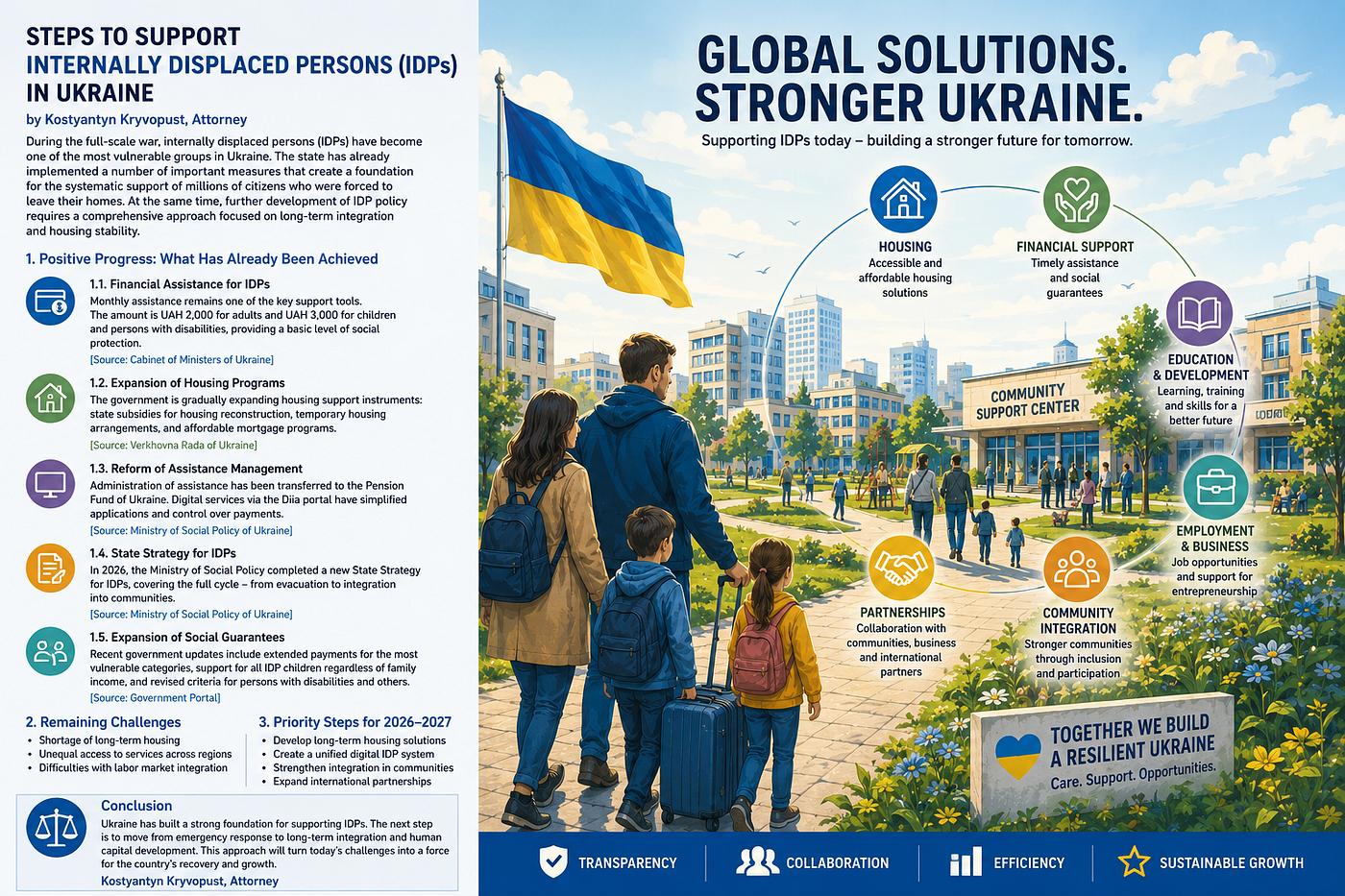
In the context of full-scale war, internally displaced persons (IDPs) have become one of the most vulnerable social groups in Ukraine. The state has already implemented a number of important decisions that form the foundation for systematic support of millions of citizens forced to leave their homes. At the same time, the further development of IDP policy requires a comprehensive approach focused on long-term integration and housing stability.
1. Already Implemented State Measures: Positive Dynamics
1.1. Financial assistance for IDPs
One of the key support tools remains monthly payments for IDPs. The amount of assistance is, in particular, 2,000 UAH for adults and 3,000 UAH for children and persons with disabilities, ensuring a basic level of social protection.
This model was introduced in 2022 and continues to operate as an element of income stabilization for the most vulnerable categories.
1.2. Expansion of housing programs
The most systemic challenge for IDPs remains housing. That is why the government is gradually expanding housing support tools:
- allocation of state subventions for restoration and reconstruction of housing for IDPs
- arrangement of temporary housing and conversion of premises into residential stock
- development of affordable lending programs, including partial compensation of mortgage costs
Separately, it is worth noting initiatives involving international funding — for example, a €200 million loan from the European Bank for Reconstruction and Development to support IDPs.
1.3. Reform of the assistance management system
An important step has been the improvement of administrative procedures:
- transfer of assistance administration to the Pension Fund of Ukraine
- digitalization of processes through the Diia portal
- simplification of application submission and payment control
This has reduced bureaucratic barriers and made the system more accessible.
1.4. Formation of a state IDP strategy
In 2026, the Ministry of Social Policy completed the development of a new IDP Strategy, covering the full cycle — from evacuation to integration into communities.
Key directions include:
- housing provision
- digital support for IDPs
- integration into the labor market
- return of citizens from abroad after the end of the war
1.5. Expansion of social guarantees
Recent changes to government programs include:
- extension of payments for the most vulnerable categories
- expansion of support for IDP children regardless of family income
- revision of criteria for persons with disabilities and other groups
This indicates a gradual transition to a more flexible social protection model.
2. Key Challenges That Remain
Despite significant progress, the IDP support system still faces several structural problems:
2.1. Housing shortage
The most acute issue is the lack of long-term housing. Temporary solutions do not provide stability for families forced to integrate into new communities.
2.2. Uneven access to assistance
Across different regions of Ukraine, the level of access to administrative and social services varies significantly.
2.3. Labor market integration
IDPs are often forced to change professions or accept lower-skilled jobs, which reduces their economic stability.
3. Priority State Steps for 2026–2027
Based on existing policy and its development, the following key directions can be identified:
3.1. Development of long-term housing solutions
It is necessary to move from temporary payments toward:
- social housing
- public–private housing construction programs
- expansion of mortgage compensation schemes
3.2. Unified digital IDP system
The creation of a complete digital ecosystem (from registration to employment) has already begun and should become a single platform for interaction between citizens and the state.
3.3. Integration into communities
The key focus should be not only support but full integration of IDPs through:
- education
- retraining
- access to local development programs
3.4. International partnership
Further attraction of financial assistance from the EU and international organizations remains critically important for the stability of support programs.
Conclusion
Ukraine has already created a basic but fairly developed system of support for internally displaced persons. It includes financial assistance, housing programs, digital services, and strategic planning.
However, the next stage of policy development should focus on moving from crisis response to systemic integration and long-term human capital development.
This approach will make it possible to turn the challenges of internal displacement into a resource for the country’s recovery.
메타데이터
- post_id
- 4e38d4926c44
- slug
- steps-of-state-support-for-internally-displaced-persons-idps-in-ukraine-analysis-of-achievements-4e38d4926c44
- url
- https://medium.com/@NathanDub/steps-of-state-support-for-internally-displaced-persons-idps-in-ukraine-analysis-of-achievements-4e38d4926c44
- canonical_url
- https://medium.com/@NathanDub/steps-of-state-support-for-internally-displaced-persons-idps-in-ukraine-analysis-of-achievements-4e38d4926c44
- author_url
- https://medium.com/@NathanDub
- status
- ok
- fetched_at
- 2026-07-13 06:23:13