Difference between a Demat account and a Trading account
If you wish to hold securities such as Shares, ETFs, Bonds, G-secs, and Mutual funds in digital form, you will need a Demat account. The…
Difference between a Demat account and a Trading account
If you wish to hold securities such as Shares, ETFs, Bonds, G-secs, and Mutual funds in digital form, you will need a Demat account. The demat account is a unique number (usually 16 digits), a combination of the broker’s reference number and the client’s unique code. Just like you can have multiple savings bank accounts, you can hold multiple demat accounts as well.
The cash in your savings bank account is held with the bank, and it's the bank’s responsibility to maintain the account accurately. Whereas in a demat account, even though the account is with your broker, the responsibility for your holdings is with the depositories like CDSL or NSDL. Even if your broker goes bankrupt, your shares, ETFs, bonds, and mutual funds remain secure.
In India, you always need to depend on a broker to buy or sell shares or securities. Once the shares are purchased, they move to the depositories (CDSL or NSDL) on T+1 day, i.e., Transaction plus one day. Until then, these securities are held in your Trading account, provided by the broker.
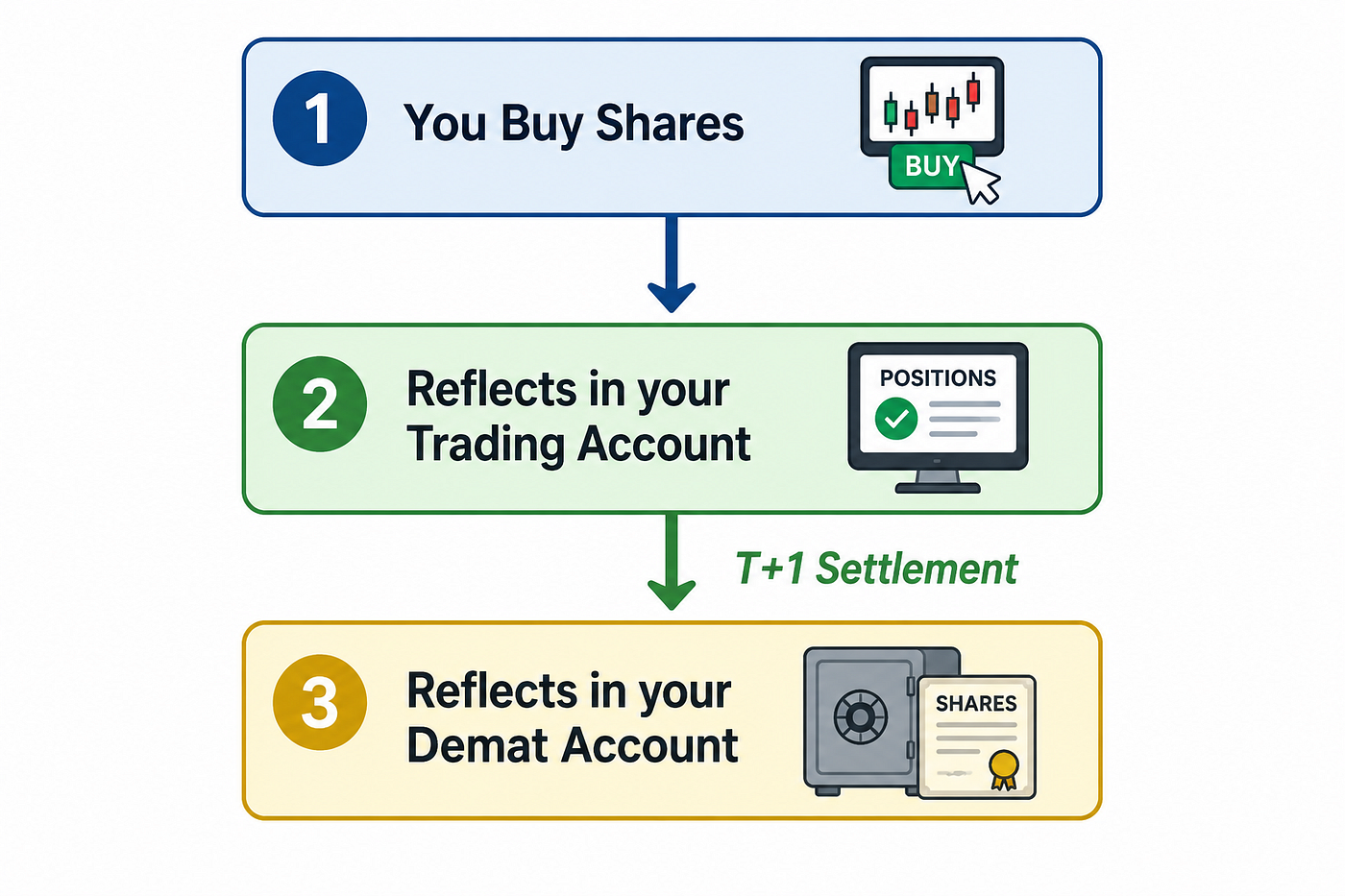
Similarly, when you place a sell order, it shows immediately in your trading account, and the actual sell transaction occurs on T+1, when the securities are debited from your demat account.
Thus, to buy or sell securities in India, you basically need two accounts.
- Trading Account (maintained by your broker)
- Demat Account (maintained by the depositories)
A buy/sell transaction occurs directly in the trading account and is passed to the demat account on T+1 day. The broker has access only to your trading account and cannot directly access your demat account without your permission. This is why, even if the broker goes insolvent, your investments are still secured.
The trading account serves an important function — handling speculation. Many people enter the stock market with the dream of making quick money, and most of them use Futures and Options (F&O) to speculate. F&O are contracts with a defined expiry date. Since these are not regular asset classes, there is no need to move this to the demat account for safekeeping. Thus, all F&O trades are held under your trading account till their expiry date.
You could also take an intraday trade in an equity share or ETF, i.e., buy shares in the morning and square them off before the close of the day, or vice versa. This transaction is carried out in your trading account and will not be linked to your demat account.
The broker has a simple structure for differentiating your demat and trading accounts. The components in your demat accounts are shown under the “HOLDINGS” tab, and those in your trading account under the “POSITIONS” tab.
When you buy shares, they reflect under the Positions tab immediately, and after T+1, they show under the Holdings tab. Similarly, when you sell shares, they appear under the Positions tab, and on T+1, they are deducted from the Holdings tab.
When you start a broking account, you need to open both a Trading and a Demat account; there is no option to choose only one. This also means that even if your securities are held with the depositories, you still need to transact them through a trading account. This also means you cannot open a direct demat account with depositories such as CDSL or NSDL; you would always have to go through a broker.
The actual workflow happens like this. Firstly, you transfer money from your savings account to the trading account. With the transferred money, you buy shares, and the purchase immediately reflects in your trading account. After T+1 day, the shares move to your demat account, and the same gets removed from your demat account.

Similarly, when you wish to sell the shares, you place a sell order in your trading account. Your broker verifies that you are actually holding the sell quantity in your demat account; if so, they send a request to deduct it from the demat account. On T+1, the shares are debited from your demat account, and the equivalent amount is credited to your trading account. You could then choose to transfer this money back to the savings account.
If you wish to transfer money from your savings bank account to another, it is an easy process. You add that person’s bank account, then make an NEFT or RTGS transaction. These days, you could do a QR payment using UPI as well. In a banking transaction, you know the counterparty very well. The risk of an error happening at the bank’s end is minimal, as you directly take responsibility for validating the counterparty’s bank account name and number.
Buying or selling shares is not as simple as transferring money from one person to another. In the securities market, investors transact through an exchange without knowing the identity of the counterparty. To facilitate this process, a trading account is used to place orders on the exchange, while a demat account is used to hold securities electronically. Once a trade is executed, the clearing corporation ensures that the buyer receives the shares and the seller receives the money through a standardized clearing and settlement process. This mechanism enables secure, anonymous, and efficient trading in the securities market. If there are any issues with the settlement, the exchange guarantees that your demat account is not falsely credited/debited.
DISCLAIMER
Investments in the securities market are subject to market risks, including the potential loss of principal. Past performance does not guarantee future results. Information provided is for educational purposes only and should not be considered financial advice. Investors should read all related documents carefully and consult a certified advisor before investing. Registration granted by SEBI and Enlistment with RAASB/BSE and certification from NISM in no way guarantee performance of the intermediary or provide any assurance of returns to investors. The investor is requested to take into consideration all the risk factors before actually trading in stocks or derivatives. The SEBI RIA license INA000021757 & RA license INH000025045 are for Balachandran RV
메타데이터
- post_id
- 4e3a4baf6814
- slug
- difference-between-a-demat-account-and-a-trading-account-4e3a4baf6814
- url
- https://viswaram.com/difference-between-a-demat-account-and-a-trading-account-4e3a4baf6814
- canonical_url
- https://viswaram.com/difference-between-a-demat-account-and-a-trading-account-4e3a4baf6814
- author_url
- https://medium.com/@viswaram
- status
- ok
- fetched_at
- 2026-07-11 12:25:54