Don’t Look Away: Your Trail Betrays You
What a Roman slave, the Tao, and a life of mistakes taught me about brutal honesty
Don’t Look Away: Your Trail Betrays You
What a Roman slave, the Tao, and a life of mistakes taught me about brutal honesty
(English version)
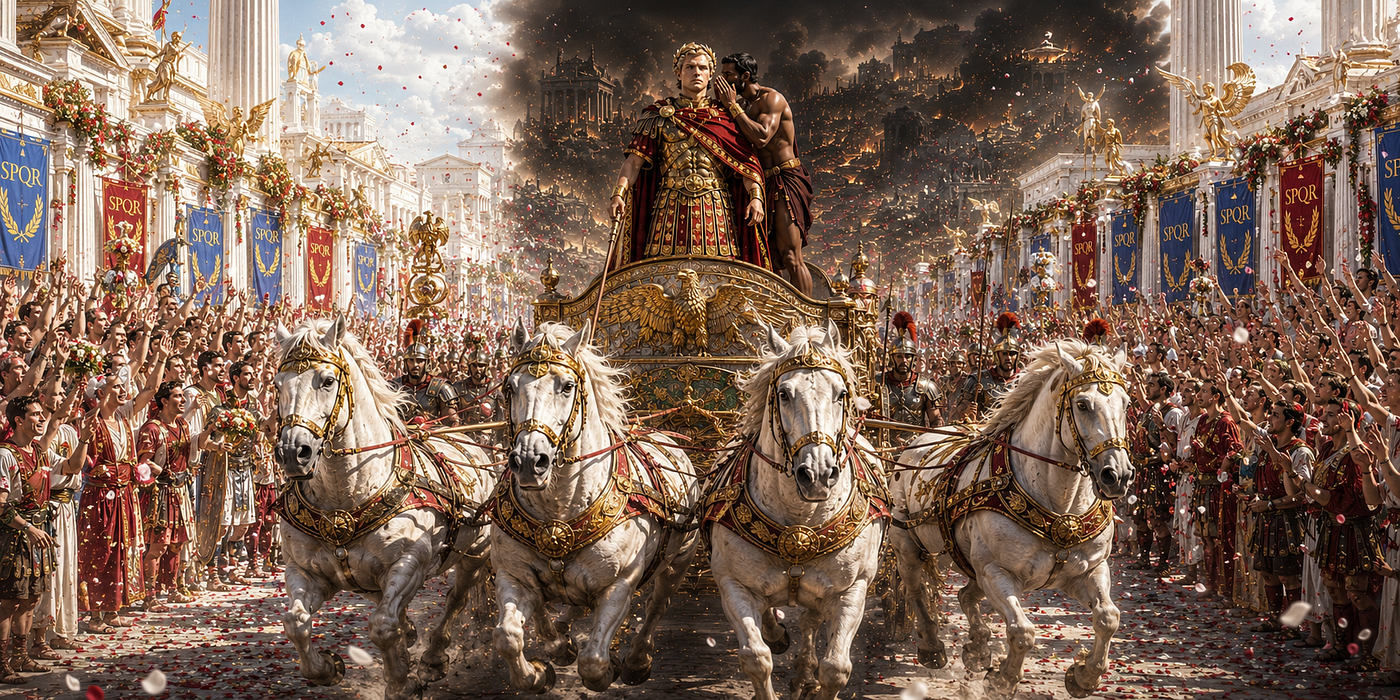
IA imagen generated by ChatGPT
Your trail is your scent.
Turn around. There’s no one else here. Just you and the silent wake you leave in yourself and in those around you. That trail doesn’t lie. It knows no filters, no “impactful content.” You can ignore it, but it betrays you. Always.
I started seeing mine around 50. Not before. Before, I believed I’d always be young, that mistakes could be covered with a “nobody’s perfect,” and that time was a renewable resource. Until I turned 40 and the ground began to crack.
But I’m getting ahead of myself.
The song in a strange tongue
When I was 13, a friend — Checo, Rafa’s brother, who must have been around 30 — started reciting Lao Tzu’s Tao Te Ching to me. He lent me that thin little book, and to be honest, I hardly understood a thing. Yet something in me sensed an immense value, like hearing a song in a foreign language and still grasping the message.
Then came life: anthropology, federal investigation and operations, sales, debt management, investment, marriage. And within all of that I got to know almost my entire country, and several degrees of education, loyalty, comfort, honesty, rule of law, health, freedom, perseverance, discipline, pride, humanity, respect, vengeance.
Lots of experience, yes. But since those 13 years, the Tao has been my bedside book. I almost always wake up between 3 and 4 a.m. Coffee, supplements, water on my face, toothbrush. Then I read and write. It’s my way of waking up, but also of reviewing the previous day’s trail before it fully dawns.
The slave who whispered to the triumphant
In ancient Rome, when a general won a crushing victory, the “triumph” was celebrated: he paraded through crowds who hailed him as a god. At that moment of ultimate glory, a slave walked behind him, holding a laurel crown over his head, and whispered in his ear:
“Respice post te. Hominem te memento.”
Look behind you. Remember that you are human.
Or more directly: “Memento mori.” Remember that you will die.
Why that whisper? Because extreme success intoxicates and lies. It makes you believe you are untouchable, eternal. The slave was a ground wire: “Don’t look away. Look at your trail, look at your humanity, look at your finitude.” Time is eternal, you are not.
That’s exactly what the Tao was telling me at 13, without me knowing it. There’s a chapter, chapter 9, that explains it with a rawness the Roman slave would have applauded:
“Better to let go than to hold a full cup without spilling. A blade too sharply honed won’t keep its edge for long. A room full of gold and jade no one can guard. Whoever takes pride in their wealth brings on their own misfortune.”
The full cup is the glory of the triumphant about to spill. The overly sharp blade is the content that forces impact until it breaks. The gold and jade that no one can protect are the successes we accumulate without looking at the trail. And the misfortune one brings upon oneself is the price of forgetting that you are human, fragile, finite.
The Roman slave and Lao Tzu drink from the same water. Both spit the same truth at you: don’t cling, don’t swell, don’t mistake borrowed shine for your own light.
The problem isn’t making mistakes, it’s not correcting them
They say we all make mistakes. And it’s true. But there’s a comfortable trap in that phrase, especially when you’re young. You hide behind “nobody’s perfect” and keep walking without looking at the ground you step on.
There comes a moment when that shield breaks. For me it was past 40, and it became urgent at 50. It’s no longer enough to admit the mistake. The trail is there, and it reeks of cheap justification. The only way to honor it is to correct it.
Memento mori is not pessimism. It’s an urgent call to live awake. Because if time is eternal and you are not, every uncorrected mistake becomes a permanent mark on your trail. And your trail betrays you. It will tell your children, your friends, and yourself in the mirror who you really were, not who you said you were.
Writing to impact (or writing with honesty)
This idea came to me after reading tips on how to make money on Medium: “Write content that impacts.” With all due respect to every writer, I don’t agree.
There’s nothing more impactful than being honest.
There’s a lot of talk about “hooking” the reader. But a hook sustained by a lie only leaves a void when the reader discovers there’s nothing behind it. Truth, on the other hand, builds a bridge. The slave’s whisper was the briefest “content” in the world, almost a meme, but with a nuclear density. The Tao is a booklet that fits in a pocket and that sustained me in prison, in illness, and in every dawn of reinvention. Both work because they don’t chase impact: they chase truth. And the truth, when you look it in the eye, is the only thing that doesn’t let you look away.
That’s why I write. That’s why I read every morning. Not to gather applause, but to check my trail before the day dirties or redeems it.
The path doesn’t exist, but your footprint does
There’s a beautiful phrase: “There is no path meant for everyone.” But few speak of the trail. Of the footprint you leave on your own flesh and on those who walk beside you.
The Tao also says, in chapter 64: “A journey of a thousand miles begins under your feet.” But beginning is not taking a step. Beginning is recognizing where you stand. Before moving forward, you must look back, just as the slave whispered into the triumphant’s ear. And looking back is nothing other than acknowledging your mistakes. It’s not difficult: there’s a trail to follow. Your own trail. There it is, waiting for you to look it in the eye. The trail won’t disappear even if you acknowledge your mistakes, but those who know it — including you — will know that “no one can give what they don’t have.” That’s a lesson that heals any wound. Instead of consuming ourselves with guilt and resentment, there’s an invitation to self-knowledge.
Every morning, between 3 and 4, I whisper to myself that time is eternal, I am not. That is my private triumph ceremony, without crowds or laurels. Just coffee, the book, and the honest attempt to correct the direction before the footprint becomes permanent.
It’s 3:47 a.m. The coffee is getting cold. My trail, today, is clean. Tomorrow I’ll have to clean it again.
Don’t look away. Look at your trail. What does it say about you? What needs to be corrected today?
Thank you for reading. If this text made you look at your own trail, share it or whisper it to someone who needs it.
📓 Ready to face your trail head-on?
I’ve put together a PDF for free with 5 questions for your own dawn ceremony. You don’t need coffee or the Tao (though they help). Just honesty and 5 minutes.
👉 Download the 5 questions here
📓 Want to go deeper?
I’ve put together a 30-day guided journal with a daily question to clean your trail for a full month. Inspired by the Tao and memento mori.
메타데이터
- post_id
- 4e3a5fd85a18
- slug
- dont-look-away-your-trail-betrays-you-4e3a5fd85a18
- url
- https://medium.com/@javieralerom/dont-look-away-your-trail-betrays-you-4e3a5fd85a18
- canonical_url
- https://medium.com/@javieralerom/dont-look-away-your-trail-betrays-you-4e3a5fd85a18
- author_url
- https://medium.com/@javieralerom
- status
- ok
- fetched_at
- 2026-06-09 14:34:10





