Monday Morning’s Earworm №122
Lily the Pink by Scaffold

Monday Morning’s Earworm №122
Lily the Pink by Scaffold
What is an earworm?
It’s a snatch or a snippet, a captured fragment, a line or two, or maybe a bit more, from a cultural reference point, that stays in your head, that keeps bubbling up accompanying your day.
It’s part of the language of your landscape that stays in your mind, whether it’s one single line, a couplet or maybe a whole verse, from a poem or song, or a part of a speech from a play, or a quote from a book, or something you heard somebody say, that won’t let you go.
Sometimes it won’t involve what we call language in the everyday. It could be purely a musical phrase that plays on your time, on a loop that follows you through day and night.
That’s what an earworm is. And so is this…
[embed]
Lily the Pink by Scaffold
UK Chart peak: №1 US Chart peak: DNC
I was reminded of this song two Fridays ago by my old pal Andy. It was many years since I’d heard it, but it’s always been a fun listen for me. It’s one of those songs I recall with great fondness, from the days when little Jim just dug a tune before the curse of inhibitions had to be learned.
Also, contrary to my contrarian memory, the group’s name has no definite article. Or does it? Even their own record covers aren’t consistent. *Discogs lists them as Scaffold, [Wikipedia](https://en.wikipedia.org/wiki/The_Scaffold#) lists them as The Scaffold, and The Virgin Encyclopedia of 60s Music also lists them simply as Scaffold, sans the definite article. I’m going to follow the lead of Disocgs and The Encyclopedia of 60s Music* as they’re the more specialised publications.
Who Were Scaffold?
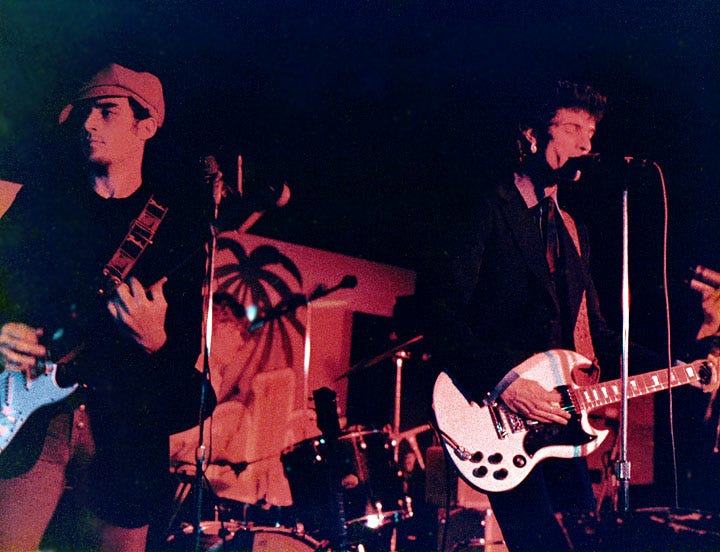
Scaffold were formed in Liverpool, England in 1962, and consisted of the poet Roger McGough, humourist John Gorman and musician Mike McGear (Paul McCartney’s younger brother Michael McCartney). The Virgin Encyclopedia of 60s Music notes that the group was “the unlikely confluence of concurrent ‘booms’ — satire and Merseybeat”, and that they created an act not solely reliant on pop music.
The three Scaffolders were originally part of a performing revue group known as The Liverpool One Fat Lady All Electric Show. (“One Fat Lady” is the bingo term for 8 and the performers mostly lived in the Liverpool 8 district.) McGough’s fellow Liverpool poet Adrian Henri was also a founding member of this early configuration.
After McGough, McGear and Gorman formed Scaffold and had completed an acclaimed residency at London’s Establishment Club, they took their ‘Birds, Marriages and Deaths’ revue to the Edinburgh Festival in 1964, for the first of several visits they made there.
Before their success with today’s earworm, they’d reached the UK singles charts with “Thank You Very Much”, which had 12 weeks on the chart, peaking at number 4 in November 1967, and “Do You Remember?” that had 5 weeks on the chart and peaked at №34 in April 1968.
Despite the obvious expectations, none of their three 1960’s albums charted, not even L the P from 1969, which included the previous year’s Christmas №1 “Lily the Pink”.
L the P, had the help of some notable session musicians, including backing vocals from Graham Nash, Reg Dwight (better known as Elton John) and Tim Rice, with bass played by Jack Bruce. However, not even the involvement of some legendary talents could lift the disc into the album charts. They’d remain a singles band.
About the Song of This Morning’s Moment
“Lily the Pink” was based upon a bawdy drinking song about a real-life character, Lydia Pinkham. The Scaffold tidied it up a bit to make it acceptable top-40 listening.
AsWikipedia tells us:
“Lydia Pinkham was an American inventor and marketer of a herbal-alcoholic “women’s tonic” for menstrual and menopausal problems, which medical experts dismissed as a quack remedy, but which is still on sale today in a modified form”.
And this is true, I just searched for it, and you can buy it in tablet and liquid form from more than one online retailer.
Lydia has definitely had the last laugh, because regardless of her product’s efficacy, it surely must be effective for some women, or it wouldn’t have lasted so long. And even if it was the placebo effect at play, relief is relief.
For proof of the bawdiness of Scaffold’s source material, here’s the last verse of a version published on the website for CAMRA.org, the real ale society of Britain:
“And Peter Whelan (Peter Whelan) He was sad because he only had one nut Till he took some of Lydia’s compound And now they grow in clusters ’round his butt”.
Even in the liberated sixties, this would’ve been a bit much for prime-time radio broadcasting.
That said, depending on how your mind works, the Scaffold’s own lyrics might be seen as dubious in places by today’s standards, especially in the verse about Jennifer Eccles:
“Jennifer Eccles had terrible freckles And the boys all called her names But they gave her medicinal compound Now she joins in all the games”.
If you were so inclined, you might wonder exactly what kind of games Jennifer was joining in.
As to the Scaffold’s song itself. It would spend four weeks at №1 in the UK over the Christmas period in 1968, dropping to №2 for one week in between its third and fourth week at the top spot. It was replaced for one week by the song written by Mike McCartney’s big brother Paul: Ob-La-Di, Ob-La-Da by Marmalade.
Recommended Listening:
L the P, Scaffold, Parlophone, 1968
As always, tell me what you thought of today’s earworm in the comments.
And don’t forget to subscribe to keep up with Monday Morning’s Earworm every week.
메타데이터
- post_id
- 4e4539cc707d
- slug
- monday-mornings-earworm-122-4e4539cc707d
- url
- https://medium.com/the-old-anorak/monday-mornings-earworm-122-4e4539cc707d
- canonical_url
- https://medium.com/the-old-anorak/monday-mornings-earworm-122-4e4539cc707d
- author_url
- https://medium.com/@jimlaing
- status
- ok
- fetched_at
- 2026-06-12 18:14:10