A guide to navigating lupus treatment and support in the Australian health system
After months, sometimes years of unexplained symptoms, a lupus diagnosis is like relief and devastation arriving in the same breath. What…
A guide to navigating lupus treatment and support in the Australian health system
After months, sometimes years of unexplained symptoms, a lupus diagnosis is like relief and devastation arriving in the same breath. What comes next can feel just as disorienting- the barrage of referrals, medications that sound like Lord of the Rings characters, the specialists you’ve never heard of, and piles of Medicare paperwork, can add to the overwhelm.
For most people, knowing where to start is a challenge in itself. This is a practical guide from your first GP visit through to ongoing management.
Your GP visit
Your GP is the expert in your care. They order and interpret the blood tests used to monitor your disease, manage your prescriptions, action your referrals, and can unlock subsidised care that many people with lupus never know they’re entitled to.
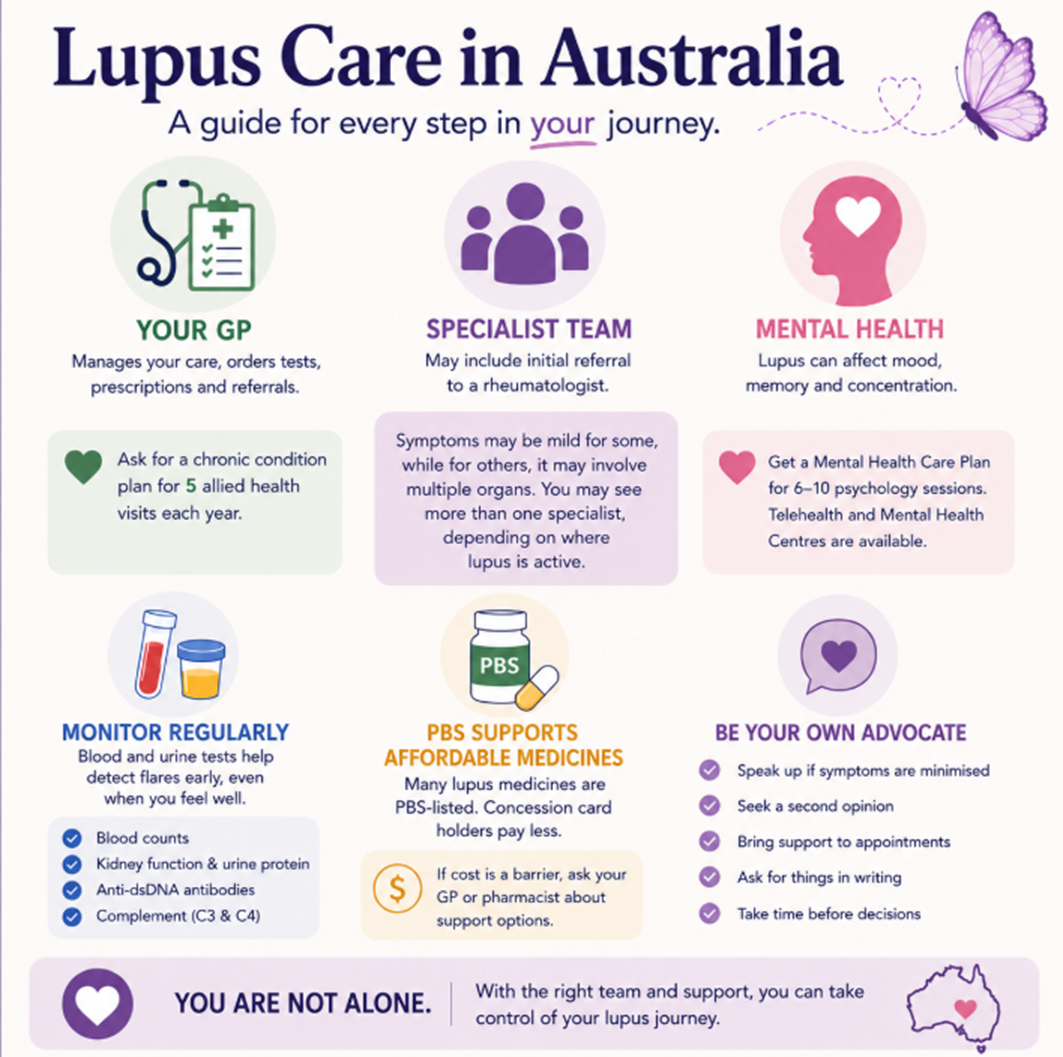
Ask your GP to set up a GP chronic condition management plan.[1] It’s a Medicare-funded chronic disease plan that entitles you to five subsidised allied health visits per year: physiotherapy, occupational therapy, dietetics, and more.[1] It takes one conversation to access.
Seeing a specialist
You may be referred to a specialist rheumatologist by your GP, who can diagnose, adjust your treatment, monitor for complications, and advise if you need additional tests or support.
In the Australian public health care system, wait times can be long. Your GP can flag clinical urgency in their referrals, and you can contact the specialist clinic directly to ask about cancellation lists to expedite review.
There are many different types of lupus. Where it’s active in your body, will dictate the team involved in your care. For example, you may be referred to a nephrologist if your kidneys are involved. Lupus nephritis, defined as inflammation of the kidneys, can progress quietly, which is why urine tests are important.[2] A dermatologist may be involved if your skin is affected. People with lupus that take hydroxychloroquine (an immunomodulator), may also need periodic eye checks with an ophthalmologist, as the drug can rarely affect the retina over time.[3] Lupus can also affect the heart and lungs, leading to a specialist cardiologist or respiratory physician referral.
Mental health support
Chronic illness and mental health often go hand in hand, and with lupus, the link can be direct. Neuropsychiatric lupus occurs when lupus affects the brain, spinal cord, or nerves, causing headaches, “brain fog,” and mood disorders.[4] If you notice cognitive changes or mood symptoms, raise them with your specialist- they may be a feature of your disease activity, not just a response to it.
A Mental Health Care Plan through your GP provides an initial six psychology sessions, extendable to ten per calendar year if your doctor determines you need more.[5] Telehealth consultations are also claimable under Medicare if you live rurally or remotely- ask your GP or psychologist whether they offer this. You can also walk into a Medicare Mental Health Centre without an appointment, referral, or Medicare card. They’re free, confidential, and open to everyone.
Ongoing monitoring
Regular monitoring is crucial, even when you feel well. In stable disease, appointments may be every six months, while active disease requires more frequent review.[6] Your GP and rheumatologist will order blood and urine tests at regular intervals. This may include a full blood count as lupus can affect red blood cells, white blood cells, and platelets, along with kidney function tests and urine protein checks to catch any kidney involvement early.[6]
Anti-dsDNA antibodies and complement proteins C3 and C4 are also tracked, as rising antibodies and falling complement can signal a flare before symptoms appear.[6,7]
What’s covered on the PBS
Many medications used to treat lupus are subsidised through the Pharmaceutical Benefits Scheme (PBS), making them more affordable. Medications like hydroxychloroquine, prednisolone (steroids), and azathioprine (immunosuppressants) are all PBS-listed.[8–11] Mycophenolate mofetil, another type of immunosuppressant, is also subsidised for people with lupus nephritis[9] while anifrolumab (biologic) is available under specific criteria your rheumatologist will assess.[10,11]
Concession card holders also pay significantly less per prescription for medicines. If cost is a barrier at any point, let your GP or pharmacist know- there are usually options available for support. Private health insurance extras, the Medicare Safety Net, 60-day dispensing for generic alternatives, and for severe cases, enrolment in clinical trials may help to bring down long-term costs.[12,13]
A word on self-advocacy
If your symptoms are being minimised, don’t be afraid to voice your concerns with your GP or treating practitioner. You’re encouraged to seek a second opinion, bring someone to appointments, ask for things in writing, and take time before making decisions about treatment.
References
-
Services Australia, 2025. GP chronic condition management plan. Available from: https://www.servicesaustralia.gov.au/gp-chronic-condition-management-plan?context=20 [Accessed 22 May 2026].
-
National Kidney Foundation, 2026. Lupus Nephritis. Available from: https://www.kidney.org/kidney-topics/lupus-nephritis [Accessed 22 May 2026].
-
The Royal Australian and New Zealand College of Ophthalmologists, 2021. Guidelines for Screening for Hydroxychloroquine Retinopathy. Available from: https://ranzco.edu/wp-content/uploads/2021/04/RANZCO-Guidelines-for-screening-for-HCQ-Retinopathy.pdf [Accessed 22 May 2026].
-
HSS, 2023. Neuropsychiatric Lupus — Lupus and the Brain. Available from: https://www.hss.edu/health-library/conditions-and-treatments/lupus-neuropsychiatric-lupus-and-the-brain [Accessed 22 May 2026].
-
Services Australia, 2025. Mental health care and Medicare. Available from: https://www.servicesaustralia.gov.au/mental-health-care-and-medicare?context=60092 [Accessed 22 May 2026].
-
Fanouriakis A, et al., 2024. EULAR recommendations for the management of systemic lupus erythematosus: 2023 update. Ann Rheum Dis. 83(1):15–29.
-
Yeo Al, et al., 2024. SMART-SLE: serology monitoring and repeat testing in systemic lupus erythematosus — an analysis of anti-double-stranded DNA monitoring. Rheumatology. 63(2):525–533.
-
Australasian Society of Clinical Immunology and Allergy, 2024. Saphnelo (anifrolumab) listed on the PBS for patients with severe SLE. Available from: https://www.allergy.org.au/about-ascia/info-updates/saphnelo-anifrolumab-listed-on-the-pbs-for-patients-with-severe-sle-1-july-2024 [Accessed 22 May 2026].
-
Pharmaceutical Benefits Scheme, 2012. Public summary document: mycophenolate sodium (mycophenolic acid) — Myfortic®. Available from: https://www.pbs.gov.au/info/industry/listing/elements/pbac-meetings/psd/2012-07/mycophenolate [Accessed 22 May 2026].
-
Monash University, 2024. First targeted treatment for lupus listed on the PBS. Available from: https://www.monash.edu/medicine/news/latest/2024-articles/first-targeted-treatment-for-lupus-listed-on-the-pbs [Accessed 22 May 2026].
-
Australian Rheumatology Association, 2024. Anifrolumab. Available from: https://rheumatology.org.au/For-Patients/Adult-Medication-Information/A-B/Anifrolumab#3372594-how-will-your-condition-be-monitored [Accessed 22 May 2026].
-
Services Australia, 2026. Medicare Safety Nets: What are the thresholds. Available from: https://www.servicesaustralia.gov.au/what-are-medicare-safety-nets-thresholds?context=22001 [Accessed 22 May 2026].
-
Department of Health, Disability and Ageing. Eligibility for 60-day prescriptions. Available from https://www.health.gov.au/cheaper-medicines/60-day-prescriptions?language=en#medicines-available-for-60day-prescriptions [Accessed 22 May 2026].
Author
Paula De Paoli is the Principal Editor and Content Lead at The Lupus Foundation of Australasia. She is a senior medical writer and communications consultant with over a decade of experience across clinical practice, university education, and national health regulation. She has held risk advisory roles at Ahpra and currently supports healthcare organisations across education and marketing projects at Medwire. She holds postgraduate qualifications in public health from the University of Sydney and Harvard University.
Reviewer
Elizabeth Donald has over a decade of experience in communications, clinical research, and education. She undertook advanced doctoral research in oncology, contributing to peer-reviewed publications on improving treatment efficacy and exploring emerging therapies. Elizabeth has presented at international congresses, facilitated webinars and podcasts, and developed award-winning continuing education programs across oncology, immunology, and rare diseases. As a patient advocate, she works to ensure the latest research is made accessible and meaningful for people navigating chronic illness.
메타데이터
- post_id
- 4e480c5f9c14
- slug
- a-guide-to-navigating-lupus-treatment-and-support-in-the-australian-health-system-4e480c5f9c14
- url
- https://medium.com/@lupusfoundationaustralasia/a-guide-to-navigating-lupus-treatment-and-support-in-the-australian-health-system-4e480c5f9c14
- canonical_url
- https://medium.com/@lupusfoundationaustralasia/a-guide-to-navigating-lupus-treatment-and-support-in-the-australian-health-system-4e480c5f9c14
- author_url
- https://medium.com/@lupusfoundationaustralasia
- status
- ok
- fetched_at
- 2026-06-25 07:00:49