Is the High-Risk Merchant Account Industry Dying?
The high-risk merchant account industry is not dying. It is being restructured — rapidly, fundamentally, and in ways that will eliminate a…
Is the High-Risk Merchant Account Industry Dying?
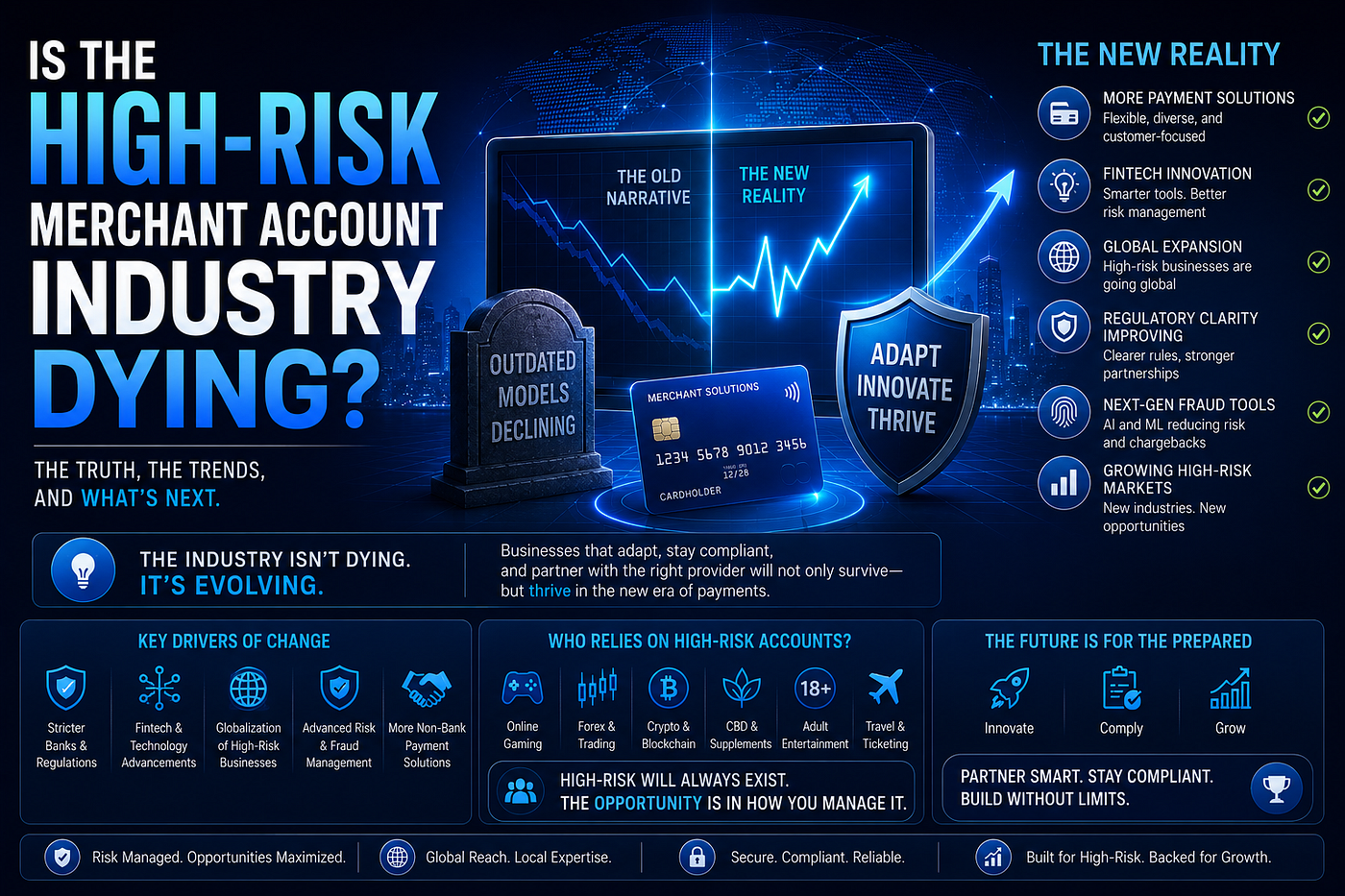
The high-risk merchant account industry is not dying. It is being restructured — rapidly, fundamentally, and in ways that will eliminate a significant number of current participants while creating structural advantages for those who adapt correctly.
The global high-risk payment processing market is valued at $63.46 billion in 2025 and is projected to reach $214.8 billion by 2033, growing at 13.5% CAGR. The demand that drives this market — Forex, iGaming, CBD, nutraceuticals, adult content, subscriptions, travel, IPTV — is not declining. It is growing. The industries that require specialist merchant accounts are expanding at double-digit rates globally.
But the mechanisms through which those merchants access payment processing are changing fundamentally. Traditional card-only acquiring, generalist high-risk processing, and offshore account stacking are being displaced by multi-rail infrastructure, AI-enhanced compliance, and specialist operators with genuine banking relationships and industry expertise.
The question is not whether the industry is dying. It is who in the industry survives the restructuring.
Why the “Dying” Narrative Exists
The narrative that high-risk merchant accounts are becoming obsolete appears in the market for three specific reasons — each of which reflects a real trend that is often misinterpreted.
Traditional Banks Are Exiting High-Risk Verticals
Traditional banks continue to exit high-risk verticals, citing compliance costs and reputational risks, creating a structural vacuum that specialised payment service providers are aggressively filling.
This is real. Major banking groups in the UK, EU, and US have been quietly withdrawing from high-risk merchant acquiring since 2020, driven by: ESG investor pressure, card scheme compliance costs, post-pandemic regulatory tightening, and the reputational calculus of association with gambling, adult content, and cannabis-adjacent industries.
The exit of major banks from high-risk acquiring looks, from the outside, like the industry is dying. What it actually represents is the consolidation of high-risk acquiring into specialist providers who have built their infrastructure specifically for these industries — and who are growing faster than the banks they are replacing.
Alternative Payment Methods Are Reducing Card Volume
As crypto, open banking, and virtual IBAN infrastructure matures, some high-risk merchants are processing a smaller proportion of their total volume through card-based merchant accounts. This looks like a reduction in demand for high-risk merchant accounts.
In reality, it represents an expansion of the definition of “high-risk payment processing” beyond card rails. The high-risk merchant account is evolving — from a card-specific product to a multi-rail payment infrastructure. Providers who offer only card processing are declining. The industry as a whole — encompassing crypto gateways, open banking rails, virtual IBAN infrastructure, and card processing — is growing.
Shady Providers Are Disrupting Legitimate Market Participants
The growth of the high-risk payment space has attracted a significant number of non-compliant and outright fraudulent providers offering guarantees they cannot deliver. When these providers fail — accounts terminated, funds held, merchants left without processing — the narrative becomes “high-risk merchant accounts are unreliable.”
This is a misattribution. The legitimate, regulated, specialist high-risk acquiring market is not becoming less reliable. The market as a whole is becoming more complex — and the ability to distinguish legitimate from illegitimate providers is a critical operational capability for merchants.
The Evidence That the Industry Is Transforming, Not Dying
Market Size and Growth Rate
The global high-risk payments market is being underpinned by a confluence of powerful forces: the global expansion of online gambling, which surpassed $95 billion in gross gaming revenue globally in 2025; the explosive uptake of cryptocurrencies as a medium of exchange, with over 560 million unique crypto wallet holders recorded as of early 2026; and the rapid scale-up of cross-border e-commerce, which drove nearly 22% of all global digital purchases in 2025.
These are not the indicators of a dying industry. They are the indicators of an industry expanding into new product categories, new geographies, and new payment rails.
The Specialist PSP Vacuum Is Growing
As traditional banks exit, specialist PSPs are not merely filling the vacuum — they are building infrastructure that the banks never built. These specialist PSPs, including dedicated high-risk payment gateways and merchant account providers, offer tailored chargeback mitigation tools, rolling reserve management, multi-currency processing, and fraud detection algorithms that mainstream processors do not provide.
The services being built by specialist providers — real-time chargeback monitoring, AI fraud scoring calibrated for specific high-risk industries, multi-rail payment orchestration, compliance frameworks that span card, crypto, and open banking — are more sophisticated than anything mainstream processors have built.
Crypto Integration Is Expanding the Industry, Not Replacing It
The emergence of crypto payment processing has not reduced demand for high-risk merchant accounts. It has expanded the category of “payment infrastructure required by high-risk merchants” to include crypto rails.
High-risk merchants face a unique set of challenges — frequent chargebacks, limited access to payment processors, and higher processing fees. Cryptocurrencies can help address these pain points by offering faster settlements and lower transaction costs.
The practical consequence: high-risk payment providers who offer only card processing are losing relevance. High-risk payment providers who offer card processing, crypto gateways, open banking integration, and virtual IBAN infrastructure are gaining market share in a growing market.
What Is Actually Dying in the High-Risk Merchant Account Industry
Three specific categories of industry participant are in genuine structural decline.
Generalist “High-Risk” Processors Without Real Acquiring Relationships
The category of provider that claims to serve “all high-risk industries” without specific industry expertise or genuine direct acquiring bank relationships is in decline — forced out by the increasing compliance and underwriting complexity that makes generalist high-risk processing operationally untenable.
VAMP and BRAM monitoring by Visa and Mastercard respectively have tightened acquirer accountability for their merchant portfolios. Acquirers who cannot demonstrate genuine risk management discipline across their high-risk portfolios face scheme fines and eventual programme termination. This pressure is eliminating the low-margin, high-volume, low-oversight end of the high-risk acquiring market.
Offshore Account Stacking Operations
The practice of stacking multiple offshore merchant accounts — using multiple MCCs, multiple business entities, and multiple offshore banking relationships to process transactions that would be declined by individual acquirers — is being eliminated by post-AI monitoring.
Visa’s VAMP and Mastercard’s BRAM both apply cross-merchant and cross-acquirer pattern recognition that identifies stacking behaviour with high accuracy. The merchants and providers who built their business model on stacking are facing account terminations, MATCH listings, and in some cases criminal investigation.
Providers Operating Without Regulatory Authorisation
The growth of the payment space has attracted providers offering “merchant accounts” without the FCA authorisation, EMI licence, or equivalent regulatory standing that legitimate payment processing requires. These providers are being identified and shut down by regulators — the FCA’s authorisation register and equivalent EU and US regulatory databases have seen a significant increase in warning notices against unlicensed payment providers since 2024.
What Is Growing in the High-Risk Merchant Account Industry
Multi-Rail Payment Infrastructure
The high-risk payment provider of 2025 and beyond is not a card acquirer. It is a multi-rail payment infrastructure operator: card processing, crypto gateway, open banking integration, virtual IBAN, and local payment method support — all orchestrated through a single API layer with unified reporting, compliance monitoring, and risk management.
The merchants who need this infrastructure are growing. The providers who are building it are capturing market share at the expense of those who have not.
AI-Powered Compliance and Risk Management
Post-AI monitoring by Visa and Mastercard is not only a threat to high-risk merchants. It is also creating a market for AI-powered compliance and risk management tools that help merchants and their processors stay below monitoring thresholds.
Real-time chargeback prediction models, AI fraud scoring calibrated for specific industry transaction patterns, automated dispute response systems, and machine learning-based velocity controls are becoming the standard infrastructure of serious high-risk payment providers.
Fraud is rising, but so are AI-driven tools that can detect anomalies in real time, reducing false declines and chargebacks.
The providers who are investing in AI-powered risk management are widening their competitive advantage over those who are not.
Regulated Crypto and Stablecoin Settlement
With the passage of the US GENIUS Act and the EU’s MiCA regulation providing regulatory clarity for stablecoins, stablecoin-based settlement is moving from the fringes of the high-risk payment market to its centre. With the GENIUS Act having been passed, stablecoins and crypto are going to become more mainstream at an accelerated pace, providing alternate, secure real-time payment options.
High-risk payment providers who have built stablecoin settlement infrastructure — enabling merchants to receive settlements in USDC or USDT with instant availability — are providing a product that traditional card acquirers cannot match.
The Predictive View: 2025–2030
2025–2026: Consolidation of specialist providers. Traditional bank exits from high-risk acquiring accelerate. Generalist high-risk processors without genuine industry expertise lose merchant relationships to specialists. Multi-rail providers gain market share.
2026–2027: AI-enhanced scheme monitoring reaches maturity. VAMP and BRAM create a two-tier market: compliant high-risk merchants with genuinely low chargeback ratios who retain card processing access, and non-compliant operators who migrate entirely to crypto and open banking rails.
2027–2028: Stablecoin settlement becomes standard for high-volume high-risk merchants. Open banking achieves critical mass in EU and UK for deposit processing. The cost of card processing relative to alternatives has widened to the point where card rails are genuinely the high-cost option for many high-risk merchant categories.
2028–2030: The “high-risk merchant account” as a card-specific product has been replaced by “high-risk payment infrastructure” as a multi-rail concept. Providers who built multi-rail capabilities are the market leaders. Providers who did not have exited or been acquired.
FAQs
Q1: Is the high-risk merchant account industry dying? No. The global high-risk payment processing market is valued at $63.46 billion in 2025 and growing at 13.5% CAGR to $214.8 billion by 2033. The industry is being restructured — from card-only to multi-rail — not dying.
Q2: Why are traditional banks exiting high-risk merchant acquiring? ESG investor pressure, card scheme compliance costs, reputational risk, and post-pandemic regulatory tightening. The vacuum they are leaving is being filled by specialist PSPs who are building more sophisticated infrastructure than the banks maintained.
Q3: What is replacing traditional high-risk card acquiring? Multi-rail payment infrastructure: card processing, crypto gateways, open banking, virtual IBANs, and local payment methods — orchestrated through unified API infrastructure with AI-powered risk management.
Q4: Are shady payment providers a symptom of industry decline? No. They are a symptom of industry growth attracting opportunists. The legitimate, regulated specialist high-risk acquiring market is not declining in quality. The market is becoming more complex, and due diligence in provider selection is more important than ever.
Q5: What is the future of card processing in high-risk payments? Card processing remains essential but is losing market share to alternatives. The cost and compliance burden of card processing for high-risk merchants continues to increase as Visa VAMP and Mastercard BRAM monitoring tighten. Card will remain one rail among several, not the default.
Q6: What kinds of providers are genuinely declining? Generalist high-risk processors without direct acquiring relationships, offshore account stacking operations targeted by AI scheme monitoring, and providers operating without regulatory authorisation.
Q7: What is the regulatory impact on the high-risk payment industry? EU MiCA, the US GENIUS Act, PSD3 in development, and VAMP/BRAM tightening are collectively raising the compliance bar. Providers and merchants who meet the higher bar are building stronger positions. Those who do not are exiting.
Q8: What should high-risk merchants do to prepare for industry restructuring? Build multi-rail payment infrastructure now. Migrate card-eligible volume to open banking and crypto where possible. Select payment partners based on regulatory authorisation, not on fee level. Build secondary acquirer relationships. Invest in AI-powered chargeback and fraud management.
메타데이터
- post_id
- 4e4bdcf34f21
- slug
- is-the-high-risk-merchant-account-industry-dying-4e4bdcf34f21
- url
- https://medium.com/@SkyUnleased/is-the-high-risk-merchant-account-industry-dying-4e4bdcf34f21
- canonical_url
- https://medium.com/@SkyUnleased/is-the-high-risk-merchant-account-industry-dying-4e4bdcf34f21
- author_url
- https://medium.com/@SkyUnleased
- status
- ok
- fetched_at
- 2026-06-17 08:20:12