Wonderful Worcester
… Even when it floods
Wonderful Worcester
… Even when it floods

Worcester Cathedral on the banks of the River Severn © Simon Whaley
“Look, Mummy,” squeals a little girl, pointing. “The swans are swimming down the road!”
I, along with several others crossing Worcester Bridge, chuckle at her incredulity. The swans are certainly making the most of Worcester’s current watery predicament.

Swans swimming in floodwater beside the River Severn in Worcester © Simon Whaley
The city of Worcester sits on the banks of the River Severn, 131 miles downstream from its source, high in the Welsh mountains. During the winter months, the extra rainfall frequently sees the river burst its banks, allowing the Severn Swans to swim where tourists and cars would normally travel.
This section of the River Severn in Worcester is a swan sanctuary, which means that fishing is banned between the railway bridge upstream, and the Worcester Cathedral ferry crossing a little further downstream.

Worcester’s swans enjoying the floodwater © Simon Whaley
You can even buy small packets of swan food throughout the city, which probably explains why the swans congregate along here!
Being on the banks of the River Severn, the city is used to flooding, which is just as well when extreme weather events, like last week’s Storm Babet, are expected to hit with greater frequency.

Flooded paths mean sitting down can get a little wet in Worcester © Simon Whaley
Today’s Worcester Bridge is a relatively modern crossing, dating from 1931. However, I’m following in the footsteps of history, because there’s been a crossing here since the 14th century. That’s why Worcester has grown up along the River Severn here.

Worcester Bridge, across the River Severn © Simon Whaley
Back then, the next nearest Severn crossings were 25 miles upstream at Bridgnorth in Shropshire, and 24 miles downstream at Gloucester.
It’s a fine vantage point, as I gaze at Worcester Cathedral dominating the skyline and the reflection in the Severn.
Before I get there, I pass another spire — that of St Andrews. It’s a spire without a church, for the rest of the building was demolished in 1948 because it was unsafe.

St Andrew’s Spire, Worcester © Simon Whaley
Standing 245 feet tall, St Andrews remains the tallest spire in Britain to have such a narrow angle. It’s so narrow, that locals called it the Glover’s Needle in recognition of the city’s once-thriving glove-making industry.
And if local historians are to be believed, the spire was constructed using kites, harnessing the wind to lift the stones into place. Hmmm. That seems a rather tall story to me!
Worcester Cathedral’s tower is visible from here, and it too has a story to tell. The first one fell down in 1175, and the second one had to be taken down before it fell down. The third version is doing rather well, considering it was built in 1374.
I bet there’s a great view to be had from there. It’s probably why it’s believed the future King Charles II watched the Battle of Worcester from the top of the Cathedral tower, in 1651, during the English Civil War.

Worcester Cathedral Tower © Simon Whaley
“The first Cathedral established here,” explains our guide, “was in 680, although this present building dates from 1084. Being so close to one of the few Severn crossings, it became a centre of learning.”
He pauses and then beckons us to follow him around the Cathedral cloister. “In the alcoves opposite the Chapter House there used to be desks, where monks would study. But this is the east side of the cloister, which means is doesn’t get much light.”
He taps his nose, then motions us to join him at the corner where the east and north corridors meet.
“Look through there.” He points.
“Wow!” exclaims our small group. There’s a hole in the pillar. In fact, there’s a hole in every pillar along this cloister wall.

Gaps in the CLoister walls at Worcester Cathedral © Simon Whaley
“It’s a clever design, and unique to Worcester Cathedral. It allows more light to pass through into the bays, where the monks would have studied.”
Our guide then grins. “It also enabled tutors to peer through and check all the monks were busy studying!”
Apparently, Bishop Wulstan was instrumental in rebuilding Worcester Cathedral in 1084. He was later Sainted in 1203 and is the Patron Saint of Vegetarians. On one occasion he was distracted from his worship by the smell of roast goose, so immediately decided to give up all meat for the rest of his life.

Inside Worcester Cathedral’s round Chapterhouse © Simon Whaley
Worcester Cathedral’s Chapter House is also unusual in that it is circular. Most other Cathedral Chapter Houses are octagonal or decahedron-shaped, having eight or ten sides, but Worcester’s is circular. At least, it is on the inside. Step outside and 14th century stone reinforcements turned it octagon-shaped.
Just below the cathedral’s high altar is a regal tomb bearing the crest of the Plantagenet royal ruler, King John. He died in 1216 and is buried here, originally under the floor. In 1529, the tomb was created and his coffin was raised, so it now sits above the floor.
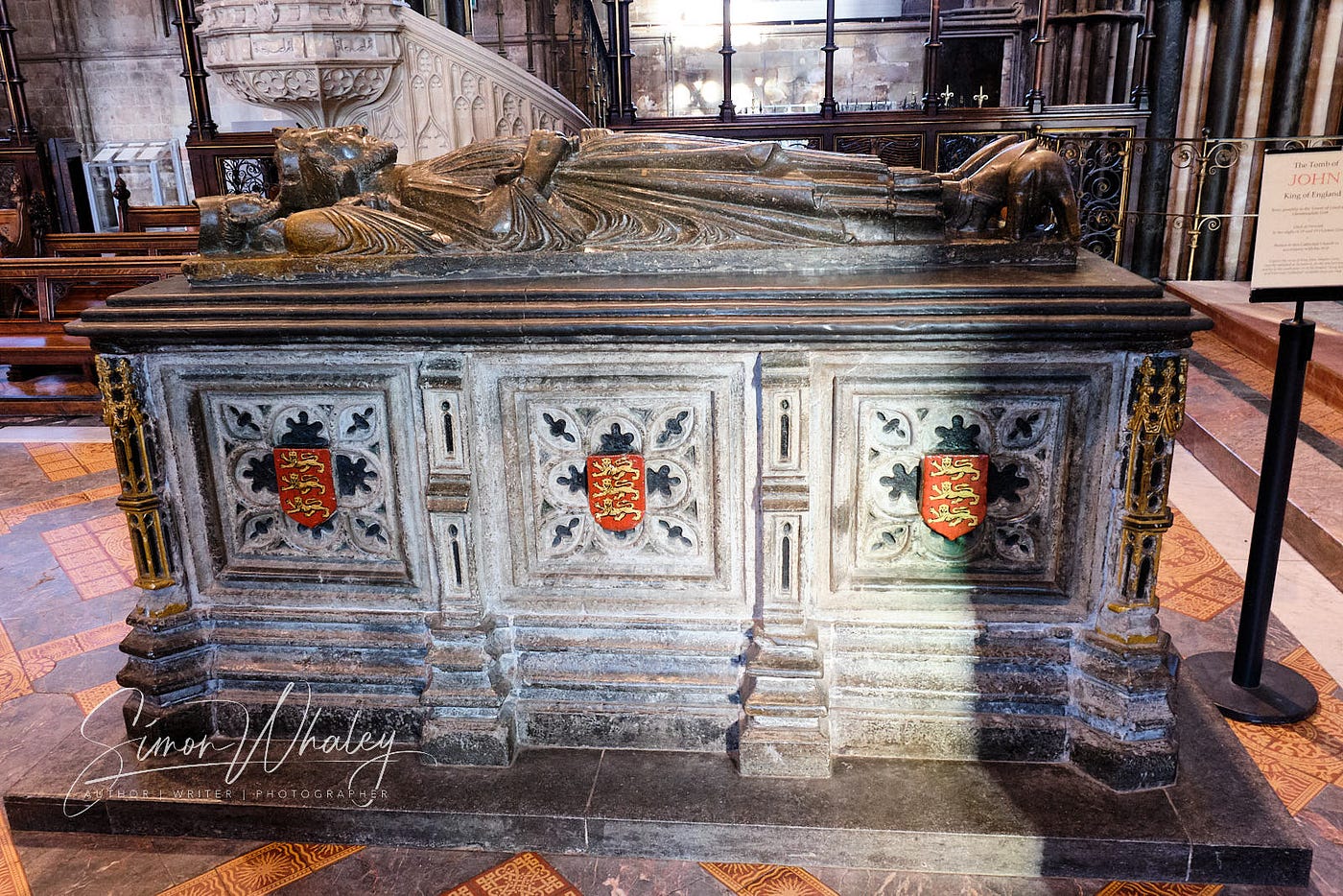
King John’s tomb in Worcester Cathedral © Simon Whaley
That’s because, nearly 300 years after his initial burial, the body of Prince Arthur, Henry VIII’s older brother, was buried a few steps away, in a tomb. It was deemed inappropriate for a King to be buried under the floor when a mere Prince had been buried in a tomb above the floor. So King John was raised in his own tomb!
The life-like effigy on King John’s tomb is the oldest royal effigy in England.
From here, our guide takes us into the main aisle, with its incredible roof. But instead of looking right up, he directs our gaze halfway up the stone columns of the arches on the northern side.

Worcester Cathedral © Simon Whaley
“These are highly decorated, and date from the early 14th century, but look at the arches on the opposite side.”
We turn and notice they’re different. The decoration on the spandrels, the triangular space between the arches, is much plainer.
“These columns and arches are younger, and date from the late 14th century,” he clarifies.
“Why are they so different?” I ask. Now it’s been pointed out, it looks odd.
“The Black Death!” he replies. “The bubonic plague swept through England in the middle of the 14th century. Many people died, including stonemasons. The nation lost large swathes of its population, including many skilled workers. Work inside the cathedral was affected by this.”
In the Cathedral’s north wall is a stained glass window in memorial to Worcester’s local hero, the composer Edward Elgar, which was unveiled a year after his death in 1934.
Although Elgar often performed at Worcester Cathedral during the Three Choirs Festival, he didn’t worship in this Anglican cathedral because his family was Catholic.

Edward Elgar’s statue in Worcester © Simon Whaley
Worcester is immensely proud of its local lad, who lived at Number 2 College Precincts, right next to the Cathedral, between 1861 and 1865. He was only 4 years old at the time when his family moved there, although, they’d previously lived at this same address before Edward was born.
Across the main road, at the end of the High Street, stands a tall statue in memory of the man, aged 64, dressed in the robes he wore when conducting at the Three Choirs Festival.
A short walk from here is Severn Street and the entrance to the Museum of Royal Worcester. It’s a fascinating place that now, thanks to a recent Heritage Lottery-funded refurbishment, houses the world’s largest collection of Worcester porcelain.

Royal Worcester’s Works at Worcester © Simon Whaley
Father and son team, Henry and John Sandon, known for their BBC Antiques Roadshow appearances, introduce a short film at the start of the tour, full of interesting facts. Thanks to the production process pioneered here in the city, Royal Worcester teapots were guaranteed not to crack when hot water was poured in.

Displays inside the Royal Worcester Works Museum © Simon Whaley
Working in the Royal Worcester factory during the 18th century was hard work. Employees worked from 6 am until 6 pm, six days a week. And they only worked in their own departments, which ensured high production standards were maintained.
But factory work wasn’t always safe work in those days. If the poisons in the paint didn’t make you ill, the vapours from the mercury gilding could cause brain damage!
Apprentices were paid half the wages of a full employee, and apprenticeships lasted seven years.
Sadly, the factories that once lined these streets have long gone, but they grew up here because of the River Severn. This river route gave them access to bustling ports like Bristol, and from there, the porcelain was transported right around the world.
Worcester also has another claim to fame. Its local newspaper, the Worcester Journal, was first published in 1753 and is the oldest, continuously published newspaper in the world.
A short ten-minute drive, four miles west of Worcester City Centre, near Broadheath, takes me to The Firs, Elgar’s birthplace. Now run by the National Trust, it’s a cosy cottage devoted to this Worcester boy from humble beginnings who went on to become one of Britain’s most famous composers.

Edward Elgar’s birthplace at Lower Broadheath © Simon Whaley
It seems this little boy knew he was destined for great things. In an upstairs bedroom, hanging on the wall, are details of an anecdote from his school days. When asked his name by a teacher, he replied, “Edward Elgar.” The teacher was not impressed at his lack of respect for his tutor, and instructed him to answer with “Sir”. So when asked again what his name was, Elgar replied, “Sir Edward Elgar.”
Elgar’s family moved here because his mother wanted her children to have a country life. His father, lodged in Worcester during the week and came home at weekends. Although Elgar only lived here for a couple of years, his mother sent him and his siblings back to Broadheath for their summer holidays.
Indeed, it is the Worcestershire countryside that Elgar claimed inspired much of his music. When he was created a Baronet in 1931, he chose to become Baronet Elgar of Broadheath.
At the bottom of the garden stands a bench, with a reclining statue of Elgar looking towards the Malvern Hills. I sit down next to him and gaze at the view.

Elgar’s bench at the bottom of the garden of his childhood home © Simon Whaley
High in the late afternoon sky, I watch four swans fly gracefully toward Worcester’s swollen river. In a few minutes’ time, they’ll be swimming along one of its riverside roads. How fitting, when my day began with swans, that these four elegant birds provided the perfect swan song to my fascinating day out in Worcester.
For more British travel pieces, check out:
메타데이터
- post_id
- 4e4c22e09742
- slug
- wonderful-worcester-4e4c22e09742
- url
- https://medium.com/globetrotters/wonderful-worcester-4e4c22e09742
- canonical_url
- https://medium.com/globetrotters/wonderful-worcester-4e4c22e09742
- author_url
- https://medium.com/@simonwhaley
- status
- ok
- fetched_at
- 2026-08-17 07:26:42