8 Mistakes That Make Good Code Difficult to Maintain
Code stays safe to change only when it preserves the context, dependencies, operational assumptions, and ownership behind its design.
8 Mistakes That Make Good Code Difficult to Maintain
Code stays safe to change only when it preserves the context, dependencies, operational assumptions, and ownership behind its design.
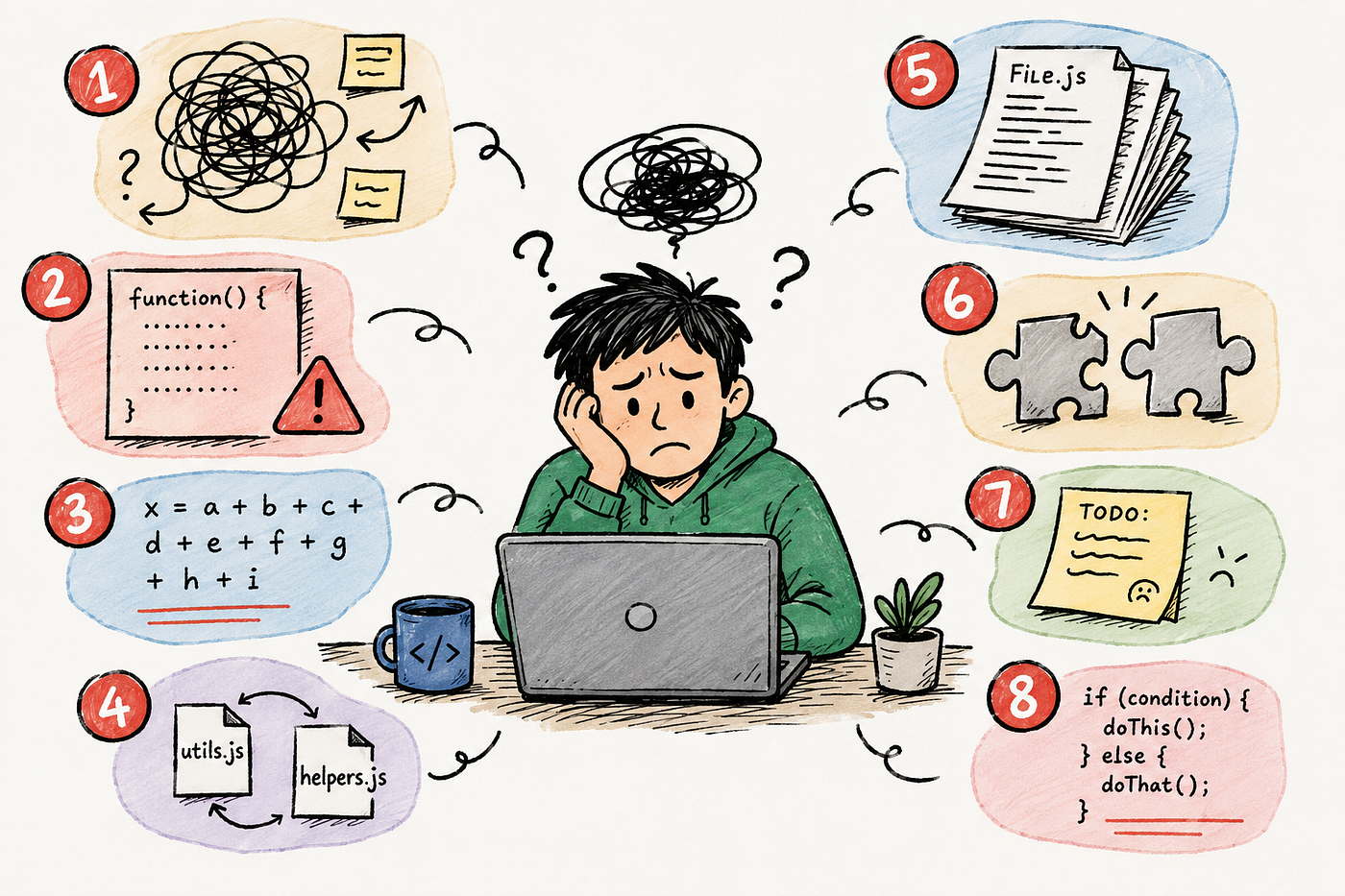
8 Mistakes That Make Good Code Difficult to Maintain
A codebase can be readable, well-tested, logically correct, and still be dangerous to change.
That contradiction appears frequently in mature systems. The code passes review. The names are clear. Responsibilities seem separated. Tests cover the primary paths. Nothing looks obviously careless. Yet a small requirement takes weeks, a routine deployment causes an incident, or a migration reveals dependencies that nobody knew existed.
The problem is that readability and correctness describe what the code looks like and what it does under known conditions. Maintenance asks a harder set of questions. Why does this constraint exist? Which consumers rely on this behavior? What happens under concurrency, partial failure, or degraded dependencies? Which team owns the outcome when several components are involved? How can an engineer verify that a change is safe before production proves otherwise?
Good code becomes difficult to maintain when the answers live outside the codebase, inside the memories of former developers, old incident conversations, undocumented infrastructure behavior, or organizational arrangements that have already changed.
The most expensive maintenance problems rarely begin with obviously bad engineering. They begin with reasonable decisions that solve a local problem while hiding information that future developers would need. Each of the following mistakes is a different expression of that same failure.
1. Abstracting Similar Code Before Confirming Similar Responsibility
Duplication creates visible discomfort. When several modules validate similar inputs, construct similar requests, or follow the same workflow, extraction feels like an obvious improvement. A shared abstraction reduces repeated code, centralizes fixes, and gives the system a more consistent shape.
Capable engineers make this decision because the immediate benefits are real. A deadline may require several related features at once. Copying the same logic into each implementation increases the chance of inconsistent behavior. A common layer can reduce review effort and make future enhancements appear cheaper.
The approach works when the duplicated code represents the same concept, changes for the same reasons, and operates under the same failure conditions. A stable parser, serializer, authentication mechanism, or protocol implementation often deserves a shared abstraction.
It begins to fail when code that looks similar does not carry the same responsibility.
Consider several order workflows that initially follow the same sequence: validate the request, reserve inventory, charge payment, and publish an event. A shared workflow abstraction removes duplication and gives every caller a clean interface. Later, one order type permits delayed payment, another tolerates partial inventory, and a third requires a compliance check before fulfillment.
The abstraction now has to represent different business meanings. It accumulates options, callbacks, strategy objects, conditional branches, and configuration. The calling code still looks clean, but the behavior has moved farther away from the place where developers reason about it.
During debugging, the line that appears to execute the workflow reveals very little. Engineers must determine which implementation was injected, which configuration was active, which hooks ran, and which branch handled the failure. A change intended for one consumer can affect several others because the abstraction erased distinctions that later became important.
The cost accumulates slowly. Pull requests require more contextual knowledge. Onboarding takes longer because developers must understand the shared framework before modifying one workflow. Tests become heavily parameterized. Production failures become harder to trace because behavior is distributed across layers.
Responsibility also becomes unclear. The team that owns the abstraction may not understand every business variation. The teams using it may not feel authorized to change the shared layer. Eventually, everyone depends on the abstraction, but nobody fully owns its consequences.
The experienced tradeoff is not abstraction versus duplication. It is repeated code versus hidden behavior. A shared design is valuable when consumers have aligned semantics, operational expectations, and release constraints. Separate implementations may be safer when two workflows only happen to resemble each other today.
Some duplication is cheaper than an abstraction that makes every future change indirect. Evidence for revisiting the design includes growing numbers of mode flags, caller-specific exceptions, unrelated regressions, and incident investigations that repeatedly cross several abstraction layers.
2. Keeping Critical Assumptions in Developers’ Memories
Many systems depend on rules that are not visible in the implementation.
A field must never change after reconciliation. One job must finish before another begins. A response format must remain stable because a legacy client parses it. A query is acceptable only because the table is currently small. A retry is safe because the downstream operation is assumed to be idempotent.
These assumptions often remain undocumented for understandable reasons. The team is small. The original developers review related changes. The feature is still evolving. Writing a decision record feels excessive when everyone involved already understands the constraint.
This arrangement can work while the original context remains intact. Informal knowledge acts as a contract because the people who made the decision are still present and involved.
The failure begins when the contract outlives the people who remember it.
A new developer sees a mutable field and updates it. Another team reuses an endpoint without knowing that one response code has compatibility implications. Traffic grows until a previously harmless query competes with production workloads. A retry mechanism is applied to an operation that creates duplicate side effects.
None of these changes need to look irresponsible. The missing context makes them appear safe.
During debugging, undocumented assumptions create a particular kind of delay. Engineers can see what the code does, but not why it must continue doing it. They search through commit history, old tickets, support conversations, database records, and former team members to distinguish an intentional constraint from an accidental implementation detail.
When that distinction cannot be recovered, the safest response is often to preserve every unusual behavior. This protects hidden consumers but also allows obsolete constraints to survive indefinitely. The codebase becomes harder to simplify because developers cannot prove which parts are still necessary.
Responsibility falls on whoever encounters the failure next. That may be an on-call engineer, a team performing a migration, or a developer assigned to a small feature. They inherit the burden of reconstructing a decision they did not make.
Not every choice deserves extensive documentation. Documentation can become stale, and maintaining it has a cost. The useful distinction is the consequence of forgetting. Assumptions involving data integrity, compatibility, ordering, security, financial behavior, recovery, or cross-team coordination need a durable representation.
The strongest representation is often executable. A database constraint can preserve an invariant. A contract test can protect behavior expected by external consumers. An assertion can expose an invalid state early. A metric can reveal when a capacity assumption stops being true. A short decision record can explain reasoning that code cannot express.
For a short-lived experiment or internal utility, informal knowledge may be sufficient. The decision should be revisited when the code gains consumers, handles durable data, enters an on-call rotation, or begins living beyond the original team’s planning horizon.
Maintainability declines whenever safe change depends on finding the right person and hoping they still remember the conversation.
3. Solving Production Problems Locally While Moving Risk Elsewhere
Production incidents reward speed. When a service is failing, restoring availability matters more than producing an elegant design. Engineers may add a retry, increase a timeout, bypass validation, disable an expensive feature, suppress an exception, or introduce a special case for malformed data.
These actions can be correct. The immediate cost of failure may be greater than the future cost of a temporary compromise.
The mistake is treating local recovery as complete resolution.
A retry may improve success rates for one service while increasing load on the dependency that is already struggling. A larger timeout may reduce visible errors while exhausting connection pools and worker capacity. Skipping validation may restore an ingestion pipeline while allowing invalid data into downstream systems. Suppressing an exception may keep requests successful while hiding incomplete business operations.
The local code looks better because the immediate symptom disappears. Tests pass. Error rates fall. The service returns successful responses. What remains invisible is the new pressure, duplication risk, ordering behavior, or data inconsistency elsewhere in the system.
The approach works when the broader effect is understood, the mitigation is bounded, and someone owns the follow-up. It begins to fail when emergency behavior becomes permanent without being incorporated into the system’s operating model.
Months later, another developer assumes the retry has always been safe. A traffic increase creates a retry storm. A migration encounters records created through the validation bypass. An incident responder sees successful requests but cannot explain why downstream work is missing.
The responsibility spreads across teams. Downstream services receive unexpected load. Data teams handle malformed records. On-call engineers investigate symptoms originating outside their component. Product teams deal with inconsistent outcomes that the original fix was never designed to support.
Maintenance cost accumulates because each incident fix changes the real behavior of the system without necessarily changing its documented architecture. Developers can no longer reason only from the normal path. They must account for fallbacks, retries, timeouts, feature flags, queues, caches, and manual recovery procedures added during earlier failures.
An experienced engineer evaluates an emergency change according to both recovery value and residual risk. A fast mitigation is justified when it limits customer harm, protects data, or creates room for a safer repair. It should also leave evidence behind.
That evidence may be a metric showing how often the fallback runs, an expiry condition for a feature flag, a documented capacity threshold, or a follow-up task tied to a specific failure mode. The amount of process should match the risk. A temporary branch in a small internal tool does not need the same treatment as a retry added to a payment operation.
Local fixes become maintenance problems when they restore service by moving uncertainty somewhere less visible. Resolving the incident requires understanding where that uncertainty went and deciding whether the system can safely continue carrying it.
4. Letting Temporary Shortcuts Become Permanent Architecture
Delivery pressure creates reasonable shortcuts.
A team may place new business logic inside an existing service because creating another boundary would delay a release. A scheduled script may replace a workflow engine. A shared database may avoid the immediate cost of building an API. A hard-coded mapping may be sufficient while the product model is still changing.
These decisions are not automatically poor engineering. A generalized platform for an unproven requirement can waste more time than it saves. A simple solution may be the right choice when expected lifetime, usage, and operational risk are low.
The problem begins when the system preserves the shortcut but loses the conditions that justified it.
Temporary solutions often become permanent through success. The script solves the problem, so another feature is added to it. The shared table becomes convenient, so more services read from it. The hard-coded mapping gains additional cases. The existing service becomes the default home for related logic because extending it remains cheaper than migrating away from it.
Each addition appears locally reasonable. Replacing the original design becomes harder, while adding one more exception remains easy. Eventually, the shortcut becomes architecture without ever receiving an architectural decision.
The code may still look clean. The surrounding system does not. Ownership reflects historical convenience rather than current responsibility. Operational behavior depends on scheduled ordering, direct database access, undocumented columns, manual interventions, or credentials that no current team clearly owns.
Migrations expose these dependencies. A team changes a schema and discovers reporting jobs that query internal tables directly. A service split reveals consumers who were never registered. A cleanup removes a field that support tooling still uses. The original shortcut saved delivery time, but every untracked dependency increased the future cost of change.
Responsibility becomes ambiguous because no team deliberately accepted ownership of the system that emerged. The original developers may have moved on. The hosting team may own availability but not the business workflow. Consumers expect compatibility because the behavior has existed for years, even though nobody intended it to become a stable contract.
A durable approach does not require eliminating shortcuts. It requires preserving a reversal path. Direct database access can be isolated behind one module. Known consumers can be recorded. A feature flag can include an expiry condition. A temporary process can have a defined scale or reliability limit.
This introduces overhead at the moment when speed matters. That cost is justified when the shortcut touches persistent data, crosses team boundaries, affects recovery, or is likely to attract more consumers. For a disposable prototype, formal migration planning may provide little value.
The evidence for redesign is usually operational rather than aesthetic. Rising usage, repeated manual intervention, multiple consumers, stricter availability requirements, and increasing exceptions indicate that the original assumptions have expired.
The practical mistake is not choosing the shortcut. It is continuing to treat the system as temporary after the organization has started depending on it.
5. Creating Technical Boundaries Without Assigning End-to-End Ownership
Modular architecture can make responsibility appear clearer than it is.
Services have separate repositories. Packages expose defined interfaces. Teams appear beside components on architecture diagrams. Each unit may have an owner, yet the behavior users depend on often crosses several of them.
A boundary is useful when it clarifies who can change the code, who approves interface changes, who responds to failures, and who understands the consequences of incorrect behavior. Without those answers, technical separation distributes responsibility without establishing accountability.
Teams create boundaries for legitimate reasons. Product teams need autonomy. Platform teams need to standardize infrastructure. Security teams need control over sensitive mechanisms. Independent deployment can reduce coordination and improve delivery speed.
The model works when contracts remain stable, and the failure path is well understood. It begins to fail when important behavior exists between components rather than inside one of them.
A request may enter a product service, pass through a shared authorization layer, write to a platform-managed datastore, and publish an event consumed by another team. When the user receives inconsistent access, every component may be operating according to its local contract. The failure exists in the combined behavior.
The product team understands the user's expectations but not the platform's internals. The platform team understands the mechanisms but not the intended business policy. The consuming team sees the incorrect event but cannot change either producer.
During an incident, this creates coordination latency. Teams gather evidence that their own component is behaving correctly while the end-to-end problem remains unresolved. During a migration, each team validates its interface, but nobody verifies the complete workflow. During review, a repository owner approves a change even though another team carries most of the operational risk.
Over time, organizations compensate with a defensive process. More approvals are required. Compatibility layers accumulate. Integration environments become larger. Teams avoid changing shared systems because the blast radius cannot be confidently assessed.
Onboarding also becomes more difficult. Repository boundaries do not match the path a real request follows. A developer may study several services before discovering that none of them owns the final outcome.
The solution is not to assign one team to every component. Specialization and shared infrastructure are necessary in many systems. The useful tradeoff is between local autonomy and end-to-end accountability.
A platform team does not need to own every business decision built on its infrastructure, but someone must own the contract connecting the infrastructure to the product behavior. Critical workflows need a clear escalation path and a team responsible for deciding whether the complete outcome is correct.
Ownership can be expressed through service catalogs, interface review rules, data stewardship, operational runbooks, and explicit responsibility for important workflows. These mechanisms introduce coordination cost. In a small team, informal communication may be faster. They become justified when teams deploy independently, failures cross boundaries, or compatibility decisions impose work on others.
The evidence of missing ownership is consistent: incidents bounce between teams, migrations reveal unknown consumers, approvals come from people who cannot evaluate the business risk, and runbooks list components without identifying decision-makers.
When these patterns repeat, another interface will not solve the problem. The system needs a clear answer to who is responsible for making the complete behavior safe.
6. Using Clean Interfaces to Hide Operationally Important Behavior
A good interface hides irrelevant implementation detail. Callers should not need to understand connection management, serialization, caching, or storage layout to use a component correctly.
Encapsulation becomes dangerous when it hides details that affect reliability, latency, consistency, or cost.
A method named save, publish, or fetch may look like a simple operation while performing remote calls, retries, distributed writes, cache invalidation, or asynchronous work. A repository interface may conceal whether reads are strongly consistent. A client library may make a network dependency look like an in-process function. An event publisher may return successfully before any consumer can observe the result.
Engineers create these interfaces because simplicity improves usability. A common abstraction can prevent every caller from reimplementing transport logic, retry behavior, authentication, and error handling.
The approach works when the operational semantics are stable, appropriate for all consumers, and understood by the people using the interface. It fails when callers reason from the interface’s apparent simplicity and make assumptions the implementation cannot guarantee.
Code review may show a harmless method call inside a loop without revealing that each iteration performs a remote request. A transaction may hold database locks while waiting for another service. A request handler may publish an event that can be delivered more than once. A migration may change ordering because callers never knew which ordering properties they relied on.
These failures often appear only in production. Local tests see quick, successful responses. Production introduces concurrency, latency, capacity limits, regional failures, retries, and stale caches. The code remains logically clean, but the interface does not reveal enough information to operate it safely.
Callers inherit failure modes they cannot distinguish and latency they cannot budget. The component owner must preserve accidental behavior because consumers built workflows around undocumented operational details.
Making semantics visible does not require exposing every implementation detail. The goal is to communicate the properties callers need for safe decisions.
Naming can distinguish local reads from remote fetches. Return types can separate accepted work from completed work. Documentation can state consistency, timeout, ordering, and retry behavior. Metrics can show dependency latency and failure rates. APIs can make idempotency requirements explicit.
This transparency creates a new cost. Every property exposed to consumers may become part of the contract and constrain future implementation changes. That cost is justified when callers must reason about transactions, user-facing latency, retries, capacity, or data correctness.
A simple interface remains reasonable when the operation is genuinely local, cheap, stable, and unlikely to acquire distributed behavior. The design should be revisited when incidents repeatedly surprise callers, performance investigations uncover hidden work, or migrations must preserve behavior that was never specified.
Encapsulation should protect developers from complexity they do not need. It should not prevent them from seeing risks they are responsible for managing.
7. Writing Tests That Preserve Implementation Details Instead of Important Behavior
A large test suite can make a codebase look safer than it is.
High coverage, fast feedback, and extensive mocking create confidence that changes will be detected. That confidence is justified only when the tests protect behavior the system cannot afford to lose.
Implementation-focused tests often begin for sensible reasons. They are fast, deterministic, and easy to isolate. Mocks remove the need for databases, queues, clocks, external services, or complex environments. Verifying collaborator calls can confirm that a unit follows the expected internal flow.
This approach works when the internal structure closely represents the contract and when most risks are local. It begins to fail as the system gains more boundaries, configuration, persistence, and operational behavior.
A test may verify that a publisher method was called without proving that the event can be serialized, delivered, retried, or consumed. Another may confirm that a repository received the expected parameters while missing a transaction boundary that allows partial updates. A controller test may assert an internal service call while ignoring response behavior that external clients depend on.
These tests often fail during harmless refactoring and pass during dangerous behavioral changes. Developers must update mocks whenever they reorganize code, so the suite becomes a detailed description of the current implementation. At the same time, production regressions escape because no test protects the contract between components.
Migrations expose the weakness. A database change passes every unit test but alters ordering relied upon by a batch process. A library upgrade changes serialization defaults. A queue configuration introduces duplicate delivery. Each component satisfies its mocked expectations, while the complete workflow no longer preserves the required outcome.
The maintenance cost is a misleading safety signal. Developers spend time repairing brittle tests but remain uncertain about deployment risk. Pull requests grow because structural changes touch many test files. Escaped defects lead teams to add more mocks around the same design, increasing effort without improving confidence.
An experienced engineer balances isolation against behavioral evidence.
Unit tests remain valuable for complex logic, boundary conditions, and fast feedback. Contract tests become important when teams deploy independently. Integration tests justify their slower execution when correctness depends on a real database, serializer, message broker, or framework configuration. A small number of end-to-end tests can protect critical workflows that no single component owns.
Broader tests introduce real complexity. They require environmental management, take longer to diagnose, and can become unreliable when poorly designed. They are not justified for every function or branch.
They are justified where the primary risk comes from interaction rather than computation.
Coverage percentage alone does not reveal whether the suite protects maintainability. Better evidence includes repeated regressions at component boundaries, tests that break during routine refactoring, incidents involving behavior no test describes, and deployments that still depend heavily on manual verification.
Maintainable tests tell future developers what must remain true. They do not merely record how the current implementation happens to produce that result.
8. Building Systems That Cannot Explain Their Production Behavior
Correct code is difficult to maintain when nobody can determine what it is doing in production.
Observability is often weakened by understandable delivery choices. Structured logging takes time. Metrics cost money. Distributed tracing adds infrastructure and instrumentation work. Teams may prioritize visible functionality while traffic is low and failures remain easy to reproduce.
This approach can work during the early life of a system. The codebase is small. The original developers know the architecture. Production resembles development closely enough that a stack trace and a few database queries are usually sufficient.
The failure begins when production conditions become meaningfully different.
Concurrency introduces timing failures that cannot be reproduced on demand. Partial dependency outages create mixed outcomes. Data accumulates states that test fixtures are never represented. Requests cross several services. Background jobs process work long after the initiating request has ended. A user reports an incorrect result hours after the relevant operation completed.
At that point, readable code is not enough. Engineers need evidence showing which path was executed, which dependency responded, which data version was used, whether retries occurred, and where the result diverged from expectations.
Weak observability turns incidents into reconstruction exercises. Logs lack request or correlation identifiers. Metrics show elevated errors but cannot identify the affected operation. Alerts detect infrastructure symptoms after user-facing behavior has already degraded. Traces stop at service boundaries. Background jobs fail without recording which records were skipped.
The code may still be behaving according to its implementation. Engineers simply cannot distinguish a code defect from invalid data, dependency failure, capacity pressure, configuration drift, or a mistaken operational assumption.
Incident response slows because every hypothesis requires another deployment, a manual query, or temporary instrumentation. Teams debate ownership because the system cannot show where the failure occurred. Defensive fixes are added without a confirmed cause, increasing complexity while preserving uncertainty.
The on-call engineer inherits the immediate investigation. Future developers inherit the retries, guards, fallback paths, and special cases created during that investigation. Repeated incidents become more expensive because each unresolved failure leaves another layer of defensive behavior behind.
Useful observability begins with the decisions engineers must make during failure.
Logs should preserve enough context to reconstruct important operations without exposing sensitive data. Metrics should connect technical health to meaningful behavior. Traces should cross boundaries where latency and failure propagate. Deployment markers and configuration versions should make operational changes visible. Correlation identifiers should allow a workflow to be followed across services and asynchronous processing.
This investment has real costs. Telemetry consumes storage and processing resources. Instrumentation can clutter implementation code. High-cardinality data can become expensive. Excessive alerts create noise rather than understanding.
The cost is justified for workflows involving durable data, external dependencies, asynchronous processing, high operational risk, or strict recovery expectations. A small internal utility may reasonably rely on simpler diagnostics.
The strongest evidence that observability is insufficient appears during incidents. Engineers must add logging before diagnosis can begin. Teams cannot measure the impact of a failure. Alerts do not correspond to user-visible behavior. The same class of defect returns because the previous incident never produced a verified explanation.
A system becomes easier to maintain when it can show not only what the code should do, but what it actually did under real conditions.
Readable code reduces the effort required to understand an implementation. Correct code satisfies the requirements that were known and tested when it was written. Neither quality guarantees that the next developer can change the system safely.
Safe change requires preserved context. Developers need to understand why constraints exist, which dependencies live beyond the current repository, what operational behavior sits behind clean interfaces, and who owns decisions that cross technical boundaries. They need tests that protect important outcomes and production evidence that distinguishes code defects from system conditions.
Providing that information has a cost. Documentation becomes stale. Broader tests run more slowly. Observability consumes resources. Explicit ownership creates coordination work. Less abstract designs may repeat logic.
The experienced choice is not to maximize every maintainability mechanism. It is to invest according to the expected lifetime of the code, the reversibility of the decision, the number of people and systems affected, and the consequences of being wrong.
A piece of code is genuinely maintainable when another developer can understand its context, observe its behavior, identify its dependencies, determine its owner, and change it without relying on missing history or unsupported assumptions.
👏 Found an idea worth applying? Clap for the article.
📩 Follow for more practical writing on software design, production systems, and the long-term cost of technical decisions.
🔄 Share this with a developer who has inherited code that looked cleaner than it behaved.
💬 What deceptively good code have you maintained that became unexpectedly difficult to change safely?
메타데이터
- post_id
- 4e4ca8ae6ea0
- slug
- 8-mistakes-that-make-good-code-difficult-to-maintain-4e4ca8ae6ea0
- url
- https://medium.com/skillstuff/8-mistakes-that-make-good-code-difficult-to-maintain-4e4ca8ae6ea0
- canonical_url
- https://medium.com/skillstuff/8-mistakes-that-make-good-code-difficult-to-maintain-4e4ca8ae6ea0
- author_url
- https://medium.com/@codebyumar
- status
- ok
- fetched_at
- 2026-07-13 06:23:13