Barbie Didn’t Market a Movie. It Marketed a Cultural Moment.
How Mattel turned brand equity, 100+ partnerships, and cultural psychology into a $1.4 billion growth engine.
Barbie Didn’t Market a Movie. It Marketed a Cultural Moment.
How Mattel turned brand equity, 100+ partnerships, and cultural psychology into a $1.4 billion growth engine.
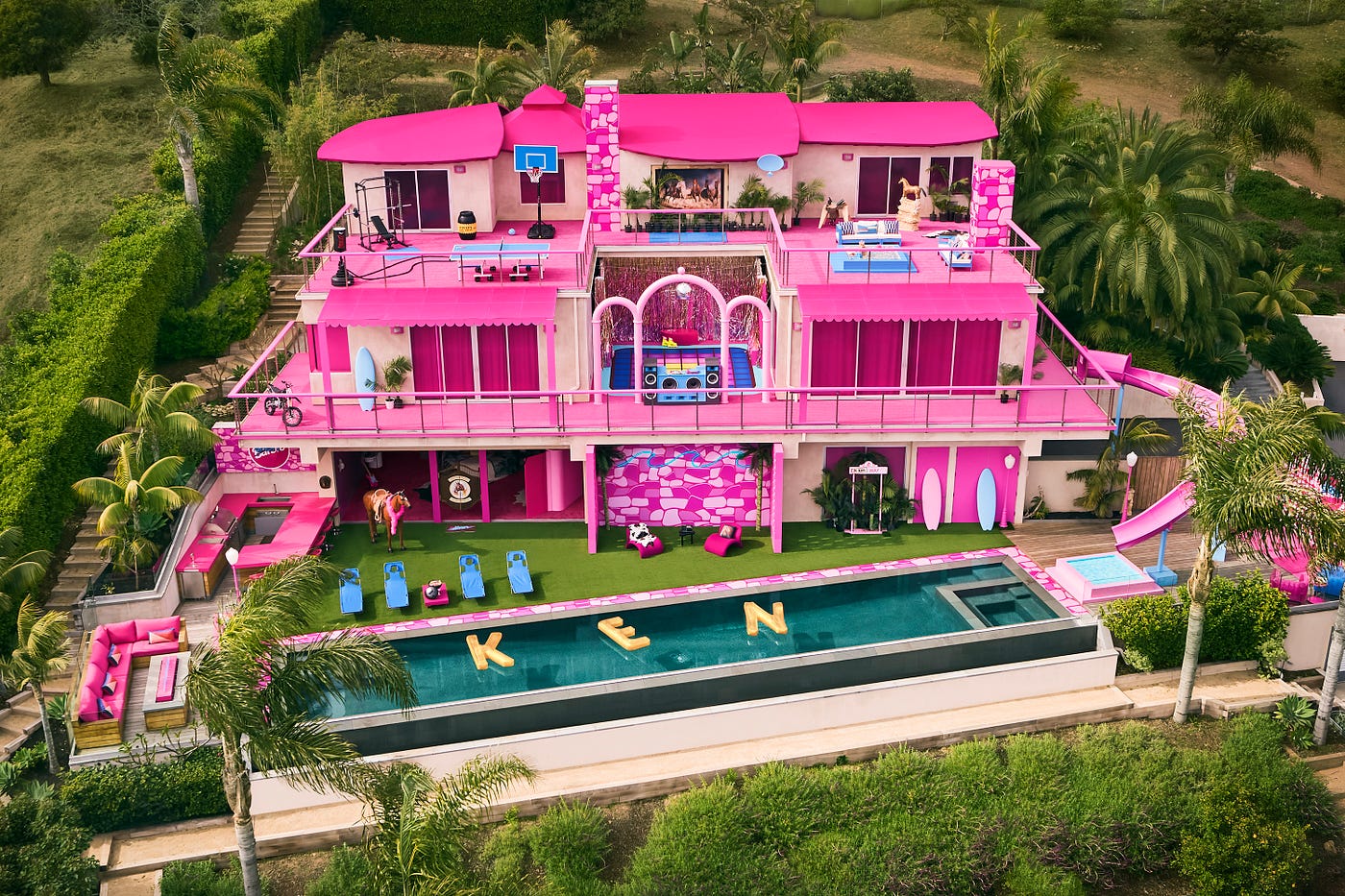
The real-life Malibu Dreamhouse listed on Airbnb months before the film’s release.
A “pink unicorn,” Warner Bros’ own head of distribution called it; nobody predicted $155 million on opening weekend for an original, non-franchise film. Nobody predicted a reported shortage of pink paint either. Both happened before a single ticket sold.
Most movie marketing tries to sell you a story. Barbie’s marketing team sold you a world you could already stand inside, a Malibu Dreamhouse on Airbnb, a pink Xbox, a Barbie-branded burger, months before the film existed to you as anything but a color. By the time “Barbie” opened on July 21, 2023, Mattel and Warner Bros. weren’t launching a movie campaign anymore. They were closing one.
The usual read on Barbie’s success is “great partnerships, great timing, great luck with Oppenheimer.” That undersells it badly. The real strategic move was refusing to market a film at all, and instead building an entire cultural infrastructure that a film simply arrived inside of. That distinction is the whole lesson.
The Business Problem Underneath the Pink
Mattel wasn’t just trying to sell movie tickets. It was solving a much harder problem: proving a 64-year-old toy brand could become a modern entertainment IP without alienating the nostalgia that made it valuable in the first place. CEO Ynon Kreiz had been public about wanting to transition Mattel “from being a toy-manufacturing company… to an I.P. company”; Barbie was the test case for an entire studio strategy riding on one film’s cultural reception.
Warner Bros. had its own problem: an original film, not a sequel or franchise entry, in a summer market that had been dominated by tired sequels. Studios don’t usually risk $100 million-plus marketing budgets on originals precisely because there’s no built-in audience to target. Barbie had a built-in audience, but one that skewed toward nostalgia and childhood, not $20 movie tickets. The marketing had to do something sequels never need to do: convince adults that a doll brand was for them, right now, unironically.
The Strategic Decisions That Actually Made It Work
- Partnerships as world-building, not product placement- Barbie assembled more than 100 brand collaborations; estimates from The Guardian put the combined value near $70 million, spanning Crocs, Xbox, Airbnb, Gap, Forever 21, Pinkberry, Progressive Insurance, and even a Barbie-pink Burger King item in Brazil. Crucially, these weren’t logo slaps. Each partner built something a fan could physically enter, wear, or eat; an approach that mirrors Integrated Marketing Communications (IMC), the principle that every channel, from social to retail to hospitality, should deliver one unified brand message instead of fragmented, disconnected promotions. Barbie’s message, “the world is pink now, and you’re invited” was identical whether you encountered it on Airbnb or in a Zara storefront.
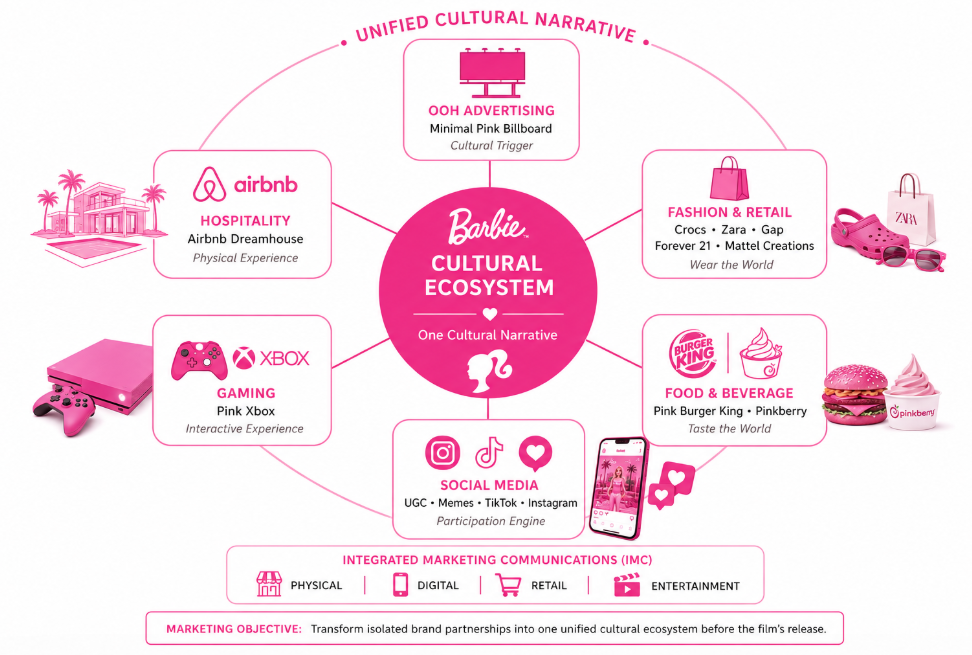
2. Protecting Brand Equity while taking real creative risk- Mattel is famously protective of the Barbie brand, yet it handed creative control to Greta Gerwig and Margot Robbie for a script that openly satirized Barbie’s own history and cultural baggage. This is Brand Equity management at its most sophisticated: rather than defending the brand by keeping the message safe, Mattel spent its accumulated brand trust deliberately, betting that self-aware humor would deepen loyalty rather than damage it. It worked partly because Barbie’s decades of consistent visual identity, the exact shade of pink, the silhouette, the logo, gave audiences a stable anchor even as the content took risks around it.
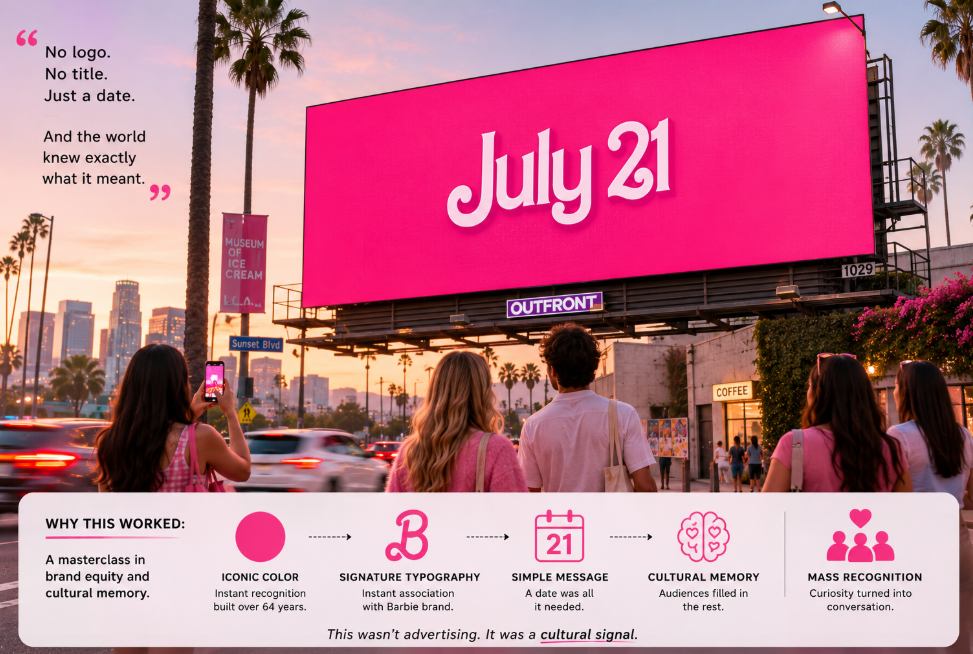
3. Engineering a moment, not a release date- The single pink teaser billboard, revealed with no film title, is now cited across the industry as the moment that reset expectations for what movie marketing could look like. MarcomCentral and other trade analyses point to it as the visual seed that “the campaign transcended traditional promotion to become a worldwide phenomenon.” This is Cultural Marketing in its clearest form: instead of interrupting culture with ads, Barbie’s team fed the cultural conversation raw material, a color, a font, a doll box silhouette, and let the internet build memes, outfits, and commentary voluntarily, for free.
4. Letting “Barbenheimer” happen instead of fighting it- When Christopher Nolan’s “Oppenheimer” was scheduled for the same release date, most studios would have tried to move dates to avoid competing head-on. Barbie’s team let the contrast stand, and the internet did the rest, turning two tonally opposite films into a single cultural event. More than 200,000 people bought tickets to see both films on the same day, according to the National Association of Theatre Owners, and the combined opening became the fourth-biggest weekend in box office history.
The Numbers Behind the Phenomenon
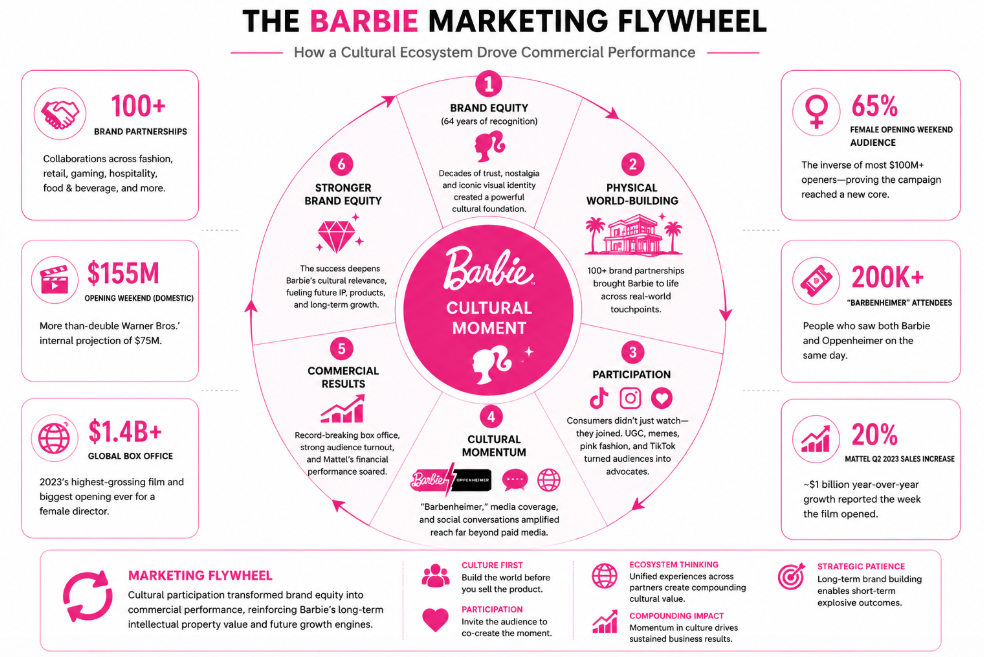
- $155 million domestic opening weekend, more than double Warner Bros.’ own internal $75 million projection, and the best opener of 2023.
- $1 billion in global box office reached within nine days of release; the film went on to earn approximately $1.4–1.5 billion worldwide, becoming 2023’s highest-grossing film and the biggest opening ever for a female director.
- **100+ to 165+ brand partnerships**, depending on the count, an unprecedented density of collaboration for a single film campaign.
- **~$150 million marketing spend, **reportedly larger than the film’s own production budget of roughly $145 million.
- 900% increase in collectible Barbie doll sales on eBay between 2021 and 2022, driven by pre-release buzz, according to eBay’s VP of global collectibles.
- **20% jump in Mattel’s Q2 2023 sales, **roughly a $1 billion swing year-over-year, reported the same week the film opened, with Mattel shares rising in the days following release.
- 65% female opening-weekend audience, notably the inverse of most $100-million-plus openers, a signal the campaign successfully reached an audience Hollywood tentpoles routinely under-target.
What Every Marketer Should Take From This
- Build the world before you build the ad- Barbie’s team spent months creating physical, ownable brand touchpoints before asking anyone to buy a ticket , by launch day, the “asking” was almost unnecessary.
- Spend brand equity deliberately, not defensively- The instinct to protect a legacy brand by keeping messaging safe is usually the wrong instinct; controlled risk, backed by decades of consistent identity, is what made Barbie’s self-aware satire land as clever instead of reckless.
- Design for participation, not just impressions- Every partnership gave fans something to wear, visit, or post, a campaign people could physically join is inherently more durable than one they can only watch.
- Don’t fight the culture around you, feed it- Barbie’s team let “Barbenheimer” happen instead of treating Oppenheimer as competition to avoid, turning a scheduling coincidence into the biggest joint marketing event of the year, for free.
Barbie never needed to convince anyone a movie was coming. By the time the trailer mattered, the color pink had already done the convincing. That’s the actual takeaway for any brand chasing “viral” today: virality is what happens after you’ve built something people already want to stand inside.
메타데이터
- post_id
- 4e652da15701
- slug
- barbie-didnt-market-a-movie-it-marketed-a-cultural-moment-4e652da15701
- url
- https://medium.com/@sumitramathan23/barbie-didnt-market-a-movie-it-marketed-a-cultural-moment-4e652da15701
- canonical_url
- https://medium.com/@sumitramathan23/barbie-didnt-market-a-movie-it-marketed-a-cultural-moment-4e652da15701
- author_url
- https://medium.com/@sumitramathan23
- status
- ok
- fetched_at
- 2026-08-01 13:00:26