Welcome to 1965: Why Quantum Programming Today Feels Like the Dawn of Personal Computing
If you are currently experimenting with quantum computing — writing your first circuits in frameworks like IBM’s Qiskit or configuring…
Welcome to 1965: Why Quantum Programming Today Feels Like the Dawn of Personal Computing
If you are currently experimenting with quantum computing — writing your first circuits in frameworks like IBM’s Qiskit or configuring quantum simulators on your local machine — you are probably experiencing a strange mix of awe and deep frustration.
The documentation feels hyper-academic. The hardware is incredibly sensitive to error. The logic requires you to completely throw out standard programming loops and think in terms of complex matrices and physical microwave pulses.
It feels alien. But if you look closely at the history of computer science, this isn’t alien at all. It is a mirror.
We are not entering a completely unknown future; we are reliving a very specific past. Programming a quantum computer in 2026 feels exactly like programming the massive mainframes of the 1960s, while using frameworks like Qiskit feels precisely like the birth of BASIC on early microcomputers in the 1970s and 80s.
To understand where quantum computing is going, we need to look back at the infrastructure patterns of the past.
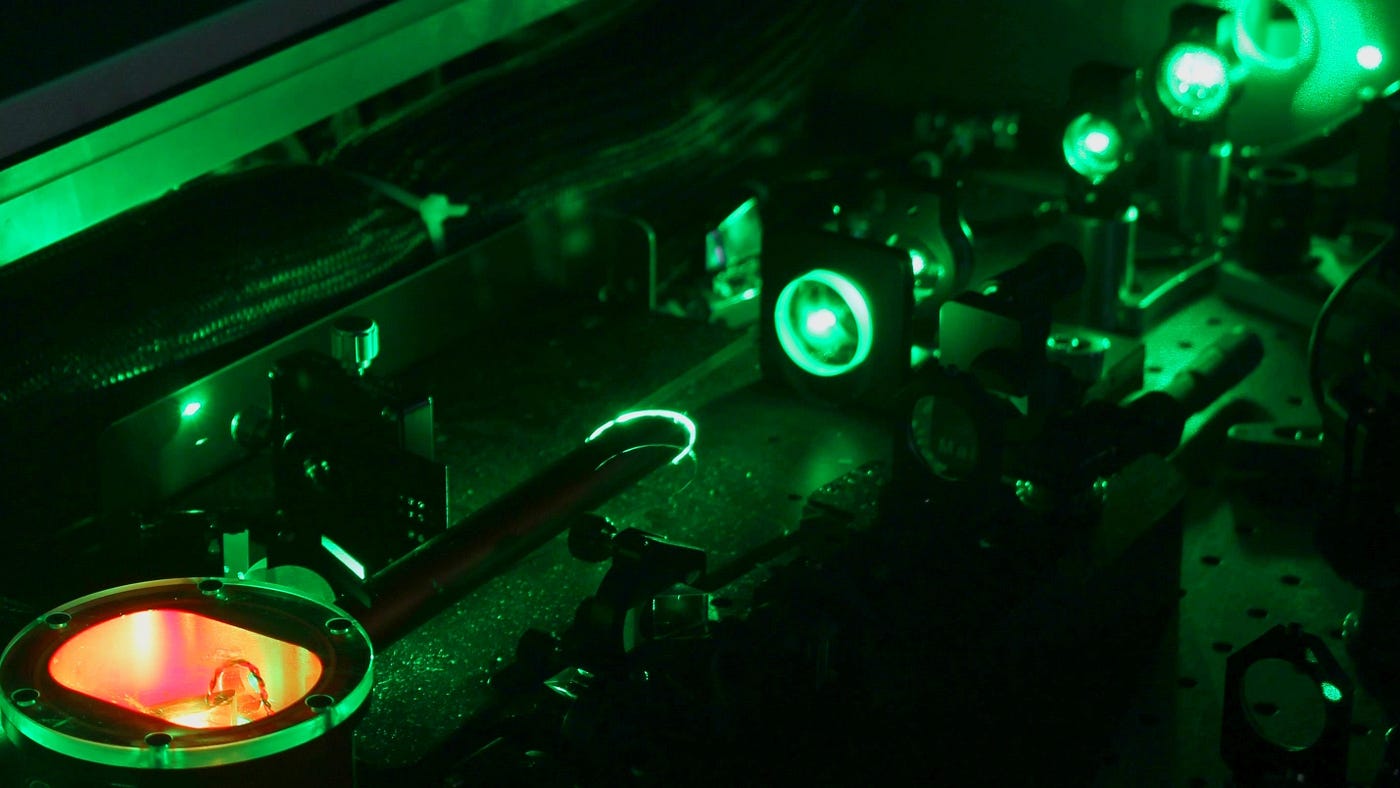
Photo by Lorenzo Herrera on Unsplash
The Hardware Analogy: Mainframes vs. Cryogenic Dilution Fridges
In the 1960s, a computer was not something that sat on a desk. Monolithic mainframes like the IBM 7090 occupied entire climate-controlled rooms. They were packed with vacuum tubes and giant transistors that generated immense heat, broke down constantly, and required a dedicated team of technicians in white lab coats just to keep the system stable.
Today’s quantum computers are the spiritual successors to those 1960s mainframes.
They do not live in home offices or standard server racks. They are housed in massive, chandelier-like structures known as cryogenic dilution refrigerators. To maintain the fragile stability of qubits, these machines must cool the quantum processors down to temperatures colder than deep space — roughly $-273^\circ\text{C}$ (near absolute zero). Just like the early computer pioneers, modern developers do not touch the physical machine; we access it remotely via terminal lines and cloud APIs.
The Software Analogy: Punch Cards vs. Quantum Circuits
In the dawn of classical computing, programming was a physical, low-level exercise. There were no operating systems, no file systems, and no high-level languages. Developers had to manually patch cables into circuit boards to route electrical currents or punch binary code into physical paper cards. One incorrect hole meant the machine outputted garbage or locked up entirely.
Quantum programming today is at that exact same prehistoric stage of abstraction.
When you write code for a quantum processor, you don’t use high-level conditional logic like if/else statements. You build a Quantum Circuit. You take a qubit and manually apply physical, mathematical operations to it—like a Hadamard gate to force it into superposition, or a CNOT gate to entangle it with another qubit. You are manipulating the underlying physics of the hardware directly. We are still programming the machine code of the quantum era.
Qiskit as the “BASIC” of the Quantum Age
This brings us to the late 1970s and 80s, the era of the Commodore 64, the Apple II, and the Sinclair ZX Spectrum.
Before this era, writing software required deep knowledge of assembly language tailored to a specific microchip. If you wanted to program a Commodore 64, you had to understand the registers of the MOS 6502 processor.
Then came BASIC (Beginner’s All-purpose Symbolic Instruction Code). It was the great democratizer. You didn’t need a degree in electrical engineering to build a program; you could just type 10 PRINT "HELLO" and the built-in interpreter handled the low-level translation. BASIC standardized software creation across fragmented, experimental hardware.
Qiskit, IBM’s open-source quantum development SDK embedded in Python, is fulfilling that exact same historical role today.
Before high-level SDKs, running a quantum algorithm meant formulating complex quantum mechanical equations. Qiskit acts as our modern BASIC. It provides a readable, accessible environment where developers can map out quantum circuits using clean syntax. The Qiskit compiler then takes that abstract logic and translates it into the precise microwave pulses required to manipulate the qubits inside the physical dilution fridge. It allows traditional software engineers to build quantum algorithms without needing a PhD in particle physics.
Looking Ahead: The Next Digital Frontier
The ultimate takeaway of this historical parallel is one of perspective.
Every time you struggle with a quantum simulator, re-write a circuit to minimize quantum noise, or spend hours trying to understand how to optimize a handful of qubits, remember this: you are doing the exact same foundational legwork as the teenagers and engineers who sat in front of their Commodore 64s in 1982 typing code out of the back of a hobbyist magazine.
We are moving past the wild west of quantum physics and entering the true engineering phase of quantum computing. The developers who learn to master these low-level abstractions, frameworks, and architectural mindsets today are the ones who will design the operating systems, compilers, and platforms of the next forty years.
Did you experience the early days of personal computing? Does the current state of quantum development give you a sense of technical nostalgia, or do you think the architectural challenges are completely different this time around? Let’s discuss in the comments below.
메타데이터
- post_id
- 4e6e083e89d5
- slug
- welcome-to-1965-why-quantum-programming-today-feels-like-the-dawn-of-personal-computing-4e6e083e89d5
- url
- https://medium.com/@luisrodriguezweb3/welcome-to-1965-why-quantum-programming-today-feels-like-the-dawn-of-personal-computing-4e6e083e89d5
- canonical_url
- https://medium.com/@luisrodriguezweb3/welcome-to-1965-why-quantum-programming-today-feels-like-the-dawn-of-personal-computing-4e6e083e89d5
- author_url
- https://medium.com/@luisrodriguezweb3
- status
- ok
- fetched_at
- 2026-06-09 15:37:30