Oracle Data Guard Explained
Why Data Guard ?
Oracle Data Guard Explained
Why Data Guard ?
In today’s world, downtime is no longer acceptable. This is where Data Guard plays a critical role for databases — helping ensure high availability and resilience against failures.
Oracle Data Guard provides a robust solution for:
- Disaster recovery
- High availability
- Data protection
In this blog, we’ll break down:
- What Data Guard is
- How it works
- Key components
🧠 What is Oracle Data Guard?
Oracle Data Guard is a feature of Oracle Database that maintains standby databases as copies of the primary database.
👉 In simple terms:
It continuously ships and applies redo logs from the primary database to one or more standby databases.
Architecture Overview
Primary Database
- The main active database
- Handles all read/write operations
Standby Database
- A synchronized copy of the primary
- Used for failover and disaster recovery
Types of Standby Databases
Physical Standby
- Exact block-by-block replica
- Most commonly used
- Supports Redo Apply
Logical Standby
- Uses SQL apply
- Allows additional flexibility (read/write operations)
How Data Guard Works
- Users perform transactions on the Primary Database
- Redo logs are generated
- Redo logs are shipped to the Standby Database
- Standby applies the redo logs using: — Redo Apply(MRP — Managed Recovery Process) — Real-time apply (if enabled)
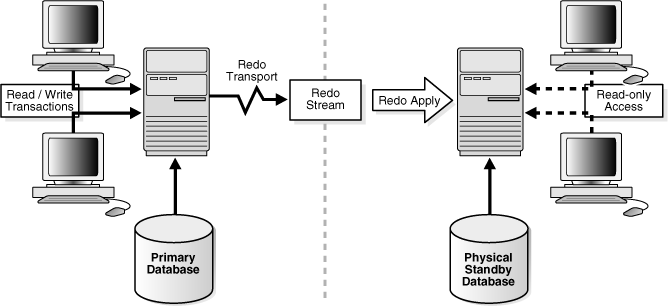
Redo Apply Mechanisim
Redo Apply Mechanism
The Managed Recovery Process (MRP) is responsible for applying redo logs on the standby database.
It ensures that the standby remains in sync with the primary by continuously applying changes.
🔐 Protection Modes
Oracle Data Guard offers three protection modes that define the trade-off between performance and data safety:
1. Maximum Performance
- Uses asynchronous redo transport
- Provides best performance
- Possible data loss in failure scenarios
2. Maximum Availability
- Uses synchronous redo transport
- Ensures zero data loss under normal conditions
- Balanced performance and safety
3. Maximum Protection
- Enforces strict synchronous transport
- Guarantees zero data loss
- Shuts down primary if standby is unavailable
Choosing the right mode depends on business requirements:
- Performance-focused systems → Maximum Performance
- Mission-critical systems → Maximum Availability
Key Components
1. Redo Transport Services
Responsible for transmitting redo data from the primary to the standby database.
2. Redo Apply Services
Responsible for applying redo logs on the standby database.
3. Data Guard Broker
A management framework (CLI: dgmgrl) that simplifies configuration and monitoring.
🧾 Conclusion
Oracle Data Guard provides a powerful foundation for high availability, but its effectiveness depends on how well it is understood and implemented.
From redo generation to log apply, every component plays a role in keeping systems consistent and recoverable.
메타데이터
- post_id
- 4e6eae12f244
- slug
- oracle-data-guard-explained-4e6eae12f244
- url
- https://medium.com/@stanya831/oracle-data-guard-explained-4e6eae12f244
- canonical_url
- https://medium.com/@stanya831/oracle-data-guard-explained-4e6eae12f244
- author_url
- https://medium.com/@stanya831
- status
- ok
- fetched_at
- 2026-08-19 18:15:50