Uncovering the Truth Behind 4,000 E-Commerce Myopia Correction Products
How False Claims Sneak into Banner Ads
Uncovering the Truth Behind 4,000 E-Commerce Myopia Correction Products
How False Claims Sneak into Banner Ads
By Yaelle Tang | June 6, 2024 | Originally published on *The Paper*
According to 2023 data from China’s National Health Commission, the overall myopia rate among children and adolescents has reached 52.7%, meaning that one in two kids is nearsighted. This has turned the market for youth myopia prevention into a highly lucrative business.
A quick search on e-commerce platforms like Taobao and JD.com reveals countless products: eye masks, electric pulse eye massagers, lutein supplements, full-spectrum lamps, and vision correction glasses. Potential buyers frequently ask in the Q&A sections, “Is this a scam?” or “Can this really reduce my prescription?”
Despite widespread consumer skepticism, many are still misled by promises like “improves vision” or “reverse nearsightedness.” Some consumers end up spending significant amounts of money. One shared, “I spent nearly 20,000 yuan on myopia treatment, but my vision got worse instead of better.” Another said, “After buying glasses that were supposed to reduce my child’s prescription, it actually increased by 1.25 diopters.”
In 2021, the State Administration for Market Regulation launched a campaign to crack down on false advertising in myopia prevention products. They prohibited misleading terms such as “myopia cure” and “prescription correction” to ensure consumers aren’t misled. Yet, three years later, questionable marketing tactics continue. To get around the platforms’ text review systems, sellers have been embedding misleading claims into the images or posters shown on product pages.
Dubious Claims Hidden in Banner Ads: Promises of “Clear Vision for Life” and “Regain 20/20 Vision”
While e-commerce platforms have banned terms like “myopia cure” and “myopia recovery,” sellers have found ways around the rules. They now hide misleading claims within promotional images or posters, allowing products to slip through review systems.
When a reporter searched with terms like “myopia improvement” and “myopia correction,” the product names and their accompanying posters told very different stories. Most seemed fairly neutral, with only a few containing exaggerated phrases like “Regain 20/20 vision” or “ Remove your glasses with one mask.” Yet the promotional posters painted a much more misleading picture. These ads featured unauthorized endorsements from celebrities, bold and colorful fonts, before-and-after comparisons of myopia prescriptions, as well as promises of “100% cure” — all methods designed to evade platform regulations and grab attention.
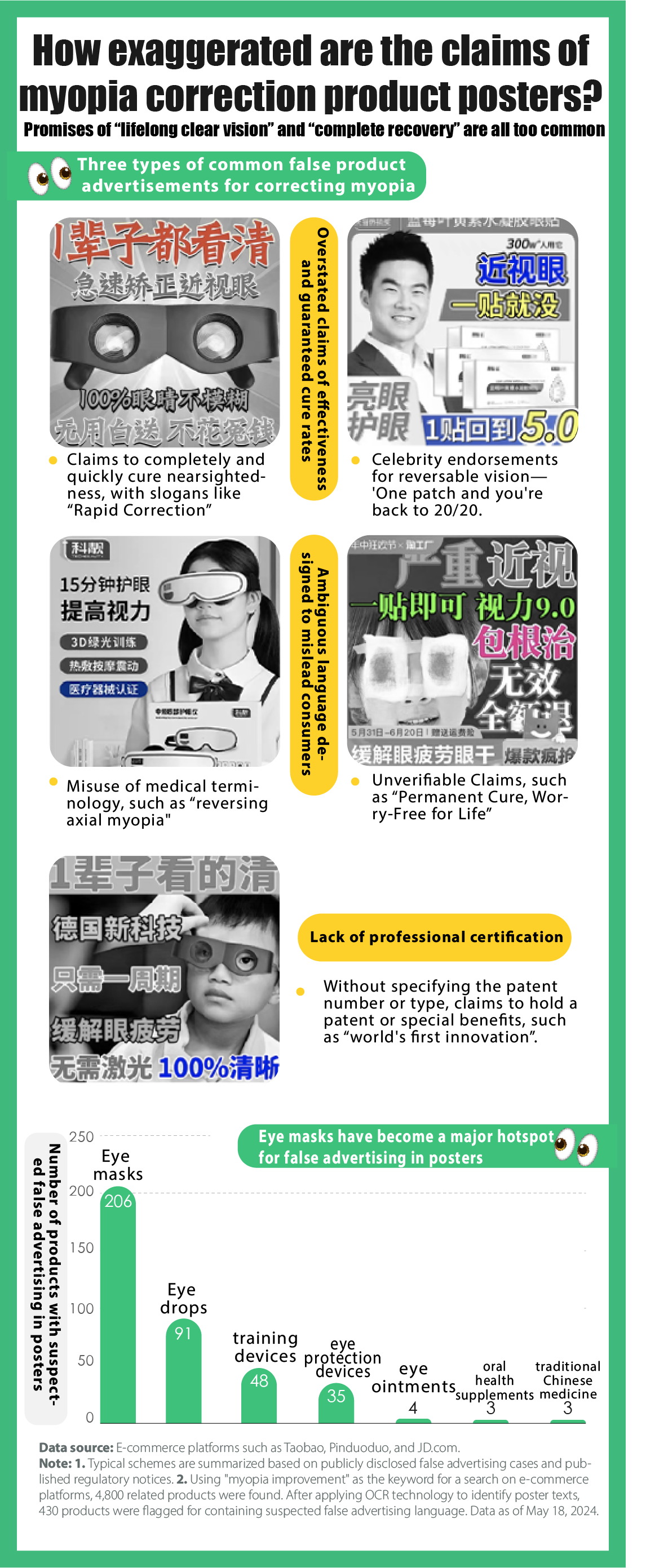
How exaggerated are the claims of myopia correction produce poster?
A search for “vision improvement” returned over 4,800 product listings, with eye masks dominating the results. These masks, accounting for 56.5% of the listings, are one of the most commonly advertised products in the market. Users frequently reported side effects like eye inflammation, allergic reactions, and even retinal damage after using these masks.
Complained Products: Ineffective at Best, Risk of Retinal Damage at Worst
Complaints filed on Black Cat, a popular Chinese consumer complaint platform, reveal that more than 25% of users who bought myopia prevention products experienced negative health impacts. Eye masks were cited most frequently for causing problems like vision deterioration, skin diseases, and eye injuries. While not all complaints were about children’s eye care products, the risks associated with these products are evident.
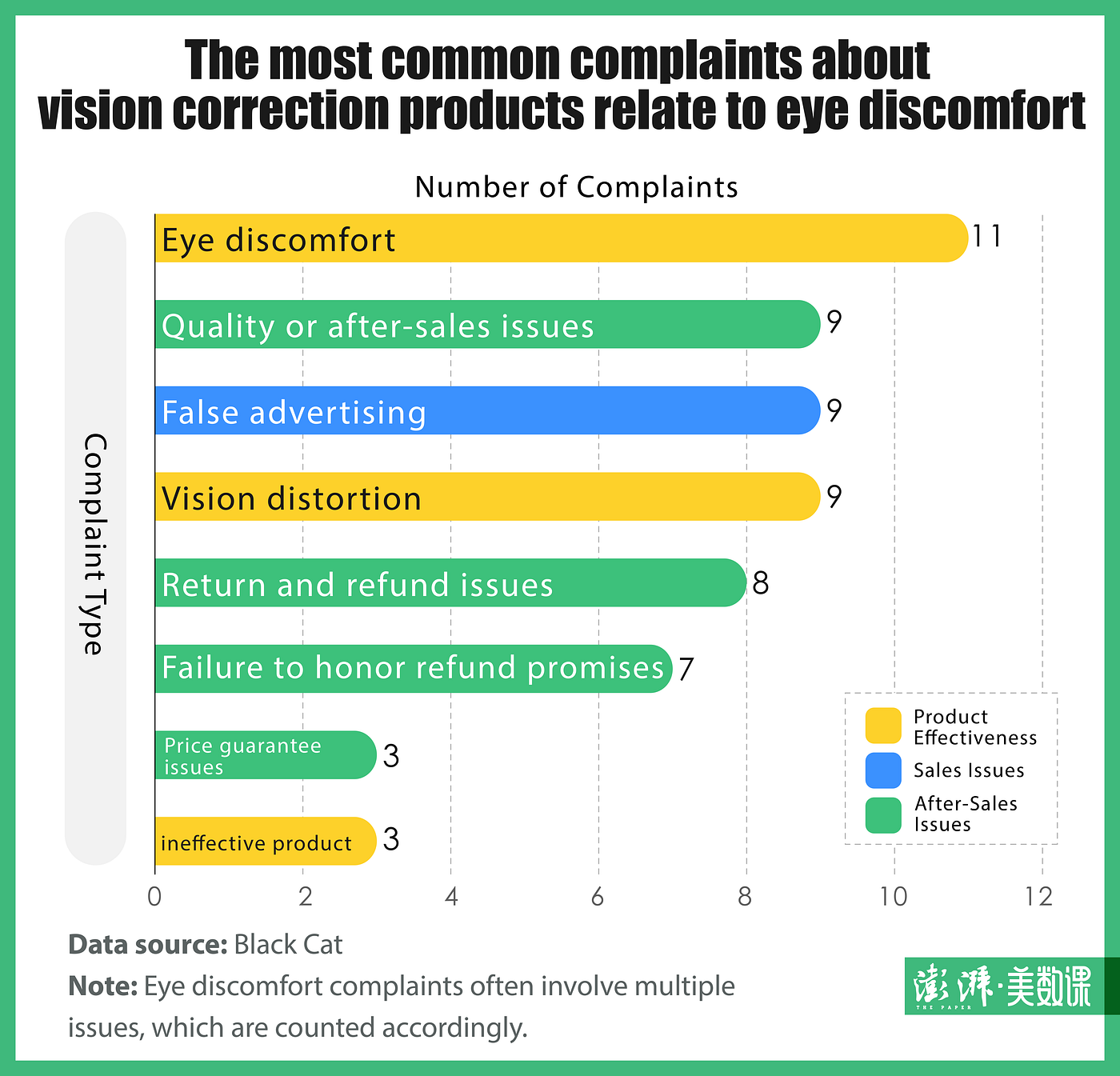
The most common complaints about vision correction products relate to eye discomfort
Despite ongoing regulatory efforts, companies continue to dodge rules, leaving consumers vulnerable. Some businesses present expert endorsements, patent certificates, and awards to convince buyers of product safety. However, deeper investigation often reveals these products lack official medical certifications or drug approvals.
Take, for example, a vision device claiming to shorten the eye axis to restore eyesight. When asked for medical certification, a customer service agent provided a quality inspection report instead of a medical device approval number. The report labeled the product as an “LED Spectrum Beauty Eye Instrument.” Despite the obvious mismatch, the agent insisted the device would improve nearsightedness with consistent use.
Patent certificates, medical device qualifications, and drug approval numbers serve distinct purposes, though many consumers often confuse them. Patent certification only provides legal protection for the innovation of a product or process, but it doesn’t ensure safety, efficacy, or quality. This lack of understanding leaves consumers vulnerable to misleading advertising. 77.22% of complaints about false advertising in myopia prevention products were made against e-commerce platforms, implying that consumers believed the platforms had a regulatory responsibility but failed to fulfill it effectively.
Parents Leave No Stone Unturned in Search for Myopia Correction
The National Bureau of Disease Control and Prevention reported in 2022 that the overall myopia rate among children and adolescents in China was 51.9%, a slight decrease from 2021. However, these rates still fall short of the 2030 targets set by China’s Comprehensive Implementation Plan for the Prevention and Control of Myopia, which aims to reduce myopia rates among young children and teenagers.
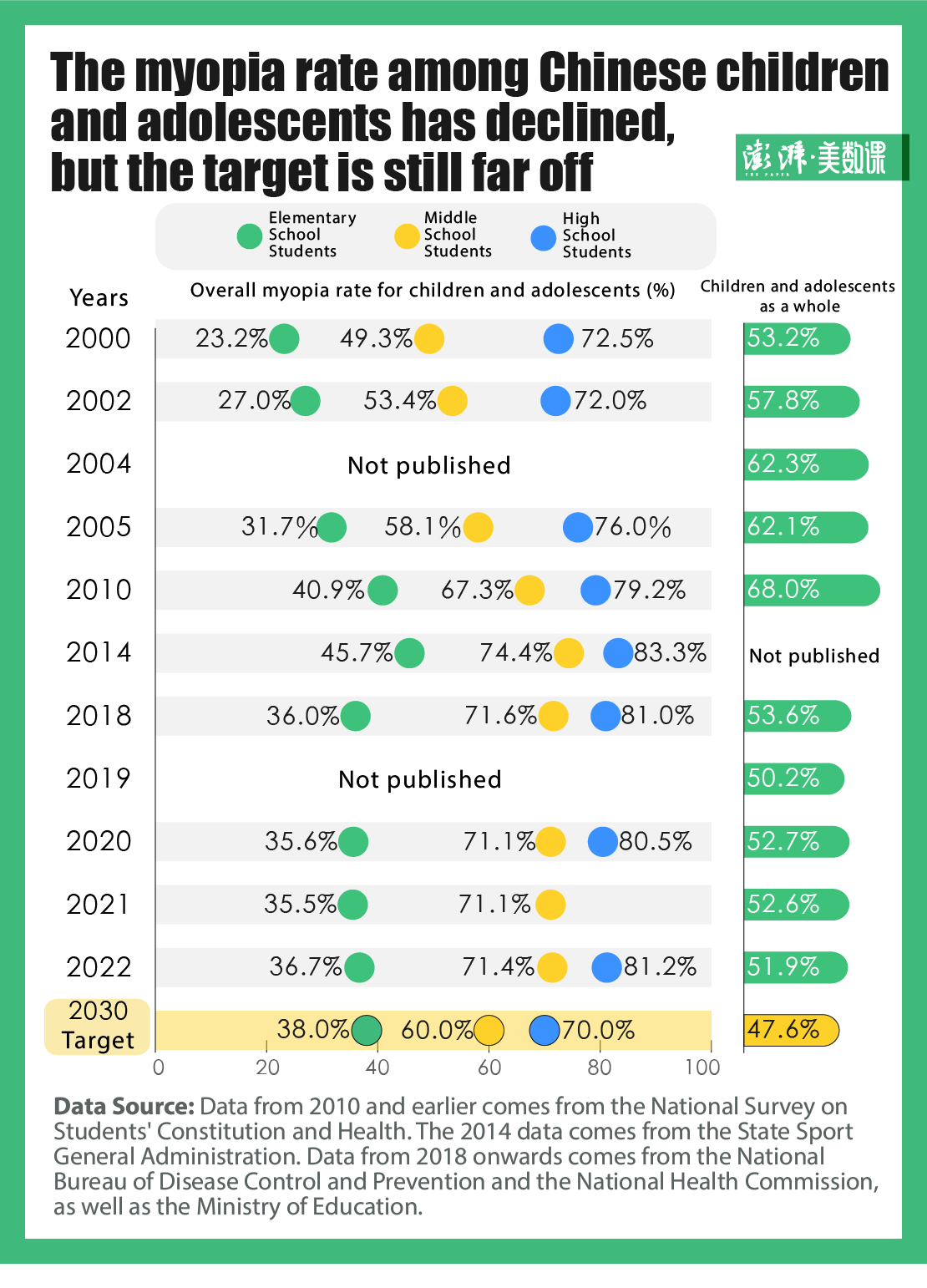
The myopia rate among Chinese children and adolescents has declined, but the target is still far off.
For families, managing myopia is an uphill battle. Parents face numerous challenges, from getting accurate prescriptions to preventing further vision deterioration. Avoiding deceptive marketing is easier said than done, as misleading claims about eye care products continue to thrive.
A user on Xiaohongshu, a popular Chinese social media platform known for lifestyle reviews, shared her personal story of managing her 6-year-old’s myopia. Determined to prevent her child from wearing glasses, she spent 24,000 yuan in eight months on myopia correction treatments.
In hindsight, she urged other parents, “The moment you discover your child is nearsighted, you should get them glasses right away — don’t resist it.” She emphasized that early intervention could save parents from expensive mistakes.
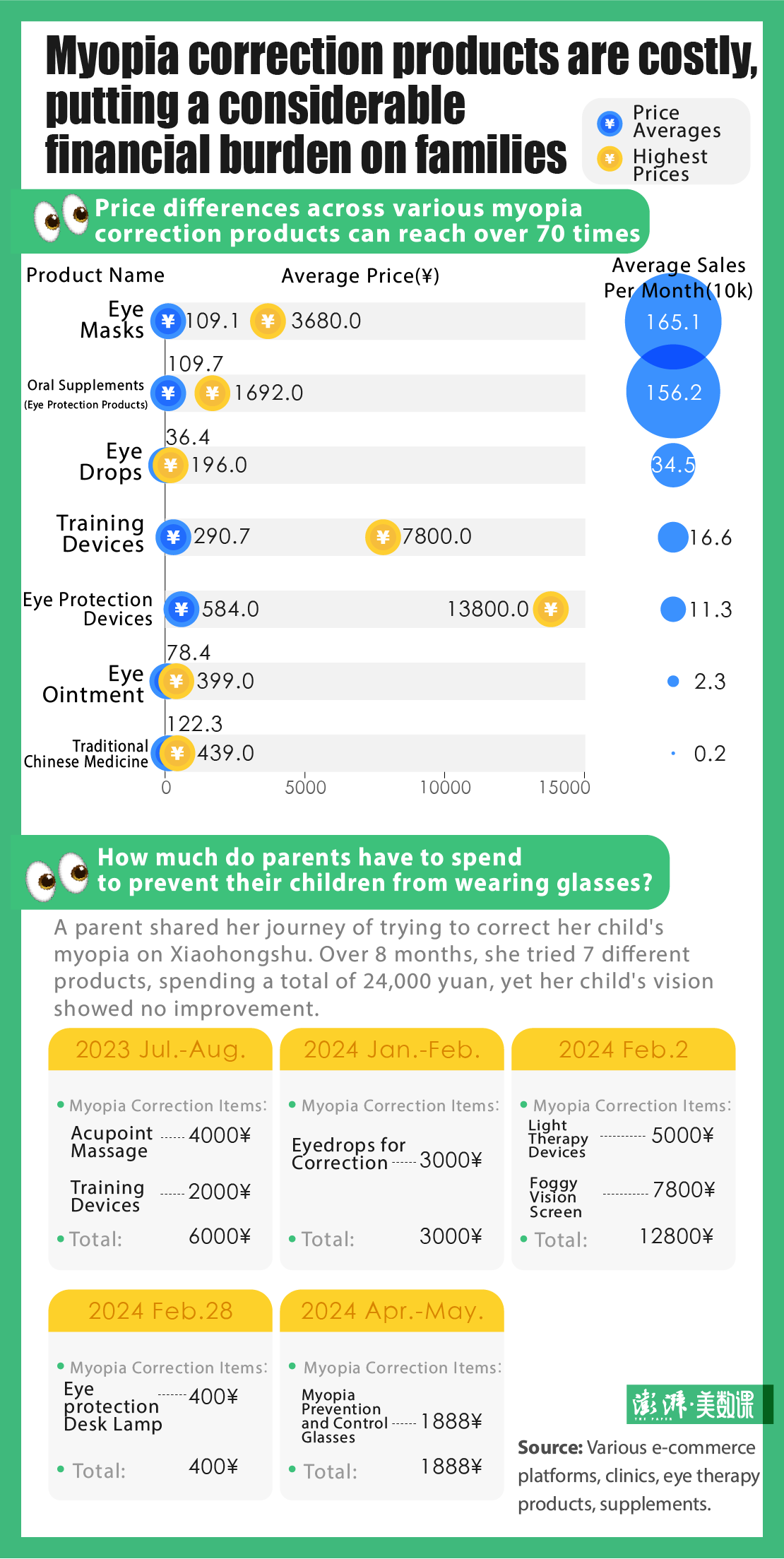
Myopia correction products are costly, putting a considerable financial burden on families.
A previous survey by China Youth Daily revealed that 77.4% of parents are more concerned about misleading information than about wasting money. Parents don’t want to miss the critical period for preventive treatment. In comparison, only 48.0% of parents worried about spending on ineffective treatments, demonstrating that their primary fear is acting too late.
Government guidelines recommend strategies to prevent myopia, such as limiting screen time, encouraging outdoor activities, and maintaining good reading habits. Yet, balancing these preventive measures with academic demands is a constant struggle for many families. The 2024 Myopia Prevention Guidelines also advocate for regular eye checkups and glasses as the simplest and safest corrective tool.
As long as loopholes exist, market chaos will continue to proliferate. E-commerce platforms bear significant responsibility to serve as watchdogs, ensuring products meet medical standards and cracking down on false advertising. With sellers continually finding ways to evade oversight, it is clear that stronger regulation and consumer education are needed to combat the ongoing flood of misleading myopia correction products.
메타데이터
- post_id
- 4e724e76c2b5
- slug
- uncovering-the-truth-behind-4-000-e-commerce-myopia-correction-products-4e724e76c2b5
- url
- https://medium.com/@yueyang_tang/uncovering-the-truth-behind-4-000-e-commerce-myopia-correction-products-4e724e76c2b5
- canonical_url
- https://medium.com/@yueyang_tang/uncovering-the-truth-behind-4-000-e-commerce-myopia-correction-products-4e724e76c2b5
- author_url
- https://medium.com/@yueyang_tang
- status
- ok
- fetched_at
- 2026-06-27 23:56:40



