Panspermia, Octopuses, and Comets 4/6
Interstellar bacteria and mass extinctions
Panspermia, Octopuses, and Comets 4/6
Interstellar bacteria and mass extinctions
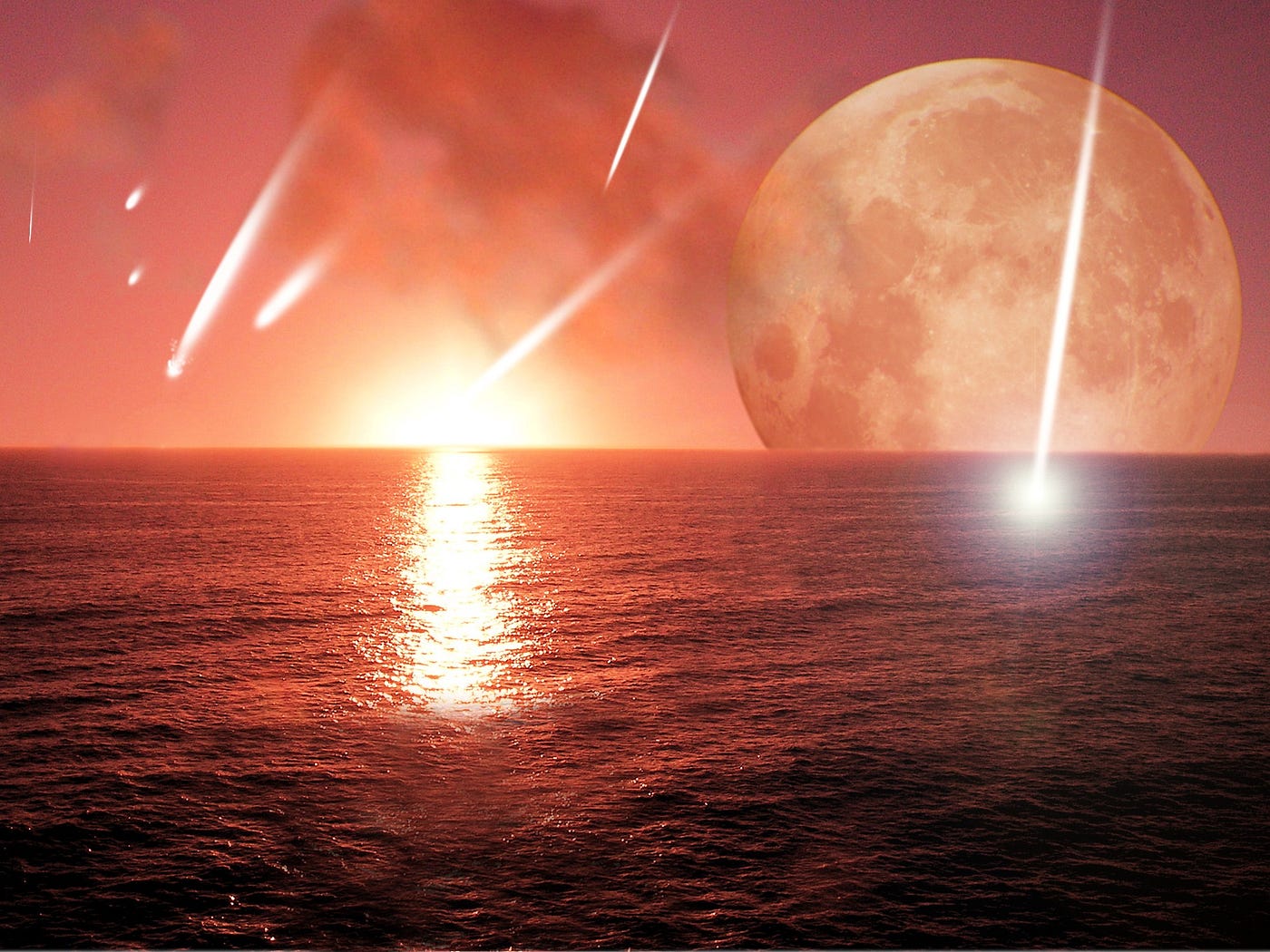
Credit: David A. Aguilar / CfA —According to the panspermia hypothesis, around 4 billion years ago, on a young Earth with an atmosphere still devoid of oxygen, frequent impacts of asteroids and comets deposited tons of biological material of extraterrestrial origin in the oceans. As soon as the environmental conditions allowed it, organisms from space managed to survive and reproduce, transforming the Earth into a place teeming with life — a life that still flourishes, despite cataclysms of all kinds and periodic mass extinctions
Bacteria from space
Regarding the incredible replication power of bacteria, in their 1999 book “Astronomical origins of life,” Hoyle and Wickramasinghe wrote (page 101):
Start with a single living cell, say a bacterium. A typical doubling time by binary-fission for a bacterium supplied with appropriate nutrients would be two or three hours. Continuing to supply materials, the initial bacterium would generate some 2⁴⁰ bacteria in 4 days, yielding a culture of the size of a pinhead. Continuing for a further 4 days and the culture, now containing 2⁸⁰ bacteria, would have the size of a village pond. Another 4 days and the resulting 10¹²⁰ bacteria would have the scale of the Pacific Ocean. Yet another 4 days and the 10¹⁶⁰ bacteria would in quantity be comparable to a molecular cloud like the Orion Nebula, and another 4 days, bringing the total time interval to only 20 days, and the scale in quantity would be that of a million or more galaxies. In a year there would be some 2³⁶⁵⁰ bacteria and in a thousand years the total would be 2³⁶⁵⁰⁰⁰⁰ bacteria. Thus biology yields superastronomical numbers as well as depending on them.
The two authors were convinced that interstellar dust clouds teemed with microbial life, whose signature, which they believed unmistakable, was definitely distinguishable in the spectra of many astronomical objects, on which Chandra Wickramasinghe, in particular, had conducted extensive research. For example, the spectrum of a red supergiant called GC-IRS7, located at the galactic center, was perfectly superimposable, point by point, with the absorption lines observed in the laboratory, produced by dried specimens of the bacterium Escherichia coli.
According to the data provided in “Astronomical origins of life,” the total mass of biological material of bacterial origin, frozen and dried, which is dispersed in the clouds of interstellar dust of the Milky Way amounts to the formidable figure of 10³⁶ kg, something as 500,000 times the mass of the Sun!
If so, it means that life is scattered across space in huge amounts. You just need to know how to recognize it. The evidence accumulated in recent years, which suggests that an immense number of potentially habitable planets exist in our galaxy, has marked a point in favor of panspermia. Suppose the Milky Way indeed is teeming with habitable planets, and life can travel from a planet to the next carried by comets or even by small meteoric fragments. In that case, there is no need for life to be born independently, by abiogenesis, on each habitable planet, a factor that panspermia’s advocates consider absurdly improbable.
In the perspective of panspermia, planets no longer need to be considered islands lost in space, separated from each other by impossible distances. Rather, they can be seen as transit stations of an unending network of cosmic communications, made possible by the existence of an astronomical number of vectors of biological material in constant motion, namely **comets**.
Speaking of comets, Hoyle and Wickramasinghe wrote in “Astronomical origins of life” (page 8):
An individual comet is a rather insubstantial object. But our solar system possesses so many of them, perhaps more than a hundred billion of them, that in total mass they equal the combined masses of the outer planets Uranus and Neptune, about 10²⁹ grams. If all the dwarf stars in our galaxy are similarly endowed with comets, then the total mass of all the comets in our galaxy, with its 10¹¹ dwarf stars, turns out to be some 10⁴⁰ grams, which is just the amount of all the interstellar organic particles.
The stars with their planetary systems orbit around the galactic center, constantly moving within the galaxy. On cosmological scales, it happens several times that two stars, moving independently of each other along their respective orbits, pass by relatively short distances. This passage produces gravitational interactions that perturb the respective cometary systems. Thus, the possibility arises that families of comets linked to one of the two grazing stars are captured by the gravity of the other, and vice versa, with the exchange of (hypothetical) biological material. In summary, panspermia works disseminating through the galaxy the life blooming in clouds of interstellar dust, hidden for millions of years under the surface of comets. Eventually, this wandering life is deposited on the surface of planets such as Earth through violent impacts or a light rain of “biological debris.”
Mass extinctions
Within this theoretical framework, mass extinctions caused by devastating impacts of asteroids and comets, such as the one that caused the demise of the dinosaurs some 66 million years ago, are like stitchings between two successive chapters in the book of evolution, sutures sewn with the contribution of biological material from space. A comet that hits the Earth destroys current habitats but also brings a new life that allows the subsequent repopulation of the planet, creating new paths for evolution.
The great and sudden explosion of biological diversity that occurred in the Cambrian is explained by proponents of panspermia in exactly this way:
It is well known that a mass extinction event, or events, occurred at the end of the Ediacaran period about 542 million years ago. This was the immediate forerunner of the Cambrian explosion and the mass extinction scale suggests the passage of our Solar System through a Giant Molecular Cloud dislodging multiple long period Oort Cloud comets into the inner Solar System setting up impacts with the Earth (…). It takes little imagination to consider that the pre-Cambrian mass extinction event(s) was correlated with the impact of a giant life-bearing comet (or comets), and the subsequent seeding of Earth with new cosmic-derived cellular organisms and viral genes (…). There may indeed have been a complex comet debris stream implying multiple impacts over the estimated 25 million years at the start of the Cambrian explosion. [E.J. Steele et al., “Cause of Cambrian Explosion — Terrestrial or Cosmic?” (2018)].
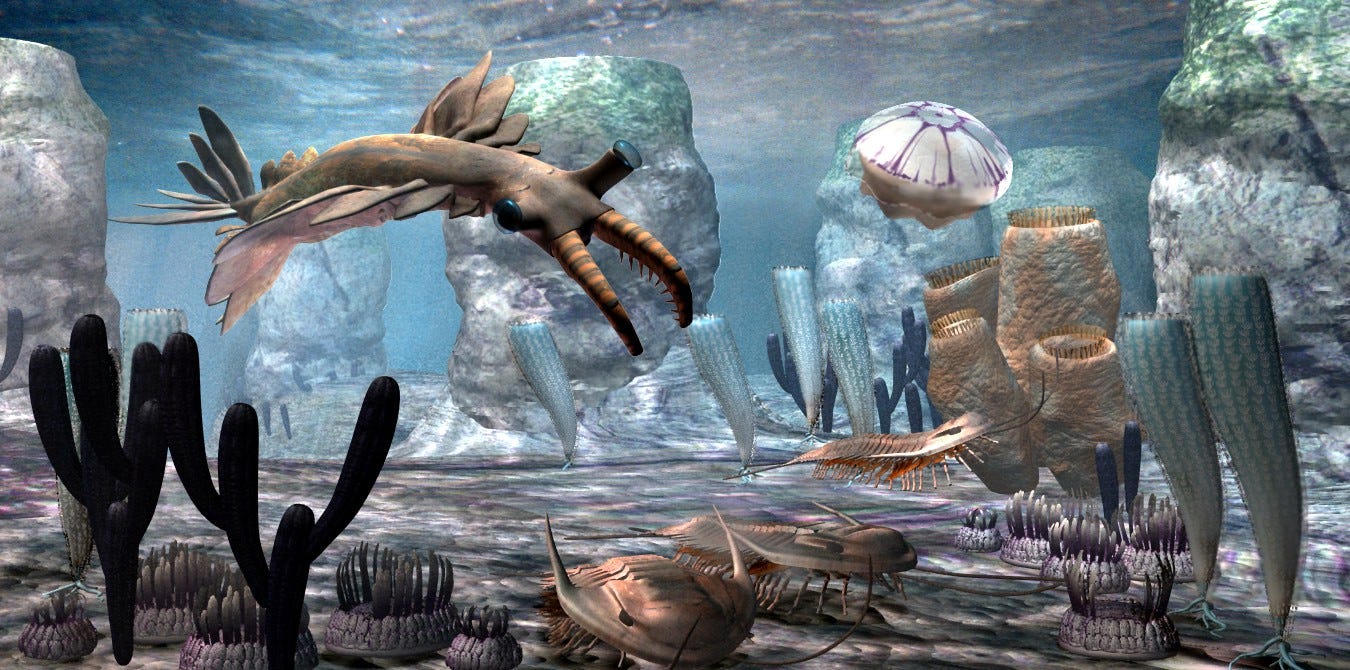
Credit: Ken Doud / NSF — Artistic representation of a Cambrian seabed populated by some strange creatures that flourished in that distant era. The animal with a tapered body visible on the left is an Anomalocaris Canadensis, one of the most dangerous predators in the Cambrian. Its potential victims are the three trilobites visible in the lower center
Read the other parts of this story
- **1/6* — The origin of life on Earth is unknown. In the scientific field, two theories try to explain the mystery: Abiogenesis, preferred by most scientists, and panspermia, defended by a small but fierce circle of scholars*
- **2/6* — Comets as vectors of life*
- **3/6* — Evolution driven by retroviruses and extraterrestrial octopuses*
- **5/6* — The biological Big Bang*
- **6/6 *— An eternal and uncreated Universe*
메타데이터
- post_id
- 4e7d8acb1b91
- slug
- panspermia-octopuses-and-comets-4-6-4e7d8acb1b91
- url
- https://medium.com/amazing-science/panspermia-octopuses-and-comets-4-6-4e7d8acb1b91
- canonical_url
- https://medium.com/amazing-science/panspermia-octopuses-and-comets-4-6-4e7d8acb1b91
- author_url
- https://medium.com/@md64
- status
- ok
- fetched_at
- 2026-06-09 18:16:15