Design Engineer Manifesto
Rules of the new hybrid builder between design, code and artificial intelligence.
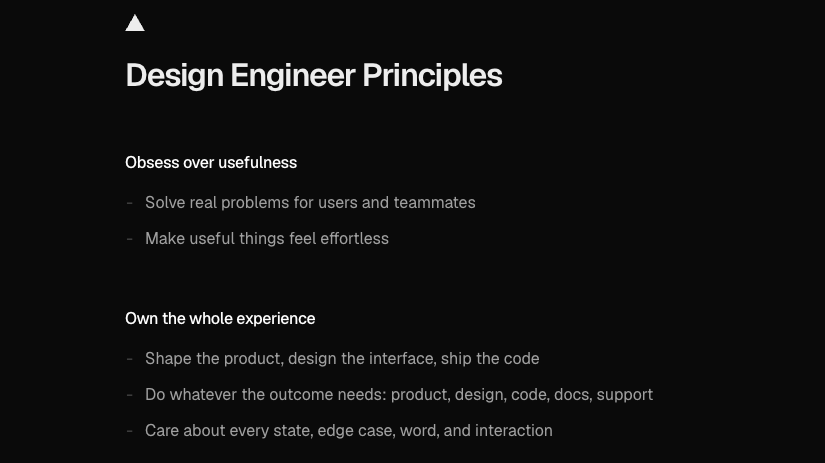
Design Engineer Principles — Vercel
Design Engineer Manifesto
Rules of the new hybrid builder between design, code and artificial intelligence.
Vercel published a manifesto with the principles of a Design Engineer:
Design Engineer Principles
Obsess over usefulness
- Solve real problems for users and teammates
- Make useful things feel effortless
Own the whole experience
- Shape the product, design the interface, ship the code
- Do whatever the outcome needs: product, design, code, docs, support
- Care about every state, edge case, word, and interaction
Understand the constraints
- Know the user, product, code, business, and tradeoffs
- Find the real constraint before choosing the solution
Build for everyone
- Design across skill levels, abilities, and contexts
- Make complexity available, not required
Make it excellent
- Scope small enough to do it well
- Push back when clarity, craft, performance, or trust is at risk
- Leave every surface better than you found it
Make the team better
- Be kind, direct, and low ego
- Share work early and give specific feedback
- Turn repeated feedback into better defaults, tools, and systems
On their blog post about AI engineering, Vercel explains how they see the evolution of AI development: the value of starting simple, iterating fast, using evals, and optimizing costs, which reads almost like an ideological framework for AI Engineers.
With that in mind, I started looking into more manifestos of this kind: Design Engineers, AI Engineers, or hybrid roles:
- Vercel — Design Engineer Principles: they reinforce the idea of end-to-end ownership over experience, interaction, and implementation quality.
- DesignEngineer.xyz — What is Design Engineering? This essay defines what a Design Engineer is and why they are key in companies that care deeply about product quality. It includes a “Notable Examples” section (Apple, Stripe, Vercel, DuckDuckGo, Airbnb, Figma) and frames the role as the convergence of design thinking and technical execution.
- Kathryn Gonzalez — Attributes of a Design Engineer (Stripe & Figma): it touches upon autonomy, love for the craft, and being comfortable as an “end-to-end software maker.” It defines the mindset, the scope of the role, and collaboration expectations across product, engineering, and design.
- HappyRobot — Design Engineer Function & Principles of Operation: a LinkedIn job posting for a “Design Engineer” that links to their “vision” and outlines operating principles like extreme ownership, craftsmanship, urgent focus, and first-principles thinking. It reads much like a cultural manifesto for any hybrid design-engineering role within the company.
- Profound — Design Engineer (AI product context): another job posting that describes the role as someone who builds polished UIs, cares about typography, interaction, and micro-interactions, and contributes to the design system. Although it is a job description, it is written like a mission statement for “builders who thrive on speed, iteration, and impact,” carrying a strong manifesto vibe.
- Kubiya — “Manifesto: Stop Automating, Start Delegating” (AI Engineer): an explicit manifesto that frames the AI Engineer’s job not as “writing automation, but designing systems that scale intelligence.” It introduces the AI Engineer as a systems architect combining intelligence and infrastructure, with a clearly prescriptive tone on how the role should be practiced.
- AI Craftspeople Guild — Manifesto & Charter: a community initiative featuring a manifesto and a professional code of conduct for people building with AI (AI engineers, craftspeople, etc.) hosted on GitHub. They emphasize aspects like the need for proper harnessing (evals, security, legal liability) and protecting the psychological safety of people exposed to AI products.
- Vercel — “How to become an AI engineering company”: a piece that defines an approach to AI engineering: starting simple, iterating fast, instrumenting and evaluating, optimizing costs, etc. It can easily be reinterpreted as “principles for AI Engineers.”
- Anthropic: Anthropic openly presents itself as an AI company focused on building “reliable, interpretable, and steerable” systems. Around this core idea, they have shaped a framework that — without being labeled a manifesto — acts as an engineering constitution. On one hand, their Responsible Scaling Policy sets AI Safety Levels and capability thresholds to keep catastrophic risk below acceptable levels as their models grow more powerful. On the other hand, Claude’s Constitution, a detailed document outlining the values the model must prioritize and how it should behave in different contexts, ensures that anyone building products or infrastructure on top of Claude at Anthropic receives not just technical requirements, but an explicit compass for responsibility and desirable behavior.
Sources:
Vercel
Anthropic
Kubiya
Design Engineer / comunidad
Job pages que también funcionan como “manifiesto”
메타데이터
- post_id
- 4e85fb834fb3
- slug
- design-engineer-manifesto-4e85fb834fb3
- url
- https://medium.com/design-bootcamp/design-engineer-manifesto-4e85fb834fb3
- canonical_url
- https://medium.com/design-bootcamp/design-engineer-manifesto-4e85fb834fb3
- author_url
- https://medium.com/@fernandocomet
- status
- ok
- fetched_at
- 2026-07-21 15:15:30