Zepto Smart Restock
Designing Predictive Grocery Replenishment Around Trust, Transparency, and Behavioral Adaptation
Zepto Smart Restock
Designing Predictive Grocery Replenishment Around Trust, Transparency, and Behavioral Adaptation
Focus Areas
Behavioural UX • Predictive Commerce • Trust Systems • Consumer AI
Let me give you the overview of what this case study is all about
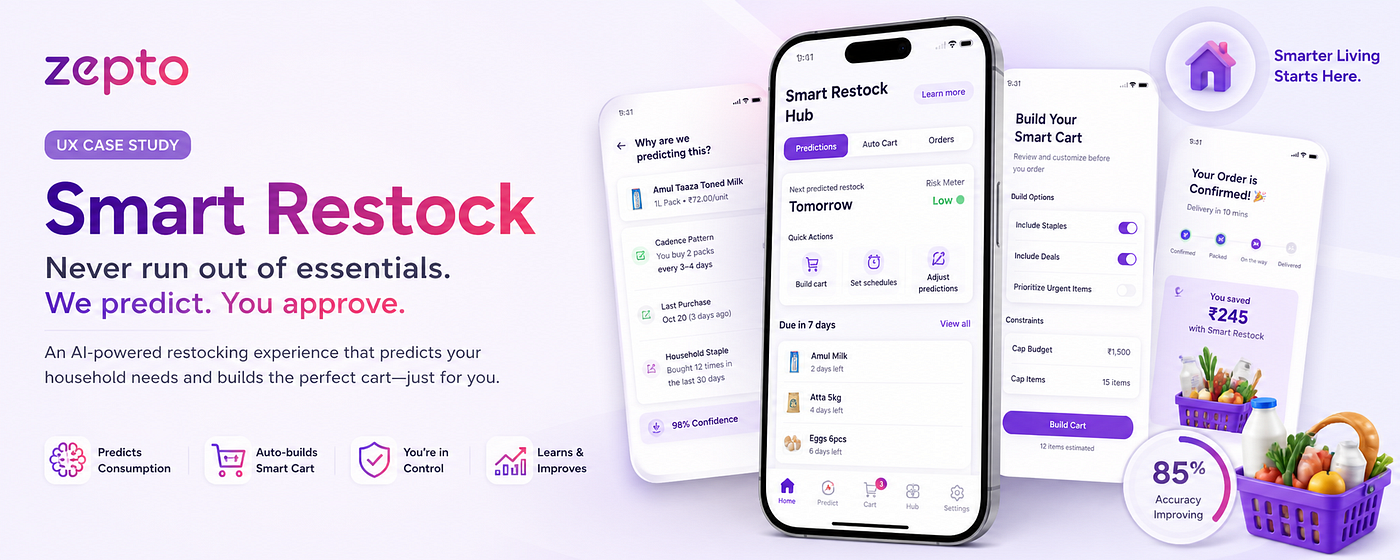
Quick commerce has optimised speed. But even with 10-minute delivery, grocery replenishment still remains mentally reactive. People repeatedly purchase the same low-attention essentials: milk, eggs, bread, snacks, detergent, atta, and household staples. Yet users still rebuild the same carts every few days. The friction was not ordering. The friction was remembering. This project explores how Zepto could evolve from an on-demand delivery platform into an assistive replenishment system that proactively reduces invisible household mental load while preserving user trust and control.
Understanding the Behavioural Problem
To better understand recurring grocery behaviour, I began thinking less about transactions and more about household routines.
I imagined someone like Riya.
Riya lives in Bangalore with her partner and young daughter.
Her grocery behaviour is repetitive, but rarely predictable.
Some weeks the household cooks every day; some weeks they order takeout frequently. Her parents occasionally visit unexpectedly; festivals change purchasing behaviour. Work schedules shift routines constantly.
Despite using quick commerce regularly, she still repeatedly encounters the same low-attention problems:
- forgetting milk, running out of eggs, missing breakfast staples, rebuilding the same cart again and again.
She does not struggle with grocery ordering.
She struggles with constantly remembering what the household is about to run out of.
That became the foundation of Smart Restock.
The Problem
High-frequency grocery behaviour is highly repetitive but cognitively fragmented. Users repeatedly rely on memory to track household essentials across: changing routines, variable consumption, work schedules, shared households, seasonal changes, and unpredictable usage patterns. Most quick-commerce systems optimize for: discovery, urgency, promotions, and browsing. But routine grocery behaviour is not discovery-driven. It is habit-driven
Users don’t mind reordering they mind remembering. This creates recurring invisible friction: forgotten essentials, fragmented ordering, reactive replenishment, and repeated cognitive effort. For Zepto, this also represents a business opportunity: stronger retention, higher repeat ordering, increased basket consistency, and long-term habit formation.
Key Insight
Users are comfortable with recommendations; they are uncomfortable with loss of control. Early exploration initially leaned toward fully automated replenishment.
But that direction quickly created trust problems:
- over-ordering anxiety, incorrect assumptions, invisible AI behaviour and fear of losing control over household purchases.
This shifted the product direction entirely.
The goal was no longer: “Automate grocery shopping.”
The goal became: “Reduce repetitive household decision-making through predictive assistance.”
That distinction shaped the entire experience.
Design Challenge
How might Zepto help users replenish recurring essentials proactively while balancing: trust, flexibility, transparency, and user control?
Understanding Existing Behavioural Gaps
Before starting anything, I got deep into what existing gaps are, which we have to consider and on that basis, design a solution. And I found 3 major gaps:
- Subscription Models Feel Rigid: Traditional subscriptions assume fixed consumption patterns. But household behaviour changes frequently. Users often consume more than expected, skip meals, travel, eat outside, or change preferences. This makes rigid automation feel unreliable.
- Passive Reminders Don’t Reduce Mental Load: Most reminder systems still require users to: decide quantities, rebuild carts, evaluate inventory, and manually plan purchases. The memory burden still exists.
- Invisible AI Feels Untrustworthy: Users become uncomfortable when recommendations appear without explanation. Especially for essential household purchases. This made “Explainability” a core UX requirement.
Now that we know what the gaps are and have an understanding of how UX should be designed, I consistently delve into design principles and integrate them into my design process, which helps me maintain a strong understanding of the principles that a product should focus on.
Here are 5 product principles I have considered:
- Reduce Cognitive Effort Without Removing Agency: The system should simplify routine replenishment while keeping users in control of final decisions.
- Build Trust Through Transparency: Users should always understand why recommendations appear, when predictions are generated, and how confidence is calculated.
- Design for Recovery, Not Perfect Prediction: Consumption behaviour is inconsistent. Prediction failure should be recoverable rather than disruptive.
- Adapt to Household Variability: The system should evolve with changing routines, guests, travel, seasonal spikes, and irregular ordering patterns.
- Keep Automation Reviewable: All predictive actions should remain editable, visible, and reversible.
Now it’s time to build a “Strategy” where we plan out what features the product should have and what controls we give to users cause design should always be about how it functions beautifully without taking every control of users.
Product Strategy
Instead of building a fully autonomous grocery system, the experience was designed as a collaborative assistant.
The system, which predicts recurring essentials, estimates depletion windows, prepares smart suggestions, explains prediction reasoning, and continuously learns through user corrections.
Where we keep, users remain in control of approvals, quantities, substitutions, exclusions, and personalisation.
Let me explain to you now how I architect the system
System Architecture

Example: If a household repeatedly purchases 2 milk packets every 3–4 days, across multiple weeks, the system predicts the next likely depletion window and proactively prepares a recommendation before stockout risk increases. Recommendations appear only when prediction confidence crosses safe behavioural thresholds. This prevents excessive or irrelevant triggering.
Once I was done with Strategy and System Architecture, it’s time to dirty my hands with a lot of sketches, 25–30 tear pages, because you can’t be satisfied with poor design.
But while sketching things out, my only thought was to design trust across experience. And I started doing it
Note: For all the sketching I did, I always asked myself why it needs to exist. Every feature, button, slider, placement, everything has been well thought out, tested and then moved to high-fidelity screens.
Designing Trust Across The Experience.

For Riya, this was important.
The experience needed to feel: helpful, not invasive.
The onboarding flow includes:
- household setup,
- consumption habits,
- brand preferences,
- and pantry baselines.
But these decisions are intentionally framed as: improving prediction quality, not extracting user data. This creates a more collaborative onboarding experience, where the system gradually earns trust rather than demanding immediate commitment.
For users, progressive onboarding reduces setup anxiety and makes predictive personalisation feel understandable.
For the business, lower onboarding friction improves activation and increases the quality of behavioural inputs collected over time.

So when Riya first sees milk automatically added to her cart, the recommendation could easily feel random or invasive.
The goal was helping users feel: “I understand why this recommendation exists.”
Not: “The app is behaving unpredictably.”
The system also openly communicates uncertainty through confidence systems rather than pretending predictions are always correct.
This transforms AI from a black-box recommendation engine into a collaborative assistant.
For users, explainability increases: trust, interpretability and decision confidence.
For the business, transparent recommendations improve: recommendation acceptance, long-term engagement and predictive system retention.
The predictive cart was not designed as an autonomous ordering system. It was designed as a prepared recommendation layer users can quickly validate and modify.
This preserves agency while still reducing repetitive decision-making effort.
For users, manual controls create emotional confidence that the system remains collaborative.
For the business, maintaining user agency prevents prediction anxiety and improves long-term adoption of predictive ordering behaviour.

For Riya, this means essentials like: milk, eggs, bread and atta can already be prepared before the household notices they are running low.
The predictive cart includes: smart replenishment suggestions, depletion timelines, confidence-based recommendations, editable quantities, substitutions and one-tap approvals.
Additional systems such as conflict resolution, duplicate prevention, budget constraints and substitution handling were introduced to make the experience operationally realistic.
For users, the predictive cart reduces repetitive cognitive effort associated with rebuilding recurring orders.
For the business, proactive replenishment encourages stronger retention, repeat ordering behaviour, stable basket consistency and long-term household habit formation.
Designing For Real-World Variability
One of the most important realisations during the project was that household behaviour is inherently inconsistent.
Real-world grocery routines constantly shift due to travel, guests, festivals, eating outside, changing diets and seasonal changes.
Rigid automation systems often fail because they assume static consumption patterns. But Riya’s household does not behave consistently enough for rigid subscriptions to work reliably.


This transforms prediction mistakes from:
“system failure” into“behavioural adaptation.”
The experience intentionally shows how the AI evolves so users can see their corrections directly shaping future recommendations.
For users, visible recovery systems reduce frustration and strengthen confidence that the system adapts meaningfully.
For the business, graceful recovery preserves long-term trust, which is critical for predictive engagement systems.

Users can: pause personalisation, disable categories, tune AI sensitivity, manage substitutions and reset prediction models entirely.
This reinforces a critical idea: users own the system, not the other way around.
For Riya, visibility into how predictions work creates emotional reassurance that personalisation remains adjustable and controllable.
For users, transparency strengthens trust and emotional comfort around predictive behaviour systems.
For the business, transparent AI controls reduce resistance to personalisation while improving long-term predictive adoption.
Business Impact
The system was designed to strengthen: Retention, Reorder consistency, repeat ordering behaviour, and household habit formation.
Potential success metrics include:
User Metrics which we can calculate
- Reduced forgotten-item additions
- Lower cart rebuilding effort
- Improved convenience perception
- Increased reorder completion
Business Metrics
- Repeat order frequency
- Retention uplift
- Replenishment engagement
- Smart suggestion adoption
- Basket consistency
Reflection
This project became less about AI prediction and more about designing behavioural trust.
One of the biggest learnings was realising that predictive systems are fundamentally trust systems.
Users do not simply evaluate prediction accuracy or automation efficiency they evaluate transparency, control, recoverability, and emotional confidence.
Another important realisation was that household behaviour is too variable for rigid automation.
This shifted the experience away from full automation and toward collaborative assistance.
The experience was intentionally designed to explain itself, adapt gradually and recover gracefully.
More importantly, this project reinforced a larger belief:
The future of convenience is not just speed. It is reducing the mental effort required to manage everyday life.
메타데이터
- post_id
- 4e8642f1f043
- slug
- zepto-smart-restock-4e8642f1f043
- url
- https://medium.com/@mayurpawar130904/zepto-smart-restock-4e8642f1f043
- canonical_url
- https://medium.com/@mayurpawar130904/zepto-smart-restock-4e8642f1f043
- author_url
- https://medium.com/@mayurpawar130904
- status
- ok
- fetched_at
- 2026-06-09 15:37:30





