Why The Arabic Language Has Not Changed Much in 1,400 Years?!
Languages die. Empires fall, civilisations collapse, and the words people spoke disappear with them. Arabic has been watching for 1400 years
Why Has Written Arabic Changed So Little in 1,400 Years?
Languages die. Empires fall, civilisations collapse, and the words people spoke disappear with them. Arabic has been watching for 1400 years.
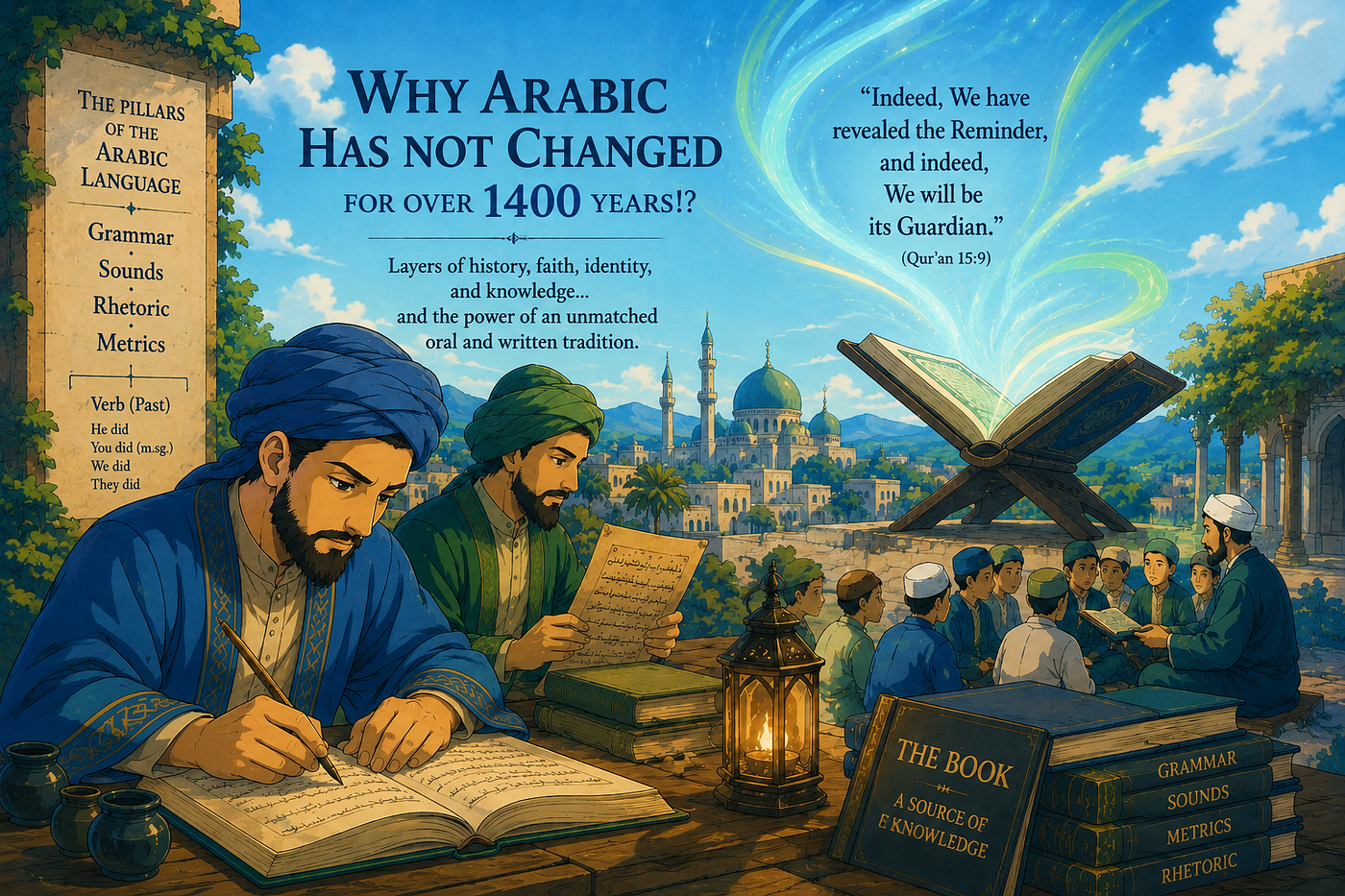
Image designed by the author using Canva
There is a moment most Arabic learners hit at some point in their studies, usually after a few months, sometimes after a few years.
They sit with an old text. A hadith. A line of pre-Islamic poetry. A passage from a 9th-century philosophical treatise. And they realise they can read it.
Not translate it with a specialist dictionary and a week of patience. Read it. The grammar is the grammar they studied. The vocabulary is the vocabulary they recognise. The sentence structure is the sentence structure their teacher explained.
That does not happen with other major languages. A French speaker approaching a 14th-century text needs years of specialist training to parse it with any confidence. A modern English speaker reading Chaucer needs annotation on nearly every line. Old English, the English of a thousand years ago, is functionally a foreign language to modern English speakers — it requires dedicated study to access at all. Spanish, Italian, German, Persian: all of them have drifted enough over the centuries that their classical forms represent a real barrier to the modern reader.
Written Arabic did not drift in the same way.
A competent reader of Written Arabic today — الفُصْحى — can access texts from fourteen centuries ago with the same general level of effort a competent English reader brings to a text from 1990. The phonology has not shifted into unrecognizability. The case system, which many learners find difficult, is the same case system. The verb conjugation tables in a modern Arabic grammar textbook are the verb conjugation tables you need for the Quran, for 9th-century hadith collections, for 10th-century geographers, for 12th-century Andalusian poets.
No other language in the world, with a comparable number of speakers and a comparable geographic spread, has maintained this degree of structural stability across this length of time.
The question worth asking is not simply whether this is true but how this degree of continuity became possible.
The answer has seven distinct layers, and many only know the first one.

Designed by the author with Canva
Layer One: The Quran
The standard explanation for Arabic’s stability is the Quran, and it is correct as far as it goes. But most people who give this answer do not fully understand the mechanism, so they cannot explain why other sacred texts did not do the same thing for their languages.
According to Islamic tradition, the Quran was revealed in the Arabic of the 7th-century Hijaz. From the earliest years of Islam, it was not just read — it was memorised verbatim, in its entirety, by large numbers of people. The practice of Hifz — committing the entire Quran to memory — elevated memorisation to a spiritual duty, producing what one source describes as an “oral transmission, unchanging and intergenerational,” that “guaranteed linguistic consistency.” Today, many Muslims worldwide memorise the Quran with intense attention to textual precision.
This is not the kind of memorisation most people are familiar with. Quranic memorisation is governed by Tajweed — a systematic science of recitation rules that codifies the precise articulation of every sound, the exact length of every vowel, the points at which letters assimilate, and the places where pauses are required or prohibited. Tajweed rules are systematic guidelines that govern the proper pronunciation, articulation, and recitation of the Quran, aiming to preserve Quranic recitation according to inherited rules of pronunciation and transmission. A recitation that violates Tajweed is considered incorrect regardless of any other qualities it might have. The rules exist specifically to prevent the kind of phonological drift that accumulates when pronunciation is left to informal transmission.
The result: the Quran has been recited in the same way for more than fourteen centuries. A Quranic recitation recorded in Malaysia sounds strikingly similar to one recorded in Morocco, despite those communities sharing no spoken dialect overlap whatsoever. The oral tradition locked the phonology. When the phonology cannot drift, the language cannot drift — because phonological change is usually the first driver of broader linguistic change.
But this cannot be the complete explanation. The Bible was written in Hebrew and Greek. Hebrew followed a very different path: it remained central in religious and scholarly use but was later revived as a modern spoken language in the late 19th and early 20th centuries. Hebrew became extinct as a spoken language while the sacred text remained. The existence of a sacred text does not automatically preserve the language in which it was written. Something else had to happen around the Quran. And it did.

Designed by the author with Canva
Layer Two: The Scholarship That Stabilised the Language
When the Arab-Islamic civilisation expanded rapidly in the 7th and 8th centuries, a problem emerged almost immediately.
The new Muslim communities in Persia, Iraq, Egypt, the Levant, and North Africa were speaking Arabic — or attempting to — but they were making errors. Not minor accent errors. Grammatical errors that changed the meaning. Errors in Quranic recitation that, in the theological framework of the time, were not acceptable. The fourth Caliph, Ali ibn Abi Talib, is reported to have commissioned the earliest known systematic documentation of Arabic grammatical rules specifically because he was concerned that contact with non-native speakers and other languages was affecting grammar and recitation.
What followed is one of the most extraordinary projects in the history of human language.
The grammarians of Basra and Kufa — two rival schools that competed intensely but together built the entire foundation of Arabic linguistic science — collected pre-Islamic oral poetry, documented the speech of Bedouin tribes whose speech was considered by early grammarians to preserve older and more conservative forms of Arabic and turned this empirical material into the foundation of a systematic grammar. Basra emerged as the primary hub for early Arabic linguistics, with scholars prioritising empirical observation and logical derivation. The Kufan school, established around 670 CE, accepted a wider range of usage but contributed equally to the project of documentation. Between them, and subsequently in Baghdad, these scholars created the sciences of Arabic grammar and lexicography — producing what became the canon of the Arabic language.
The culminating achievement of this entire tradition was Al-Kitab, written by Sibawayhi in the 8th century.
Sibawayhi was Persian. Arabic was not his mother tongue. He had come to Basra to study Islamic law and instead became, in the assessment of nearly every subsequent scholar, the greatest Arabic grammarian who ever lived. Al-Kitab is the first complete and systematic work on Arabic grammar, upon which all subsequent grammatical studies are based. It continues to be studied throughout the world. The work spans more than 900 pages, and Al-Nadim, the 10th-century bibliographer, describes it as “unequalled before his time and unrivalled afterwards.”
Sibawayhi based his findings on three sources: the Quran, early Arabic poetry, and the speech of the Bedouins. He was not producing a historical document. He was producing a standard — a reference work that defined what was correct and incorrect in Arabic. And his application of logic to the structural mechanics of language was wholly innovative for its time.
What Al-Kitab did that no earlier work had done was create a prescriptive framework. Most grammars describe how a language is used. Sibawayhi’s grammar became authoritative about how Arabic should be used. Every subsequent Arabic teacher, every madrasa, every court, every literary tradition worked from this standard or from works built directly on top of it. The language did not happen to stay stable. It was actively maintained in a stable state by a field of scholarship that treated stability as a goal — and had the institutional weight to enforce it.

Designed by the author with Canva
Layer Three: The Counterintuitive Power of Diglossia
Here is the argument most people have not encountered, and the one that genuinely surprises linguists when they first work through it.
Arabic is not one language in practice. It never has been.
There is الفُصْحى — Written Arabic. The classical and modern written standard. The language of the Quran, of literature, of formal media, of education, law, diplomacy, and any communication that crosses regional borders.
There is العامية — Colloquial Arabic. The spoken dialects. Egyptian Arabic, Moroccan Darija, Levantine Arabic, Gulf Arabic, Iraqi Arabic, and dozens of sub-dialects within those. These vary enough that a Moroccan and an Iraqi speaking their respective native dialects may struggle to understand each other fully.
This coexistence of a “الفُصْحَى” MSA and an “العَامِيَةْ” Colloquial Arabic, variety of the same language, is called diglossia, a term introduced to linguistics by Charles Ferguson in his foundational 1959 article “Diglossia” — which used Arabic as its primary example. In Ferguson’s framework, the formal variety (H, for “high”) is used in education, religion, formal media, and writing; the informal variety (L, for “low”) is used in everyday conversation, domestic life, and informal contexts. Arabic is one of the most cited examples of “classic diglossia” in sociolinguistics. The terms “high” and “low” describe social function, not inherent value.
Now here is the counterintuitive part.
Most people assume that diglossia would cause instability — that the formal language would gradually contaminate the informal, or vice versa, until they merged. The opposite happened.
Because الفُصْحى was never the language anyone grew up speaking at home, it was always learned rather than acquired. No one’s grandmother passed down الفُصْحى through childhood conversation. It had to be studied deliberately. And because it had to be studied, it had to be taught from texts. And because it was taught from texts, the texts governed it. The teachers were working from Sibawayhi, from classical poetry, from the Quran. The standard was the texts. The texts were stable.
Spoken languages change because speakers change them in the process of using them. Pronunciation simplifies under the pressure of fast casual speech. Grammar erodes at its edges. New words enter, and old words drop out. But a language that is primarily a written and formal spoken register — one that people approach as a system to be learned, not a mother tongue to be inherited — is insulated from that erosion. The pressure that all spoken languages absorb was absorbed by العامية instead. The colloquials changed constantly and continue to change. الفُصْحى remained comparatively stable, while the colloquial varieties carried much of the everyday linguistic change.
Ferguson himself noted that “Arabic diglossia seems to reach as far back as people’s knowledge of Arabic goes, and the superposed Classical language has remained relatively stable.” He was right about the observation. The explanation is that stability was not accidental — it was structural. Diglossia created a protected enclosure for الفُصْحى, and the colloquials bore the evolutionary weight that the written standard was shielded from.

Designed by the author with Canva
Layer Four: An Architecture Designed to Resist Change
Most languages borrow vocabulary from other languages and, in doing so absorb foreign structural patterns. This is one of the primary mechanisms of language change over time. English is a textbook example: the Norman Conquest introduced massive amounts of French vocabulary, and modern English reflects that fusion in its grammar, word order tendencies, and vocabulary register.
Arabic did something different. Its morphological architecture made it resistant to certain kinds of structural influence from the beginning.
Arabic vocabulary is organised around roots — consonant skeletons, usually three letters, that carry a core semantic idea. From each root, words are generated by inserting vowels and applying fixed patterns to the consonant skeleton. The root ك-ت-ب (K-T-B) carries the semantic field of writing: كَتَبَ (kataba — he wrote), كِتَاب (kitaab — book), كَاتِب (kaatib — writer), مَكْتَب (maktab — office/desk), مَكْتَبَة (maktaba — library/bookshop), مَكْتُوب (maktoob — written, or a letter). The Lexicon of Modern Arabic contains approximately 5,778 roots from which over 32,000 lemmas are derived.
When Arabic needs a new word for a new concept, it has a strong preference for building that word from internal resources rather than borrowing. Arabic Language Academies have established nominal templates specifically for this purpose — fixed patterns into which new root-derived terms can be inserted. The word for telephone in Arabic is هَاتِف (haatif) — built from the root ه-ت-ف (h-t-f), following the active participle pattern, meaning “one who calls out.” The word for computer is حَاسُوب (hasoob), from the root meaning to calculate. The word for aviation is طَيَرَان (tayaraan), from the root for flying. The word for factory is مَصْنَع (masna’), from the root for making. Each new concept gets a new word built from old materials following established patterns.
This matters enormously for structural stability. When a language imports loanwords, it sometimes imports the structural assumptions of the source language along with the vocabulary. Arabic’s preference for derivation over borrowing means the architecture stays intact. Every addition is made from existing materials. The template — the grammar — remains undisturbed. The root-pattern system is so productive that several hundred patterns in combination with thousands of roots allow for an enormous number of possible derived words.
This is not a superficial feature of the language. It is a deep structural property. A language built this way does not need to borrow structure, because its own structure is generative enough to handle almost anything. And a language that does not borrow structure does not change structure.

Designed by the author with Canva
Layer Five: The Prestige Infrastructure
Language change is not only a linguistic phenomenon. It is a social one.
Spoken language varieties that carry high prestige tend to be maintained more carefully by their speakers. When a form of language is associated with religion, education, intellectual authority, and social status, speakers actively preserve it rather than allowing it to drift toward informal usage. The reverse is also true: stigmatised or low-prestige forms change faster, partly because speakers are not invested in their preservation.
The الفُصْحى has carried the highest conceivable prestige in Arab-Islamic civilisation for fourteen centuries simultaneously across every domain that matters: religious, literary, scholarly, legal, and institutional.
It is the language of the Quran, which makes it sacred. It is the language of classical Arabic poetry, which is considered among the highest aesthetic achievements in the language’s history. It is the language of Islamic jurisprudence, which means the entire legal tradition of Muslim societies was conducted in it. It is the language of every major philosophical and scientific work produced during the Islamic Golden Age. And in the modern period, it is the language of formal education, formal media, official government communication, and every form of writing that crosses national borders.
Many major religious, educational, literary, and state institutions have reinforced the prestige of الفُصْحى. The practical consequence was the creation of a formal institutional infrastructure dedicated to maintaining الفُصْحى, which has no real equivalent in the history of any other language.
The Damascus Academy for Arabic Language was founded in 1919. The Academy of the Arabic Language in Cairo was established by royal decree on December 13, 1932, with an explicit mandate to maintain the integrity of the Arabic language, coin new terms from Arabic roots, and publish comprehensive dictionaries. Similar academies exist in Amman, Rabat, Baghdad, Khartoum, and elsewhere. These institutions actively deliberate over new terminology, resist borrowing in favour of derivation, and produce authoritative reference works.
The French Académie française has a comparable mandate. It is largely ignored. The difference in Arabic is that the Académie’s equivalent functions within a web of religious, educational, and literary authority that actually gives its decisions weight. You cannot simply ignore a ruling from the Cairo Academy if you write for a major Arabic newspaper, because the newspaper operates within a professional culture that treats الفُصْحى as a standard, not a preference.
No comparable enforcement mechanism exists in English, French, German, or most other major languages. The people who decide how English changes are the millions of English speakers who change it without asking anyone’s permission. The people who decide how الفُصْحى is maintained are institutions with fourteen centuries of accumulated authority behind them.

Designed by the author with Canva
Layer Six: The Network That Prevented Drift
The Arab-Islamic world of the 8th through 13th centuries was one of the most intensely connected intellectual networks in pre-modern history.
Between the 8th and 13th centuries, under Abbasid rule, the Islamic world experienced a long period of scientific and philosophical progress centred in Baghdad, Cairo, and Córdoba. Arabic became the primary language of science, philosophy, mathematics, medicine, astronomy, and literature across a territory stretching from Spain to Central Asia. Scholars in Baghdad translated texts from Greek, Persian, and Indian sources into Arabic, and the Arabic text became the medium through which that knowledge circulated across the entire civilisation.
What this created, linguistically, was a constant cross-referencing pressure.
Drift — the process by which languages diverge over time — requires isolation. Communities that develop without sufficient contact with each other develop their spoken and written varieties in different directions. The divergence of Latin into French, Spanish, Italian, Portuguese, and Romanian is a textbook example of what happens when a shared language loses its network. The Roman Empire’s collapse meant that communities that had been in regular communication stopped being in regular communication, and their shared language split.
The Arab-Islamic scholarly world was the opposite of isolated. Scholars in Samarkand, Nishapur, Baghdad, Cairo, and Córdoba were reading each other’s texts. A discovery made in Baghdad was in circulation in Andalusia within decades. An argument made in Cairo generated responses from scholars in the Levant. The written language they shared was under constant cross-referencing pressure from every direction. Regional drift was not impossible — it happened in the colloquials — but the written standard was continuously being pulled toward convergence by the network that used it.
This is why the Islamic Golden Age matters for language stability in a way that goes beyond its cultural and scientific achievements. Arabic had already become the language of international scholarship by the time of the House of Wisdom. A language that is the medium of international scholarship is a language that everyone who participates in that scholarship has a strong incentive to share in a standardised form. The network demanded a common standard. The common standard survived because the network demanded it.

Designed by the author with Canva
Layer Seven: What Oral Transmission Actually Does
The final layer is the one that is most often underestimated, even by people who understand the others.
Written language alone does not produce the kind of stability Arabic has shown. What produces it is the combination of written tradition and oral transmission — specifically, oral transmission that is tightly governed and transmitted from teacher to student in an unbroken chain.
The Quran is not primarily a text people read silently. It is a text people recite aloud. This is not a secondary practice or a cultural preference. Recitation is the primary mode of engagement with the Quran for the majority of Muslims. And the recitation is governed, as described above, by Tajweed — a system that codifies not just what sounds are made but exactly where in the mouth and throat they are made, how long vowels are held, when letters assimilate into each other, and when pauses occur.
Tajweed rules cover precise letter articulation, proper pauses, and how to stretch certain sounds. One essential rule is mastering the correct pronunciation of Arabic letters, known as Makharij — the exact spot in the mouth or throat from which each letter emerges. These are not guidelines. They are requirements. And they are transmitted through a teacher-student chain understood within Islamic tradition as preserving the earliest recitational forms.
The consequence: the phonological system of 7th-century Arabic is not just preserved in written form — it is performed, checked, and corrected by millions of people across the world on a daily basis. Every Quranic school in Indonesia, West Africa, South Asia, and the Arab world produces graduates whose recitation of the same text reflects the same phonology. The oral tradition is a quality control system operating at global scale.
This matters for language stability because phonological change is usually the first domino. When pronunciation drifts in a spoken community, the written representations eventually follow. Spelling reforms, simplifications, and vocabulary changes often trail phonological shifts by a generation or two. A language whose phonology is locked by an active and globally maintained oral tradition cannot begin this process. The first domino cannot fall.
The hadith tradition added a second layer to this. The sayings attributed to the Prophet were transmitted with chains of narration (isnad) that were subjected to rigorous scholarly verification — a science of hadith criticism that became one of the most sophisticated verification systems in pre-modern scholarship. This tradition preserved classical Arabic vocabulary, idiom, and grammatical construction in a corpus that was actively studied, taught, memorised, and referenced across the entire Muslim world. It was not just the Quran that locked the language. It was the entire ecosystem of texts that surrounded and supported the Quran.

Designed by the author with Canva
Why Other Languages Did Not Do This
It is worth being precise about what makes Arabic unusual, because loose comparisons can obscure what is actually happening.
Latin was the intellectual language of medieval Europe. It did not do what Arabic did. The reason is instructive. Latin remained central to clerical and scholarly life, but it did not function as a widely learned formal register across everyday communities in the same way. There was no widespread Latinising equivalent of Quranic education. When the Roman Empire’s political structures collapsed, the network that maintained Latin as a living shared standard collapsed with it. The spoken varieties had been diverging for centuries, and with nothing pulling them back toward the centre, they became distinct languages.
Hebrew is the closest analogy to Arabic as a sacred language preserving a classical form. But Hebrew became extinct as a spoken language between roughly the 3rd century BCE and its revival in the 19th and 20th centuries. Ben-Yehuda had to convince people to speak a language that had existed only in religious and scholarly texts — he had to create new words and import new concepts into the language. Arabic never needed revival. It never ceased being used as an active written and formally spoken language by millions of people simultaneously. The infrastructure never collapsed. The network never broke.
Sanskrit is another comparison that sometimes comes up. Sanskrit’s trajectory was similar to Latin’s — it became the preserve of specialists while the vernacular languages of South Asia (Hindi, Bengali, Marathi, Tamil) developed entirely separately. It did not survive as a living communicative standard.
The الفُصْحى survived because of a combination of factors that existed nowhere else simultaneously: the sacred status of the text it was embedded in, a grammatical codification project that preceded major linguistic drift, a diglossic arrangement that insulated it from everyday erosion, a morphological architecture that resisted structural borrowing, a prestige infrastructure with institutional weight, an intellectual network that demanded convergence, and an oral transmission system that locked the phonology. Remove any one of these, and the outcome might have been different. All seven together produced something unique in the history of human language.

Designed by the author with Canva
What Pre-Islamic Poetry Tells Us
There is one more detail worth noting, because it demonstrates how far back the stability actually extends.
Arabic was a highly developed literary language before the Quran. The Mu’allaqat — the “Suspended Odes,” considered the greatest poems of pre-Islamic Arabia — were composed in the 6th century CE, before the Quran’s revelation. A competent reader of الفُصْحى today can read these poems. They are challenging — they use vocabulary that is archaic and poetic conventions that require familiarity — but they are accessible. The same grammar. The same case system. The same morphological architecture.
This tells us that the stability of Classical Arabic is not entirely a product of the Quran. The Quran was revealed into a language that was already stable as a literary standard among the Arabian tribes. What the Quran did was elevate that standard to sacred status and give it a durability that would outlast any political structure, any geographic expansion, any cultural disruption. But the language that was elevated was already old. The Quran did not create Classical Arabic’s stability. It guaranteed it.
The grammarians who treated Bedouin speech as an especially authoritative source for older Arabic usage were documenting something they understood to be already ancient. The Kufan and Basran schools collected pre-Islamic poetry precisely because they considered it the authoritative record of authentic Arabic before contact with other languages. The codification project was not inventing a standard. It was preserving one. That distinction matters. What was preserved had already proven its stability before the preservation effort began.

Designed by the author with Canva
What This Means If You Are Learning Arabic Now
If you are struggling with Arabic, the most likely reason is not that the language is inherently harder than other languages.
The most likely reason is one of three things:
You are trying to learn العامية when what you actually need for reading, writing, and broad communication is الفُصْحى — or vice versa — without anyone having clearly explained to you that these are functionally different registers that have been diverging for centuries. The gap between them is historical and structural. It is not going to go away if you wait long enough.
Or you encountered the language’s case system, its phonology, or its script without a clear picture of how the system works as a whole — without understanding that the difficulty is concentrated at the beginning, not spread evenly throughout, and that the root system means every hour of vocabulary work compounds more than it does in most other languages.
Or you are learning it backwards. Grammar tables before sounds. Letters before pronunciation. Rules before any sense of why the rules exist.
The stability of الفُصْحى is actually the best news you can receive as a learner. It means the grammar you are studying now is the grammar of everything ever written in Arabic over the last fourteen centuries. It means there is no second standard to learn for classical literature. It means the investment you make in الفُصْحى is not time-limited — you are building access to a textual tradition that stretches back to the 6th century without a significant gap.
But it also means the standard is real. الفُصْحى survived 1,400 years without softening its case system for the convenience of learners. The phonology that feels unfamiliar is the phonology that exists. The gap between the language and whatever you spoke before you started learning Arabic is not a problem the language will solve on your behalf.
Languages change to accommodate their speakers. Arabic did not change. That is exactly what makes it worth the effort of learning to meet it on its own terms.

Designed by the author with Canva
The Actual Answer to the Question
Why has written Arabic remained so stable for more than 1,400 years?
Because the Quran’s sacred status made precision in recitation and interpretation religiously significant, and the Tajweed tradition enforced phonological precision at global scale.
Because Sibawayhi and the grammarians of Basra and Kufa codified the language into a prescriptive standard before it could drift, and that standard became the foundation of everything written in Arabic for the next thirteen centuries.
Because diglossia insulated الفُصْحى from the everyday erosion that all spoken languages undergo — the colloquials absorbed that pressure instead.
Because the trilateral root system gave Arabic a morphological architecture that builds new vocabulary from old materials, keeping the grammar intact even as the world changed.
Because the prestige infrastructure of Arabic — religious, literary, scholarly, and institutional — gave every major institution in the Arab world an active interest in maintaining the standard, backed by academies in Cairo, Damascus, and elsewhere with genuine authority.
Because the intellectual network of the Islamic Golden Age created a demand for a unified written standard across an enormous geographic area, pulling the language toward convergence rather than allowing regional divergence.
Because oral transmission through the Tajweed tradition locked the phonology in a way that written traditions alone cannot achieve.
No single one of these is sufficient. Together, these seven factors helped produce one of the most stable major written traditions in the world.
The short answer — “because of the Quran” — is not wrong. It is simply the surface of something that goes much, much deeper.
If you want to understand Arabic before you touch a grammar table or open an alphabet chart, the place to start is the sound system. Not the letters. The sounds. The difference between how Arabic works phonologically and how your native language works is the root of most of the confusion that stops people from making progress.
Before You Begin covers exactly that — what Arabic phonology actually is, why it feels the way it does, and what your mouth needs to do before anything else makes sense. Free.
Once your mouth knows the sounds, the next step is understanding the space where الفُصْحى and العامية actually live — what they share, where they split, and why that gap exists at all. Inside the Room handles that. Also free.
Both are the starting point. Not the whole road — but the part that most courses skip entirely.
메타데이터
- post_id
- 4e940aa89bcd
- slug
- why-the-arabic-language-has-not-changed-much-in-1-400-years-4e940aa89bcd
- url
- https://medium.com/language-lab/why-the-arabic-language-has-not-changed-much-in-1-400-years-4e940aa89bcd
- canonical_url
- https://medium.com/language-lab/why-the-arabic-language-has-not-changed-much-in-1-400-years-4e940aa89bcd
- author_url
- https://medium.com/@bayt.al.lugha
- status
- ok
- fetched_at
- 2026-07-08 23:38:59