When Tuesday Night Becomes an Expedition: Microadventures and the Geography of Everyday Randomness
I have spent nearly two decades teaching English to professionals at companies like Volkswagen, JetBrains, and ABInBev, and one pattern…
When Tuesday Night Becomes an Expedition: Microadventures and the Geography of Everyday Randomness
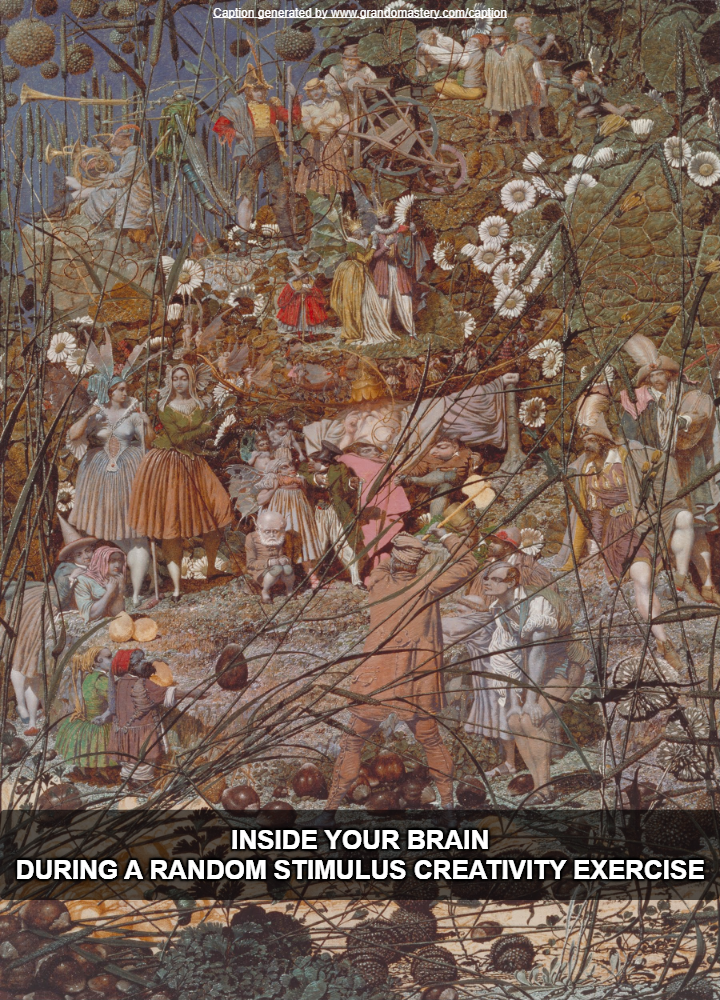
The Fairy Feller’s Master-Stroke / Richard Dadd / 1855–1864
I have spent nearly two decades teaching English to professionals at companies like Volkswagen, JetBrains, and ABInBev, and one pattern never stopped troubling me: people who could negotiate contracts in flawless English often could not tell you what surprised them last Tuesday. Their linguistic competence was intact, but something else had atrophied — the muscle for noticing, for pivoting, for treating the mundane as worth exploring.
Around 2015, British adventurer Alastair Humphreys began championing what he called microadventures: short, simple, local, and cheap excursions that fit into the cracks of ordinary life. Sleep on a hilltop on a Wednesday night. Cycle to work via the longest possible route. Kayak a stretch of river you have only ever driven past. The philosophy was almost radical in its modesty. You do not need weeks off and thousands of dollars to have an adventure. You can have one on a Tuesday night.
What Humphreys understood, and what I have come to recognize in language education, is that the crisis is not a lack of grand opportunities but a poverty of engagement with what is already here. We have optimized the joy out of our lives. We have flattened unpredictability into scheduling blocks. We have mistaken efficiency for living.
The concept of microadventures rejects the premise that adventure must be large, distant, or expensive. It reclaims a sense of aliveness by reintroducing spontaneity into the midst of routine. This is not about extreme sports or exotic destinations. It is about recalibrating attention. It is about choosing the unmapped route home, starting a conversation with a stranger at a bus stop, or attempting to cook a dish from a culture you know nothing about, using only ingredients you can find within walking distance.
What fascinates me is how closely this mirrors certain cognitive practices. The neurological research on exploratory behavior shows that novelty activates dopaminergic pathways and strengthens synaptic plasticity. The brain literally rewires itself when confronted with the unfamiliar. Routine, by contrast, operates on autopilot, conserving energy but also narrowing the associative horizon. Over time, this produces what psychologists call cognitive rigidity: the inability to switch perspectives, adapt to new information, or tolerate ambiguity.
In language learning, this manifests as lexical fossilization. Learners plateau at a functional vocabulary level and stop expanding. They rely on safe sentence structures. They avoid metaphor. They produce communication that works but does not live. And no amount of traditional grammar drilling breaks this pattern, because the problem is not linguistic — it is dispositional. The learner has stopped exploring.
Grandomastery emerged from my frustration with this dynamic. I wanted to build something that functioned like a microadventure for the mind: a way to inject serendipity into intellectual life without requiring weeks of preparation or travel visas. The platform generates randomized creative tasks — over seventy activity types, each with thousands of variables — that force learners into unfamiliar conceptual territory. You might be asked to pitch an anti-startup (a deliberately counterproductive business idea), reinterpret vintage dreambook symbols as psychological archetypes, or construct a narrative from words generated through an anagram of your own name. The tasks are absurd, unpredictable, and designed to resist formula.
This is not gamification. Gamification rewards you for doing what the system wants. Microadventures — whether literal or cognitive — reward you for doing what you did not plan to do. The value is in the detour, the surprise, the moment when your expectations collide with something you were not looking for.
Humphreys talks about breaking rigid routines to reclaim a sense of agency and spontaneity. Grandomastery does something parallel in the domain of language and creativity. It treats randomness not as chaos but as a deliberate intervention. The random stimulus technique, popularized by Edward de Bono in his work on lateral thinking, introduces a maximally irrelevant input to disrupt conventional cognitive patterns. This is not about solving a problem you already understand. It is about encountering a problem you did not know existed.
Consider the Random Location activity (https://grandomastery.com/location), where users are dropped into a distant, arbitrary point on Google Maps and must justify their presence there to a skeptical audience. Or Random Magnifier (https://grandomastery.com/magnifier), which isolates fragments of text through metaphorical lenses and asks users to reorder them into coherent new meanings. These are not practical exercises in the conventional sense. They are expeditions into the adjacent possible, the term complexity theorist Stuart Kauffman uses to describe the space of reachable but not yet realized ideas.
What makes this a microadventure is the same thing that makes sleeping on a hilltop on a Wednesday night one: it is small enough to fit into life as it is, but disruptive enough to remind you that life could be otherwise. You do not need to quit your job or move to another country. You need to choose the unmapped option when it appears.
Humphreys also emphasizes that microadventures are not about external validation or social media. They are about reclaiming direct experience. This maps onto what psychologists call autotelic engagement: activities pursued for their own sake, not for external rewards. When language learning becomes purely instrumental — focused on passing exams, writing business emails, securing promotions — it loses its capacity to sustain intrinsic motivation. The affective filter rises. Burnout follows.
Grandomastery attempts to restore the autotelic dimension by making language use playful, exploratory, and irreducible to utility. The Random Simile activity (https://grandomastery.com/simile), for instance, asks users to invent fresh comparisons to replace clichés. This has no immediate practical payoff. But it trains the brain to think in terms of metaphorical distance, to tolerate the discomfort of searching for remote associations, and to experience language as a medium for discovery rather than mere transmission.
The cognitive benefits are not trivial. Research on cognitive flexibility — the ability to switch between tasks, strategies, or perspectives — shows that it declines when individuals repeatedly follow predetermined paths. Grammar drills, AI-generated suggestions, and formulaic communication all reinforce the same neural pathways. The brain becomes efficient at what it already does, but brittle when confronted with the unexpected. This is why so many advanced English learners can pass standardized tests but struggle in spontaneous conversation, negotiation, or humor. They have not practiced pivoting.
Microadventures train you to pivot. So does forced bisociation — the practice of linking unrelated conceptual domains, a technique Arthur Koestler explored in The Act of Creation. When you are asked to explain how a random abstract noun connects to your career path, or to pitch two complementary AI startups based on words containing the letters “AI,” you are performing what neuroscientists call cross-activation: distant neural networks fire together, and over time, they wire together. This is how creativity becomes habitual.
Interestingly, the original concept of the dérive — developed by the Letterist International and later the Situationist International — anticipated much of this. The dérive was a technique of unplanned exploration through urban spaces, allowing individuals to experience new ambiances and encounters by rejecting utilitarian routes. It was both a critique of capitalist spatial organization and a practice of cognitive liberation. The randomness was the point. It prevented habit from calcifying into inevitability.
In education, we rarely talk about this. We talk about learning outcomes, rubrics, alignment. We do not talk about what happens when you let a learner get lost. But getting lost — literally or cognitively — is often the precondition for discovery. The Random Article activity (https://grandomastery.com/article), which drops users into a random Wikipedia entry on a paradox, phenomenon, or principle, and asks them to relate it to personal experience, operates on this principle. You are not studying a topic you chose. You are encountering a topic that chose you. The relationship you build with it is improvisational, not prescribed.
This does not mean all structure is bad. Microadventures still require intention. You still have to decide to sleep on the hilltop. You still have to pack a sleeping bag. The point is not to eliminate planning but to leave room for the unplanned within the plan. This is what John Cleese calls the open mode: a mental state tolerant of ambiguity, expansive, playful, and receptive to new ideas. It contrasts with the closed mode, which is rigid, hierarchical, and defensive. Most of modern life — including most of modern education — operates in the closed mode. Microadventures are a deliberate practice of opening.
One of the underappreciated consequences of over-relying on AI in language learning is that it eliminates the need for open mode thinking. The AI provides the answer. The learner accepts it. There is no struggle, no detour, no surprise. Over time, this produces what cognitive scientists call cognitive inertia: once a mental direction is chosen, it becomes difficult to shift or pivot. The brain stops scanning for alternatives because alternatives are no longer necessary.
This is why I believe microadventures — whether literal or cognitive — are not a luxury but a necessity in the age of algorithmic efficiency. We are training a generation to be excellent at following instructions and terrible at noticing when the instructions are wrong. We are building systems that reward predictability and penalize deviation. And in doing so, we are systematically undermining the very capacities — adaptability, improvisation, tolerating ambiguity — that define human intelligence.
The irony is that adventure has always been about this. Not about conquering mountains or discovering continents, but about leaving the map behind long enough to remember that the map is not the territory. Humphreys’ microadventures remind us that you do not need to go far to leave the map. You just need to stop optimizing the route.
Grandomastery does the same thing for language and creativity. It is a platform for getting lost on purpose. For practicing the pivot. For remembering that the most interesting ideas are often the ones you were not looking for. You can explore the full range of activities at https://grandomastery.com, or connect with the broader thinking behind the project through my profile at https://www.linkedin.com/in/grandomastery.
The question is not whether you have time for a microadventure. The question is whether you can afford not to.
microadventures #grandomastery #cognitiveresilience #creativethinking #languagelearning #spontaneity #lateralthinking #bisociation #openmodeculture #defamiliarization #experientiallearning #lifewideeducation #edtech #ESL #TESOL #creativitytraining #exploratorypedagogy #urbanexploration #derive #adventuremindset #english #unscheduled #doinnovation #21stcenturyskills #growthmindset #adaptivethinking
메타데이터
- post_id
- 4e96c64986bc
- slug
- when-tuesday-night-becomes-an-expedition-microadventures-and-the-geography-of-everyday-randomness-4e96c64986bc
- url
- https://medium.com/@grandomastery/when-tuesday-night-becomes-an-expedition-microadventures-and-the-geography-of-everyday-randomness-4e96c64986bc
- canonical_url
- https://medium.com/@grandomastery/when-tuesday-night-becomes-an-expedition-microadventures-and-the-geography-of-everyday-randomness-4e96c64986bc
- author_url
- https://medium.com/@grandomastery
- status
- ok
- fetched_at
- 2026-08-19 17:55:31