Requestly vs Postman Comparison—When to Use Each Tool for Frontend & API Testing
A practical comparison of Requestly and Postman for API testing, debugging, request interception, and frontend development workflows.
🔍Requestly vs Postman Comparison — When to Use Each Tool for Frontend & API Testing
Two tools that are frequently mentioned in discussions about API development and testing are Postman and Requestly. Although they both assist developers in working with APIs, their functions are rather different. Whether you’re testing APIs, debugging browser/network behavior, or automating real-world scenarios will determine which tool is best.
Let’s examine the differences between Requestly and Postman, their advantages, and the situations in which you should choose one over the other in this post.
🧩 What Each Tool Is Designed For
🟢 Postman: API Development, Testing, and Cooperation
Postman is primarily built for:
- Creating and evaluating APIs
- Making HTTP requests and reviewing the answers
- Overseeing API environments, workflows, and collections
- Testing APIs automatically
- Working together across engineering teams
- Backend developers, QA engineers, and API-first teams use it extensively.
Consider Postman to be your API lab, an organized setting for creating, testing, and recording APIs.
🟡 Requestly—Network Debugging, Mocking & Traffic Interception
Requestly operates in a different way. It emphasizes:
- Real-time network request modification and rerouting
- Using the browser to directly mock APIs
- Rewriting answers, headers, and URLs
- Debugging behavior similar to production without redeploying code
- Testing front-end applications’ edge cases
Requestly is particularly helpful for:
- Front-end programmers
- QA examiners
- Engineers for automation
- Teams for growth and experimentation
Consider Requestly to be your go-to tool for browser-based testing and troubleshooting.
⚖️ Requestly vs. Postman—Key Differences
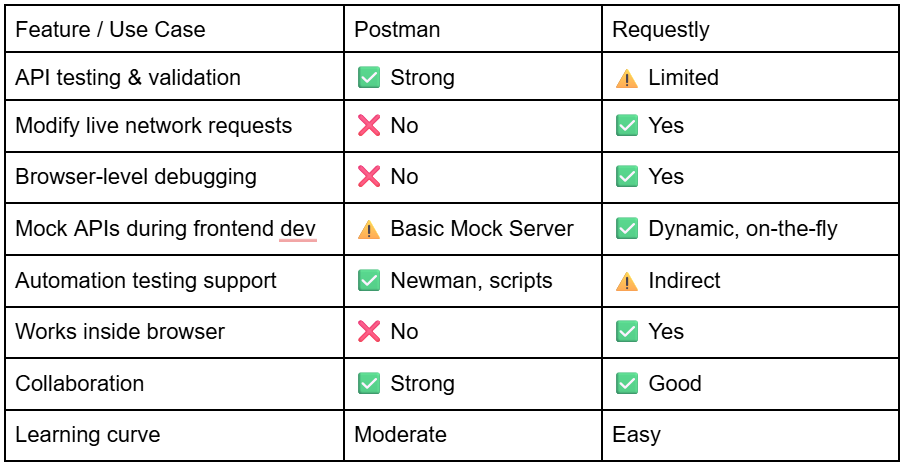
🛠️ When Should Postman Be Used?
Select Postman if your job entails:
- Creating or using APIs
- Creating test suites for APIs
- Controlling environment variables (production, QA, and development)
- Regression and API workflow automation
- Producing documentation for APIs
- Using CI/CD pipelines to do API tests
The industry standard for organized API testing and teamwork is Postman.
💡 As an illustration, a backend team developing a payments API verifies endpoints, authorization, and response types using Postman collections prior to release.
🛠️ When Is Requestly Appropriate to Use?
When necessary, use Requestly:
- Use the browser to directly debug API problems.
- Reroute API requests to staging or fake servers
- Incorporate fictitious responses without modifying the backend
- Test failure situations (500 errors, timeouts, etc.)
- Override query parameters, cookies, or headers
- Replicate the actions of actual users
Requestly excels in cases involving live testing and frontend-first debugging.
💡 For instance, without requesting that backend teams alter the service, a QA engineer evaluates how the user interface responds when an API returns an error.
📌 Where They Collaborate Most Effectively
In fact, a lot of teams use both technologies concurrently:
- To verify API behavior, use Postman.
- To see how the frontend responds to those APIs, use Requestly.
Workflow example:
- Postman’s backend testing API
- QA uses Requestly to simulate edge responses.
- Frontend instantly verifies user interface flows
Together, they produce an entire testing ecosystem.
🏁 Concluding Remarks: Which Should You Select?
The ideal tool depends on your workflow; there is no clear “winner”:
- If API design, testing, or automation are your main concerns, go with Postman.
- If you want to request interception, mocking, or live debugging, select Requestly.
- For end-to-end testing efficiency, combine the two.
In short:
Postman validates APIs. Requestly validates user experiences built on top of those APIs.
메타데이터
- post_id
- 4e97339ac3d2
- slug
- requestly-vs-postman-comparison-when-to-use-each-tool-for-frontend-api-testing-4e97339ac3d2
- url
- https://python.plainenglish.io/requestly-vs-postman-comparison-when-to-use-each-tool-for-frontend-api-testing-4e97339ac3d2
- canonical_url
- https://python.plainenglish.io/requestly-vs-postman-comparison-when-to-use-each-tool-for-frontend-api-testing-4e97339ac3d2
- author_url
- https://medium.com/@abhattacharjee056
- status
- ok
- fetched_at
- 2026-06-21 22:26:41