The Crucible of Responsibility|John Cage’s Character Journey in Edge of Tomorrow (2014)
Edge of Tomorrow (EOT) is one of my favorite films. It is admittedly not a great film, but it is very entertaining. Much like Mad Max: Fury…
The Crucible of Responsibility|John Cage’s Character Journey in Edge of Tomorrow (2014)
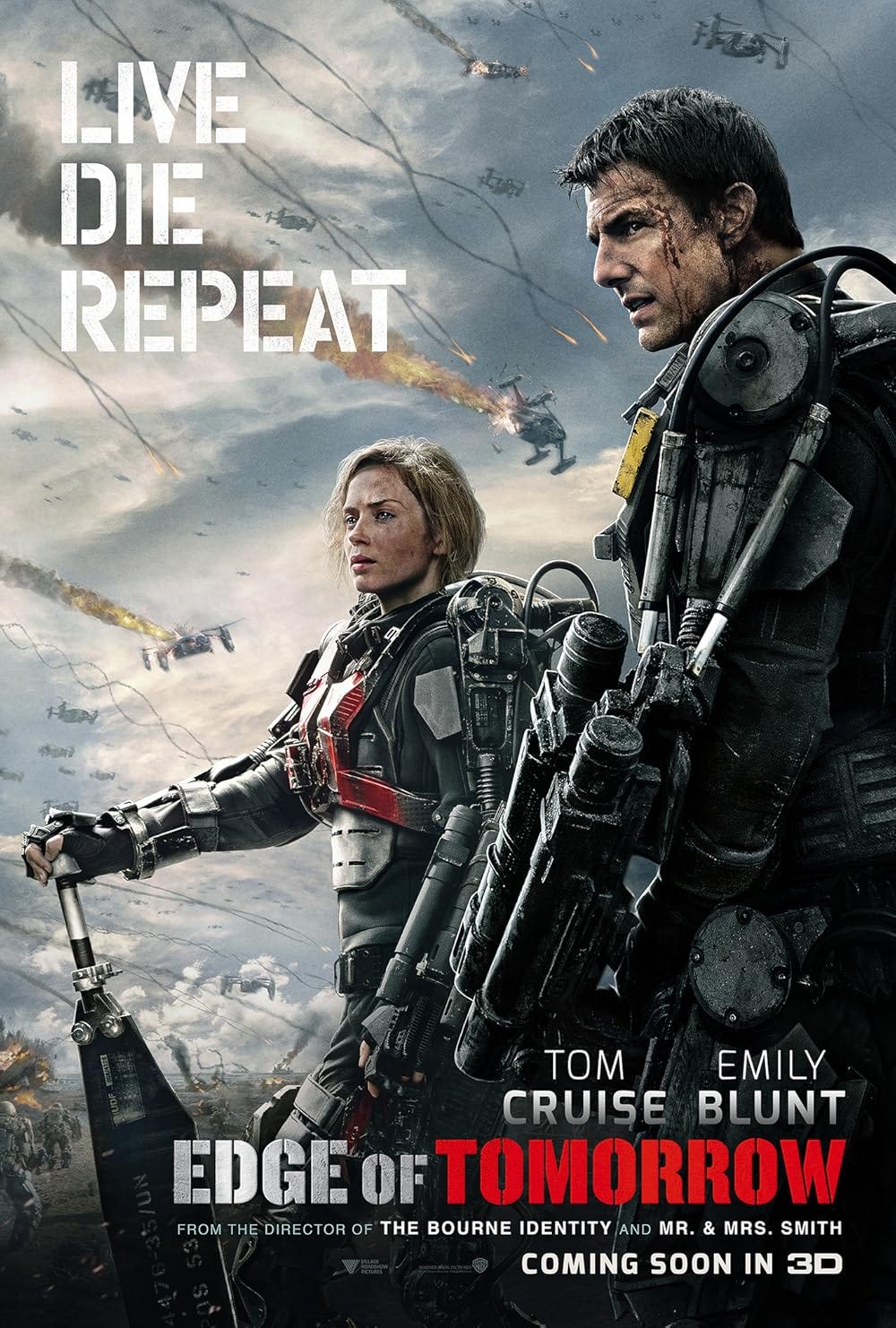
Edge of Tomorrow (EOT) is one of my favorite films. It is admittedly not a great film, but it is very entertaining. Much like Mad Max: Fury Road (2015), I couldn’t understand why we were the only ones in the theater when the trailers were so good. Granted, the title is terrible, and the marketing was likely just as bad — but these are both excellent pop-action flicks. What more could you ask for? (Unless you’re not the demographic that gets excited for something like Wicked Part Two: The Wickeding.) In the case of EOT, having the best mech-suit battles on film would be enough to make it special — but the movie delivers much more.
I’m a huge fan of action — sci-fi action in particular — and this is my favorite Tom Cruise action role. Much like in Mission: Impossible, his weaknesses as an actor are outweighed by his physical embodiment of the part, a level of commitment we’ve only really seen in recent decades from the likes of Keanu Reeves.*
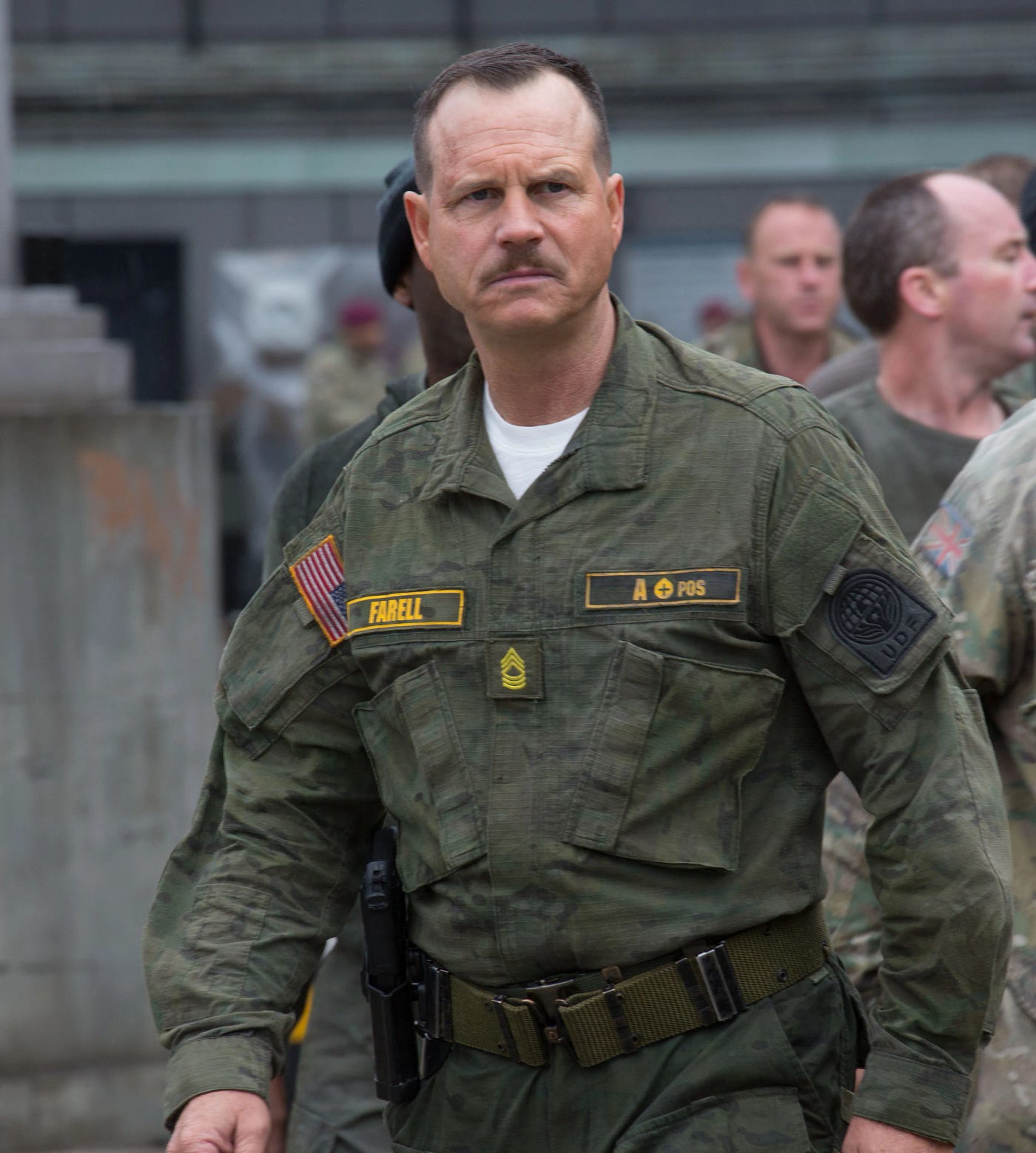
The action in the film is incredible and still holds up beautifully a decade later. The main cast is excellent: Emily Blunt is fantastic as the co-lead, and her chemistry with Cruise is superb. Then there’s Bill Paxton, giving a performance of a lifetime in a supporting role, and the always-great Brendan Gleeson. Oh — and did I mention that I love time-loop movies?
Though in EOT the sci-fi mechanics are pure convenience-and-contrivance trash, the writing and editing in the multiple-iteration montages are so good they almost make the plot-device laziness forgivable — despite how egregious it really is.
The final act is tragically weak. It would have completely undone the film were it not for all the goodwill it had earned — until the story’s obligatory lead-up to the “science guy,” an utterly wasted Noah Taylor (Shine 1996; Game of Thrones 2013; Peaky Blinders 2014; Paddington 2 2017) and his MacGuffin gadget. That said, this plotline does culminate in an epic heist montage sequence.
Again — is it worth it? Sometimes you have to take the bad with the good, especially in sci-fi.
The cast of misfits known as J-Squad is a complete waste of space. They aren’t an interesting foil to Cage, they’re non-entities, and their role as cannon fodder in the finale is meaningless — because we never care, and the film never gives us a reason to. The stakes created by the loss of the reset affect only Cage and Rita. J-Squad is utterly expendable; their only “moment” comes when Cage decides not to save one of them from being crushed on the beach, which makes literally no difference. He can’t save anyone without achieving absolute victory — if he survives that moment, he dies five minutes later anyway.
So yes, the movie has flaws.
Time Loops
I love the temporal loop structure because it’s such an elegant mechanism for character growth. It demands tight, intelligent writing and near-perfect editing to succeed — and EOT excels in this respect. I’m generally more drawn to darker, existential explorations of the concept, which a more faithful adaptation of the source material would have provided.
But I genuinely enjoy EOT’s levity. It’s especially valuable given how little comedy we get these days — we already have plenty of moroseness and nihilism, so I don’t see this as a flaw.
Story
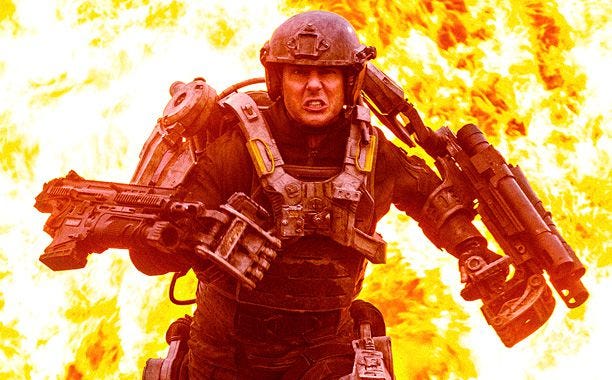
John Cage (Cruise) is a public relations officer tasked with inspiring enlistment for an ultimate counteroffensive against a seemingly unbeatable alien invasion force that has nearly taken over continental Europe.
He’s ordered to join a combat battalion on the ground to help sell the narrative that victory is just around the corner. Cage knows the attack is, at best, a long shot and, at worst, a mass death sentence — and while he’s perfectly willing to sell that lie to the public, he has no interest in becoming part of the slaughter himself. One could reasonably argue that he knows too much about the real odds of the operation he’s been spinning, and that his removal is as convenient as it is strategic. When he tries to extort his superior by threatening to shift blame for the inevitable catastrophe (accurately, as it happens), the general responds by demoting him to private and shipping him off to the front lines — no training, no preparation, and absolutely no way out.
As expected, the attack is a complete slaughter. Cage, mangled and near death, manages to place a landmine between himself and a particularly massive tentacled Mimic — the alien invaders reminiscent of Super Mario monstrosities — just as it attacks. The mine detonates.
And then Cage wakes up, startled, back at base — just moments before deployment.
With no better plan than trying to convince people who already view him as a traitor and schemer that he’s “from” the future, Cage is repeatedly shipped out to the battlefield — dying, and waking up at the exact same point in time.
With each iteration, Cage learns something new, and through memorization, he gradually manages to delay his otherwise instantaneous death.
The Relationship Makes the Film
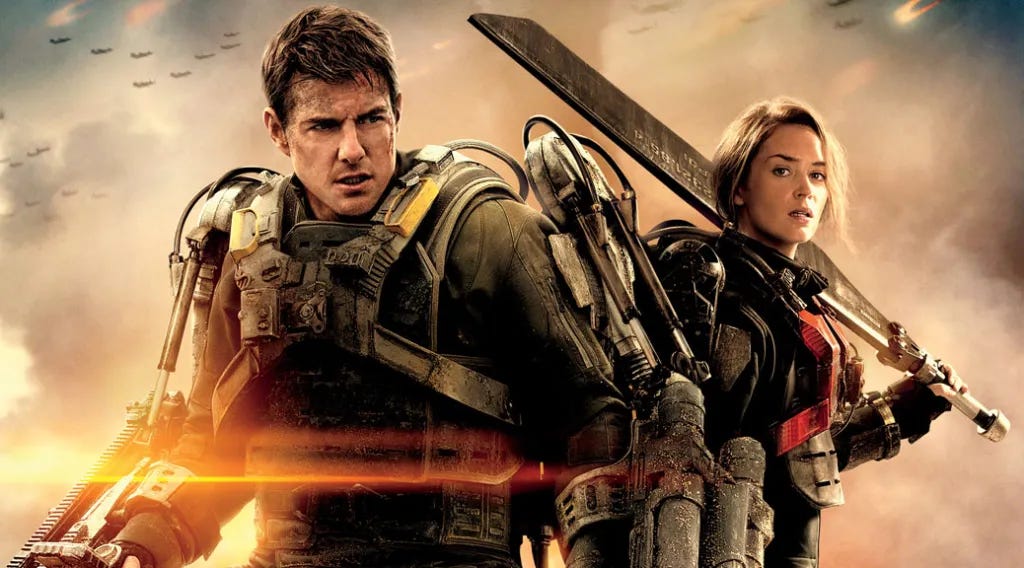
Eventually, he survives long enough to encounter the legendary Rita Vrataski on the battlefield. As the most celebrated soldier of her time, she serves as the public face of the war, thanks to her success in the previous campaign.
She immediately recognizes that he alone is demonstrating any capacity to fend off the Mimics. She tells Cage to find her when he wakes up.
See, Rita has had the same experience as Cage. She managed to kill what she refers to as The Alpha, and from that moment, just like Cage, each time she died, the day reset. That’s why she got so good at killing Mimics. But she eventually lost the ability after a blood transfusion following a severe battle injury, rendering her unable to reset.
She needs John to bring her to the Omega Mimic, once they can track it using the obligatory nonsense MacGuffin. The Omega‘s death will allegedly destroy the entire invasion force.
She will train Cage. But he will need to die every day to reset until they can accomplish their mission. And since his infinite iterations are always the first and only version of this day for Rita, he will need to escape his squad, who are charged with making sure he deploys, finds her, and convinces her, every time, before they get to the business of improving their odds in any way. And he, of course, needs to avoid being saved from death so the day resets, and avoid injury without the ability to ensure said death.
A lot of moving parts here.
Not unlike most time loop movies (or at least the best), Cage and Rita’s dynamics are the absolute key for the story to work, and thankfully, it is exceptionally well written. It might be the only film iteration of a girl boss who is inherently more competent than the male lead, isn’t at all shy about it, and yet, instead of being insufferable, is actually likable. Who could have seen that coming? People who’ve seen Emily Blunt in movies before, I guess.
Rita displays traditionally masculine traits without compromising her femininity, which barely factors into the story at all. This is just a story of two people trying to prevent the apocalypse. Interestingly enough, they don’t have time for any other agenda. Crazy.
The training montage, in which Rita casually shoots Cage in the face every time he gets injured, remains one of the most
Both heroes losing their powers before the final confrontation is a strong narrative choice — it’s just a shame the finale isn’t written and executed with the level of precision the movie is clearly capable of. The finale is anti-climactic in that account, and reminds us of much lesser films.
Painstaking Growth
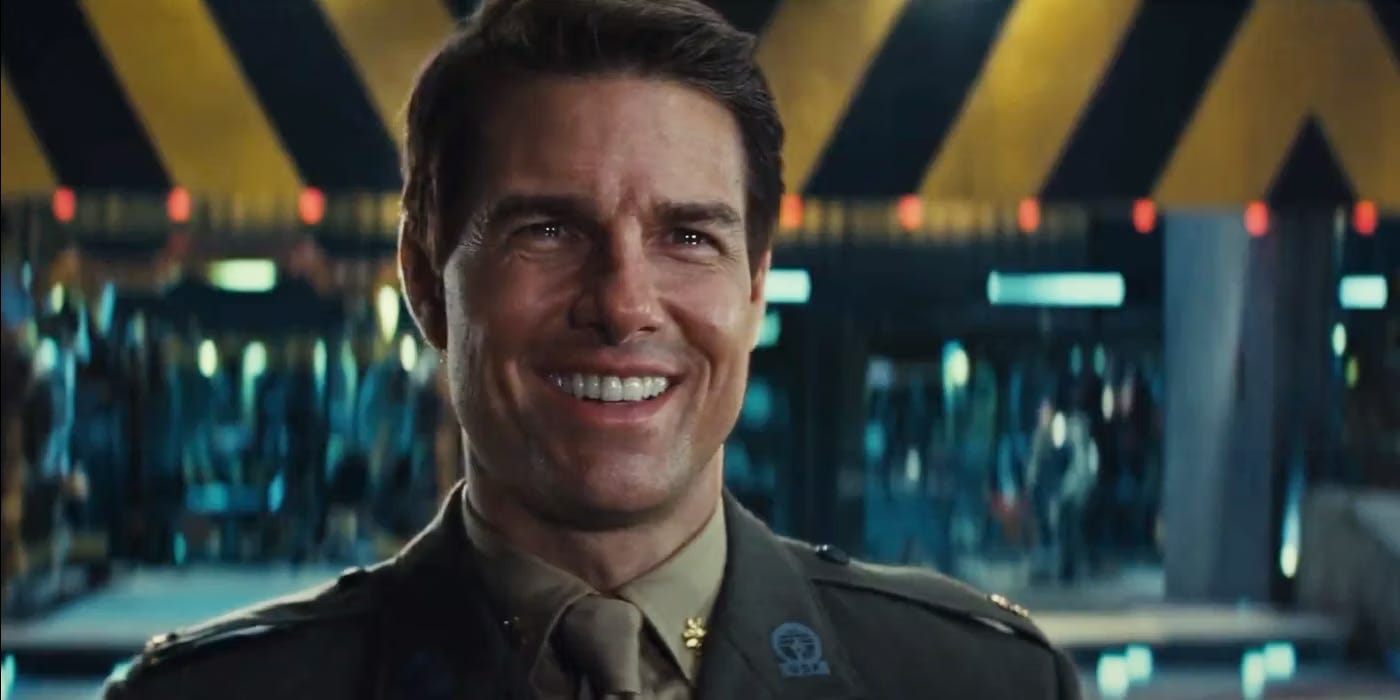
The super power in EOT is a temporary reset of the day, not crushing Mimics in battle. Any progress he made during that time is entirely up to Cage to carry on to the next day, and he doesn’t just get to do the fun parts over and over again.
Cage must earn every inch of progress, and I love that the only way to reset the day — which is crucial to saving humanity — depends entirely on him dying every day; one flawed, unremarkable everyman, with only one ally (and a scientist). If they speak to anyone else about this, at best, they get put away in a mental institution.
The superpower itself isn’t earned, but mastering it absolutely is. And now everything is up to a man who begins the story doing everything possible to avoid the war. The man who never believed in sacrifice must now sacrifice himself repeatedly for the slimmest chance of success — all while racing against an invisible timer before his power vanishes.
The early resets are humiliating: failure, repetition, failure. The best he can manage is delaying death a little.
But each loop erodes his distinctly unheroic nature. He is placed in a world where his manipulations hold no power. Everyone despises him. No one is invested in his survival. No one will listen to him. Rita doesn’t even see him as a person at first — only as a tool, a mechanism for one more shot at defeating the enemy.
Through repetition, muscle memory becomes the engine of heroism. Cage improves — again and again — until he becomes unrecognizable, a super-soldier, composing an incremental strategy to “single-handedly” save the day.
Until he hits a wall, then his old habits return, because they weren’t eradicated, merely dormant. When progress stalls, he gives up.
And then he loses the ability to reset.
No more retries. No more rehearsed success.
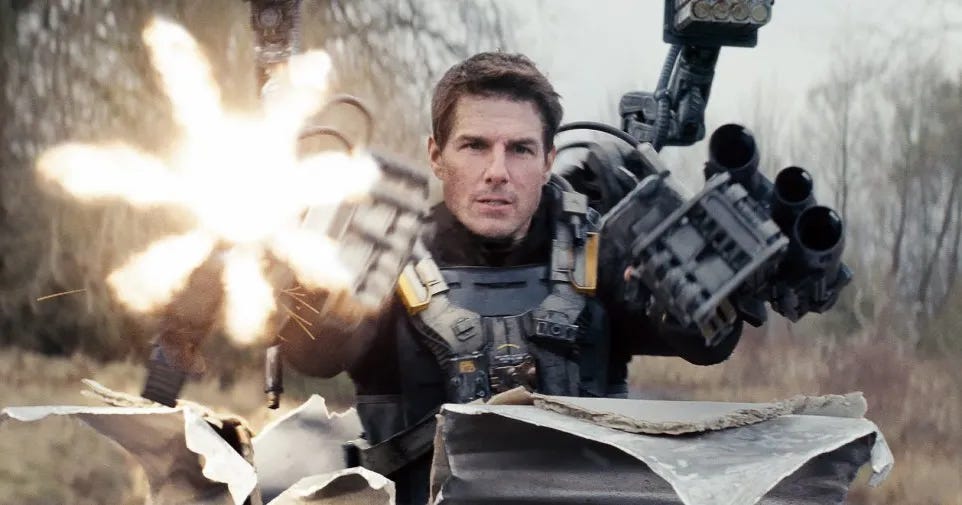
And by then, something real has taken deep root. True transformation has indeed occurred. Cage moves forward without the shield of immortality. There is no hope of survival — only the faint possibility of victory. He no longer cares about avoiding death at all costs, only about saving humanity. Either way, there will be no glory. No one will ever know what he sacrifice. (So, basically, just like Wanda Maximoff in WandaVision.)
This is John’s journey: from avoiding the frontline at all costs, to being thrown into its heart, to returning, willingly, again and again until victory is achieved. And this is where winning only means not losing. From getting others to do the dirty work, to literally acting as a one-man army, carrying the whole burden of the war, with not so much as a grumble of complaint.
When it’s finally over, he stands alone with his infinite traumatic experiences. The world is saved. No one knows how or why. Rita is now a complete stranger — but she is alive.
In Closing
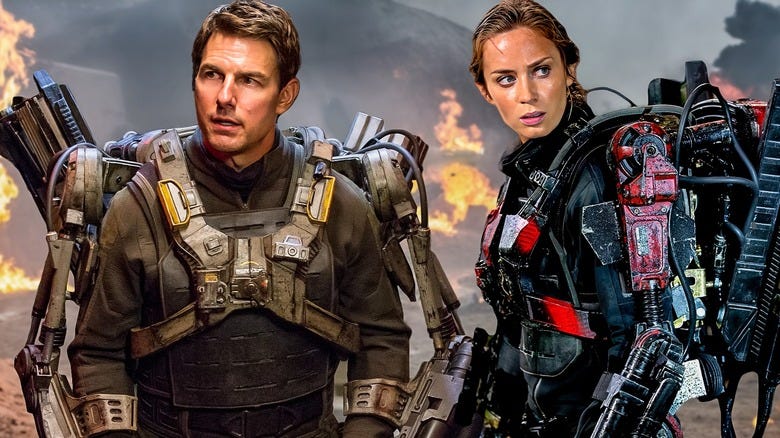
The day is saved. John comes to see Rita. He has literally performed the most noble deed humankind has ever known, and nobody knows it, and only one person could understand, or even believe it.
Does he tell her?
She doesn’t even know him, of course. She has none of their shared experiences. She was never going to, as everything they went through together was always going to get reset.
But, since their experiences were so out there, it would be super easy for him to convince her he, too, got reset powers, and that they saved the world together. He could let her know all her effort and sacrifice paid off in the end, and that the victory wasn’t this fluke out of nowhere, like the rest of the world thinks. That would probably be worth everything to her. And it would be nice for the Science Guy to know he contributed as well. Maybe that trumps any sort of recognition and praise. ***
Could Cage have undergone such a profound transformation through endless iterations that having Rita (and humanity) survive is enough, and he can simply walk into the sunset, content? Could Rita have gone through a similar thing and not needed to be told it was her accomplishment?
Could you?
It’s a nice idea for sure…
Whichever the case, John still has to face the ultimate question: what to do with the rest of his life? Has he ever considered being a pirate, you think?
He’d make a great pirate Roberts.
*Though you could make the case with some exceptional martial artists who also appear in films.
*Emily Blunt has a knack for on-screen chemistry: Five-Year Engagement (2012) with Jason Segel, Looper (2012) with Joseph Gordon-Levitt, Sicario (2015) with Josh Brolin, A Quiet Place* (2018) with John Krasinski.
***Though I don’t know what it means for humanity to carry the story that it was spared annihilation by a complete mystery.
Having some sort of foundation for developing a viable strategy for a potential future occurrence could be nice, but I can’t imagine Rita, John, or Bill Nye attempting to convince anyone of what they know, despite the stakes, since their story is as ridiculous as it is unprovable.
Perhaps we are doomed to have to rely on the common Cold, as usual. At least people buy stories about Colds.
메타데이터
- post_id
- 4e9d5d4ec1ec
- slug
- the-crucible-of-responsibility-4e9d5d4ec1ec
- url
- https://medium.com/@movieidiotblog/the-crucible-of-responsibility-4e9d5d4ec1ec
- canonical_url
- https://medium.com/@movieidiotblog/the-crucible-of-responsibility-4e9d5d4ec1ec
- author_url
- https://medium.com/@movieidiotblog
- status
- ok
- fetched_at
- 2026-06-27 23:56:40