15 Agent Reliability Patterns Borrowed From SRE Incident Culture
Make LLM agents behave like production services: measurable, debuggable, and safe under pressure — without turning your prompts into…
15 Agent Reliability Patterns Borrowed From SRE Incident Culture
Make LLM agents behave like production services: measurable, debuggable, and safe under pressure — without turning your prompts into heroics.
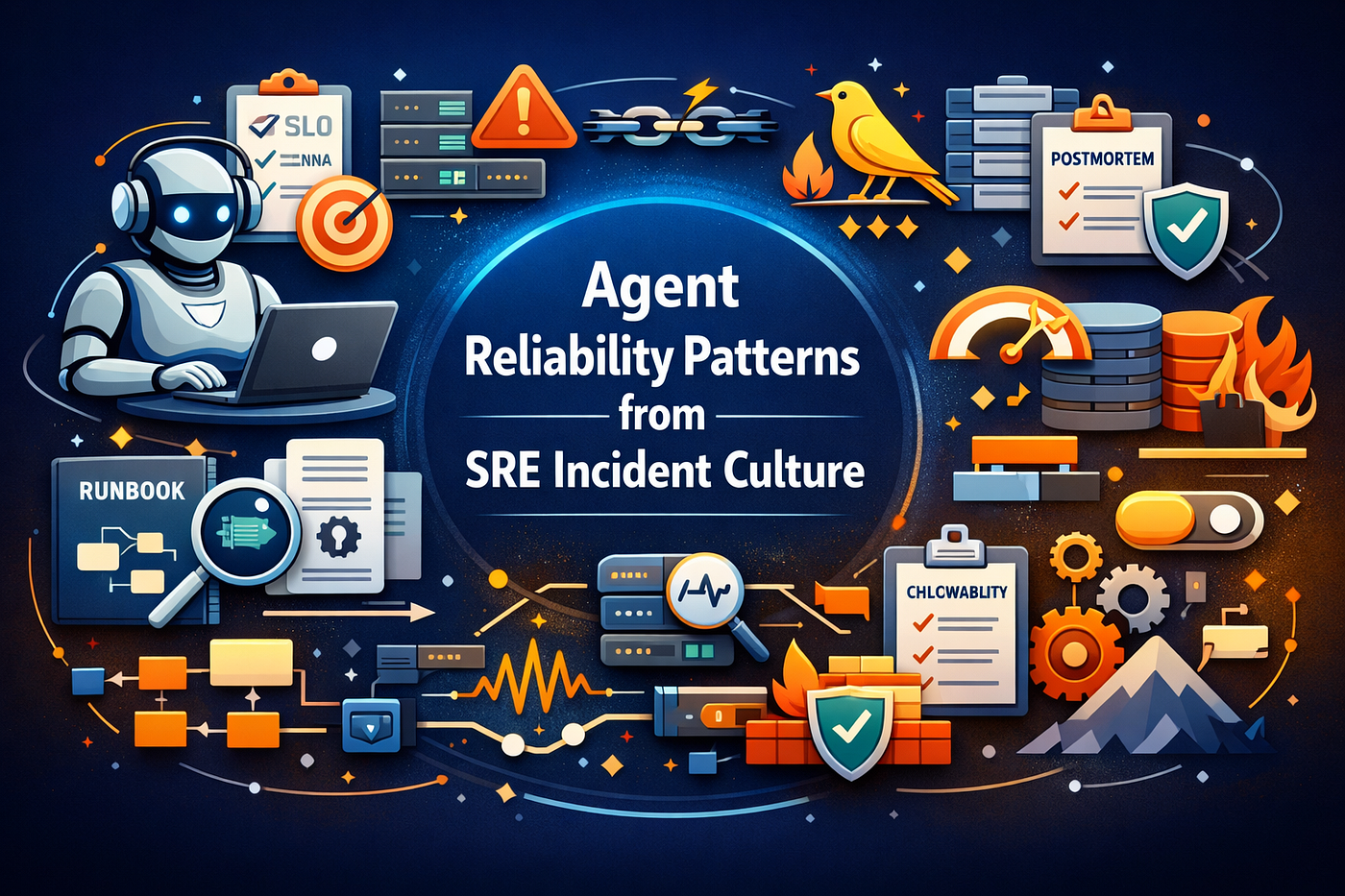
15 SRE-inspired agent reliability patterns: SLOs, runbooks, guardrails, canaries, postmortems, and observability to keep LLM agents stable in production.
Let’s be real: most “agent failures” aren’t mysterious AI moments. They’re the same old production problems — just wearing a new mask.
Timeouts. Bad inputs. Partial outages. Silent retries. Confusing logs. And the classic: “It worked in staging.”
SRE teams have spent decades building cultures and mechanisms that turn chaos into learning. If you’re shipping tool-using agents (LLM + functions + workflows), you can borrow that incident culture and skip a few painful quarters.
Below are 15 reliability patterns, translated from SRE into agent systems — practical, shippable, and measurable.
Why SRE incident culture maps to agents
Agents are distributed systems with a narrator.
You have:
- a planner (the model),
- tools (APIs, DBs, browsers),
- state (memory, scratch, cached context),
- and a runtime (orchestrator, queues, rate limits).
When it breaks, it breaks in production-shaped ways. So treat it like production software.
Architecture flow you should actually implement
Here’s the reliability spine most teams end up building anyway — might as well design it on purpose:
User Request
   |
   v
[Intent Gate] ---> (policy, authz, budget, rate limit)
   |
   v
[Planner LLM] ---> emits Plan + Tool Calls (typed)
   |
   v
[Tool Router] ---> retries, backoff, circuit breakers
   |
   v
[State Store] ---> conversation state, tool outputs, checkpoints
   |
   v
[Verifier]  ---> validation, safety checks, schema, grounding
   |
   v
Response + Telemetry ---> traces, metrics, incident breadcrumbs
You might be wondering: “Isn’t this overkill?” Not after your first high-severity incident caused by a helpful agent.
1) Define Agent SLOs (not vibes)
SRE starts with service level objectives. Agents need the same.
Examples:
- Task Success Rate (per intent category) ≥ 92%
- Tool Call Error Rate ≤ 0.5%
- Time-to-First-Useful-Answer p95 ≤ 8s
- Unsafe Action Rate = 0 (yes, zero)
The trick: define success in a way you can measure without lying to yourself. If you can’t measure it, you can’t improve it.
2) Error budgets for “agent autonomy”
Error budgets are permission slips. They answer: how risky can we be this week?
If your agent’s success rate drops below the SLO, freeze new capabilities and spend the budget on reliability work (guardrails, evals, tooling), not new features.
This is how you stop shipping chaos with a smile.
3) Blameless postmortems for agent incidents
When an agent messes up, the instinct is to blame:
- “The model hallucinated.”
- “The prompt was bad.”
- “Users are dumb.”
SRE culture says: blame systems, not people.
Postmortem format that works well for agents:
- What did the agent believe was happening?
- What tools did it call, in what order?
- What signals were missing?
- What guardrail should have caught it?
- What would make detection faster next time?
4) Incident taxonomy: classify failures by shape
You’ll move faster if your incident labels are stable:
- Planning failure (wrong steps)
- Tool failure (timeouts, 500s, auth)
- State failure (bad memory, stale cache)
- Verification failure (no validation, weak checks)
- Policy failure (allowed what shouldn’t be allowed)
- UX failure (agent did the right thing, user couldn’t see it)
This turns “agents are unpredictable” into “we know where to look.”
5) Runbooks for common agent breakdowns
SRE has runbooks because adrenaline kills creativity.
Make runbooks for:
- tool timeouts
- quota/rate-limit storms
- schema mismatch loops
- “stuck planning” (endless reasoning, no action)
- repeated retries causing duplicate side effects
Runbook rule: it should work at 3AM.
6) Make tool calls typed, validated, and versioned
Your agent should not be calling tools like it’s freestyle jazz.
Use schemas + validation + versioning:
- strict JSON schema
- clear error messages the agent can use to recover
- version tool contracts so you can deploy safely
A tiny reliability boost that feels like magic: return structured errors instead of vague strings.
7) Idempotency keys for side-effect tools
If your agent can trigger payments, emails, tickets, updates — assume retries will happen.
Pattern:
- Every write tool requires an
idempotency_key - Backend deduplicates on that key
This prevents the “agent retried and created 12 orders” incident. And yes, that one is real.
8) Circuit breakers for flaky tools
When a dependency degrades, stop calling it. Don’t let the agent panic-retry itself into an outage.
Circuit breaker states:
- closed (normal)
- open (fail fast)
- half-open (probe recovery)
If a tool is down, the agent should switch modes: degrade gracefully, ask user for alternatives, or queue the task.
9) Progressive delivery: canaries for prompts and models
SRE doesn’t roll out to 100% instantly. Neither should you.
Canary any change that can shift behavior:
- model upgrades
- prompt updates
- tool routing changes
- new memory strategy
- new verifier logic
Start with 1–5% traffic, compare SLOs, then ramp.
10) Observability: traces over chat logs
Chat logs are not observability. They’re vibes with timestamps.
You want:
- distributed traces per request
- tool latency histograms
- tool error rates by endpoint
- “plan steps per task” metrics
- verifier failure counts
- retry counts and reasons
Most agent debugging becomes trivial once you can answer: what happened, where, and why.
11) “Golden signals” for agents
Classic SRE signals: latency, traffic, errors, saturation.
Agent-adapted golden signals:
- Latency: end-to-end + per tool
- Errors: tool failures + verification failures
- Quality: success rate + user correction rate
- Autonomy cost: tool calls per success (efficiency)
- Safety: blocked actions + policy violations
If you don’t watch these, you’ll learn them… during an incident.
12) Guardrails as policy gates, not prompt wishes
A reliability pattern that saves reputations: separate policy from prompting.
- Prompt: “Don’t do risky things.”
- Policy gate: “You literally cannot do risky things.”
Examples:
- require explicit user confirmation for destructive actions
- enforce permission checks per tool
- cap spend/time per task (“compute budget”)
- forbid certain actions by default unless allowlisted
Prompts guide. Gates enforce.
13) Checkpoints + rollback for multi-step tasks
SRE loves safe rollbacks. Agents should checkpoint state as they progress.
Checkpoint after:
- data fetch
- transformation
- decision
- write action (and store the write receipt)
If something fails mid-way, you can resume instead of restarting — and you can explain to users what was already done.
14) Chaos drills for agent-tool ecosystems
Chaos engineering isn’t just for infra.
Inject failures:
- tool returns 500
- tool returns slow response
- tool returns malformed JSON
- network drops mid-step
- stale cache returns wrong data
Then verify:
- agent fails safely
- user gets a useful explanation
- system doesn’t spam retries
- telemetry shows root cause
You’ll be shocked how many “smart” agents collapse when a tool hiccups.
15) A “learning loop” that turns incidents into evals
The most SRE thing you can do: never waste an outage.
Every incident should produce:
- a regression test (eval case)
- a new alert threshold
- a runbook update
- a contract/policy improvement
If an incident doesn’t change the system, it’s not a postmortem. It’s storytelling.
A quick case study (because this gets real fast)
A support agent is allowed to “update customer address” via a tool. During a partial outage, the tool intermittently returns a success-looking response but fails to commit.
Without reliability patterns, you get:
- repeated retries
- duplicate updates
- angry customers
- support team drowning
With SRE patterns:
- circuit breaker opens after error burst
- idempotency key prevents duplicates
- verifier detects mismatch (read-after-write check)
- agent degrades: queues request + tells user “I’ll confirm once systems stabilize”
- postmortem turns the scenario into a permanent eval
Same model. Different system.
Conclusion
Agent reliability isn’t a prompt craft problem. It’s a systems discipline.
If you want agents you can trust:
- measure them (SLOs),
- constrain them (policy gates),
- debug them (traces),
- deploy them safely (canaries),
- and learn ruthlessly (postmortems → evals).
You don’t need to copy SRE culture perfectly. Just steal the parts that keep your weekends intact.
CTA: If you’re shipping agents in production, drop a comment with your most painful failure mode — and I’ll suggest the SRE pattern that fixes it. Follow for more reliability-first agent design.
메타데이터
- post_id
- 4ea5d372dcc7
- slug
- 15-agent-reliability-patterns-borrowed-from-sre-incident-culture-4ea5d372dcc7
- url
- https://medium.com/@jickpatel611/15-agent-reliability-patterns-borrowed-from-sre-incident-culture-4ea5d372dcc7
- canonical_url
- https://medium.com/@jickpatel611/15-agent-reliability-patterns-borrowed-from-sre-incident-culture-4ea5d372dcc7
- author_url
- https://medium.com/@jickpatel611
- status
- ok
- fetched_at
- 2026-07-14 15:40:45