Singapore Oceanarium Deep Sea Tour Review: Is the Extra $88 Worth It?
A local reviews Singapore Oceanarium’s $88 Deep Sea Exhibit tour. See blobs, jellies & behind-the-scenes secrets. Is it worth the price?
Singapore Oceanarium Deep Sea Tour Review: Is the Extra $88 Worth It?
It is no surprise that Singapore’s aquarium would be recognised as one of the world’s best aquariums to visit. As a local Singaporean and an aquarium lover, I had to visit.

I’ll be honest, Sentosa is not a place I frequent. It is expensive and tiny, so I could hardly believe my eyes when I heard the tickets to a small part of the island were costing me SGD55 for entry to the aquarium. Moreover, I paid an additional SGD88 for the Deep Sea Exhibit Guided Tour. I had no idea what to expect. But I did want to see a Blob Fish! It might be ugly, but I think it’s charming.
P.S. I did get to see my blob fish but it was not what I thought it would be.

One of the biggest kreisel tanks in the world with 6.8m diametre.
Right after I entered, I was ambushed by photographers who told us to stand to the side. As an experienced aquarium goer, long before SeaWorld was renamed Oceanarium, I immediately declined. They won’t make you pay for that photograph, and it’s totally optional. However, with my startup business (Coffee Creed) and the excruciatingly difficult decision to pivot to a content creator founder hybrid model, I was paranoid about having my pictures exposed. You can, however, get amazing photographs that you can purchase at checkout with a QR Code they give you, and even preview the photographs and get them to retake it if you want. It’s great for families and dates, so dress your best and pose away!


This is the main feature sea jelly tank that has LED light shows and moving internal current.
Once you get past those, you’d be greeted by adorable sea jellies. Yes, I mean jellyfish. However, according to our guide (Haera & Jen), they renamed jellyfish to sea jellies because they were technically not fish. I mean, it’s probably about time someone made that distinction. As a teacher who once taught children, I had to say they were sea creatures, so fish made sense even if scientifically non-compliant to that category.
[embed]
There are many forms of jellyfish. And I will be sticking to the term jellyfish for the sake of readers who would have a hard time getting used to their new names. I know I’m dead naming, but can you blame me when the majority of the world is trying to catch up to Singapore’s pace of progression?
[embed]
Most of them are named after their looks. I just found it hilarious that my friend accompanying me that day pointed out it was called “Fried Egg” Sea Jelly. What a way to be remembered!

One fun fact we were shared was how sea jellies were actually considered plankton, and they do not move if they are not pushed by a current inside the tank. In other words, they are at the bottom of the ocean food chain alongside kelp.

Now, don’t quote me on this because I’m not a marine biologist. It’s what I was told, and I didn’t register or comprehend half of what was said. They just flew over my head. One day at the Oceanarium was clearly not enough for me.
[embed]
Right after the sea jelly section, we were launched into the heart of the oceanarium’s theme — the deep sea exhibit. The first thing that caught everyone’s eye was this gigantic, life-sized, moving model replica of the Dunkleosteus.

To be fair, I had no idea what it was until I arrived at Oceanarium. However, our guide explained a few fun facts about this monstrous ancient fish. The skull of this fish was found, but not the rest of its body, and it was said that the rest of its body might have been made from cartilage, while the teeth and head were bony armour plates. They had terrifying teeth and were apex predators in their time. Also, they might have been cannibals and eaten the young of their own species. Think of them as giant piranha?

I had a question that our guide could not answer, so I’m going to do a little research. I asked if armour bone plates were bones, and they were not sure, but it wasn’t quite the same thing. Hence, after some online research while writing this, I found it to be something called dermal bone in specific. While it is a type of calcium compound similar to bone, it is not an internal structure that provides form. In fact, it’s grown onto the skin externally for protection, much like turtle shells. That’s enough science for me today. I can’t keep up lmao!

While the Dunkleosteus remains the main star of this exhibit, there was another very important ancient creature that we were told about. It’s basically the prototype model of shrimps, in my opinion, and is the feeder model of evolution, developing the modern filter feeding in some animals like whales.

There is actually a descendant of this creature with very similar looks. I did not catch the name because the guide recited it once, and it took her a month to remember it. If I’m not mistaken, after a brief search, it should be the Anomalocarididae.

Interestingly enough, there are some ancient creatures that survived until the present day. No, the Nautilus is not extinct, but the Ammonites are. Horseshoe crabs are also incredibly ancient, existing even before dinosaurs. Interestingly enough, there are local species of these horseshoe crabs in Singapore found at the Sungei Buloh Wetland Reserve. I have yet to visit there since their boardwalk addition. Maybe that’s a future trip.
[embed]
In addition to these creatures, sturgeons and paddlefish are also considered living fossils. Yes, these are also slowly becoming extinct because humans love their caviar. I would like it if people ate less caviar and more broccoli so that I can continue to enjoy seeing these platypus founders for more generations to come.
[embed]
Moving from the deep-sea exhibition section has to be one of the saddest things during my visit. There was so much more to learn about them but it was surprisingly small, even if informative. I wasn’t sad for long, fortunately. The next section had an explanation of ancient evolution to modern-day marine life and how they grew to adapt to land when the waters became overcrowded.

Between cooing at the axolotl popularised by Minecraft and listening to our guide explain about the ‘neck fish’ Tiktaalik that was the ancestor to all land animals, I vaguely recalled some biology trivia about why we have such terrible airway designs.

You would think it would be more efficient to have two tubes linking to different parts of the lungs and the stomach. However, they are so close together and put all the burden of segregation on one trapdoor in the Pharynx called the Epiglottis. Should it malfunction, we could easily choke and die.

Remember the first fish that came to land? The Tiktaalik? According to science, the first lungfish transformed its swim bladder into lungs. Notice the position of the stomach and the evolved gas bladders. I think you can understand how humans came to evolve this way.

If you eat it and die, it’s poisonous. If it bites you and you die, it’s venomous.
Evolution is a strange thing. Salamanders and frogs are amphibians, but snakes are reptiles. I don’t really know the difference, but they are all cousins of fish as cold-blooded creatures. All I really liked was understanding the difference between venomous and poisonous. A good example was the jellyfish vs the poison arrow frog. If the jellyfish touches me, I die. If I eat the jellyfish, it’s delicious. But if I touched the poison arrow frog, I could make good poison arrows. However, if I ate poison arrow frog, I’m a dumbass and should have shot myself with that same poisoned arrow.

Ok, random ship display time. We were pop-quizzed here, so wrong answers only! Do you know what this ship’s name is? It’s actually a gift from Oman to Singapore and sailed for months with no modern technology used in sailing navigation or building the ship. No, it’s not a replica. It’s the actual ship now displayed here.
For people who got it wrong, here’s the real answer. This is called the Jewel of Muscat. No, not the large expensive grapes. It’s the capital of Oman. And right behind this ship is some sort of activity called Pier adventure where you can walk on this rope obstacle course right behind the Jewel of Muscat. You can read the full Jewel of Muscat’s origin story here. However, there’s a trivia most people don’t know. It’s about how the original boat got into where it is sitting.

When our guide first asked us that, it seemed obvious that they would have used a crane to lift it in. However, she said it was not, and that was where we had to get creative. The image above gives you a little hint of how it arrived. You can also read the journal of building the Jewel of Muscat and the sailing journey here.
Alright, time for the real answer. It was sailed into place. It cannot be seen in the photograph, but if you lean safely forward, you’d see similar bars holding the ship in place on the ground. That’s for docking and holding the ship in place. I had a question at the back of my mind about how the sailors who arrived here were cleared for immigration, because they obviously did not pass through customs. But that’s probably something the government would have known beforehand. They were warmly welcomed with all of Singapore’s hospitality after roughing it out on the sea for weeks and safely delivering a previous gift, so immigration checks would be the last thing anyone would think about.

Once we left this cafe break area with the view of the Jewel of Muscat, we headed down a long escalator and reached the petting tank area. I obviously did not pet anything because they seemed freaky. I mean, look at that curvy starfish. I had no idea if it counted as one, but it had five arms, so it was technically a starfish, just weirder.
[embed]
Even more trivia, did you know that a group of seahorses are called a shoal? Similar to fish in a sense. I spotted a group here at the very end of the touch tanks. Yes, there were other things like sea cucumbers that looked like long sea poop at the bottom of the sand, as well as hermit crabs and shrimps. I’m sure this would be the children’s favourite section of the oceanarium. But I move on quickly because I was eager to eat lunch at the next section.
[embed]
Behold! A separate tank for sharks. There were all kinds of sharks, and the guide told us trivia about the spotted leopard shark. When it is an adult, it appears like a spotted leopard. However, it had a second name called the zebra shark and we would soon find out why in a secret area accessible to only those who paid the extra SGD88 for the tour that I’m about to share with you for free if you continue reading.

In any case, they reworked the oceanarium so much that what I remembered as that tunnel for viewing large rays and sharks was now shark-only. This particular one was sleeping, I assume. Truthfully, I like this better. However, as this is a highlight attraction of the oceanarium, it can get very crowded as everyone wants to get the best angle for selfies and photoshoots.
[embed]
I dislike crowded places, so my friend and I squeezed right past them. We went from bright lights to darkness once more, and this time, it was the tropical zone.
[embed]
If there was one thing I learned from visiting numerous aquariums, it was how the first sight of any tall tropical tank was a trap. You don’t stop there like the rest of the tourists, you continue walking because eventually, you’d get the best view at the bottom and not from the top hanging from a ledge elbowing the crowd.
[embed]
Just when I thought I’d seen it all because lionfish are so common, I stopped at this tank for a long time. What the fuck is a weedy seadragon? They look so unique that I just can’t help but stare at them for a whole five minutes. Forget the people behind me wanting pictures. I mean, look at them! It’s the first time I've seen something like this anywhere. I don’t know if any other aquariums had it or if I commonly overlooked them but they are my favourite type of seahorses.

As we continued walking, we passed by a sneak peek of the nursery in the oceanarium. Apart from the Deep Sea Exhibit, they have a special pass at SGD28 for a 45-minute special session to learn more about how the marine scientists and oceanarium staff take care of these sea creatures. You can find their packages here. And it would be amazing for families with children, as it is very educational, inspiring future marine biologists.

Even without this behind-the-scenes pass, looking through the window would give you an idea about the work that goes on behind the glass tanks. Singapore Oceanarium has a very high standard of professionalism that I will talk about later when I get to the part behind the scenes with my special pass.
[embed]
Finally, we reach the halfway point of the oceanarium displays — the main tank. We reached there in time for the diver shows, so be sure to research beforehand when they will be happening! I did not record it because we were in the second row and there were many children up in the front. It was fine, I wanted to look at the fish, not the divers. If they were mermaids, it would be a different matter. I might kick a kid just to hi-five a mermaid.
[embed]
The main tank is huge. The largest creature there has to be the manta rays. Believe it or not, this is also one of the world’s largest tanks, spanning 36 meters long, 8.3 meters tall and 70cm thick for the viewing panel. It is also a certified open-water dive site. You can check with the staff to sign up and dive here. Singapore Oceanarium provides diving courses by certified professionals. I don’t know many places in the world that would allow you to dive in a tank with over 120 species that isn’t the wild, but Singapore is one of those places that says “yes, you can” for a pretty dollar. Is it worth it? I’m not sure. But it’s surely unforgettable. I mean, you’re swimming in 18 million litres of water. That’s over 7 Olympic-sized pools in one tank with manta rays. I don’t suggest you pet them while you dive, but brushing past a 5-metre manta ray in person is going to be a story you won’t ever forget for the rest of your life.
[embed]
I don’t have many pictures because I think I spent over an hour just sitting at the main tank. Something about the main tanks in aquariums soothes my mind. It was also why my friend dragged me to the Oceanarium because he knew I was highly stressed from running a business. But we’re not here to talk about that. Instead, enjoy the video above featuring a pineapple fish. Very festive, in time for Chinese New Year. Yes, I’m Chinese. It’s Chinese New Year to me and not Lunar New Year.
[embed]
Passing by quickly, we saw the dolphins briefly. Sentosa was known to have a dolphin cove and a dolphin show. You can actually get up and close to play with them in the Dolphin Immersion programme. Note that it is a wet program. You will be getting into the water that we are viewing now with the dolphins.

Remember what I said about the tropical tank? This is the best spot and view if you continue to walk. Take as many photographs here because it is one of the best scenic spots before you leave.

Here’s a chunky crab. I’m showing him now because there’s something that I have to show you later in the special section we paid for, and it affects this dude. For now, just admire his buffy self.
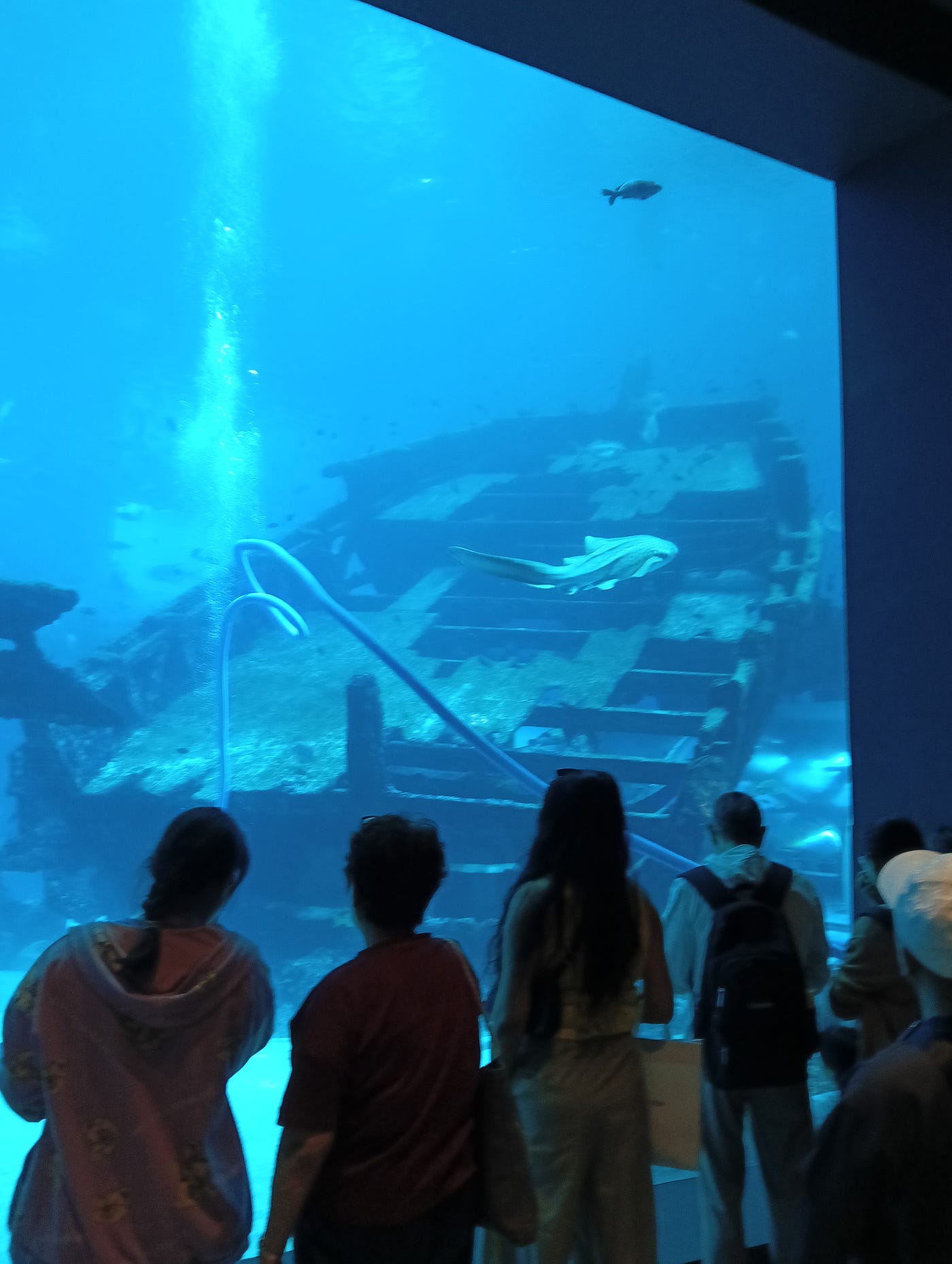
This is a shipwreck replica at 50 metres. It’s still in the sunlight zone and this is kind of important. Our guide explained to us in detail the sea levels and the four zones.

90% of sea creatures known are found in the sunlight zone. At this stage, you can still see the sun, and the more colourful marine creatures exist. However, as colours are lost as the depth increases underwater, with red the first to go, you’d start to see less colour diversity past it. By the Midnight zone, there is no light left. And that is where things get very interesting, including the whale fall.

Shipwrecks are manmade disasters and a mankind tragedy. But did you know, if built from organic materials like the Jewel of Muscat, a shipwreck quickly turns into an ocean blessing in the sunlight zone below 50 meters? Interestingly enough, these organic materials mimic corals and start new ecosystems when biofilm gathers on them, attracting small fish that attract bigger predators and form a new living community.

Triton submersible model in Singapore Oceanarium
Deep-sea exploration craze might have been a thing from science fiction, and was further inspired after the Titanic fell into the Marina Trench. However, did you know that in 2010, we succeeded in reaching it? I personally thought we were still in the sending robots to map the sea floor phase, but no, we have sent humans down there the same way we have sent jellyfish up into space. The Triton Submersible, which looks like a handbag, is found in the Oceanarium. You can see how huge and claustrophobic it could be, and the model is good for 8 dives, lasting hours each trip.

To be honest, I should have known. Apart from the anglerfish and blob fish, my favourite octopus is the umbrella octopus, and it resides there.
[embed]
Moving from the sunlight zone exhibit, we now enter the Twilight zone section. These are adult jellyfish found in the Twilight Zone, but they’re so freaking tiny! I gave the same expression our tour guide gave when she first learned they were full-sized adults. It was hilarious.

This particular spiky sea cucumber was found rolling and pooping when our guide introduced it. She was also in disbelief when I asked if it were pooping. I mean, we know sea cucumbers can shit its innards when threatened and regrow them later. But even she has never seen it doing this weird rolling poop dance. It was new for everyone.

And of course, spiders would also exist in the ocean. This is not a starfish with curly legs, it’s a literal sea spider. People with arachnophobia, I sincerely apologise.

Then we have these sea anemone, which are the swimmable versions of corals. They swim by twisting their bodies and are considered animals, not mushrooms.

Last but not least, expensive deep-sea crabs. Yes, probably the kind in buffets, but much bigger. It’s the last of the Twilight zone so now we head straight to the Midnight and Abyss levels of the sea where things become weird.

Many of the creatures here somehow resemble their ancient ancestors. Remember the ancient shrimp I mentioned? This is the closest living descendant.

According to our guide, many creatures here are red and have eel-like bodies. They also have large eyes due to the lack of light, which is why any light attracts the attention of the creatures in this environment. Red is a pigment used for camouflage due to brown and black being spotted easily in darkness with adapted vision.
This place has all the preserved bodies of actual creatures from the deep sea cast in resin and glass for the public to view. It’s real and not a replica. Unfortunately, the blob fish, although a common catch, is not here.

This should be a replica in the hidden section of the deep sea exhibit that we paid good money for. Our guide explained that due to the atmospheric pressure difference, the blob fish we catch are often severely damaged. In their natural form, they look like tadpoles with large heads and eel-like body structures.

Not the blob fish’s real appearance
The regular oceanarium pass will only show you the carcess of preserved isopods that looks small. However, this is the real model of the giant isopod’s true size if it had not died prematurely. It’s literally the length of my forearm.
[embed]
Behind the scenes, this room is where the chemicals for preserving dead animals, autopsy, jar specimens lie. It’s no surprise we find dead crab shells, too. Or are they really dead?

Remember the chunky crab I showed you? This belongs to that fellow. Apparently, many shellfish shed their shells and grow a bigger one, similar to snakes. Prawns, lobsters and crabs often do this. The shells do not grow with them like turtles, and that’s where we get softshelled crabs.

As shedded shellfish are vulnerable without hard shells, they often go into hiding. The divers who visit tanks twice a day will collect these if they find them and send them to the lab workers for preservation. In addition, any pregnant marine animals will be raised separately from tank buddies to prevent bullying of their young and targeting the pregnant. On rare occasions when a fish is found dead, they would be brought for an autopsy.

This jar contains the heart of a ray. It’s an autopsy case. Can you figure out the cause of death?
At first, I thought it was a stick. However, my friend was more observant. The jagged edges actually gave him a clue and the guide confirmed his suspicions that it belonged to the barb of a stingray.

Murder in the main tank… now that’s tea! There isn’t CCTV footage for this, so the likely story was an accident, not a murder. There is one stingray without barbs in that main tank you saw earlier that I sat at for an hour. Now, I did ask the question if it wasn’t dangerous for divers, and the answer is a resounding: YES. The job comes with risks, but they are trained professionals. That brings me to my next question: Why doesn’t Singapore Oceanarium remove the barbs from stingrays if they are dangerous?

Goblin shark
This information is not publicly available, but we were told that Singapore Oceanarium does not habitually debar rays due to its ethical beliefs and concerns. I’m not even sure if they have the expertise required for debarbing rays, but that makes perfect sense. Apart from this one freak accident, there have been no other incidents involving stingray accidents. The animals seemed well cared for and docile, reflecting great care by Oceanarium staff.

Apart from feeding fish and cleaning tanks, you saw sneak peeks into the laboratory nursery. They do raise baby fish separately, and this is one unfortunate chap that did not make it despite the best care. It is a leopard shark baby, also known as a zebra shark.
When first born, leopard sharks have stripes that appear like zebras instead. These stripes stretch out into dots as they grow, hence their name. Something to note is that they reproduce asexually. Most of the leopard sharks in the Singapore Oceanarium are actually female. The cause of this unfortunate baby leopard shark might have been due to fertilisation instead of asexual reproduction but the cause was unknown.

It was not the only unfortunate birth case in Singapore Oceanarium. This one was still in the egg with the yolk sac attached when it stopped moving. An autopsy was done to uncover the cause of death, but even with science, nature is tricky. RIP, little one, you will forever be remembered.
I did not take many pictures there, but the explanation was detailed and interesting because I did not want to spoil the experience completely for the people who want to try it for themselves. The staff are knowledgeable, and you can even find the preserved carcasses and how they do it by dyeing them in different colours. It might be morbid but I’m a writer. This is more fascinating to me than disturbing.

Speaking of morbid, this is the most unique and valuable gift in the entire gift shop. It is the small carcass I talked about, but preserved in a pen you could use. I’ll repeat what I heard from the guide. Red is for bones, blue is for cartilage and other colours that appear would be an investigative point for the cause of death. This one was SGD65 for a ballpen, but if you had the money, it is the most meaningful gift you could get among other merchandise like shirts, cups and stuffed animals.

Oh, before I forget to mention. SGD88 comes with free snacks and drinks at the VIP lounge, including these adorable cookies. I had the manta ray one. But neither my friend nor I got the drinks because we didn’t want to be carrying them around inside.

These are some of the souvenirs we received. My favourite had to be this sea cockroach plushie. There were also coupons for some snacks we could buy, and we did end up enjoying artisanal sundae ice creams before we headed home.
Conclusion…
Yes, it was worth it for me. I know that I probably would not be able to get the same behind-the-scenes experience elsewhere or talk to experts. Some of the information on this blog is also not found elsewhere, so if it helps you decide what you want to do for your trip to Singapore, you can support me with the links below. I do not monetise my Medium blogs because it is not a business. I already have a business importing and selling coffee to cafes, restaurants and hotels, on top of office pantries and consumers. I’m busy enough as it is.
Although this blog was not sponsored by Singapore Oceanarium, I do hope it represents it well because I love aquariums and hope to revisit some time again in the future.
Want to support my business? Scan the QR code in the banner below or click on any of those links! Check out the rest of my reading list.

The website: https://coffeecreed.carrd.co/
Also available in Singapore on Shopee. For all other international orders (except for North America region for now) please head over to my Ko-fi.
메타데이터
- post_id
- 4ea88caaf855
- slug
- singapore-oceanarium-deep-sea-tour-review-is-the-extra-88-worth-it-4ea88caaf855
- url
- https://medium.com/@destinyaitsuji/singapore-oceanarium-deep-sea-tour-review-is-the-extra-88-worth-it-4ea88caaf855
- canonical_url
- https://medium.com/@destinyaitsuji/singapore-oceanarium-deep-sea-tour-review-is-the-extra-88-worth-it-4ea88caaf855
- author_url
- https://medium.com/@destinyaitsuji
- status
- ok
- fetched_at
- 2026-08-25 06:30:40