Understanding Bridge Rectifiers and Their Importance in Electronics — Fastron Electronics
Bridge rectifiers are essential components in the world of electronics, playing a crucial role in converting alternating current (AC) to…
Understanding Bridge Rectifiers and Their Importance in Electronics — Fastron Electronics
Bridge rectifiers are essential components in the world of electronics, playing a crucial role in converting alternating current (AC) to direct current (DC). This simple yet powerful device is widely used in various applications, from power supplies to industrial machinery. In this blog, we’ll take an in-depth look at what bridge rectifiers are, how they work, and why they are indispensable in modern electronics.
Bridge Rectifier
What is a Bridge Rectifier?
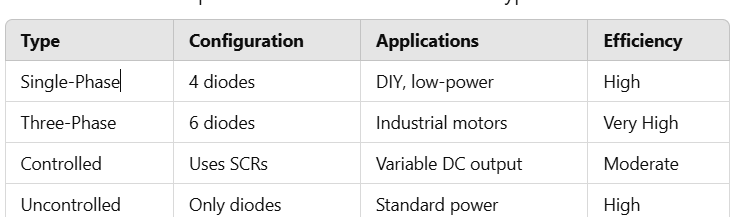
A bridge rectifier is an electrical circuit that converts AC (alternating current) into DC (direct current). This conversion is necessary because many electronic devices and circuits operate on DC power, while most power sources (like power lines) supply AC. The bridge rectifier uses four diodes arranged in a specific configuration to efficiently rectify the AC input and produce a smooth DC output.
The key components of a bridge rectifier are:
- Four diodes arranged in a bridge configuration.
- AC input, which provides the alternating current.
- DC output, which is the direct current produced by the rectifier.
Bridge rectifiers are particularly favored due to their ability to handle both positive and negative half-cycles of the AC input, making them more efficient than simpler single diode rectifiers.
How Does a Bridge Rectifier Work?
To understand the working principle of a bridge rectifier, it’s important to look at how it handles AC signals.
- AC Input: The AC power source delivers an alternating signal that fluctuates between positive and negative voltage.
- Diode Conducting Paths: The four diodes in the bridge rectifier are arranged such that during the positive half of the AC cycle, two diodes conduct current, and during the negative half, the other two diodes conduct.
- Conversion to DC: As the AC voltage alternates, the diodes always direct current in the same direction through the load, effectively smoothing out the fluctuating AC input into a unidirectional DC output.
Key Features of Bridge Rectifiers
Bridge rectifiers come with a range of features that make them valuable in various applications:
- Full-Wave Rectification: Unlike half-wave rectifiers that only use one half of the AC signal, bridge rectifiers use both halves, making them more efficient.
- Improved Efficiency: Due to the full-wave rectification, they provide higher output voltage and lower ripple compared to half-wave rectifiers.
- Compact Design: A bridge rectifier can be built using just four diodes, making it compact and cost-effective.
- Widely Available: Bridge rectifiers are commonly available and easy to integrate into electronic systems.
Applications of Bridge Rectifiers
Bridge rectifiers are used in a wide variety of applications, particularly where a steady DC supply is needed from an AC source. Some common applications include:
- Power Supplies: Most power supplies **use bridge rectifiers **to convert the AC from the mains into DC power that can be used by electronic devices.
- Battery Charging: When charging batteries, a stable DC current is required, and a bridge rectifier helps convert the AC power from the charger to DC.
- Signal Processing: In communication systems and other signal processing circuits, bridge rectifiers can be used to ensure the correct polarity of the DC voltage.
- Motors: DC motors rely on a consistent DC supply, and bridge rectifiers are commonly used in motor control circuits to ensure a stable voltage is applied to the motor.
Advantages of Bridge Rectifiers
- Higher Efficiency: By using both halves of the AC signal, bridge rectifiers provide more efficient power conversion.
- Compactness: Due to the simple arrangement of four diodes, bridge rectifiers are more compact and can easily fit into most electronic systems.
- Reliability: The design of bridge rectifiers makes them highly reliable, with minimal moving parts and a long lifespan.
- Cost-Effective: Bridge rectifiers are relatively inexpensive and offer an excellent price-to-performance ratio.
Fastron Electronics
Types of Bridge Rectifiers
Bridge rectifiers are available in various types to suit different needs:
- Standard Bridge Rectifiers: These are the most commonly used type and provide basic rectification in a wide range of applications.
- Fast Recovery Bridge Rectifiers: Designed for applications where speed is crucial, these rectifiers have diodes with faster recovery times, reducing switching losses.
- High Voltage Bridge Rectifiers: Used in applications that require high voltage rectification, these rectifiers are designed to handle higher input voltages.
- Low Current Bridge Rectifiers: Suitable for low-power applications, these rectifiers are often used in smaller electronic devices and systems.
How to Choose the Right Bridge Rectifier?
Choosing the correct bridge rectifier for your application depends on several factors:
- Voltage and Current Requirements: Ensure that the rectifier is rated to handle the voltage and current levels of your circuit.
- Ripple Factor: Some applications require low ripple in the DC output. Choose a rectifier that minimizes ripple if needed.
- Size and Form Factor: If you are working with limited space, consider the physical size and form factor of the rectifier.
- Speed and Recovery Time: In high-speed circuits, choose rectifiers that feature fast recovery times.
How to Connect a Bridge Rectifier
When connecting a bridge rectifier in a circuit, follow these general steps:
- Connect the AC Input: Attach the two AC input terminals to the AC power source.
- Connect the DC Output: The positive terminal of the rectifier goes to the positive terminal of your load, and the negative terminal goes to the negative terminal of the load.
- Ensure Proper Orientation: Make sure the diodes are oriented correctly within the bridge configuration to ensure proper rectification.
- Test the Output: Once connected, test the output with a multimeter to ensure that DC voltage is being produced and that there is minimal ripple.
Maintenance of Bridge Rectifiers
Bridge rectifiers are generally low-maintenance components, but like any other electronic component, they require occasional inspection:
- Check for Overheating: Ensure that the diodes are not overheating, as excessive heat can damage them.
- Check the Output: Use a multimeter to regularly check the output voltage and ensure it remains within the desired range.
- Inspect for Damage: Regularly inspect the diodes for any signs of physical damage or wear.
Conclusion
Bridge rectifiers are fundamental components in the field of power conversion, enabling efficient and reliable transformation of AC to DC power. Whether you’re powering devices, charging batteries, or controlling motors, a bridge rectifier can provide the stable DC output you need. With their simple design, high efficiency, and reliability, bridge rectifiers remain a vital part of modern electronic systems.
For more information on bridge rectifiers or other electronic components, you can contact Fastron Electronics.
Ph: 397635155 Mail Id: Sales@fastron.com.au Working Time: Monday to Friday 8.00am — 6.00 pm.
메타데이터
- post_id
- 4ec91be265eb
- slug
- understanding-bridge-rectifiers-and-their-importance-in-electronics-fastron-electronics-4ec91be265eb
- url
- https://medium.com/@jeenonzzmarinezi/understanding-bridge-rectifiers-and-their-importance-in-electronics-fastron-electronics-4ec91be265eb
- canonical_url
- https://medium.com/@jeenonzzmarinezi/understanding-bridge-rectifiers-and-their-importance-in-electronics-fastron-electronics-4ec91be265eb
- author_url
- https://medium.com/@jeenonzzmarinezi
- status
- ok
- fetched_at
- 2026-07-13 06:23:13