The Cancer Route Built for Urgency Is the Slowest One
The NHS has one 62-day cancer standard. But the route used for urgent GP referrals turns out to be the slowest one of all. This is the last…
The Cancer Route Built for Urgency Is the Slowest One
The NHS has one 62-day cancer standard. But the route used for urgent GP referrals turns out to be the slowest one of all. This is the last piece in a series on what the national average hides.
This is the third and final piece in a series that started with me getting lost in a hospital corridor.
In the first piece, I found that your chance of timely cancer treatment depends, in part, on which hospital trust your referral lands in. A 48-point gap between the best and worst.
In the second, I found it also depends on what kind of cancer you have. Skin cancer came close to the target. Gynaecological and head and neck cancers were closer to a coin flip.
At the end of that second piece, I admitted there was one more assumption I had not checked. Not everyone enters the cancer system the same way. Some are sent down the urgent route by a worried GP. Some are picked up by a consultant already treating them for something else. Some come through screening.
I assumed the route in did not matter much. The cancer is the cancer, however you arrive at it.
I was wrong about that too.
The same standard, four different doors
A reminder of what is being measured. From an urgent cancer referral to the start of first treatment, the NHS says no more than 62 days should pass, with 85% of patients treated inside that window.
That standard does not care how you were referred. The 62 days is the same whether your GP sent you, a consultant upgraded you, or a screening programme found something.
But the chance of being treated inside those 62 days is not the same at all.
I broke the national data down by referral route, across the same 18 months from October 2023 to March 2025.
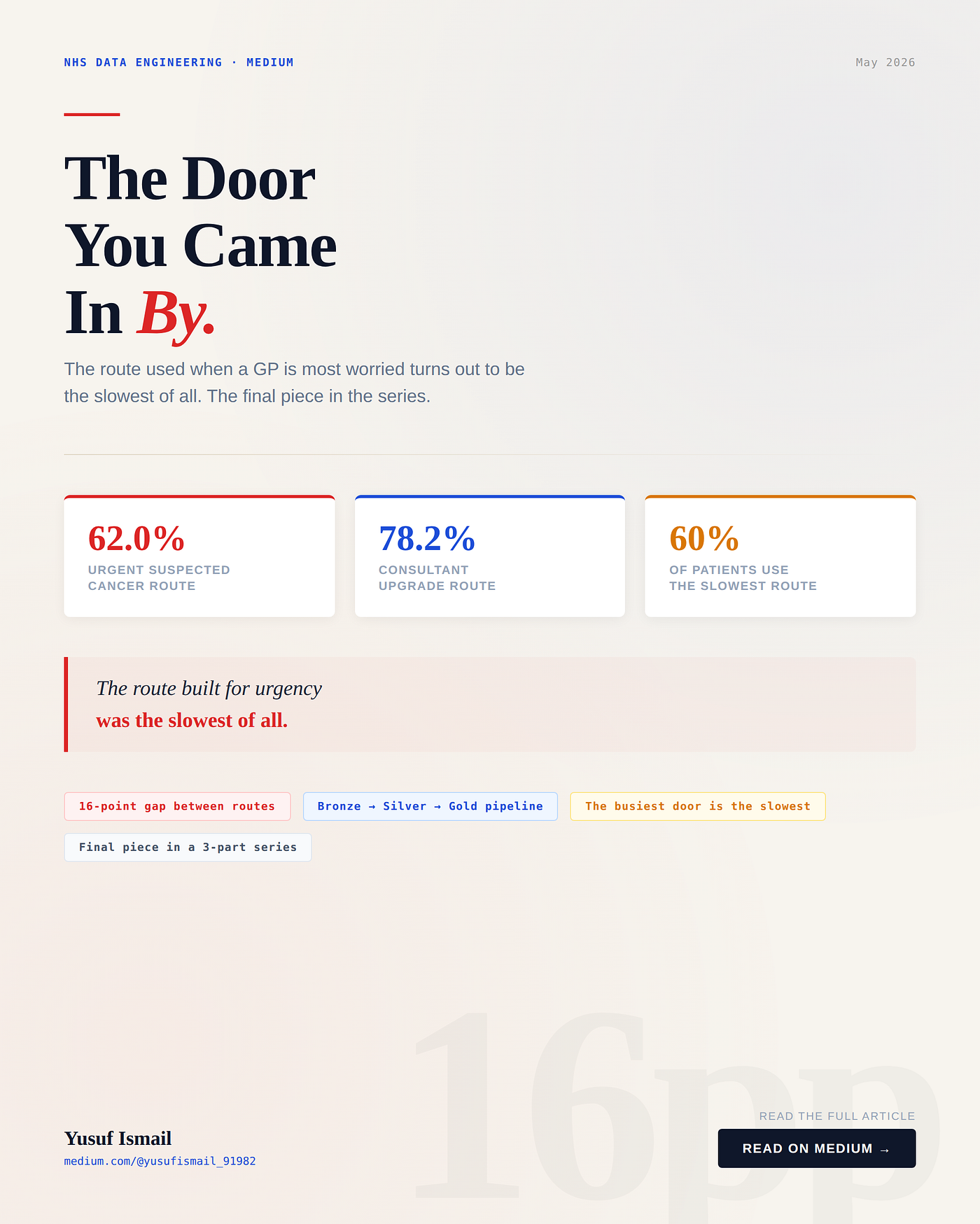
The Consultant Upgrade route, where a hospital doctor already seeing you spots a cancer and moves you onto the pathway, ran at 78.2%. The best of any route.
The Urgent Suspected Cancer route, the one used when a GP is worried enough to fast-track you, ran at 62.0%. The worst of any route.
That is a 16-point gap. And here is the part that stopped me.
The Urgent Suspected Cancer route is not some small side channel. It is the main front door. Around 60% of all the patients in this data came through it. The single biggest route into cancer treatment is also the slowest.
The route built for urgency is the one least able to deliver it.

62-day compliance by referral route
The obvious objection, and what it does not explain
There is a sharp objection to all of this, and I want to raise it myself before anyone else does, because it is partly right.
The routes are not really starting from the same line.
When a consultant upgrades a patient, that person is often already inside the hospital system. They have been seen, scanned, assessed for something else. Part of the journey towards diagnosis has already happened by the time the clock starts. So of course that route looks faster. It had a head start.
Screening works in a similar way. Screening programmes are organised, scheduled, and built with their own capacity. They are designed to move people through smoothly.
The Urgent Suspected Cancer route, by contrast, starts cold. A GP sees a patient, becomes worried, and refers them in from outside the hospital entirely. Everything that follows- the first appointment, the scans, the biopsy, the decision to treat, all of it has to happen after the clock has already started.
So some of this gap is structural. It is not proof that one route is treated with less care. It is partly that the routes measure different things from different starting points.
But here is what the head-start argument does not explain.
The Urgent Suspected Cancer route is still the route most patients use. It is still the route designed for cases worrying enough for urgent GP referral. And on that route alone, around 293,000 patients started treatment across the period, with more than 111,000 waiting longer than 62 days.
That figure is worth pausing on. In my first piece, the national breach count across the whole standard was 111,280. It turns out almost all of that national failure sits on this one route. The headline number for the entire 62-day standard is, more or less, the story of its busiest door.
You can explain why the urgent route starts further back. You cannot explain away the fact that the system knows this is the main front door, knows it starts cold, knows it carries the largest volume, and still has not built enough capacity around it.
A head start for one route is not the same as a fair race for the others.
What the data cannot tell me
The same honesty applies here as in the first two pieces.
The data does not tell me why the urgent route runs slowest. It does not show me how long each stage of the pathway took, where the bottlenecks sit, how many patients needed complex diagnostics, or how referral demand changed month to month.
It does not tell me whether a particular patient’s delay was avoidable or clinically reasonable.
So this is not a claim that GPs refer badly, or that the urgent route is staffed with less care. It is not a claim that consultant upgrades are gaming the figures. The structural head start is real, and I have tried to give it its due.
What the data does show is simple, and it is the thing I keep returning to. The route most cancer patients use, the one chosen when a doctor is most worried, is the one least likely to treat them on time.
What I am left holding, after all three
I went into that hospital corridor with a single question: what happens to the person with cancer?
Three pieces later, I have an answer, and it is not one clean number.
It depends on where you are treated. The best trust hit 87%, the worst 39%.
It depends on what you are treated for. Skin cancer came close to the target; gynaecological and head and neck cancers were much closer to a coin flip.
And it depends on how you came in. The urgent route, the busiest route, was the slowest of all.
None of these is the whole story on its own. But together, they show what the national average hides. There is one 62-day cancer standard, written to mean the same thing for everyone. Underneath it, your odds shift by postcode, tumour type, and the door you came in by.
The standard treats every cancer patient as equal.
The data shows the system does not.
That is not where I expected the project to end. I started this looking for a parking machine. I am ending it convinced that the national average, the one number that makes the headlines, is the least interesting thing in this entire dataset.
The real story was never the average.
It was always what the average hides.
This analysis covers NHS England Cancer Waiting Times monthly statistics from October 2023 to March 2025, eighteen months of provider-level data, filtered to the post-October 2023 standards framework for clean comparability. Routes are compared on the all-cancers, all-modalities national view. Referral routes have different structural starting points, which I have discussed in the piece. The full pipeline was built in Python and Parquet using a Bronze, Silver, Gold structure, and all analysis code is on GitHub.
GitHub: github.com/YusufIsmailayo
This is the final piece in my NHS cancer waiting times series. Part one looked at the hospital lottery. Part two looked at the cancer-type divide. This one looked at the door you came in by.
메타데이터
- post_id
- 4ec929091da4
- slug
- the-cancer-route-built-for-urgency-is-the-slowest-one-4ec929091da4
- url
- https://medium.com/@yusufismail_91982/the-cancer-route-built-for-urgency-is-the-slowest-one-4ec929091da4
- canonical_url
- https://medium.com/@yusufismail_91982/the-cancer-route-built-for-urgency-is-the-slowest-one-4ec929091da4
- author_url
- https://medium.com/@yusufismail_91982
- status
- ok
- fetched_at
- 2026-06-09 15:37:30