How to Destroy Speed, Reliability, and Scalability in IT Teams All at Once
At first glance, the desire to build a “universal” product development team capable of doing everything is not just understandable — it…
How to Destroy Speed, Reliability, and Scalability in IT Teams All at Once
At first glance, the desire to build a “universal” product development team capable of doing everything is not just understandable — it looks like the gold standard of efficiency and business genius.
This ambition is rooted in three key, yet often flawed, beliefs:
-
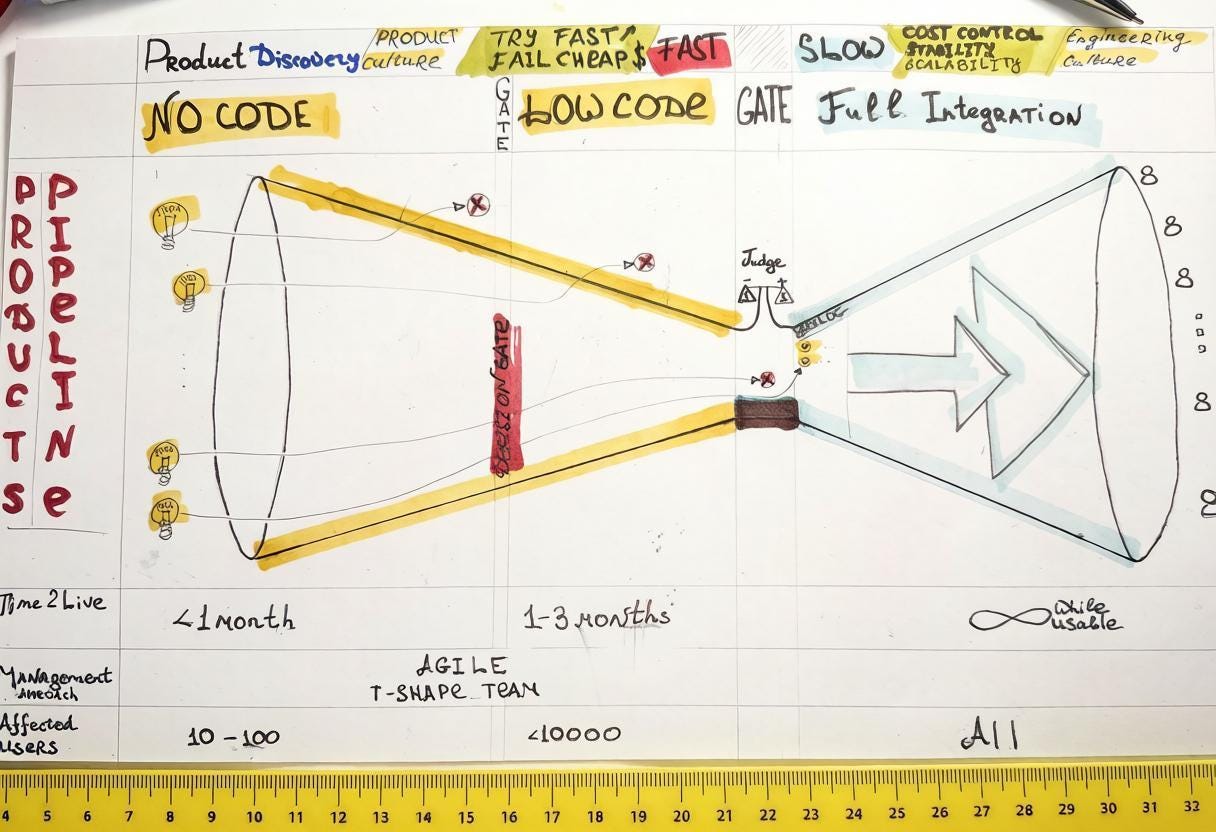
The Myth of the Perfect “Factory-in-a-Box” Management dreams of self-managed, self-sufficient units — “factory teams.” In this ideal world, such a team generates an idea, rapidly prototypes it, then professionally scales and supports it 24/7 in record time. This creates the illusion of direct control and simplified management: one stakeholder, one backlog, one point of responsibility, one team. Executives don’t have to strain themselves; everything works “out of the box,” as if by magic.
-
The Fetishization of “Agility” at the Expense of Specialization In an era where “speed is the new core competency,” the hybrid approach looks like a panacea. The logic is simple: “If a team can do everything, it can instantly pivot to any circumstance.” No need to restructure, hire new people, or change processes — just give the team a new task. This is perceived as the ultimate adaptability to business reality. Companies fear becoming “rigid,” and the hybrid model seems like the antidote to bureaucratic stagnation.
-
Avoiding the Transaction Costs of Handover Deepest of all is the desire to avoid the painful, yet natural and necessary, phase of handing a product off between stages of its lifecycle. When a research “startup” team hands off their work to an engineering “enterprise” team, inevitable friction arises: loss of context, code rewrites, and conflicting visions. Management thinks, “What if we just don’t hand it off at all?” The illusion is that these costs will simply disappear. In reality, they aren’t eliminated; they are internalized within the hybrid team, metastasizing into perpetual internal conflict, cognitive overload, and an invisible slowdown across all fronts.
The hybrid approach to team organization (not project management) is popular for a reason — it allows companies to pretend they are simultaneously a startup and an enterprise, promising everything at once without complex organizational changes or the need to make unpleasant top-down decisions. In practice, it simply pushes those painful decisions down to each individual team. The perfect compromise between speed and reliability? In theory — yes. But let’s come back down to earth. Behind the glossy façade lies systemic chaos: the hybrid has no clear purpose, yet it guarantees a chronic war of priorities, burnout of top engineers, an absence of product/technology culture, and technical debt as a way of life. Spoiler alert: It loses on every front, except one — it creates the illusion of productivity and endless opportunities for internal negotiations, shifting all necessary decisions from the management level down to the team level, or even to each individual executor (e.g., the Feature Leader).
Comparative Analysis: Startup vs. Hybrid vs. Enterprise
The table below clearly demonstrates the profound differences in organizational culture and technical approach across the three models.
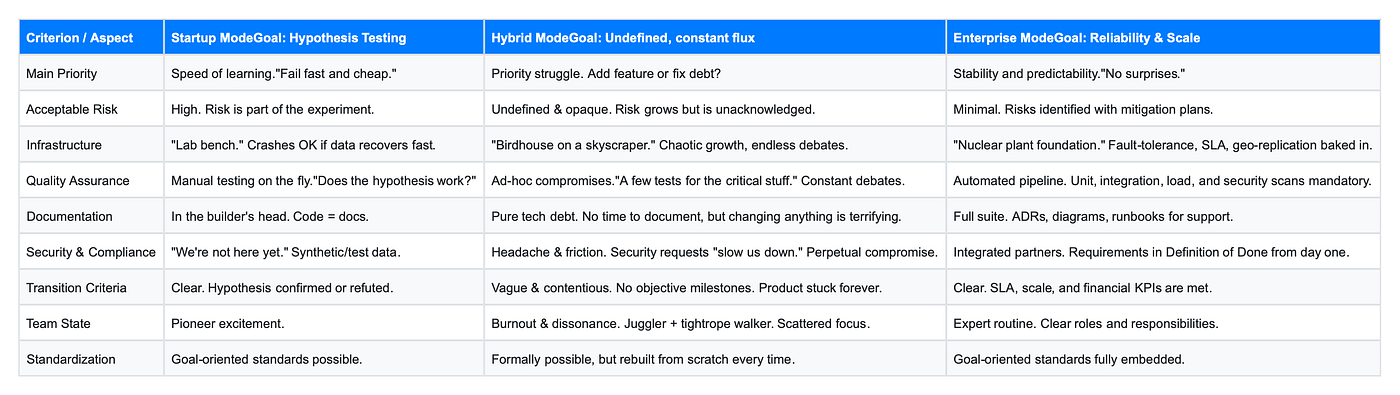
Even a cursory glance reveals just how wildly divergent the product (startup) and industrial/enterprise approaches are — and how the hybrid becomes catastrophically overloaded with contradictory decisions, depriving the organization of both speed and reliability.
The Hidden Costs and Consequences of the Hybrid Approach
The hybrid approach is like an iceberg: the visible tip is a single team doing “everything.” But beneath the surface lies a massive mass of unforeseen costs that are rarely accounted for and are invisible to management/leaders.
1. Business & Strategic Risks (The Most Dangerous)
- Slower Time-to-Market: Ironically, the pursuit of speed through a hybrid model produces the opposite result. Constantly having to “pump the brakes” to ensure stability causes the average delivery velocity to plummet. The company loses to real startups in terms of speed.
- Reputational & Revenue Risk: One major incident caused by “experimental” code in production can not only lead to direct losses but also erode the trust of key clients, directly impacting the company’s proven, profitable products. The hybrid blurs the lines of responsibility for this risk.
- Blocking Real Innovation: The hybrid creates an illusion of innovative activity. The company spends resources on “fast experiments” that are actually just minor tweaks to existing features or — worse — accumulate debt. Meanwhile, there are no free resources or a clear mandate for the risky, breakthrough research that requires true isolation from operations.
- Talent Scarcity & Rising Salaries: The market for “universal soldiers” is extremely limited. Finding, hiring, and retaining them is prohibitively expensive. The company overpays (in time, money, and missed opportunities) searching for this unicorn, when it could have already started working on new ideas with two top-tier specialists — a researcher and an engineer.
2. Human & Organizational Costs (The Most Expensive)
- Chronic Context-Switching Syndrome: Constantly toggling between the mental models of a “garage inventor” and a “nuclear power plant engineer” causes severe cognitive overload. The brain fails to keep up, leading to errors, fatigue, and a decline in decision quality across both domains.
- “Universalist” Burnout: These employees are gold, but their motivation rapidly depletes because they take the heat for everything. They feel perpetually guilty — for slow progress (in the eyes of the business) and for cutting corners (in their own eyes and those of specialized colleagues). High turnover of such talent is a direct consequence.
- Double Jeopardy in Incentive Systems (KPI/OKR Schizophrenia): How do you measure a hybrid team’s success? By the number of validated hypotheses, or by uptime and incident counts? Trying to combine these metrics leads to a situation where the team is punished for bothinsufficient speed and insufficient stability. The result is gaming the metrics and internal politics, rather than value creation.
- The “Tyranny of the Urgent”: Operational incidents and routine support will always be more urgent and louder than long-term improvements or risky experiments. Consequently, the hybrid team effectively becomes a firefighting squad, gradually losing its innovative capacity. The “fast” part of the hybrid dies off first.
- Product Discovery Degradation: Discovery degrades into validating ideas solely through coding, skipping crucial research phases, calculations, and systematic synthesis of insights for future solutions. It is simply easier to generate a flood of ideas and wait for the team to digest them.
3. Technical & Operational Costs
- Technical Debt as a Way of Life: In “hypothesis testing” mode, writing quick and dirty code is acceptable. But when that same code is immediately scaled and supported 24/7, the debt becomes systemic and critical. Refactoring it now costs 10 times more and blocks future development. With such poor quality, teams spend 40% to 80% of their time reworking old functionality just to stabilize it.
- Frankenstein’s Infrastructure Monster: The product is built on a random assortment of tools — some from the rapid prototype (e.g., SQLite and Python scripts), some added for reliability (Kubernetes, complex monitoring). The result is a monster with weak links that defies standard support and analysis.
- The “Blind Spot” Effect in Monitoring: You cannot effectively monitor a system that was never designed for it. The team spends massive effort patching holes in observability instead of extracting valuable insights. Incidents are detected late and investigated painfully slowly.
- The Chronophage: “Invisible” Coordination: A huge chunk of work goes not towards building features, but towards endless internal and cross-team negotiations to find a convoluted balance. And the worst part? These negotiations directly feed the “tech debt piggy bank” — along with countless quiet meetings, chat threads, and doom-scrolling that never make it into Jira.
The Bottom Line: The advantages of the hybrid are a mirage that leads to total slowdown, employee burnout, the accumulation of irremovable debt, and strategic paralysis. The company pays not just with money, but with its future effectiveness, innovative potential, and the psychological safety of its employees. This price almost always exceeds the imaginary “savings” from not splitting teams and processes.
The Crucial Missing Piece: Systemic “Firmware”
This approach ignores the fundamental law of specialization (or division of labor) and only amplifies cognitive dissonance. Attempting to create a universalist team inevitably leads to creating a team of compromise, where depth of expertise is sacrificed for breadth of coverage. The team ceases to be brilliant at one thing and becomes mediocre at everything, spending the lion’s share of its energy not on creating value, but on internal struggles with conflicting requirements. You simply cannot be a genius of rapid prototyping while simultaneously designing complex, hyper-scalable machinery for 1,000,000 RPS (Requests per Second).
Even if we manage to work a miracle and shift the mindset of everyone involved — from top management to the rank-and-file engineer — from a confrontational stance to a collaborative (win-win) one, the fundamental problems of the management system won’t disappear. Changing mindsets is a necessary but insufficient condition. Goodwill and mutual understanding shatter against daily routine unless an interaction architecture is explicitly built for them.
We need explicit, codified, company-supported new “coupling” processes that institutionalize collaboration, define clear boundaries, and set the conditions for crossing them. Processes that honestly answer these critical questions:
- How do we organize experiments safely and quickly from a legal perspective?
- What trade-offs are we willing to make in pursuit of validating an idea, and which are absolutely off-limits?
- What infrastructure should be used?
- How intensive can the load on the core system be?
- When do we hand off a validated hypothesis for implementation into the main revenue-generating system?
- Which projects should follow a product-centric approach, and which should follow the classic model from day one (e.g., finance and legal reporting to government bodies must be delivered completely and on time — there is no room for code-based research there)?
- etc…
Without this organizational “firmware” — without formal yet flexible rules of engagement — two opposing cultures (Speed and Reliability) cannot coexist within a single company. They will continue to collide on projects, draining team energy in endless situational alignments and masking systemic dilemmas as personal disagreements.
Furthermore, you must also build the infrastructure that allows teams to leverage enterprise data and APIs safely, ensuring the security and revenue of the core business.
Conclusion: A Symptom of Organizational Laziness
Thus, for large companies, the hybrid approach is not a strategic choice — it is often a symptom of organizational laziness: the desire to have it all and have it now, offloading all responsibility onto the Agile team while avoiding the difficult, mature decisions required to build systemic workflows. The company buys into the slick slogan “agile, fast, and stable,” failing to see that in the long term, it is losing everything at once.
The apparent “simplicity” and operational efficiency (one team for everything) transforms into massive hidden costs, deceleration, and unacceptable risks. Until large companies recognize that different stages of a product’s lifecycle require distinct cultures, processes, and often separate teams, they will continue to pay a heavy price for the internal war between two opposing realities. Because, according to the Theory of Constraints, the management system itself is the primary limiting factor.
Disclaimer
Everything described above applies to large corporations with established organizational structures and numerous teams. For startups and growth-stage companies, the hybrid approach may not be a problem but the only possible reality. The operational load is much lower, there is no stable income stream to protect, and incidents are far less destructive. Since they lack the resources for division, hybridity is not a pathology but an evolutionary stage — especially given the minimal number of teams (as opposed to 20, 50, or 200 teams). Additionally, a hybrid model can be justified when the business model is still solidifying, or when clients do not yet demand high reliability and product perfection.
About the Author (Alexey V. G.)
This research is based on consultations with over 10 leaders from various product teams in large enterprises and incorporates the author’s hands-on experience with complex legacy system transitions (lasting over 10 months) and large-scale program management (involving 50+ specialists), including one project focused on industrializing the research outputs of scientists from Moscow State University (MSU).
The author’s theoretical and practical background includes the Theory of Constraints, Project Management (PMP), hybrid project methodologies, Regular Management principles, and startup management as a co-founder.
메타데이터
- post_id
- 4ec997fa0e5d
- slug
- how-to-destroy-speed-reliability-and-scalability-in-it-teams-all-at-once-4ec997fa0e5d
- url
- https://medium.com/@avgrudin_14459/how-to-destroy-speed-reliability-and-scalability-in-it-teams-all-at-once-4ec997fa0e5d
- canonical_url
- https://medium.com/@avgrudin_14459/how-to-destroy-speed-reliability-and-scalability-in-it-teams-all-at-once-4ec997fa0e5d
- author_url
- https://medium.com/@avgrudin_14459
- status
- ok
- fetched_at
- 2026-07-28 00:11:24