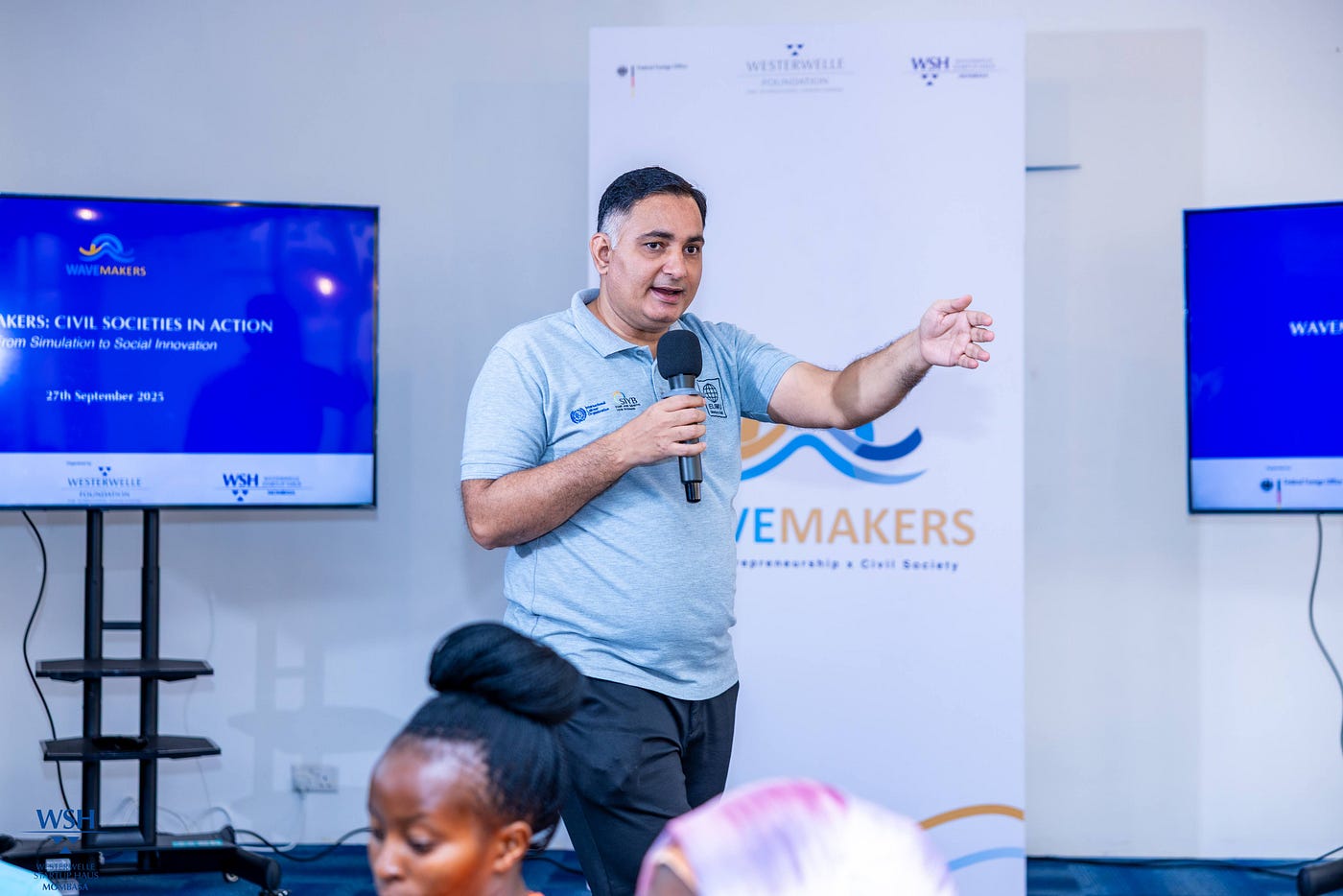
The Lamu Mega-Refinery: The Opportunity Is Coming — Will You Be Ready?
A Motivational Address to the Entrepreneurs of Kenya and Africa
The Lamu Mega-Refinery: The Opportunity Is Coming — Will You Be Ready?

Yashpal Sihag — ILO SIYB Master Trainer
A Motivational Address to the Entrepreneurs of Kenya and Africa
By Yashpal Sihag ILO/SIYB Master Trainer
Ladies and gentlemen, entrepreneurs, professionals, farmers, young people, innovators and builders of Africa’s future:
Let us begin with one important idea.
A great project can be built in your country without building your future.
A new port can open, a new highway can pass through your county, a new factory can rise near your town and billions of dollars can be invested around you — yet you can remain exactly where you were before.
Why?
Because opportunity does not reward the person who is merely nearby.
Opportunity rewards the person who is prepared.
Today, Africa may be standing before one of those rare moments when preparation, courage, planning and enterprise can come together.
The proposed mega-refinery in Lamu, Kenya, is not merely an oil project.
It could become a new industrial centre.
It could become a regional supply chain.
It could become a marketplace serving several African countries.
It could become a source of employment, contracts, professional services, digital innovation and business growth.
But most importantly, it could become one of Africa’s biggest business classrooms.
The refinery may teach us a lesson that every entrepreneur must eventually learn:
A large opportunity does not automatically create a successful business. It only creates the possibility of one.
What happens next depends on preparation.
Africa Must Move from Potential to Production
For many decades, Africa has exported raw materials and imported finished products.
We export what is beneath our soil.
We import what has been processed from it.
We export crude oil.
We import petrol, diesel, aviation fuel, lubricants, plastics and industrial products.
We export agricultural produce.
We import packaged foods.
We export minerals.
We import machines, equipment and manufactured goods.
And then we ask why other economies have accumulated more industries, more technology, more skilled employment and more wealth.
The answer is not difficult.
The greatest value is often created after the raw material has left our hands.
The proposed Lamu refinery represents an opportunity to change that story.
Dangote Industries has proposed establishing a refinery in Lamu with the capacity to process approximately 700,000 barrels of crude oil per day.
Think about that figure.
Seven hundred thousand barrels represent approximately 111 million litres of crude-processing capacity every day.
At 90 per cent utilisation, the refinery could process around 630,000 barrels, or close to 100 million litres, daily.
The proposed investment has been discussed in the range of US$17 billion to more than US$20 billion.
That is approximately KSh2.2 trillion to KSh2.6 trillion.
Construction could take roughly 30 months to three years after approvals, financing and final investment commitments are secured.
These are not small numbers.
These are nation-shaping numbers.
But remember this:
A trillion-shilling project may pass through your economy without leaving one shilling in your business — unless you are prepared to participate.
The refinery itself may be built with steel, tanks, pipelines and machinery.
The surrounding economy, however, will be built through thousands of transactions.
Someone will transport the workers.
Someone will feed them.
Someone will supply their uniforms.
Someone will maintain the vehicles.
Someone will provide accommodation.
Someone will install security systems.
Someone will recruit employees.
Someone will keep the records.
Someone will train the staff.
Someone will manage the waste.
Someone will build the software.
Someone will supply the spare parts.
Someone will get that business.
The question is not whether somebody will benefit.
The question is whether African entrepreneurs will be ready to become that somebody.
Sixty Thousand Opportunities Begin with Individual Preparation
The Kenyan government has suggested that the refinery could support approximately 60,000 employment opportunities.
It could also supply petroleum products to a regional market that may include:
- Kenya
- Ethiopia
- South Sudan
- Uganda
- Tanzania
- Rwanda
- Burundi
- The Democratic Republic of Congo
Sixty thousand opportunities sound impressive.
But let us remember that projections do not build careers.
Preparation builds careers.
A young person may hear “60,000 jobs” and wait to submit an application.
An entrepreneur hears “60,000 workers” and begins asking better questions.
Where will they live?
What will they eat?
How will they travel?
Who will wash their uniforms?
Where will they receive healthcare?
Who will repair their phones?
Who will supply office materials?
Who will provide safety equipment?
Who will train subcontractors?
Who will manage accommodation?
Who will deliver food and water?
This is one of the great differences between an employee’s view and an entrepreneur’s view.
The employee sees a job.
The entrepreneur sees a problem that needs to be solved.
And wherever a real problem meets a prepared problem-solver, a business opportunity is born.
The Refinery Is Not One Opportunity
Many people hear the words “oil refinery” and immediately decide that the opportunity belongs to petroleum engineers, multinational companies and people who own ships.
But that is like seeing a hospital under construction and concluding that only surgeons will earn money from it.
A hospital requires doctors, but it also requires food, cleaning, transport, laundry, technology, furniture, security, waste management and administration.
A refinery operates in the same way.
The main industrial project sits at the centre.
Around it grows an ecosystem of suppliers, contractors, workers, service providers and consumers.
A project of this scale may require:
- Food and catering
- Drinking water
- Accommodation
- Construction materials
- Uniforms
- Personal protective equipment
- Transportation
- Warehousing
- Communication services
- Equipment maintenance
- Vehicle servicing
- Cleaning
- Security
- Recruitment
- Accounting
- Legal services
- Insurance
- Training
- Technology
- Waste management
- Environmental services
- Health and emergency support
Do not make the mistake of saying, “I am not in the oil business.”
You may not need to be in the oil business.
You may need to be in the business of serving the oil business.
That is where many entrepreneurs will find their opportunity.
Small Spending Can Create a Large Local Economy
Let us consider a simple illustration.
Suppose only 10,000 workers and contractors are active around the project during one phase of construction.
Suppose each person spends an average of KSh500 per working day on meals, transportation, communication, household needs and personal services.
Over 300 working days, that would create approximately:
KSh1.5 Billion in Local Consumer Expenditure
This is not an official project forecast.
It is an illustration of how a large workforce creates a secondary economy.
The worker receives income.
The worker buys food.
The food vendor buys vegetables.
The farmer buys seeds.
The transport operator purchases fuel.
The mechanic repairs the vehicle.
The spare-parts dealer restocks the shop.
The landlord improves accommodation.
The furniture maker produces beds and tables.
Money begins moving.
And when money moves through local businesses, communities grow.
Now consider project procurement.
Suppose African SMEs capture only 1 per cent of procurement from a US$17 billion project.
That would represent approximately:
US$170 Million in Business Opportunities
If they captured 3 per cent, the figure would rise to approximately:
US$510 Million
Now here is the important lesson:
Do not complain that small businesses receive only a small percentage until you have prepared your business to capture that percentage.
One per cent of a very large opportunity can transform thousands of enterprises.
The challenge is not simply that opportunities are unavailable.
The challenge is that too many businesses are not yet ready to meet the required standards.
Microentrepreneurs Must Not Underestimate Their Place
You may operate a very small business.
You may sell food.
You may repair clothes.
You may run a motorcycle.
You may offer laundry services.
You may manage a small guesthouse.
You may sell fish, vegetables or household supplies.
Do not disqualify yourself too early.
Every large development creates daily human needs.
Micro and informal entrepreneurs could find opportunities in:
- Prepared meals
- Mobile catering
- Drinking-water distribution
- Laundry and garment repair
- Motorcycle transport
- Vehicle washing
- Phone accessories and repairs
- Hairdressing and barbering
- Temporary accommodation
- Furniture and bedding
- Childcare
- Agricultural produce
- Fish and seafood
- Household products
- Recycling
- Cleaning
- Small equipment repair
A woman running a food enterprise may never enter the technical section of the refinery.
But she may feed the people who build it.
A young entrepreneur may never own an oil tanker.
But he may repair the tyres of vehicles that serve the contractors.
You do not have to own the biggest business.
You must solve a real problem consistently.
Start where you are.
Use what you have.
Improve what you do.
Build your reputation.
Then prepare to grow.
A small business becomes valuable when it becomes dependable.
Established SMEs Must Become Contract-Ready
For established small and medium enterprises, the opportunity could be even greater.
Potential areas may include:
- Civil works
- Construction support
- Hardware distribution
- Cement and aggregate supply
- Staff transportation
- Fleet management
- Warehousing
- Inventory control
- Protective equipment
- Industrial cleaning
- Mechanical maintenance
- Electrical maintenance
- Equipment leasing
- Security systems
- Recruitment
- Catering contracts
- Accommodation management
- Occupational health and safety
- Emergency services
- Customs clearing
- Freight forwarding
- Vehicle servicing
- Waste treatment
But let us be honest.
A company does not become ready for an industrial contract because it printed a beautiful brochure.
A business does not become capable because it opened a social media page.
And a person does not become a supplier simply by calling himself a supplier.
Industrial buyers will ask serious questions.
Is your business registered?
Are your taxes compliant?
Can you submit a professional quotation?
Do you understand your costs?
Can you meet the required quality?
Can you deliver on time?
Do you have enough working capital?
Can you keep proper records?
Do your workers understand safety?
Do you have insurance?
Can you survive delayed payments?
Can you prove that you have delivered similar work before?
These are the questions that separate interest from readiness.
Many people will be interested.
Fewer will be prepared.
And it is usually the prepared group that receives the contracts.
A Small Business Can Enter Through Partnership
Do not believe that you must win the largest contract directly.
A small business can participate as:
- A subcontractor
- A local distributor
- A service provider
- A second-tier supplier
- A third-tier supplier
- A logistics partner
- A consortium member
- A community-based supplier
Several SMEs can come together.
One may have equipment.
Another may have technical staff.
Another may have local networks.
Another may have financial capacity.
Another may have compliance systems.
Together, they may qualify for work that none could perform alone.
Sometimes growth does not require you to become bigger immediately.
Sometimes it requires you to become better connected.
The future will not belong only to the strongest individual business.
It may belong to businesses that know how to cooperate, specialise and form reliable partnerships.
Professionals Must Prepare for a Service Economy
A refinery is not operated only by machines.
It is operated through decisions, contracts, systems, regulations, procedures and human competence.
This could create demand for:
- Engineers
- Environmental consultants
- Lawyers
- Accountants
- Tax advisers
- Safety trainers
- Insurance professionals
- Risk advisers
- Project managers
- Human-resource consultants
- Procurement specialists
- Translators
- Community-engagement experts
- Data analysts
- Cybersecurity professionals
- Entrepreneurship trainers
- Business-development service providers
Steel may build the physical refinery.
Knowledge will help operate it.
Every major industrial project requires professionals who can help organisations manage people, information, risk and compliance.
Professionals should therefore begin asking:
What specialised service can I provide?
Which certification do I need?
What industry standard should I understand?
Which firms should I begin engaging?
What evidence of competence can I build now?
Do not wait for the project to begin before developing the skills the project may require.
By then, somebody else may already be prepared.
Digital Entrepreneurs Must See the Hidden Infrastructure
Young people often imagine industrialisation as a story of pipes, trucks, concrete and heavy machinery.
But modern industries also depend on digital systems.
The proposed refinery economy could require:
- Fleet-tracking software
- Digital procurement systems
- Worker-management platforms
- Digital identity systems
- Online accommodation booking
- Delivery platforms
- Equipment-monitoring technology
- Drone inspection
- Digital mapping
- Inventory software
- Safety-reporting applications
- Business directories
- Cybersecurity
- Data protection
- Online training
- Digital certification
- Payment systems
- Business-management applications
The young entrepreneur with coding skills may be as valuable as the person supplying physical equipment.
Remember:
Every time a business asks, “How do we track this?” there may be a digital opportunity.
Every time a company asks, “How do we automate this?” there may be a digital opportunity.
Every time a contractor asks, “How do we monitor this?” there may be a digital opportunity.
Every time a customer asks, “How do we make this faster?” there may be a digital opportunity.
Industrial development and digital development are no longer separate.
The machines may be physical.
But the systems controlling them are increasingly digital.
Farmers Must Prepare Before Demand Arrives
Some farmers may hear about a refinery and say, “This has nothing to do with agriculture.”
But it has everything to do with agriculture.
Workers must eat.
Hotels need food.
Caterers need supplies.
Retail shops need products.
A growing population creates demand.
Agriculture also depends on fuel, transportation, storage, refrigeration, machinery and packaging.
The construction and operation of a large industrial project could increase demand for:
- Vegetables
- Grains
- Poultry
- Meat
- Fish
- Fruits
- Dairy products
- Processed foods
- Drinking water
- Catering supplies
But farmers must not wait until the workers arrive before preparing.
Preparation may require:
- Studying expected demand
- Organising producer groups
- Improving quality
- Meeting food-safety standards
- Standardising packaging
- Establishing transport systems
- Improving storage
- Keeping production records
- Building relationships with caterers and hotels
- Learning how to supply consistently
The opportunity is not merely to grow more.
The opportunity is to supply reliably.
A customer may forgive a small farmer for being small.
The customer may not forgive a supplier for being unreliable.
Development Must Protect Lamu’s Heritage and Environment
Let us also recognise an important responsibility.
Lamu is not an empty industrial space.
It is a place of culture, history, tourism, fishing, mangroves, marine ecosystems and traditional livelihoods.
Development must not destroy the very community it is meant to improve.
A refinery that creates industrial jobs while destroying fisheries, heritage and tourism would not represent complete progress.
True development must create value without carelessly destroying existing value.
That means protecting:
- Mangroves
- Fishing grounds
- Marine ecosystems
- Coastal communities
- Cultural heritage
- Tourism assets
- Community health
- Land rights
Responsible development will require:
- Emissions monitoring
- Oil-spill preparedness
- Community consultation
- Fair compensation
- Local hiring
- Environmental reporting
- Responsible land use
- Investment in the blue economy
- Protection of tourism and cultural assets
Lamu should not be forced to choose between prosperity and preservation.
Good planning should make both possible.
Growth without responsibility creates tomorrow’s problems.
Responsibility without growth preserves today’s limitations.
The challenge is to build a model that combines progress with protection.
African Governments Deserve Recognition — and Carry Responsibility
African governments are often criticised.
Sometimes the criticism is justified.
But we should also recognise leadership when governments pursue industrialisation, regional trade, infrastructure and value addition.
The proposed refinery connects with a much larger African vision.
It connects with:
- Lamu Port
- The LAPSSET Corridor
- Regional highways
- Railways
- Pipelines
- Industrial zones
- The African Continental Free Trade Area
- Agenda 2063
- East African energy security
A refinery of this scale cannot depend on one market alone.
It may require:
- Regional crude supplies
- Cross-border transport agreements
- Harmonised standards
- Predictable trade rules
- Efficient customs systems
- Shared infrastructure
- Stable investment policies
- Regional security cooperation
Africa’s greatest advantage is not only the resources beneath its soil.
It is the size of its combined market.
The governments of Kenya and other African countries deserve appreciation for moving towards greater value addition and regional cooperation.
But appreciation must be accompanied by responsibility.
Governments must ensure:
- Transparent agreements
- Environmental protection
- Fair procurement
- Local participation
- Skills development
- Community consultation
- Predictable regulations
- Infrastructure coordination
- Protection against corruption
- Opportunities for qualified SMEs
The project must not only be located in Africa.
Its benefits must be rooted in Africa.
Entrepreneurs Must Become Ready Before the Opportunity Arrives
African entrepreneurs deserve enormous respect.
They build businesses under difficult conditions.
They deal with:
- Expensive credit
- Currency fluctuations
- Unreliable logistics
- Fuel shortages
- Delayed payments
- Weak infrastructure
- Informal competition
- Unpredictable regulations
- Customers demanding high quality at very low prices
And still, they continue.
They continue because enterprise is not merely about convenience.
Enterprise is about determination.
But determination without management creates exhaustion.
Hard work without costing creates losses.
Sales without records create confusion.
Growth without planning creates crisis.
This is why entrepreneurs must become contract-ready.
They must improve:
- Registration
- Tax compliance
- Financial records
- Costing
- Quality systems
- Safety procedures
- Staff skills
- Working capital
- Banking relationships
- Contract management
- Procurement documentation
- Delivery reliability
Do not wait for the tender before organising the business.
Do not wait for the customer before calculating your costs.
Do not wait for the inspection before introducing standards.
Do not wait for the crisis before managing your cash flow.
Preparation is less expensive than failure.
This Is Where SIYB Training Becomes Crucial
As an ILO/SIYB Master Trainer, I appeal to entrepreneurs across Kenya and Africa:
Do not wait for the refinery to be completed before preparing for its opportunities.
The Start and Improve Your Business programme provides a practical pathway through four interconnected stages:
- Generate Your Business Idea
- Start Your Business
- Improve Your Business
- Expand Your Business
These are not merely training titles.
They represent the journey of an entrepreneur.
First, you identify an opportunity.
Then, you test and plan it.
Next, you improve the systems.
Finally, you prepare for growth.
Generate Your Business Idea: Look Before You Leap
The first task is not to rush into business.
The first task is to understand the opportunity.
Entrepreneurs should map the refinery value chain and ask:
- Who will come to Lamu?
- What will contractors buy?
- Which services are missing?
- What will workers need every day?
- Which products currently come from far away?
- Which opportunities will continue after construction?
- Who will pay?
- What standards will be required?
- Who are the competitors?
- What problem can I solve better?
Do not copy a business simply because somebody else appears successful.
Their opportunity may not be your opportunity.
Their strengths may not be your strengths.
Their customers may not be your customers.
A good business idea must connect three things:
- A real need
- A paying customer
- Your ability to deliver value
An idea becomes a business opportunity only when somebody is willing and able to pay for the solution.
Start Your Business: Convert Excitement into a Plan
After identifying an opportunity, prepare a business plan.
Excitement is useful.
But excitement cannot calculate cash flow.
Motivation can help you begin.
But only planning can help you continue.
A refinery-related business must examine:
- Market demand
- Customers
- Competition
- Pricing
- Staffing
- Equipment
- Purchasing
- Operating costs
- Capital requirements
- Cash flow
- Risk
- Profitability
Consider a transport entrepreneur.
Before buying or leasing a vehicle, the entrepreneur must calculate:
- Acquisition costs
- Fuel
- Maintenance
- Insurance
- Driver wages
- Expected trips
- Payment delays
- Breakdown risks
- Regulatory costs
- Monthly cash requirements
- Profit margins
A contract that cannot be financed may become a burden.
Winning the work but lacking the money to perform it is not success.
It is a well-dressed financial emergency.
Improve Your Business: Build Systems That Produce Results
Existing entrepreneurs must improve their:
- Marketing
- Costing
- Purchasing
- Stock control
- Record keeping
- Planning
- People management
- Productivity
These are not optional academic subjects.
These are the systems that keep a business alive.
Industrial customers may request:
- Professional quotations
- Proper invoices
- Delivery notes
- Tax records
- Safety documentation
- Product specifications
- Banking details
- Quality-control systems
- Evidence of previous work
- Proof of capacity
A business without records cannot prove its performance.
A business without costing cannot protect its profit.
A business without stock control cannot protect its investment.
A business without planning cannot manage its future.
A business without productive people cannot deliver consistently.
Good intentions do not replace good systems.
Expand Your Business: Think Beyond One Contract
Businesses that prove themselves in Lamu may later serve wider regional markets.
A protective-equipment supplier may begin in Lamu and later supply clients in Turkana, Ethiopia or South Sudan.
A logistics company may begin by serving one contractor and later connect Lamu Port to inland warehouses.
A catering company may grow into an institutional food supplier.
A technology company may develop a fleet-management platform and sell it throughout East Africa.
A construction supplier may become a recognised regional contractor.
Do not see the refinery as the final destination.
See it as a possible starting point.
A local opportunity can become a regional enterprise when the business builds competence, reputation and reliable systems.
Five Actions Entrepreneurs Should Begin Now
1. Map the Value Chain
Do not chase “oil business” in general.
Identify a specific customer, requirement, problem and purchasing process.
Find out who buys, who supplies, who approves and who pays.
2. Assess Your Capacity Honestly
Determine:
- What you can deliver now
- What skills you lack
- What equipment you need
- What standards you must meet
- Where partnership is necessary
An honest assessment does not weaken you.
It tells you where improvement must begin.
3. Formalise Your Business
Strengthen your:
- Registration
- Tax compliance
- Banking
- Records
- Contracts
- Staffing
- Safety procedures
- Quality systems
Opportunity respects preparation.
4. Develop a Realistic Business Plan
Calculate how much capital you need to:
- Start
- Operate
- Pay workers
- Purchase supplies
- Manage delayed payments
- Survive unexpected costs
Revenue may arrive later than expected.
Expenses rarely wait politely.
5. Begin Before the Crowd Arrives
The best time to build supplier relationships is before procurement notices appear.
The best time to improve your records is before the customer requests them.
The best time to train your staff is before the contract begins.
The best time to prepare is before the opportunity becomes urgent.
A mega-project does not create opportunity only for the company building it. It creates opportunity for every prepared entrepreneur who can solve a real problem around it. SIYB training helps entrepreneurs turn excitement into a viable business and a viable business into sustainable growth.
What Could Go Wrong?
We must remain optimistic, but optimism should not make us careless.
Large industrial projects can experience:
- Financing delays
- Cost overruns
- Construction delays
- Engineering complications
- Inflation
- Currency weakness
- Regulatory disputes
- Crude-supply challenges
- Political disagreements
- Environmental litigation
- Community opposition
- Land disputes
- Weak local procurement
- Skills shortages
- Corruption
- Poor institutional coordination
- Competition from imported fuel
- Pressure from the global energy transition
A refinery designed for 700,000 barrels per day may also have greater capacity than the current estimated refined-product demand of Eastern Africa.
Its success may depend on:
- High utilisation
- Wider regional sales
- Export markets
- Competitive costs
- Efficient transport
- Stable crude supplies
- Strong regional agreements
These risks do not mean the project should be abandoned.
They mean the project must be properly planned.
Governments must coordinate.
The investor must control costs.
Communities must be engaged.
Environmental systems must be strong.
Training institutions must develop skills.
Financial institutions must support qualified local suppliers.
Large contractors must create realistic entry points for SMEs.
And entrepreneurs must prepare before expecting to benefit.
The Real Test of African Readiness
The proposed Lamu refinery could:
- Reduce petroleum imports
- Strengthen regional trade
- Support the LAPSSET Corridor
- Create employment
- Stimulate local demand
- Encourage industrial development
- Strengthen logistics
- Support agriculture
- Expand hospitality
- Grow digital entrepreneurship
- Increase professional-service opportunities
- Improve regional energy security
But the refinery’s deepest importance may be symbolic.
Africa has exported enough raw potential.
It is time to build the capacity to process, manufacture, distribute and add value.
It is time to convert resources into industries.
It is time to convert industries into jobs.
It is time to convert jobs into stronger households.
It is time to convert opportunities into sustainable African businesses.
The refinery may be constructed from pipes, tanks, steel and concrete.
But its true success will be measured by different questions.
How many African businesses will supply it?
How many young people will acquire valuable skills?
How many women-owned enterprises will participate?
How much value will remain in Africa?
How many local companies will survive after construction?
How many professionals will rise into leadership?
How many entrepreneurs will build businesses that continue for decades?
The opportunity does not begin when the first barrel enters the refinery.
It begins when entrepreneurs decide to prepare.
Ladies and gentlemen, do not merely admire development.
Participate in it.
Do not merely celebrate investment.
Prepare to supply it.
Do not merely wait for employment.
Build enterprises that create employment.
Do not stand beside a trillion-shilling opportunity with a thousand-shilling level of preparation.
Raise your knowledge.
Raise your standards.
Raise your capacity.
Raise your ambition.
The refinery may create the marketplace.
But your discipline must create the business.
The government may build the corridor.
But you must decide where that corridor will take you.
The future may bring opportunity to Lamu.
The real question is:
Will Lamu find you ready?
메타데이터
- post_id
- 4edc2b0bfdd4
- slug
- the-lamu-mega-refinery-the-opportunity-is-coming-will-you-be-ready-4edc2b0bfdd4
- url
- https://medium.com/@yash.hln/the-lamu-mega-refinery-the-opportunity-is-coming-will-you-be-ready-4edc2b0bfdd4
- canonical_url
- https://medium.com/@yash.hln/the-lamu-mega-refinery-the-opportunity-is-coming-will-you-be-ready-4edc2b0bfdd4
- author_url
- https://medium.com/@yash.hln
- status
- ok
- fetched_at
- 2026-09-08 16:54:14