Tally on Cloud vs Local Server: Cost, Speed & Remote Access Compared
In 2026, businesses are rapidly modernizing their accounting infrastructure to support remote work, cloud computing, automation, and…
Tally on Cloud vs Local Server: Cost, Speed & Remote Access Compared
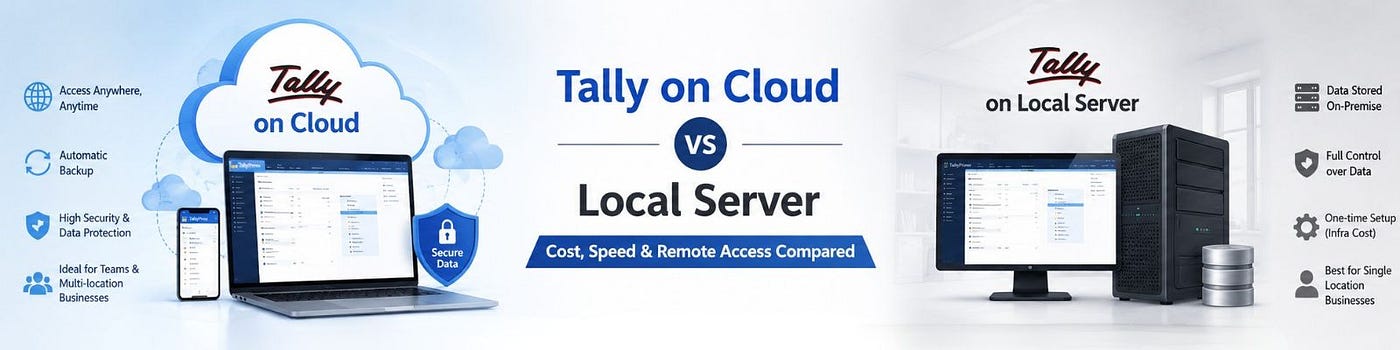
In 2026, businesses are rapidly modernizing their accounting infrastructure to support remote work, cloud computing, automation, and digital collaboration. One of the biggest decisions companies face today is whether to use TallyPrime on a traditional local server or move to Tally on Cloud.
For years, businesses relied on local office servers to run accounting software. While this setup worked for basic office operations, modern businesses now require flexibility, scalability, remote accessibility, stronger security, and better performance.
This shift has made Tally on Cloud increasingly popular among startups, SMEs, retailers, manufacturers, CA firms, and enterprises across India.
But many businesses still ask an important question:
Which is better — Tally on Cloud or a Local Server?
The answer depends on several factors including:
- Cost
- Speed
- Remote accessibility
- Security
- Scalability
- Maintenance requirements
- Business size
In this blog, we will compare Tally on Cloud vs Local Server in detail and explain which solution is best for modern businesses in 2026.
What is Tally on Cloud?
Tally on Cloud refers to hosting TallyPrime on secure cloud servers instead of office-based local systems.
This allows users to access TallyPrime remotely through:
- Laptops
- Desktops
- Mobile devices
- Tablets
from anywhere with internet connectivity.
Cloud hosting providers manage the infrastructure, security, backups, and server maintenance.
What is a Local Server Setup?
A local server setup means TallyPrime is installed on a physical server located inside the office premises.
Users connected to the office network can access the software and accounting data internally.
Traditional local servers require businesses to manage:
- Hardware
- Networking
- Backup systems
- Security
- Maintenance
- IT infrastructure
This setup has been widely used for many years by businesses operating from a single office location.
Why Businesses Are Comparing Cloud vs Local Servers in 2026
Modern businesses require:
- Remote work support
- Real-time collaboration
- Faster operations
- Better security
- Lower IT costs
- Business continuity
Traditional local servers often struggle to support these modern operational needs.
Cloud technology has become a more flexible and scalable alternative.
Cost Comparison: Tally on Cloud vs Local Server
One of the biggest deciding factors for businesses is cost.
Initial Setup Cost
Local Server
Local server setups require significant upfront investment, including:
- Physical server hardware
- Networking equipment
- UPS systems
- Software licenses
- Server rooms
- Cooling systems
This can become expensive for startups and SMEs.
Tally on Cloud
Cloud hosting usually works on a subscription-based model.
Businesses pay monthly or yearly fees for:
- Cloud server access
- Infrastructure
- Maintenance
- Security
- Backups
This reduces upfront capital investment significantly.
Maintenance Cost
Local Server
Businesses must manage:
- Hardware maintenance
- IT staff
- Server upgrades
- Security monitoring
- Backup systems
Maintenance costs increase over time.
Tally on Cloud
Cloud providers handle:
- Server management
- Updates
- Monitoring
- Security patches
- Backup systems
This reduces long-term IT expenses.
Scalability Cost
Local Server
Scaling a local server often requires:
- New hardware
- Storage upgrades
- RAM upgrades
- Network modifications
This increases operational complexity and cost.
Tally on Cloud
Cloud infrastructure allows easy resource upgrades without major hardware investment.
Businesses can scale according to their needs.
Speed & Performance Comparison
Performance is critical for accounting operations, especially for businesses handling large data volumes.
Tally on Local Server Performance
Local servers can deliver good performance if:
- Hardware is powerful
- Network is optimized
- Maintenance is proper
However, performance often decreases due to:
- Aging hardware
- Limited resources
- Poor network configuration
- Multi-user load issues
Tally on Cloud Performance
Modern cloud hosting providers use:
- SSD-powered infrastructure
- Enterprise-grade servers
- High-speed processors
- Optimized virtualization
This improves:
- Tally loading speed
- Report generation
- Multi-user performance
- Data processing efficiency
Cloud hosting generally provides more consistent performance for growing businesses.
Remote Access Comparison
Remote accessibility is one of the biggest reasons businesses move to cloud hosting.
Local Server Remote Access
Accessing local servers remotely can be complicated.
Businesses often require:
- VPN configurations
- Remote desktop software
- Firewall management
- Dedicated IT support
Remote access may also create security risks if not configured properly.
Tally on Cloud Remote Access
Cloud-hosted TallyPrime allows secure access from anywhere.
Users can work from:
- Home offices
- Client locations
- Branch offices
- Travel locations
This flexibility supports modern hybrid and remote work environments.
Security Comparison
Financial data security is extremely important for businesses.
Local Server Security
Security depends entirely on the business’s internal IT management.
Common challenges include:
- Weak firewall systems
- Delayed updates
- Poor backup management
- Physical hardware risks
Small businesses may struggle to maintain enterprise-grade security.
Tally on Cloud Security
Professional cloud hosting providers offer advanced security features such as:
- Firewall protection
- Data encryption
- Antivirus systems
- Multi-factor authentication
- Secure access controls
- Automatic backups
- Real-time monitoring
Cloud providers usually offer stronger security infrastructure than small office environments.
Backup & Disaster Recovery Comparison
Data protection is critical for accounting operations.
Local Server Backup
Businesses must manually manage:
- Backup systems
- External drives
- Recovery plans
- Storage devices
Improper backups increase the risk of permanent data loss.
Tally on Cloud Backup
Cloud hosting providers typically offer:
- Automatic backups
- Backup redundancy
- Disaster recovery systems
- Fast data restoration
This improves business continuity significantly.
Multi-User Collaboration Comparison
Modern businesses require multiple users to access accounting systems simultaneously.
Local Server Multi-User Access
Performance may slow down when many users access the system simultaneously.
Collaboration across branches can also become complicated.
Tally on Cloud Multi-User Access
Cloud infrastructure is optimized for multi-user environments.
Benefits include:
- Real-time collaboration
- Faster synchronization
- Better accessibility
- Shared workflows
This is especially useful for CA firms and multi-branch businesses.
Business Continuity Comparison
Unexpected disruptions can impact business operations.
Local Server Risks
Local servers are vulnerable to:
- Hardware failure
- Power outages
- Office disasters
- Physical theft
- System crashes
These issues may interrupt operations.
Tally on Cloud Reliability
Cloud providers use enterprise-grade infrastructure with:
- High uptime
- Backup redundancy
- Disaster recovery systems
- Multiple server locations
This improves operational continuity.
IT Management Comparison
Local Server IT Requirements
Businesses often require:
- Dedicated IT staff
- Server administrators
- Hardware engineers
- Network management
This increases operational complexity.
Tally on Cloud Simplicity
Cloud providers manage most technical operations including:
- Updates
- Maintenance
- Monitoring
- Security
This allows businesses to focus on operations instead of IT management.
Which Businesses Prefer Local Servers?
Local servers may still be suitable for:
- Small offices with limited remote needs
- Businesses with strict offline operations
- Organizations with internal IT departments
- Companies with compliance-specific infrastructure requirements
However, even many large enterprises are now moving toward hybrid or cloud environments.
Which Businesses Prefer Tally on Cloud?
Cloud hosting is ideal for:
- Startups
- SMEs
- Retail businesses
- Manufacturing companies
- eCommerce businesses
- CA firms
- Multi-branch organizations
- Remote teams
Cloud hosting provides greater flexibility and scalability for modern business environments.
Why CA Firms Prefer Tally on Cloud
Chartered accountant firms increasingly use cloud-hosted TallyPrime because it offers:
- Multi-client management
- Remote accounting access
- Faster collaboration
- Better client servicing
- Secure financial management
Cloud systems improve productivity and operational flexibility for accounting professionals.
Tally on Cloud for Remote Work
Remote and hybrid work models continue growing rapidly in 2026.
Cloud-hosted TallyPrime enables employees to:
- Work from anywhere
- Access reports remotely
- Share data instantly
- Collaborate securely
This improves operational flexibility and employee productivity.
Future of Accounting Infrastructure
Accounting systems are becoming increasingly:
- Cloud-based
- AI-driven
- Mobile-friendly
- Automated
- Collaborative
Businesses still relying entirely on traditional local servers may face scalability and flexibility limitations in the future.
Why Cloud Adoption is Growing Rapidly
Businesses are adopting cloud solutions because they offer:
- Lower infrastructure costs
- Better flexibility
- Faster deployment
- Improved security
- Easier scalability
- Remote accessibility
Cloud computing is becoming the standard for modern business operations.
Local Server vs Cloud: Side-by-Side Comparison
Feature Local Server Tally on Cloud Initial Cost High Lower Maintenance High Murity Depends on internal IT Enterprise-grade Backup Manual Automatic Scalability Complex Easy Multi-User Support Limited Optimized Business Continuity Moderate High Hardware Dependency High Minimal IT Management Required Provider-managed
How to Choose the Right Option
Businesses should evaluate several factors before deciding.
Choose Local Server If:
- You operate from a single office
- You have a dedicated IT team
- Remote access is not important
- You prefer complete infrastructure control
Choose Tally on Cloud If:
- You need remote access
- You support hybrid work
- You want lower maintenance
- You require scalability
- You prefer managed infrastructure
- You want better collaboration
Importance of Cloud Security in 2026
Cybersecurity threats continue increasing globally.
Professional cloud providers now offer:
- AI-powered monitoring
- Advanced firewalls
- Data encryption
- Secure remote access
- Threat detection systems
This makes cloud infrastructure increasingly secure and reliable.
Future Trends in Tally Cloud Hosting
Major trends shaping the future include:
- AI-powered accounting
- Cloud ERP integration
- Mobile accounting
- Real-time analytics
- Automated backups
- Advanced cybersecurity systems
Cloud accounting infrastructure will continue evolving rapidly.
Final Thoughts
In 2026, businesses require accounting systems that support flexibility, scalability, security, and remote collaboration. While local servers still work for some organizations, cloud hosting has become the preferred choice for modern businesses.
Tally on Cloud offers major advantages including:
- Lower infrastructure costs
- Better remote access
- Enhanced security
- Faster scalability
- Automatic backups
- Improved collaboration
- Reduced IT management
On the other hand, local servers may still suit businesses that require offline infrastructure or complete internal control.
For most startups, SMEs, CA firms, and growing enterprises, Tally on Cloud provides a more future-ready accounting solution that aligns with modern business needs.
As digital transformation continues expanding across industries, cloud-hosted TallyPrime will remain one of the most efficient and scalable solutions for business accounting and financial management.
FAQs
What is Tally on Cloud?
Tally on Cloud allows businesses to run TallyPrime on secure cloud servers and access it remotely from anywhere.
Is Tally on Cloud better than a local server?
For most modern businesses, cloud hosting offers better flexibility, remote access, scalability, and lower maintenance costs.
Which is more secure: local server or cloud hosting?
Professional cloud providers usually offer stronger security systems including encryption, firewall protection, backups, and monitoring.
Can multiple users work on Tally on Cloud?
Yes, cloud hosting supports simultaneous multi-user access and collaboration.
Is cloud hosting expensive?
Cloud hosting typically reduces upfront infrastructure costs and works on flexible subscription-based pricing.
Why are businesses moving from local servers to cloud hosting?
Businesses want remote access, better scalability, lower maintenance, improved security, and business continuity.
Is Tally on Cloud suitable for CA firms?
Yes, CA firms widely use cloud-hosted TallyPrime for remote accounting access, client management, and collaboration.
메타데이터
- post_id
- 4edc557a74fc
- slug
- tally-on-cloud-vs-local-server-cost-speed-remote-access-compared-4edc557a74fc
- url
- https://medium.com/@cloudcevious/tally-on-cloud-vs-local-server-cost-speed-remote-access-compared-4edc557a74fc
- canonical_url
- https://medium.com/@cloudcevious/tally-on-cloud-vs-local-server-cost-speed-remote-access-compared-4edc557a74fc
- author_url
- https://medium.com/@cloudcevious
- status
- ok
- fetched_at
- 2026-06-09 15:37:30