AI Made the Options, I Chose One — Finishing the Pavilion (Part 3)
Multi-objective optimization, a Pareto front of 10, and the part only a designer can do.
AI Made the Options, I Chose One — Finishing the Pavilion (Part 3)
Multi-objective optimization, a Pareto front of 10, and the part only a designer can do.
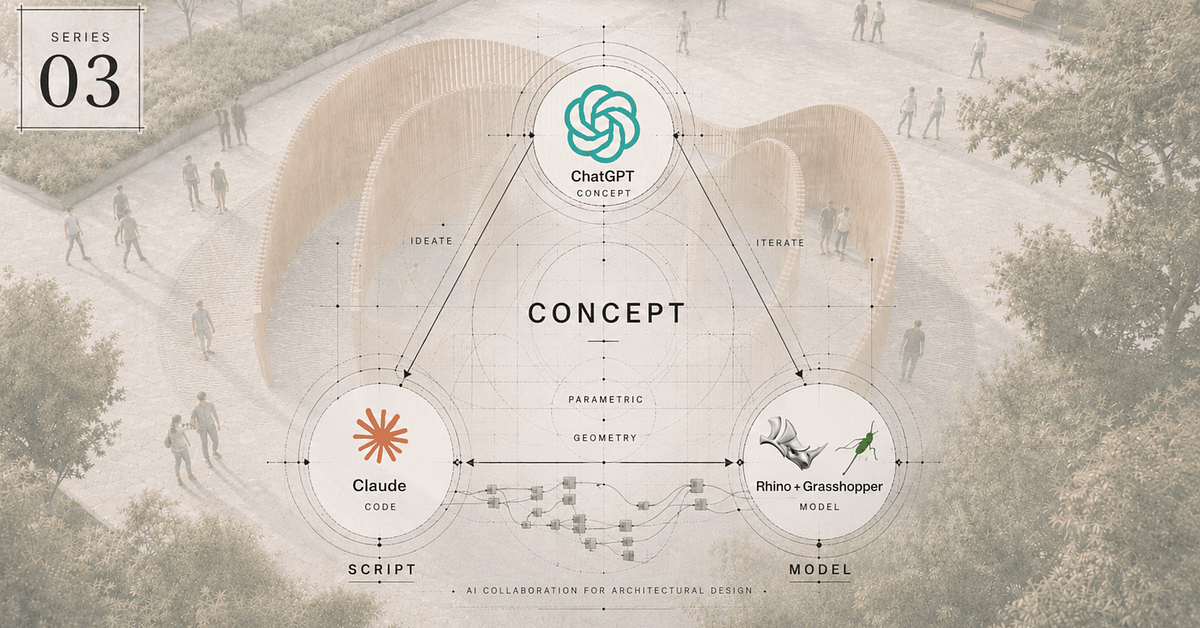
The design that started in ChatGPT has finally been converted from an image into a model. From here it is the choosing phase — bringing real function and design judgment to bear.
Note: this series is framed as an experiment in using AI. I deliberately spent little time on design deliberation; spots that would normally deserve careful thought are left as a first pass. When you use AI for real, check the outputs properly.


Running the optimization — Wallacei setup
At PoC4 everything was ready. The Grasshopper program Claude produced:
- Genes (5 variables): outer-ring count / middle-ring count / inner-ring count / main amplitude / main period
- Fitness (3 axes): F1 solar shading / F2 rhythm / F3 openness
- Cleanly wired by group, the 3 rings processed in parallel through a tree structure

I handed this set to Wallacei and ran an optimization of Pop 50 × Gen 30 = 1,500 individuals.

Wallacei evolves a population with a genetic algorithm; 50 individuals over 30 generations, 1,500 evaluations, each triggering a Ladybug annual-radiation analysis. Roughly 1–2 hours total — you leave the machine running and focus on other work.
But here one task can’t be handed to the AI. Wallacei is a plugin you operate by launching its own UI panel — you input Pop / Gen and press the run button by hand. Claude can’t press on-screen buttons through RhinoMCP, so this part the human does (as of May 2026).

The division of labor: AI lays out and wires the Genes / Fitness; human launches the Wallacei UI, inputs Pop / Gen, presses run; after compute the human tells the AI “it’s done”; AI selects the Pareto-front cases. “Writing the code correctly” and “reading the result and moving on” are the AI; “pressing the run button” alone is the human — the reality of RhinoMCP + plugin integration.
Extracting a Pareto front of 10
From the 1,500 individuals, I extracted a Pareto front of 10.

A Pareto front is the set of solutions where you can’t improve one axis without worsening another. Each of the 10 is “the best in some respect.”

Looking across the 10, their personalities clearly diverge.
Comparing 4 representative cases — A / B / C / D
Organized by character, the 10 collapsed into 4 — each measured against the “Kanjun no Niwa” concept (environmental filter + circulation rhythm).
A — maximum shade. Strength: maximum solar shading (largest louver count). Weakness: no openness; closed.

B — maximum rhythm. The wave-form variation is largest. Nearly everything converged to the same result (I should have refined the evaluation value more…).

C — maximum openness. Strength: maximum pass-through; good sightlines and ventilation. Weakness: low shading; visually sparse.

D — balance. Strength: the midpoint of the 3 axes. Weakness: no standout strength.

This pickup itself was the designer’s interpretive work. The AI extracts 10 from 1,500 and organizes the trends automatically. From here it is the choosing work the human has to do.
Narrowing to one
What I finally adopted was D, the balanced case — the midpoint across the 3 axes. Honestly, because this round is a verification of the AI design flow, the design deliberation was rough. Normally you’d revisit the parameters and evaluation axes here — this time I skipped that.
Baking the model — the finished form
D’s Genes: outer ring 303 / middle ring 237 / inner ring 153–693 louvers in total. Excluding the louvers overlapping the entrance-offset region, a final 655 louvers were baked into Rhino. Claude executed this too. Finally, from the image of the finished Rhino model, I had ChatGPT produce a photoreal render again.

This is the finished form of “Kanjun no Niwa.” From the concept born in ChatGPT, through modeling in Claude + RhinoMCP, optimization in Wallacei, and the designer’s selection — across all of it, one piece of architecture took shape.
AI makes the options; the designer chooses
“Hand AI everything” doesn’t hold. But “let AI make the options, and concentrate yourself on the choosing role” does. ChatGPT makes concept candidates; Claude + RhinoMCP makes the GH implementation; Wallacei makes 1,500 optimization candidates — and every final decision is made by the designer. AI makes candidates; the human chooses (concept lock-in, wiring adoption, case selection); the human operates UI-based plugins. No feeling of being taken over — rather, a clearer sense of where to concentrate my own judgment.
To be honest about the current state: for just building a complex, practical-level GH program, a human is still faster — nuance alignment, re-placement, canvas tidying take several rounds. Even so, an era where these improve is not far off, and giving precise instructions then will be an advantage for people who understand Grasshopper now.
Next time — toward a technical deep-dive
That is the design-process arc. Across Parts 1–3 we followed the flow of AI relay design. Next, I am considering a technical arc — the detailed parts this arc did not touch, written when the mood strikes. To be continued…
📚 Read more in this series
🇬🇧 I Built 100 Rhino Models Almost on Autopilot — with RhinoMCP × Claude Code (Medium) 🇬🇧 I Wrote 100 Grasshopper Programs with RhinoMCP × Claude Code (Medium) 🇬🇧 Part 1 — I Let AI Design a Pavilion (Medium) 🇬🇧 Part 2 — I Had Claude + RhinoMCP Write the Grasshopper (Medium) 🇯🇵 Japanese original (note)
Want the whole workflow in one place?
I put the full setup, the Claude Code prompting patterns, and the environmental-analysis walkthroughs into a practical guide — plus the 5 ready-to-run Grasshopper definition files Claude generated.
Already 100+ copies sold on the Japanese release.
→ Get the guide + 5 GH files (Gumroad)
Studio.Allelishi is a research studio at the intersection of architecture, parametric design, environmental analysis, and AI.
Follow on X: @allelishi · Web: studio.allelishi.com
메타데이터
- post_id
- 4f0a48e54d39
- slug
- ai-made-the-options-i-chose-one-finishing-the-pavilion-part-3-4f0a48e54d39
- url
- https://medium.com/@allelishi/ai-made-the-options-i-chose-one-finishing-the-pavilion-part-3-4f0a48e54d39
- canonical_url
- https://medium.com/@allelishi/ai-made-the-options-i-chose-one-finishing-the-pavilion-part-3-4f0a48e54d39
- author_url
- https://medium.com/@allelishi
- status
- ok
- fetched_at
- 2026-06-09 15:37:30